KAPLAN: Kolmogorov-Arnold Prognostic Learnable Activation Networks for Survival Analysis
Published 21 May 2026 in stat.ML, cs.AI, and cs.LG | (2605.23082v1)
Abstract: Survival analysis aims to model how covariates and time jointly shape the time-to-event distribution under right censoring. Classical methods such as the Cox model and generalised additive models (GAMs) require interactions and time-varying effects to be manually specified, which is increasingly impractical on rich clinical datasets. We introduce KAPLAN-HR, a B-spline Kolmogorov-Arnold Network (KAN) for nonparametric estimation of the conditional hazard as a joint function of covariates and time. A single-layer KAPLAN-HR model recovers a GAM, while deeper architectures capture interactions and time-varying effects through composition. We establish a convergence rate for the nonparametric KAN hazard estimator that depends only on the smoothness of the underlying KAN representation and not on the covariate dimension, thereby mitigating the curse of dimensionality for KAN-representable targets. In evaluations over six clinical benchmark datasets, KAPLAN-HR matches or exceeds the predictive performance of established statistical and deep learning survival methods.
The paper introduces KAPLAN-HR, a spline-based compositional activation network that generalizes survival analysis beyond traditional additive and proportional hazards models.
It leverages B-spline parameterizations to capture complex covariate-time interactions and achieves a covariate-dimension-independent convergence rate.
Empirical evaluations on multiple clinical datasets demonstrate that KAPLAN-HR outperforms several baselines in discrimination, accuracy, and calibration.
Kolmogorov-Arnold Prognostic Learnable Activation Networks for Survival Analysis
Introduction and Motivation
KAPLAN-HR introduces a nonparametric, compositional approach to survival analysis using Kolmogorov-Arnold Networks (KANs) parameterized via B-spline expansions. The model addresses fundamental limitations of classical survival regression methods, notably the Cox proportional hazards (PH) and generalised additive models (GAMs), which are structurally restricted and require manual specification of time-varying effects and covariate interactions. As high-dimensional and rich clinical datasets proliferate, existing models are inadequate in capturing complex interactions and temporal dynamics without sacrificing interpretability or incurring severe overfitting.
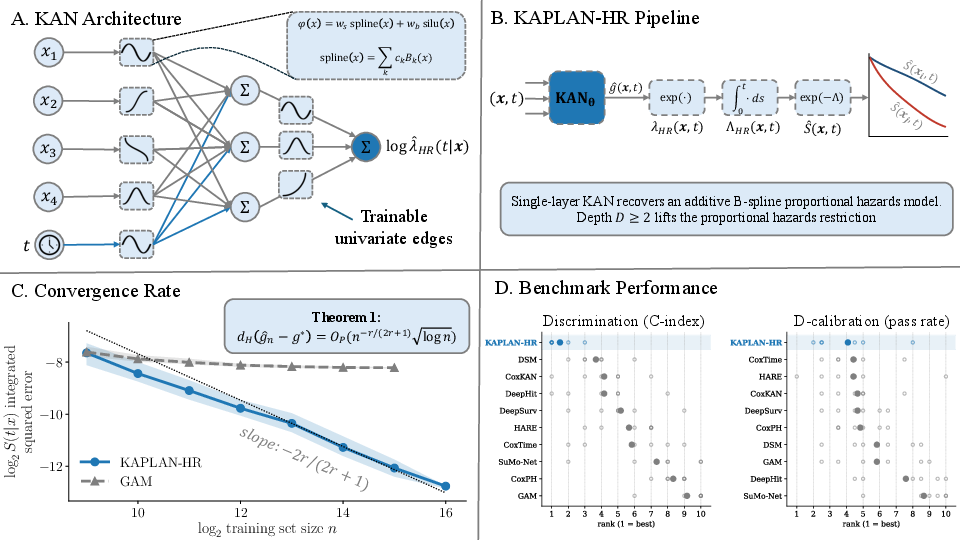
KANs offer a principled middle ground between additive statistical models and deep neural survival architectures. They combine layers of univariate, learnable activation functions on edges—parameterized as B-splines—with nodewise summation, yielding compositional representations where depth controls the expressivity and ability to capture non-additive, time-dependent interactions. The resulting KAPLAN-HR estimator generalizes spline-GAMs and time-varying hazard regression, bridging statistical interpretability and deep learning flexibility.
Figure 1: Overview of KAPLAN-HR, illustrating how KANs model the log-hazard function as a joint compositional function of covariates and time, with depth enabling increasing structural relaxation and the ability to capture complex interactions.
Model Architecture
The hazard regression framework models the log-hazard g(x,t) as a KAN with input (x,t). A single-layer KAPLAN-HR reduces to an additive univariate spline model for each covariate and for time:
logλHR(t∣x)=i=1∑dφi(x(i))+φt(t)
Deeper architectures (D≥2) learn hidden representations by composing trainable spline edge functions and nodewise summing, allowing covariate-time interactions and relaxation beyond the additive or PH constraints. The cumulative hazard and survival functions are computed via numerical integration, reflecting the absence of closed-form expressions for KAN-modeled hazards. Training is performed by negative log-likelihood minimization, leveraging right-Riemann integration over discretized time grids.
Theoretical Convergence Analysis
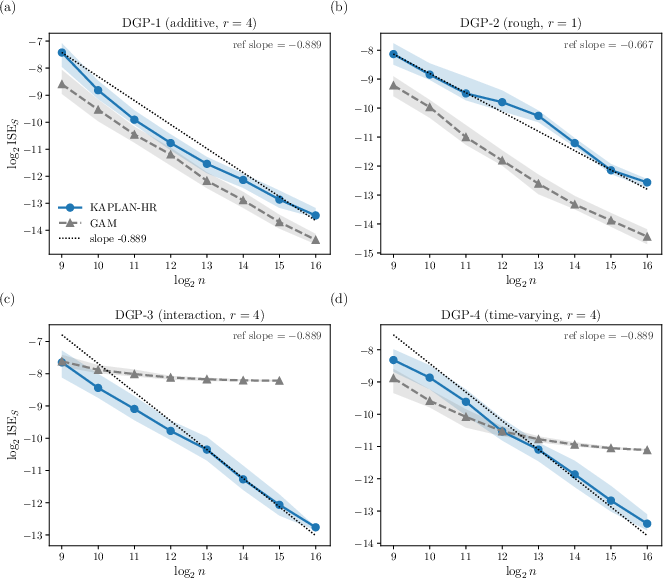
A significant theoretical contribution is the establishment of a covariate-dimension-independent convergence rate for the nonparametric KAN hazard estimator. Using the method of sieves, it is shown that if the true log-hazard admits a KAN compositional smooth representation, the estimator converges (in a covariate-averaged Hellinger sense) at rate OP(n−r/(2r+1)logn), where r is the target's smoothness. This mitigates the curse of dimensionality, and the depth and smoothness of the KAN architecture are the controlling factors—not the ambient covariate dimension.
The proof constructs a sieve of B-spline KANs, bounds approximation error via the compositional structure, quantifies bracketing entropy, leverages bounded likelihood ratio and bracketing integral bounds, and invokes empirical process theory for sieve maximum likelihood estimation. Simulation results corroborate the predicted rates empirically.
Figure 2: Log-log convergence of integrated squared error (ISE) versus sample size n, confirming the predicted convergence slope for KAPLAN-HR and demonstrating its advantage over additive GAMs on interaction-rich data generating processes.
Empirical Evaluation
KAPLAN-HR is benchmarked on six well-established clinical datasets: METABRIC, RotGBSG, NWTCO, FLCHAIN, SUPPORT, and MIMIC-III. Predictive discrimination, survival function accuracy, and calibration are evaluated against nine baselines spanning classical (CoxPH, GAM, HARE) and deep learning (DeepSurv, CoxTime, DeepHit, DSM, CoxKAN, SuMo-Net) paradigms.
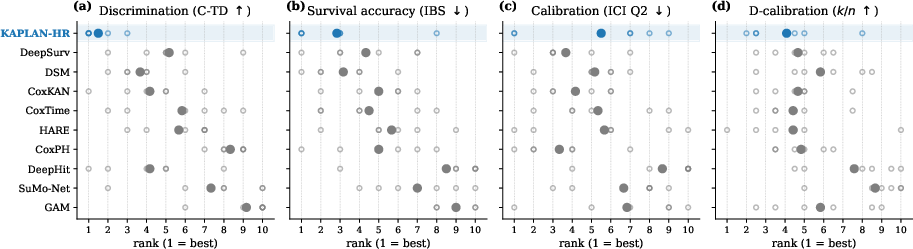
Results show that KAPLAN-HR matches or exceeds the best baseline C-TD (concordance) on 4/6 datasets, IBS (integrated Brier score) on 3/6 datasets, and ICI (integrated calibration index) on 2/6 datasets. The improvement in discrimination for the FLCHAIN dataset is statistically significant, with no significant degradations observed. KAPLAN-HR also exhibits robust calibration (D-CAL) across splits. These results support its practical competitiveness, particularly in settings with complex, high-dimensional covariate structures and time-varying hazards.
Figure 3: Ranking of KAPLAN-HR performance across discrimination, accuracy, and calibration metrics relative to baseline models on multiple clinical datasets.
Practical and Theoretical Implications
KAPLAN-HR demonstrates that spline-based KAN architectures can simultaneously capture interpretable additive effects and flexible, higher-order covariate-time interactions in survival modeling—without manual specification. The dimension-independent convergence rate is a strong theoretical guarantee, positioning KANs as scalable alternatives to MLPs and classical kernel methods.
The practical utility of KAPLAN-HR is reinforced by its competitive performance on real-world clinical benchmarks and its ability to recover complex relationships that classical GAMs cannot. These properties advance the state-of-the-art in transparent survival modeling, particularly for high-dimensional, interaction-heavy biomedical datasets.
Limitations and Future Directions
The theoretical convergence results rest on structural assumptions about the true log-hazard's KAN representability and smoothness, which may not universally hold. Finite-sample behaviour and robustness beyond this function class remain open. Larger-scale and more standardized benchmarks would further clarify practical reliability. Training efficiency and architectural design choices (spline order, grid adaptivity, residual basis) are ongoing areas for improvement and investigation.
The broader implications for AI include the expansion of compositional function approximators to other time-to-event and temporally structured prediction domains, as well as integration of symbolic and hybrid interpretability pipelines. Future developments may address the interpretability-performance tradeoff in even larger scale biomedical applications, with rigorous theoretical backing.
Conclusion
KAPLAN-HR generalizes established spline-based survival models by introducing a compositional KAN parameterization, achieving covariate-dimension-independent convergence rates and strong empirical performance for complex clinical survival analysis tasks (2605.23082). The model effectively bridges statistical interpretability and deep learning flexibility, positioning KANs as competitive, theoretically sound alternatives for modeling nonparametric hazards in clinical and biomedical settings.
“Emergent Mind helps me see which AI papers have caught fire online.”
Philip
Creator, AI Explained on YouTube
Sign up for free to explore the frontiers of research
Discover trending papers, chat with arXiv, and track the latest research shaping the future of science and technology.Discover trending papers, chat with arXiv, and more.