- The paper presents a scalable nonparametric continuous-time survival model that leverages high-order Gauss-Legendre quadrature for accurate cumulative hazard integration.
- It introduces the Time-LoRA mechanism to efficiently condition time in high-dimensional neural architectures, eliminating discretization artifacts.
- Experimental results on synthetic and real-world datasets demonstrate smooth hazard trajectories and superior predictive performance compared to traditional models.
Nonparametric Continuous-Time Survival Analysis via Numerical Quadrature: QSurv
Introduction and Motivation
Modeling complex, time-varying hazards within high-dimensional survival data is a persistent challenge due to the requirements of censoring management and intractable likelihood integrals. Classical approaches, including the Kaplan-Meier estimator and Cox proportional hazards models, lack the flexibility to directly capture continuous-time hazard dynamics required in clinical and engineering domains. While discrete-time ML methods and parametric deep survival models expand the representational capabilities, they often impose restrictive assumptions or discretization artifacts that limit temporal granularity and hazard expressivity.
QSurv ("A Scalable Nonparametric Continuous-Time Survival Model through Numerical Quadrature" (2605.16208)) directly parameterizes the instantaneous hazard in continuous time via flexible neural architectures, leveraging high-order Gauss-Legendre quadrature to approximate cumulative hazard integrals required for likelihood computation. The method eliminates time discretization and distributional constraints, directly modeling time-resolved risk as a function of covariates and follow-up time, while enabling scalable, differentiable optimization via standard backpropagation. The innovative Time-LoRA mechanism further accommodates complex time-covariate interactions in high-dimensional (e.g., imaging) backbones by efficient low-rank weight modulation, allowing time conditioning with minimal inference overhead.
Methodological Innovations
Continuous-Time Hazard Parameterization
QSurv models the log-hazard using a neural network fθ(x,t), resulting in λθ(t∣x)=exp(fθ(x,t)). The negative log-likelihood objective for censored data decomposes into two components: the event contribution requiring local evaluation λθ(oi∣xi) and the survival contribution requiring the cumulative hazard integral ∫0oiλθ(u∣xi)du. Unlike grid-based numerical integration (Riemann/trapezoidal), QSurv uses K-node Gauss-Legendre quadrature for high-order accuracy with minimal function evaluations:
Λ^θ(t∣x)=2tk=1∑Kwkλθ(tτk∣x)
where τk and wk are canonical quadrature nodes and weights, mapped to [0,t]. Differentiability and efficient batching are preserved.
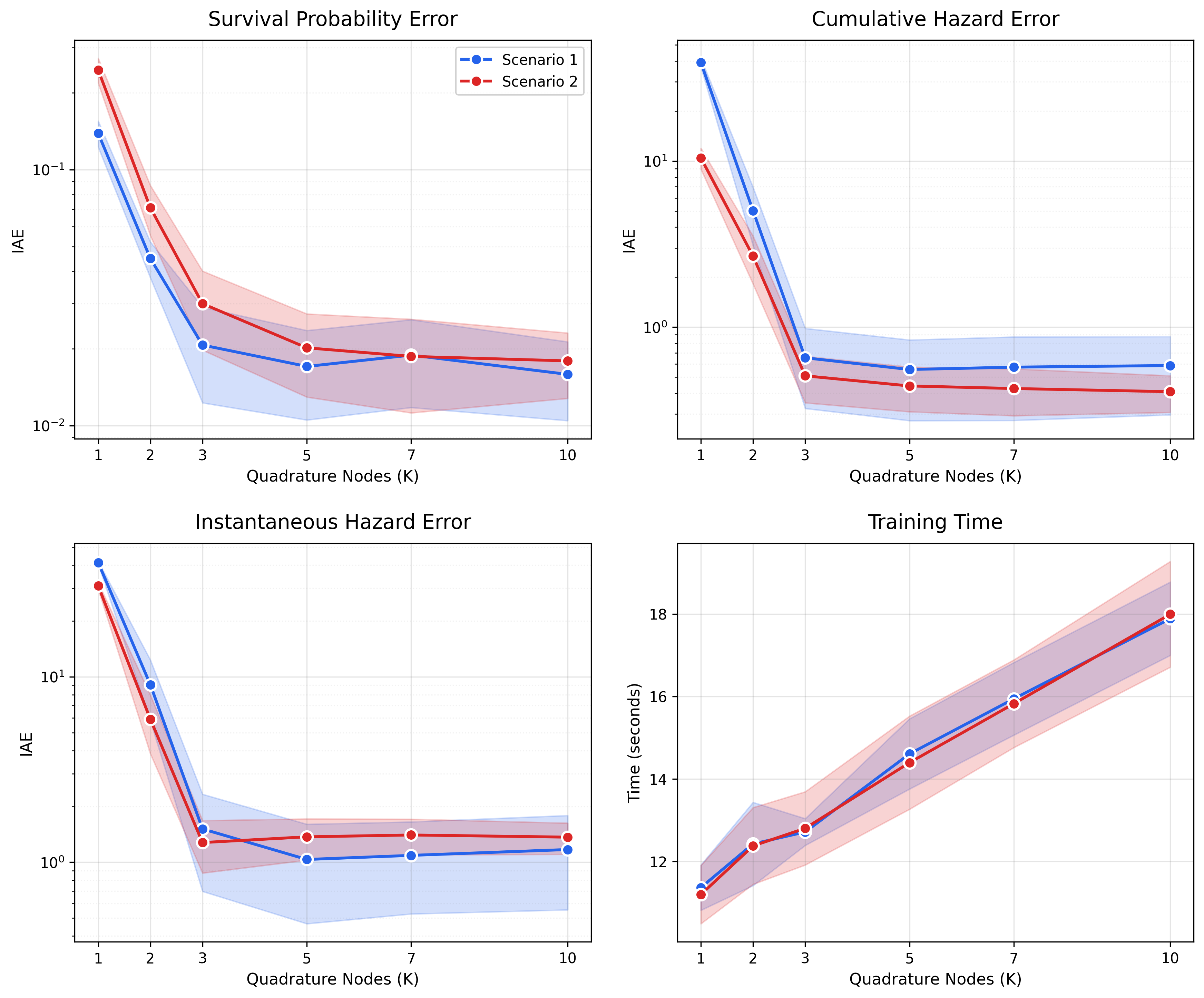
Figure 1: Rapid convergence of integrated absolute errors in survival probability, cumulative hazard, and instantaneous hazard as quadrature node count K increases; computation time scales linearly.
The theoretical error bound on the cumulative hazard approximator, controlled by the smoothness of λθ(t∣x)=exp(fθ(x,t))0, decays factorially with λθ(t∣x)=exp(fθ(x,t))1 and is exact for hazards polynomial in time of degree λθ(t∣x)=exp(fθ(x,t))2. This bound is additive in the negative log-likelihood, stabilizing optimization.
Time-Conditioned Low-Rank Adaptation (Time-LoRA)
While input concatenation suffices for MLPs, in high-dimensional backbones (e.g., ResNet, DenseNet, Vision Transformers), conditioning on time via input features is suboptimal. Time-LoRA introduces dynamic low-rank weight adaptation at the penultimate layer:
λθ(t∣x)=exp(fθ(x,t))3
where λθ(t∣x)=exp(fθ(x,t))4, λθ(t∣x)=exp(fθ(x,t))5 are low-rank projections and λθ(t∣x)=exp(fθ(x,t))6 arises from a time embedding MLP. This mechanism combines efficient caching of static image features with flexible temporal modulation, avoiding repeated backbone passes during quadrature evaluation for each subject. It enables expressive, temporally-adaptive hazard prediction in medical imaging survival settings.
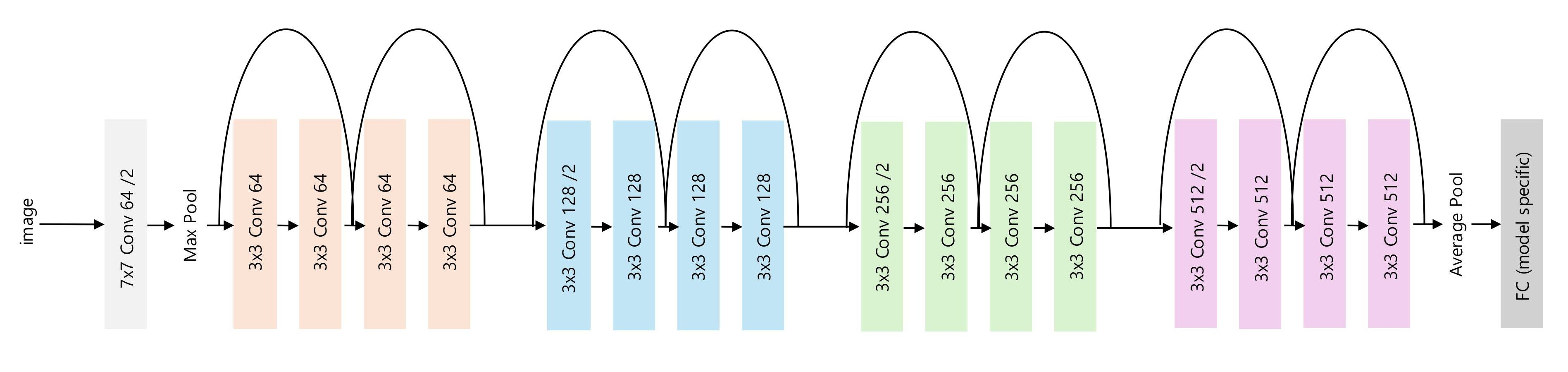
Figure 2: ResNet-18 medical imaging backbone—with backbone fixed, model-specific heads (including LoRA-enabled) generate time-resolved survival predictions.
Experimental Evaluation
Synthetic Simulations
QSurv was benchmarked on six parametric distributions (Exponential, Weibull, Gamma, Gompertz, Log-Normal, Log-Logistic) with nonlinear covariate effects. Across λθ(t∣x)=exp(fθ(x,t))7 hazard estimation error, QSurv matches or outperforms ODE-based SODEN, at a fraction of computational cost.
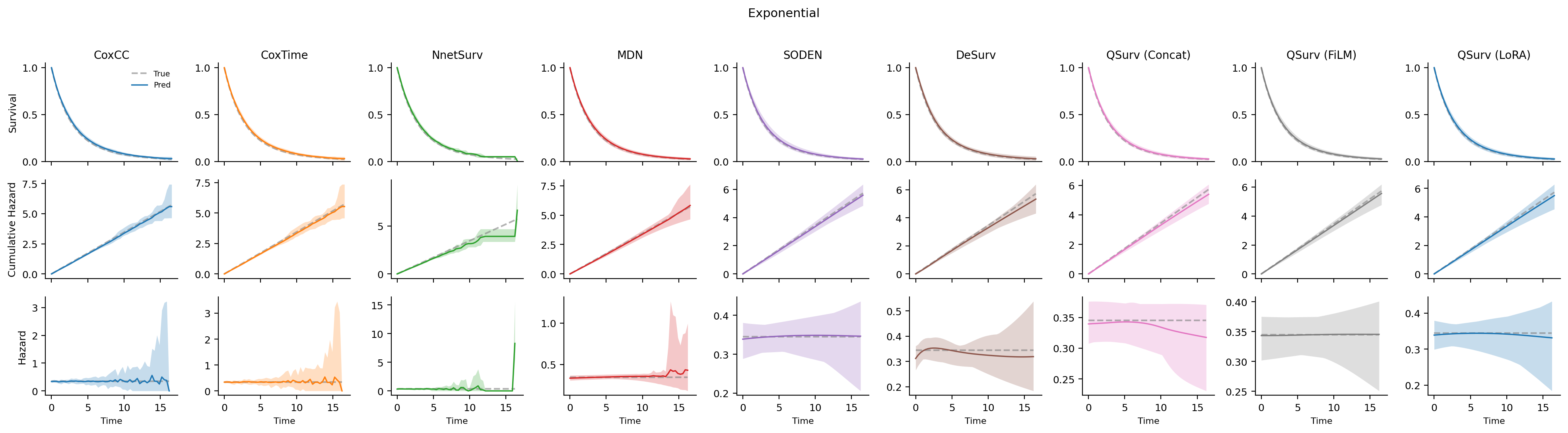
Figure 3: QSurv accurately reconstructs survival, cumulative hazard, and hazard functions for Exponential ground-truth distribution (shaded = 95% CI).
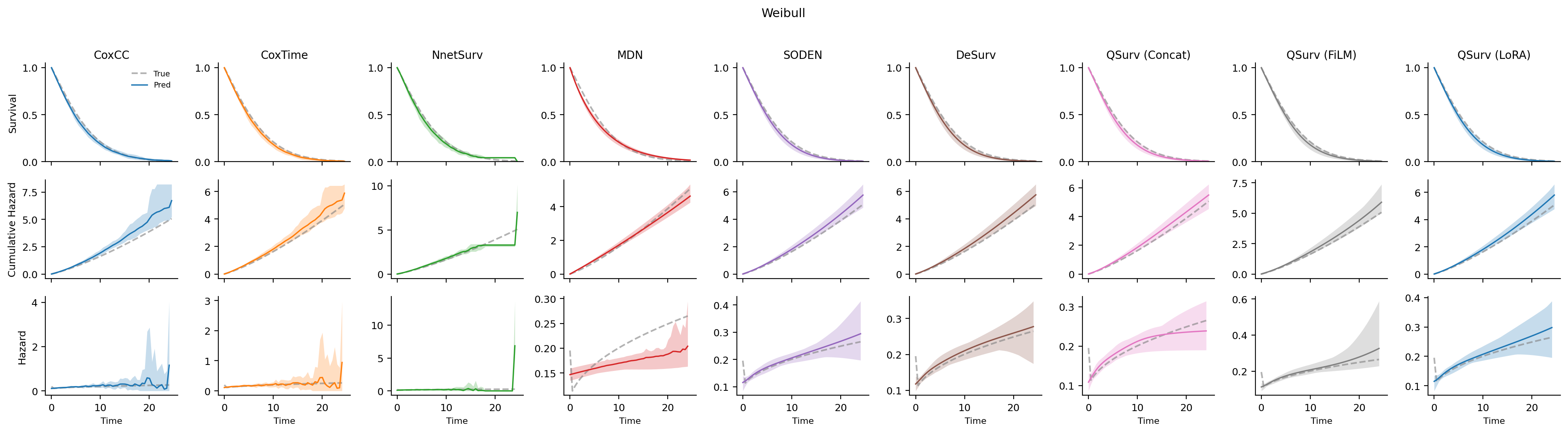
Figure 4: Results for Weibull scenario demonstrate flexible adaptation to nonproportional hazards.
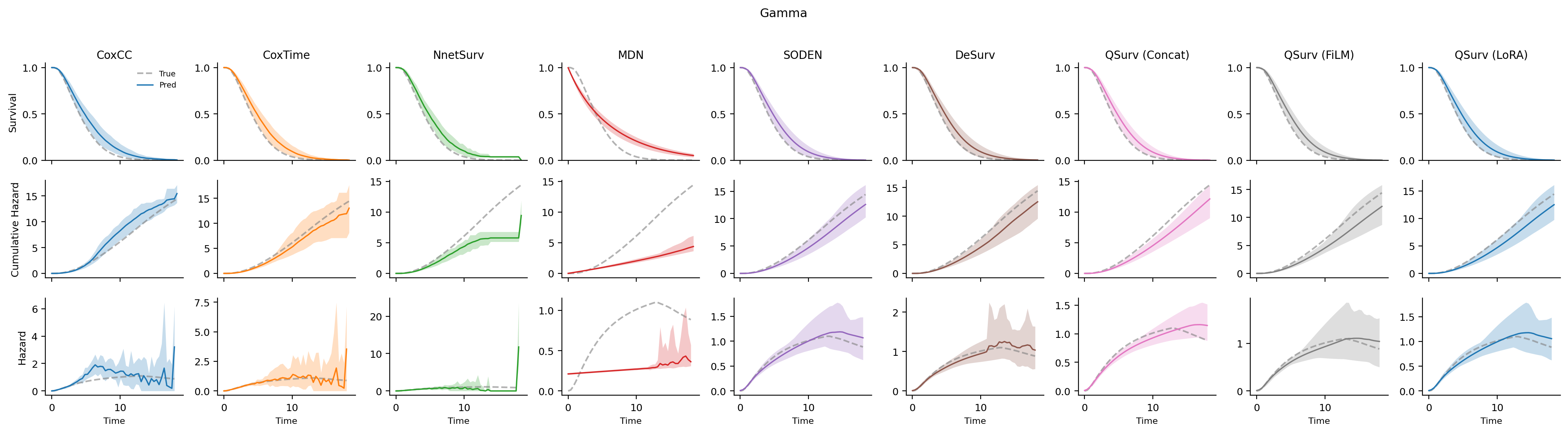
Figure 5: Recovery of gamma distribution hazard and survival patterns.
Real-World Tabular and Imaging Benchmarks
QSurv was evaluated on nine diverse datasets (six tabular, three imaging), comparing against CoxCC, CoxTime, DeepHit, NnetSurv, MDN, DeSurv, and SODEN. Metrics included time-dependent concordance index (λθ(t∣x)=exp(fθ(x,t))8), Integrated Brier Score (IBS), Integrated Binomial Log-Likelihood (IBLL), and D-calibration.
QSurv consistently achieves best or second-best results for discrimination and calibration across datasets and horizons. Its advantages are pronounced in high-dimensional imaging domains, where complex temporal risk patterns emerge and classical models underperform. On COVID-19-NY and C4KC-KiTS, QSurv outperforms or matches all baselines, notably for λθ(t∣x)=exp(fθ(x,t))9 and short-horizon IBS/IBLL.
Qualitative analysis revealed that QSurv's hazard trajectories are substantially smoother and more interpretable than discrete-time or ODE-based rivals, e.g., cluster-level hazard patterns for COVID-19-NY showed early elevated risk falling off over follow-up—a clinically validated dynamic.

Figure 6: QSurv yields interpretable, temporally-resolved hazard clusters, contrasting with irregular or flat hazards from other models.
Practical and Theoretical Implications
QSurv provides a scalable, nonparametric approach for learning clinically meaningful instantaneous hazard functions in continuous time, without the limitations of discretization or distributional assumptions. Its quadrature-based likelihood ensures computational tractability and stable optimization. Time-LoRA addresses the practical challenge of time conditioning in high-dimensional neural architectures, making QSurv applicable to both structured and unstructured data.
The method enables nuanced temporal risk stratification—risk localization and timing of intervention—by directly modeling the hazard landscape. This is directly relevant for treatment scheduling, monitoring strategies, and prognosis in time-dependent disease contexts.
Numerical quadrature as a surgical tool for likelihood construction may extend to other domains requiring nonparametric integration over neural functions, including event prediction and continuous-time regression.
Future Directions
Potential developments include extending QSurv to multiple events (competing risks), robustifying under high censoring or distribution shift, integrating Bayesian uncertainty quantification for hazard estimation, and deploying in federated or privacy-preserving clinical workflows. Improving hazard smoothness via network architecture and activation design (e.g., second-order continuity) could further enhance quadrature accuracy and interpretability in complex settings.
Conclusion
QSurv establishes a practical and theoretically sound paradigm for flexible continuous-time survival analysis. By directly parameterizing the instantaneous hazard and evaluating the cumulative hazard via high-order quadrature, it overcomes the computational bottlenecks and representational limitations of existing approaches. Performance and interpretability are validated across synthetic and real-world datasets, especially in high-dimensional medical imaging. The methodological framework holds promise for further extensions in deep survival analysis and time-resolved risk modeling in AI-driven healthcare, reliability, and financial analytics.