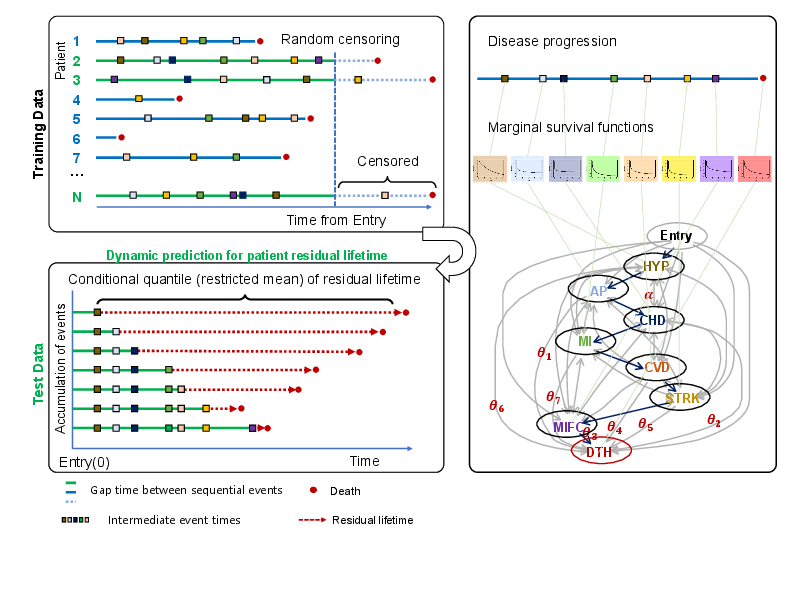
- The paper introduces a multistage copula-based framework that models the complex dependencies between intermediate cardiovascular events and death.
- It employs a two-stage estimation process using nonparametric marginals and maximum pseudo-likelihood to address informative censoring and partial event ordering.
- The proposed algorithm enhances dynamic survival prediction by providing calibrated, individualized risk estimates and outperforming standard landmarking models.
Copula-Based Association Learning for Dynamic Survival Prediction: Application to Cardiovascular Disease Prognosis
Problem Motivation and Clinical Context
Cardiovascular diseases encompass multiple interconnected conditions (e.g., hypertension, angina pectoris, coronary heart disease, stroke, myocardial infarction, and fatal cerebrovascular events) with complex temporal and stochastic relationships to mortality. Their onset times are subject to informative censoring via death, resulting in partially ordered event times and observable regions constrained by semicompeting risks structure. Conventional survival models inadequately capture the intricate dependence among these intermediate events and their association with death. Improvements in dynamic survival prediction demand flexible modeling that integrates individualized disease histories and onset times, beyond the limited use of occurrence indicators or recurrent-event aggregation.
Copula-Based Modeling Framework
This paper introduces a multistage copula-based methodology for learning association structures and facilitating dynamic survival prediction in the presence of multiple dependent intermediate events. The architecture leverages Archimedean copulas due to their versatility with multivariate right-censored data and their capacity to encode asymmetric/nonexchangeable dependence via generator functions.
The unique parameterization allows capturing disease-specific risk contributions and conditional dependencies, overcoming limitations in existing semicompeting risks, multi-state, and landmarking models.
Estimation and Association Learning
Estimation proceeds via a two-stage procedure:
- Marginals and Bivariate Associations: Marginal survival functions (Sk, D0) are estimated nonparametrically; D1 is estimated by concordance techniques exploiting order statistics and pseudo-likelihoods tailored to the copula structure. Informative censoring is handled with pseudo self-consistency equations for marginals.
- Multivariate Association: The global parameter D2 is estimated by maximum pseudo-likelihood, integrating information on onset histories and observable event orderings. Computational efficiency is achieved by leveraging Laplace transforms for higher-order derivatives in the likelihood contributions, allowing for consistent estimation as sample size and event count grow.
Strong theoretical guarantees are established, including consistency and asymptotic normality for D3 and plug-in joint survival function estimators, even with complex censoring patterns and partial ordering.
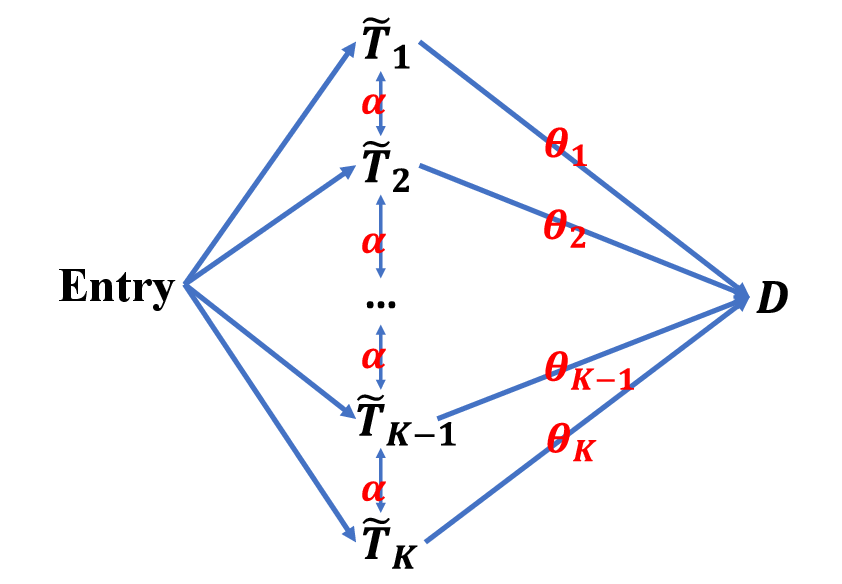
Figure 2: Association structure of event times and the flow of conditional dependence in estimation.
Dynamic Survival Prediction Algorithm
The proposed approach dynamically predicts overall survival given an individual's observed history of intermediate event onsets and maximal follow-up. Unlike standard landmarking (which incorporates only indicator variables or fixed covariates), this methodology computes conditional survival probabilities and restricted mean residual life for arbitrary combinations of event times using the learned joint copula structure.
- Prediction quantities: Conditional survival probabilities, restricted mean residual life, and conditional quantiles of survival time are provided, anchored at individualized landmark times.
- Interval prediction and calibration: Individual prediction intervals are constructed from conditional quantiles, enabling reliable coverage and assessment of uncertainty.
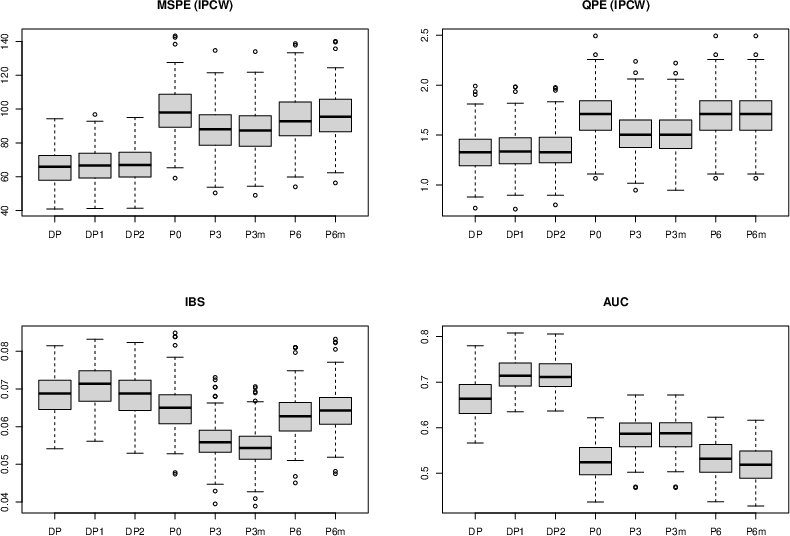
Empirical accuracy is assessed via mean squared prediction error (MSPE), quantile prediction error (QPE), integrated Brier score (IBS), and time-dependent AUC. The methodology supports robust performance evaluation for both in-sample and out-of-sample predictions.
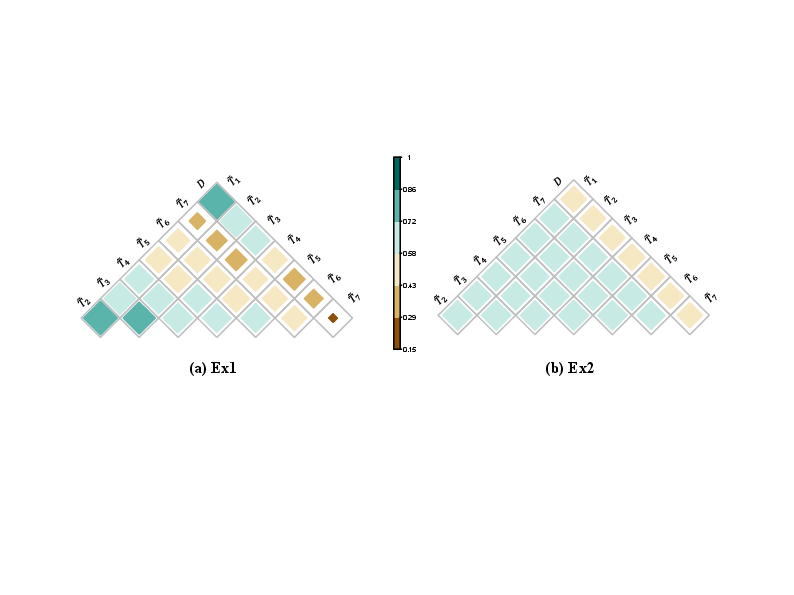
Figure 3: Pairwise Kendall correlations illustrating complex nonexchangeable dependence among simulated intermediate and terminal events.
Numerical Results and Cardiovascular Data Application
Extensive simulation experiments verify the robustness and accuracy of the estimators and the dynamic prediction algorithm under variable association structures, levels of censoring, and copula mis-specification. Numerical results include:
- Consistent estimation: Parameters (D4, D5) are recovered with low bias and proper coverage across different D6 and censoring rates.
- Prediction superiority: Dynamic prediction (DP) outperforms competing methods (landmarking, single-event models, and aggregate-recurrent analysis) in both MSPE and IBS, especially when the number of intermediate events is large or their associations are heterogeneous.
The methodology is applied to the Framingham Heart Study cohort. Empirical estimates show:
Practical and Theoretical Implications
This research advances the modeling and prediction landscape for survival analysis subject to informative censoring and semicompeting risks. The copula-based framework:
- Enables disease-specific risk quantification, supporting precision medicine and adaptive risk stratification.
- Captures complex conditional and unconditional dependencies among intermediate events, offering insights beyond aggregated recurrent-event models or longitudinal landmarking approaches.
- Unlocks path toward scalable, computationally tractable individualized survival prediction for multi-pathogenesis clinical cohorts.
In theoretical terms, the parameterization and estimation framework generalize beyond semi-competing risks, allowing for systematic handling of partial ordering, dynamic prediction, and informative censoring in multivariate survival contexts. Methodological extensions are feasible for recurrent events, incorporation of covariates, and alternative copula structures.
Future Directions
Potential advancements include:
- Extension to non-Archimedean copula families and time-varying global association structures.
- Integration of genomic or biomarker panels for further risk stratification [meyre2025biomarker].
- Algorithmic improvements for high-dimensional survival data, parallel computing, and efficient C++ implementations.
- Theoretical exploration of joint model estimation with pseudo-observations and handling mixtures of event types.
Conclusion
The copula-based multistage conditional dependence framework developed in this work substantially improves individualized dynamic prediction for survival under multiple intermediate events and informative censoring. It resolves major limitations of existing approaches, accommodates the complex stochastic nature of cardiovascular disease progression, and provides a rigorous foundation for personalized risk estimation in diverse clinical contexts. The methodological rigor and empirical robustness suggest broad applicability and further extension for advanced AI-driven prognosis systems.