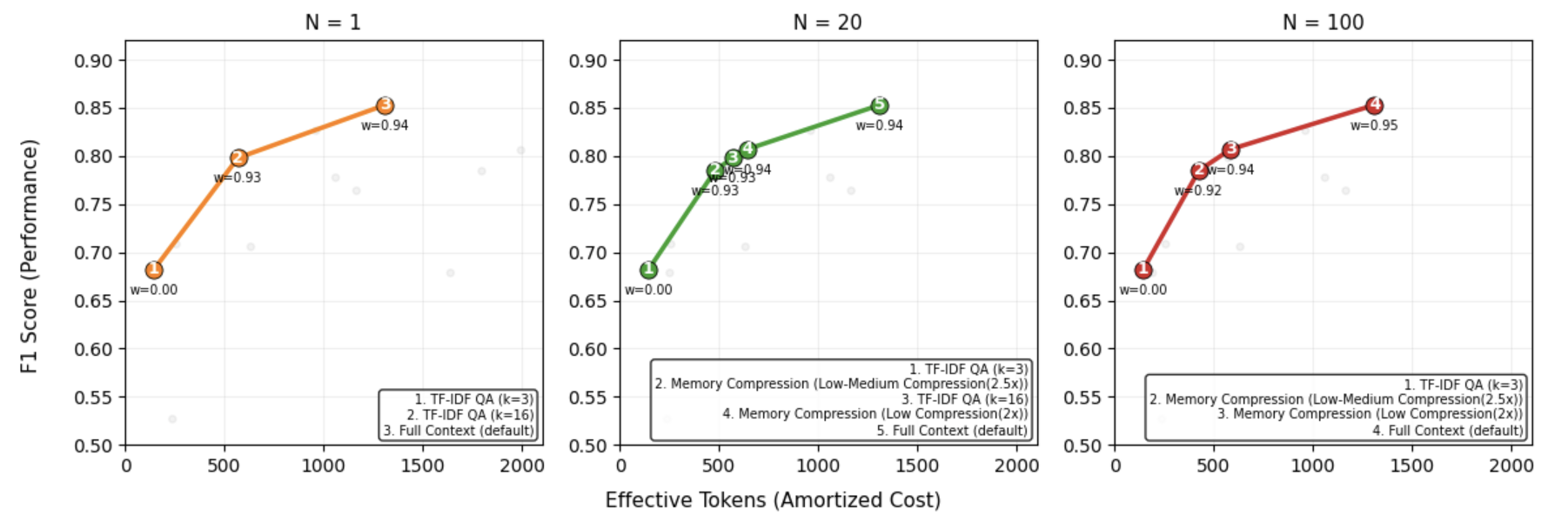
- The paper introduces a unified Efficiency Frontier framework that models trade-offs between task performance and token cost using a parameterized utility function.
- The approach systematically selects optimal context management strategies by incorporating preprocessing amortization and varying deployment preferences.
- Experimental results on HotpotQA demonstrate significant token cost reductions (up to ~25%) and performance gains while highlighting the dynamic optimality of strategies.
Summary of "The Efficiency Frontier: A Unified Framework for Cost–Performance Optimization in LLM Context Management" (2605.23071)
Handling long-context inputs is a critical bottleneck in scalable and sustainable deployment of LLMs, as expanded context windows induce substantial increases in computational cost—often disproportionately to performance gains. Existing approaches to context reduction (retrieval, summarization, compression) are typically evaluated with performance and cost metrics treated independently, resulting in fragmented methodology and limited operational guidance. This paper introduces the Efficiency Frontier as a principled, decision-oriented framework for evaluating and optimizing context management in LLMs, explicitly modeling trade-offs between task performance, token cost, and preprocessing amortization.
Unified Efficiency Frontier Framework
The proposed framework formalizes context strategy selection as a deployment-aware optimization problem. It utilizes a parameterized utility function, EfficiencyScore(w)=w⋅F1−(1−w)⋅log(EffectiveTokens), where w captures preference weight between performance and efficiency. Effective token cost incorporates both per-query inference and context preprocessing amortized via reuse parameter N, reflecting multi-query and persistent agent scenarios. This enables systematic modeling of diminishing returns and practical tolerance to cost scaling.
The framework proceeds through three stages:
- Intra-Strategy Optimization: Identification of non-dominated configurations per strategy.
- Candidate Scoring: Consistent evaluation across strategies with heterogeneous cost structures.
- Global Decision Optimization: Construction of the global Efficiency Frontier, mapping preference weights to optimal strategies and configurations.
Experimental Evaluation and Numerical Results
The analysis is instantiated on HotpotQA (multi-hop QA with distractors) using GPT-5.4 mini. Strategies evaluated include Full-Context prompting, Oracle retrieval, memory compression, TF-IDF (vanilla and query-aware), and semantic embedding retrieval. All metrics are based on effective token cost after preprocessing amortization and F1 score.
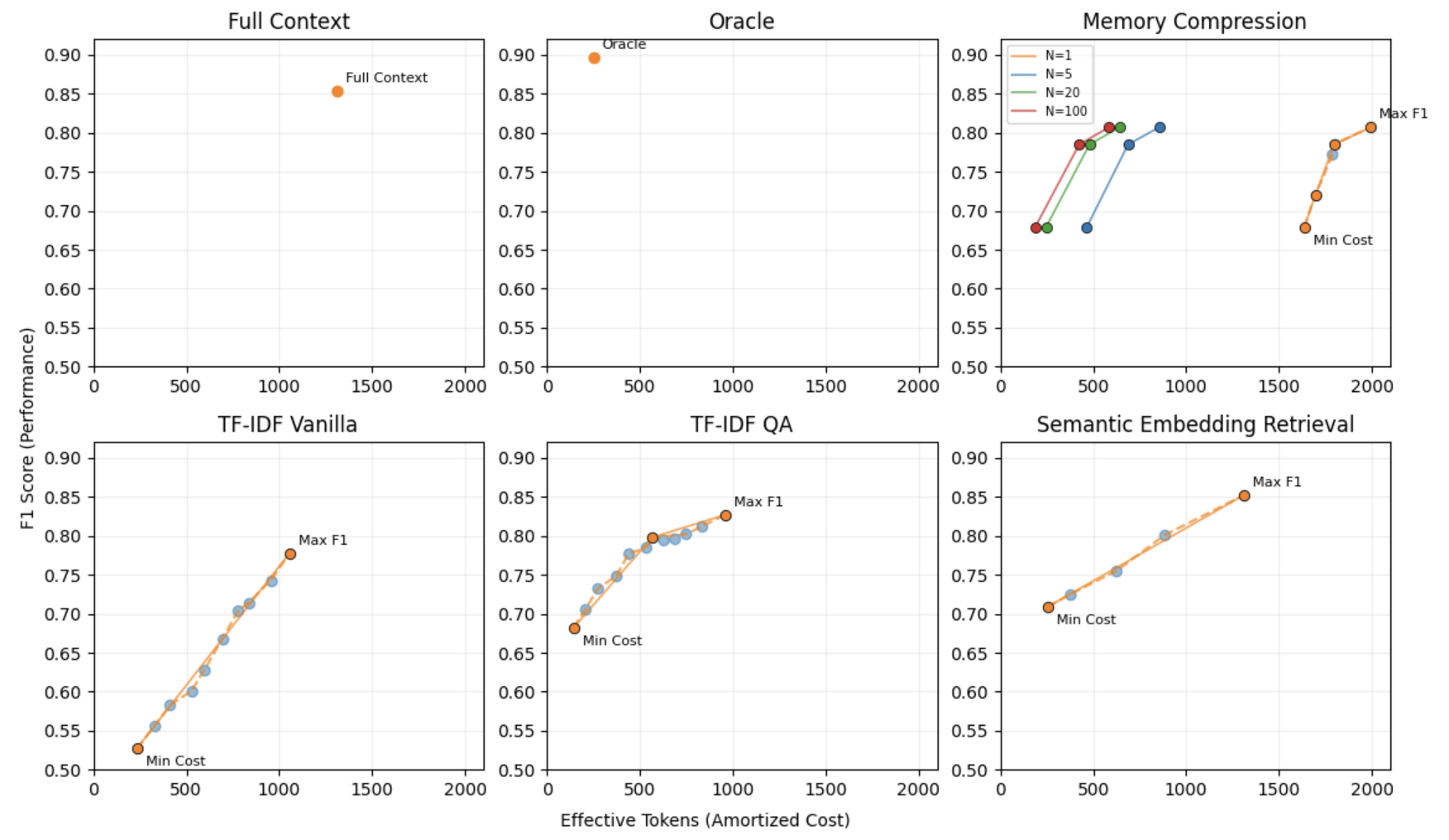
Figure 1: Strategy-level Efficiency Frontiers with token cost (x-axis) versus task performance (F1, y-axis). The Pareto frontier and decision paths reveal that optimal operating points vary with deployment preference weight w.
Key findings:
Strong numerical results include token cost reductions of ~25% in balanced performance regimes (F1=0.78), when shifting from TF-IDF QA (566 tokens) to Memory Compression (424 tokens) for N=100; in high-performance settings, amortized memory compression achieves >50% lower token cost relative to Full-Context prompting. Peak performance (F1≥0.82) remains achievable only via Full-Context strategies, but with efficiency loss due to token bloat and diminishing marginal gains.
Practical and Theoretical Implications
The Efficiency Frontier provides dual operational guidance: continuous trade-off visualization via the preference parameter w, and discrete mapping from target performance to optimal strategy under given deployment constraints. Systematic reductions in token overhead translate to substantial gains in computational efficiency and sustainability. The framework is general and supports extension to other tasks (agentic memory, code generation, conversational systems) and multi-objective optimization (latency, energy, monetary cost).
From a theoretical standpoint, the integration of amortization (N) formalizes the dependency of optimal strategy on deployment regime, unifying isolated evaluations and informing reproducibility and benchmarking. The approach reveals that isolated per-query performance/cost analyses are misleading, and that optimal context management is inherently dynamic.
Speculation on Future Developments
Future research directions include adaptation of the framework to additional context-intensive domains, incorporation of more granular system objectives (energy, hardware, latency), and development of adaptive or learned utility functions reflecting application-specific priorities. Integration with domain-aware compression, knowledge-enhanced retrieval, and specialized latent representations may further enhance efficiency and context fidelity.
Conclusion
The Efficiency Frontier framework establishes a robust paradigm for cost–performance optimization in LLM context management. By explicitly modeling deployment-aware trade-offs and amortized cost, it enables systematic selection of strategies that minimize token usage without sacrificing accuracy, achieving notable efficiency gains in practical settings. The approach supports sustainable scaling of LLM systems and generalizes across heterogeneous deployment scenarios, providing actionable guidance for both research and industrial application. Future extensions promise further granularity and adaptability, advancing the operational optimization of context utilization in LLMs.