- The paper introduces a probabilistic ray-grounded inference method that integrates vision foundation model depth priors with Bayesian factor graph optimization to resolve scale ambiguity.
- It employs a four-process asynchronous pipeline with dynamic scene uncertainty gating and a log-domain Kalman filter to ensure robust, real-time tracking at 30 FPS.
- Empirical results demonstrate subcentimeter metric accuracy and effective loop closure using ViT descriptors, achieving deployment-ready SLAM without additional depth sensors.
Probabilistic Ray-Grounded Inference for Scale-Aware Metric SLAM: An Analysis of PRISM-SLAM
Introduction
Monocular SLAM has long been constrained by scale ambiguity and vulnerability to dynamic distractors, presenting a significant bottleneck for real-world robotic deployments. PRISM-SLAM ("PRISM-SLAM: Probabilistic Ray-Grounded Inference for Scale-aware Metric SLAM" (2605.19257)) presents a comprehensive method that synthesizes vision foundation model (VFM) priors with structured Bayesian inference to achieve real-time, scale-verified metric SLAM from monocular RGB. This essay provides a detailed examination of PRISM-SLAM’s core architectural innovations, probabilistic modeling, empirical performance, and implications for future scalable, robust metric SLAM.
System Architecture and Bayesian Integration of VFMs
PRISM-SLAM addresses the unobservability of global scale in monocular geometry by probabilistically incorporating dense metric depth priors from vision foundation models, specifically DA3, within a factor graph framework. The architecture is realized as a four-process asynchronous pipeline composed of a CPU frontend for tracking, a GPU worker for VFM-based depth and uncertainty extraction, a log-domain Kalman scale estimator, and a backend for metric factor graph optimization.
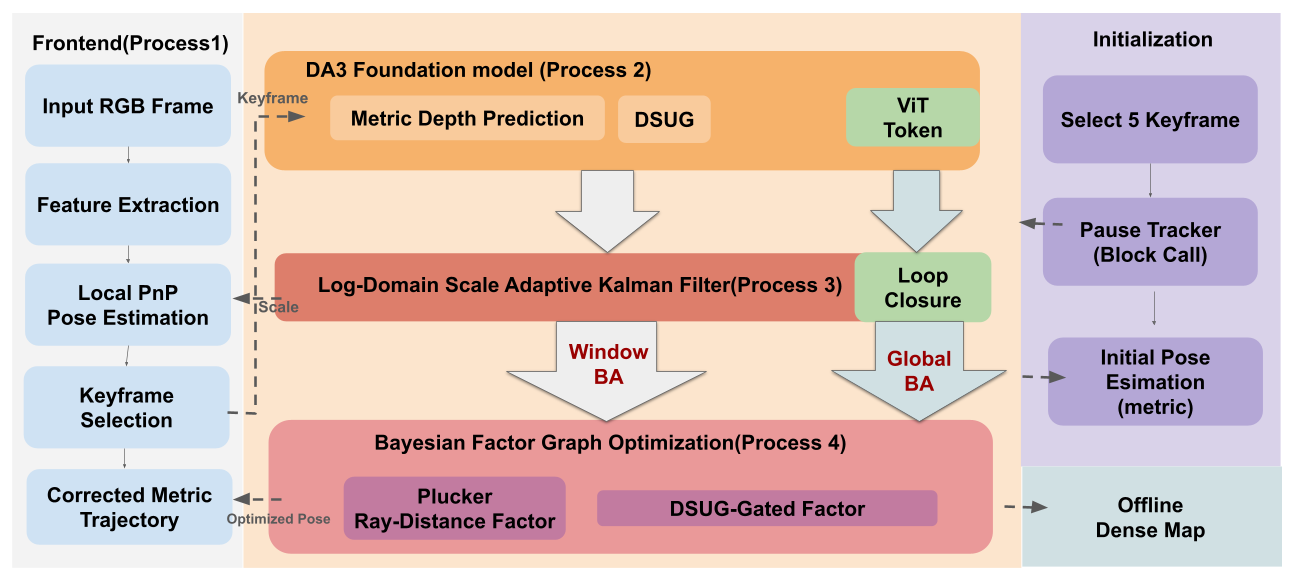
Figure 1: PRISM-SLAM system architecture. The pipeline coordinates real-time tracking, VFM depth inference, epistemic gating, and joint metric graph optimization.
The factor graph formulation allows for cross-process fusion of geometric tracking and scale-anchored VFM depth, operating at 30 FPS while ensuring that each subsystem's outputs contribute robustly weighted evidence to a globally consistent SE(3) estimate.
Resolving Scale Ambiguity via Plücker Ray-Distance Factor
Traditional monocular SLAM estimates, being up-to-scale due to projective geometry, are fundamentally limited in their metric fidelity. PRISM-SLAM introduces a 3D Plücker Ray-Distance Factor that aligns each monocular observation with the absolute coordinate system defined by DA3’s predicted metric rays. This formulation constrains the scale degree of freedom by rendering the metric scale Fisher-identifiable; arbitrary rescaling increases the residual orthogonal distance between projected points and the VFM ray, hence enforcing absolute scale consistency.
A log-domain Kalman filter refines the temporal integration of the scale, ensuring positivity and smoothing heteroscedastic fluctuations from the VFM. The initial system state is anchored with a robust synchronous metric initialization phase, which synchronizes several keyframes to DA3 queries prior to transitioning to full asynchrony.
Dynamic Scene Uncertainty Gating (DSUG) for Robustness
Handling dynamic objects and temporal depth inconsistencies is addressed by PRISM-SLAM's Dynamic Scene Uncertainty Gating (DSUG). Rather than hard-thresholding pixels via semantic masks—which typically introduce optimization discontinuities and significant computational cost—DSUG constructs an epistemic uncertainty proxy by combining both VFM spatial confidence and temporal depth residuals.
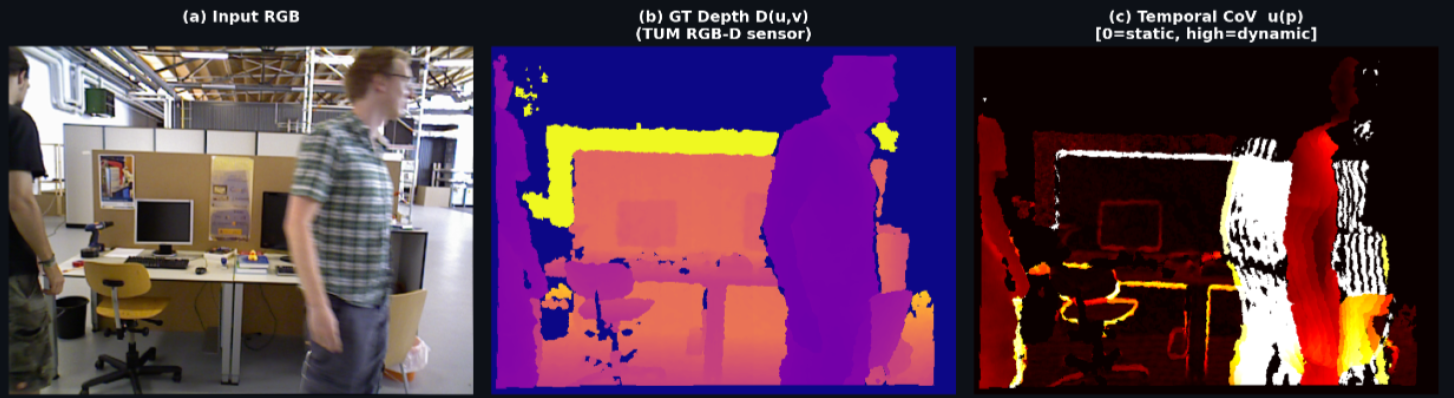
Figure 2: Temporal Uncertainty Modeling in Dynamic Scenes. High temporal depth variance (bright regions) marks boundaries of dynamic objects, which are smoothly down-weighted in the optimization.
This proxy is mapped through a sigmoid function to yield a continuous information matrix weight per pixel, probabilistically down-weighting contributions from temporally or spatially ambiguous regions. This soft gating preserves optimization continuity and efficiently targets the most reliable, static structure for metric anchoring.
Loop Closure and Large-Scale Consistency
Loop closure is realized by reutilizing ViT [CLS] tokens from DA3 as global scene descriptors, yielding computationally free and highly discriminative relocalization cues. Candidate loops are verified geometrically, and global pose-graph optimization fuses both standard reprojection and Plücker ray-distance constraints under DSUG gating, correcting long-term drift without requiring a complex map-merging pipeline.
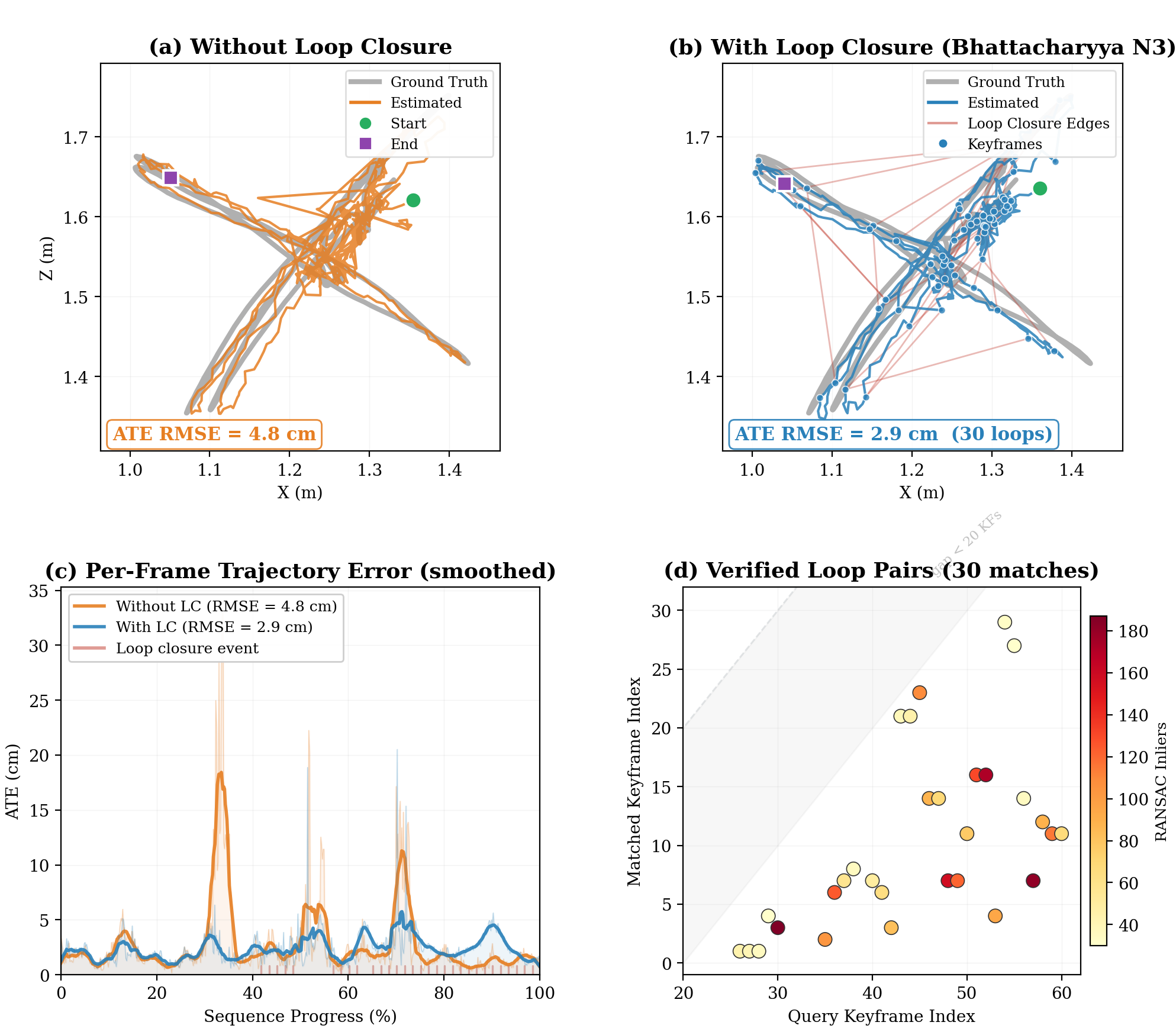
Figure 3: Impact of ViT-driven Loop Closure on the TUM fr1/xyz sequence. Loop closure detection and graph optimization sharply reduce accumulated trajectory error.
This ViT-driven loop closure module consistently converges to a tightly-aligned metric trajectory, with empirical precision in loop detection reaching 100% in extended sequences.
Empirical Results
Metric Scale Recovery
PRISM-SLAM’s principal claim is that it achieves real-time, deployment-ready, metric-consistent SLAM from monocular RGB, with SE(3) Absolute Trajectory Error (ATE) at parity with oracle Sim(3) alignment. On TUM fr1/xyz, Sim(3) and SE(3) ATEs are 2.86 cm and 3.04 cm respectively, yielding a scale error of just 3.3%. Comparable metrics are achieved on challenging dynamic TUM sequences and the BONN Dynamic dataset, demonstrating resilience to moving occluders. Notably, these results are achieved without any post-hoc scale correction or reliance on depth hardware, a sharp contrast to competing neural SLAM baselines.
Throughput and Efficiency
Operating at 30 FPS, PRISM-SLAM is an order of magnitude faster than SOTA dense neural SLAMs that rely on foundation models but suffer from GPU bottlenecks, semantic mask computation overhead, or expensive SL(4) graph optimization. Ablation experiments reveal that the Plücker ray factor provides the greatest boost to metric performance, while the DSUG module is essential for robustness in dynamic environments, with the absence of DSUG resulting in up to 7.2 cm increased mean ATE in dynamic settings.
Dense 3D Reconstruction and Metric Fidelity
PRISM-SLAM’s offline backend fuses global consistent depth using multi-view DA3 inference guided by optimized keyframe poses. Dense metric reconstructions demonstrate subcentimeter surface thickness and accurate real-world measurements, closely matching ground-truth scale even at room scale.
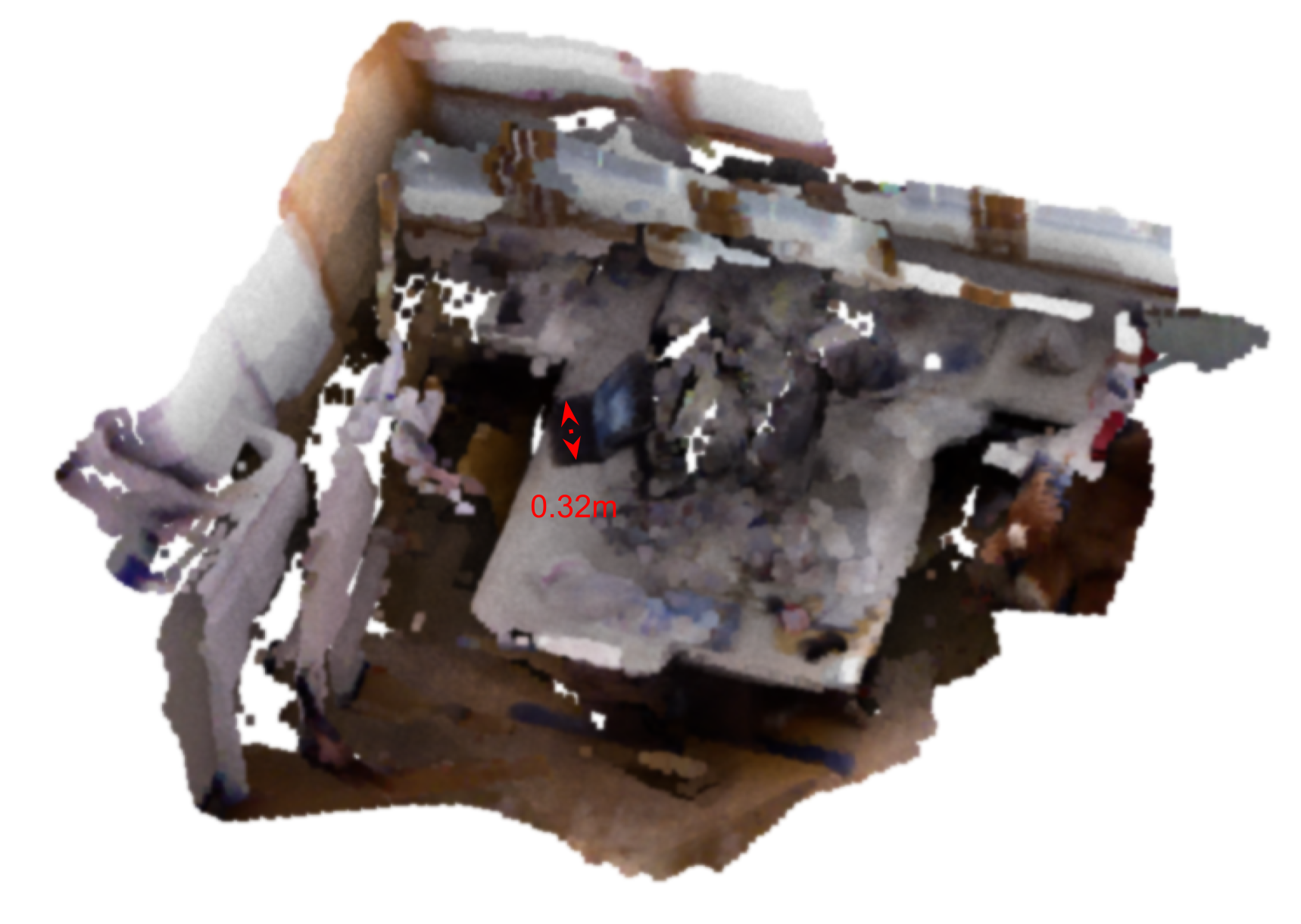
Figure 4: Qualitative 3D Reconstruction on fr1/desk2. Recovered point cloud demonstrates metric accuracy and sharp surface boundaries verified against real-world dimensions.
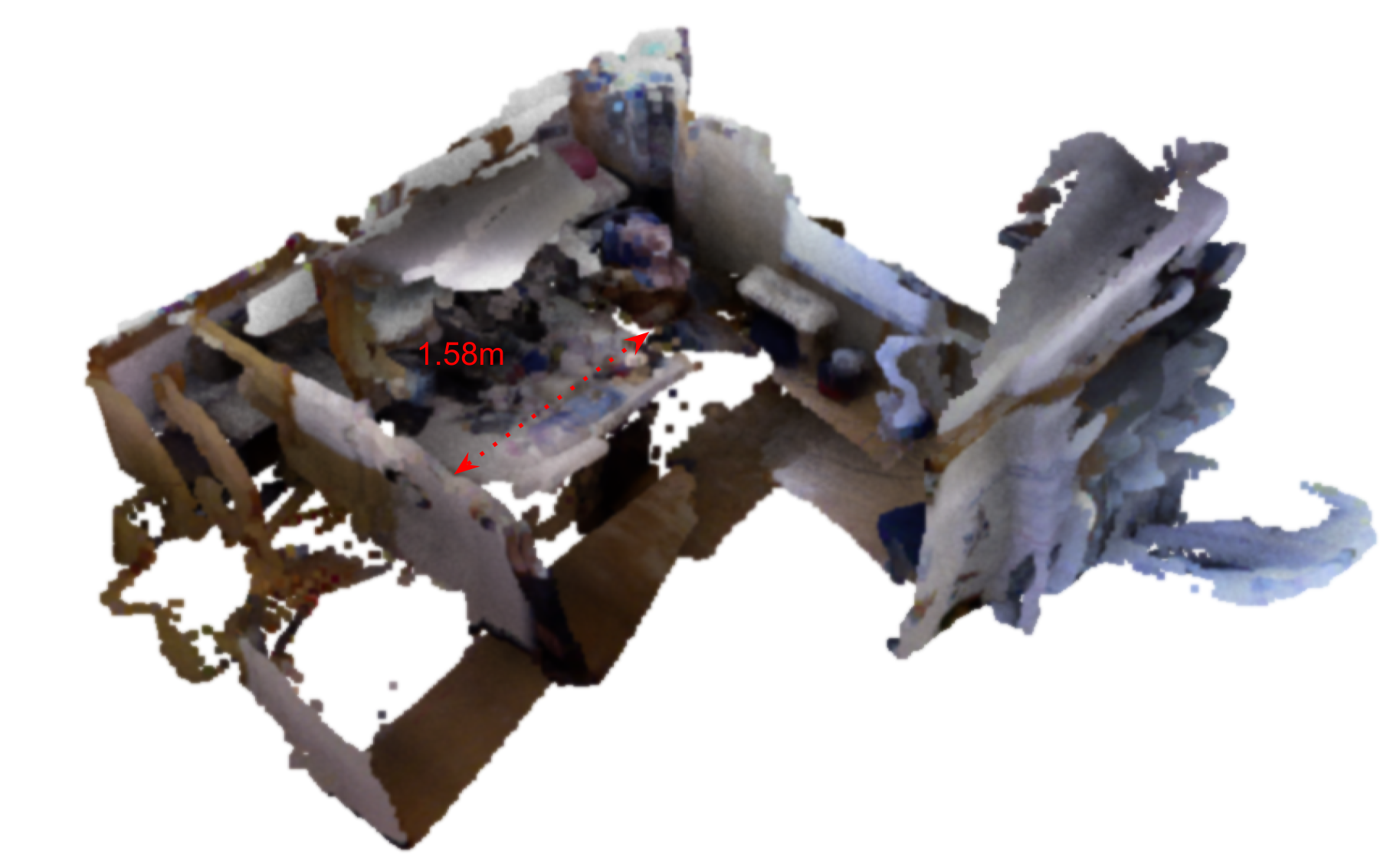
Figure 5: Large-scale point cloud on TUM fr1/room. The measured wall-to-wall distance (1.58 m) substantiates absolute metric consistency.
Theoretical and Practical Implications
PRISM-SLAM provides a principled demonstration that joint factor graph optimization incorporating probabilistic VFM priors and epistemic gating is sufficient for resolving the scale ambiguity of monocular SLAM. The separation of dynamic uncertainty modeling from hard classification enables robust, generalizable performance in scenes with nontrivial motion. The tight coupling of dense metric constraints and loop closure within the Bayesian framework allows for robust long-horizon topological and metric consistency.
This work highlights that truly metric, real-time monocular SLAM is attainable without post-hoc scale alignment or auxiliary depth sensors by leveraging structured probabilistic integration of large-scale learned priors.
Limitations and Future Directions
While PRISM-SLAM achieves near-parity with depth sensor-based and oracle-aligned SLAM on benchmark datasets, it is not immune to degradation in extremely dynamic scenarios with dense occlusion or minimal baseline at initialization. Computation throughput on GPU can be negatively impacted by more complex learned feature descriptors, and the offline mapping backend is still susceptible to dynamic contamination during dense TSDF integration. Future directions include integrating per-pixel DSUG weighting directly at the volumetric integration level and extending the method toward outdoor, multimodal, and unsupervised settings.
Conclusion
PRISM-SLAM establishes a new paradigm for metric monocular SLAM by synthesizing foundation model priors, epistemic uncertainty modeling, and Bayesian inference at frame rate, obviating the need for post-hoc scale recovery and explicit dynamic segmentation. These results strongly indicate the practical and theoretical viability of probabilistic metric SLAM driven solely by vision-foundation priors, with direct implications for scalable, real-time perception in robotics and embodied AI.
Reference:
"PRISM-SLAM: Probabilistic Ray-Grounded Inference for Scale-aware Metric SLAM" (2605.19257)