- The paper introduces a Sim(3) anchor-based pose-graph optimization that robustly corrects both catastrophic scale collapse and drift-induced failures.
- It integrates a novel Scale Collapse Alarm mechanism to reject spurious loop closures and ensure accurate global scale recovery.
- Experimental results on KITTI and indoor datasets demonstrate significant ATE reductions, underscoring its scalability and effective fusion of heterogeneous front-ends.
Scale-Consistent Collaborative Mapping from Crowd-Sourced Monocular Videos: An Analysis of MR.ScaleMaster
Introduction
MR.ScaleMaster addresses the critical challenge of achieving metric-scale consistent multi-agent mapping from a federation of monocular video sources, including robots and consumer devices. Distinctively, the system is architected to enable robust loop closure and seamless scale correction without reliance on depth sensors, IMUs, or prior calibration—a fundamental requirement for large-scale, real-world collaborative mapping scenarios. The research empirically identifies and systematically addresses two principal scale failure modes: catastrophic scale collapse (from false loop closures) and drift-induced inter-session scale discrepancies. The proposed system establishes a rigorous pipeline for fusing heterogeneous monocular SLAM and dense geometry front-ends, introducing several methodological innovations: a two-criterion scale collapse alarm, a generalization of anchor-based Sim(3) pose-graph optimization, and a modular, front-end-agnostic interface.
System Architecture and Methodology
The MR.ScaleMaster system follows a centralized architecture, wherein robots and devices act as local front-ends transmitting incremental keyframe packets (containing images, up-to-scale poses, and optional dense point maps) to a central server. The server implements server-side place recognition, loop closure detection, and global pose-graph optimization in the Sim(3) domain.
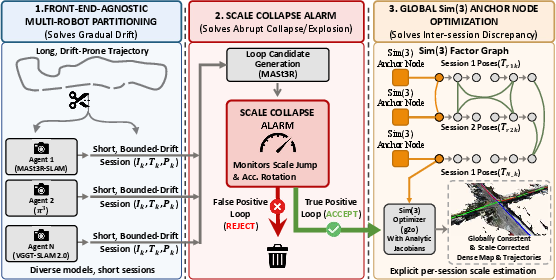
Figure 1: System overview of MR.ScaleMaster highlighting front-end-agnostic partitioning, the Scale Collapse Alarm, and Sim(3) anchor optimization for unified dense mapping.
Scale Collapse Alarm
To eliminate catastrophic scale degeneracy stemming from false-positive loop closures—particularly pernicious in visually repetitive environments (e.g., corridors)—the paper introduces a Scale Collapse Alarm. This mechanism consists of:
- Accumulated Rotation Check: Candidate loop closures exhibiting minimal accumulated rotation over large temporal gaps are flagged as physically implausible and rejected.
- Adaptive Scale Jump Detection: After each pose-graph optimization, the system tracks per-session scale evolution; abrupt scale deviations (relative to trajectory complexity and gap context) trigger transactional rollback of the offending constraint.
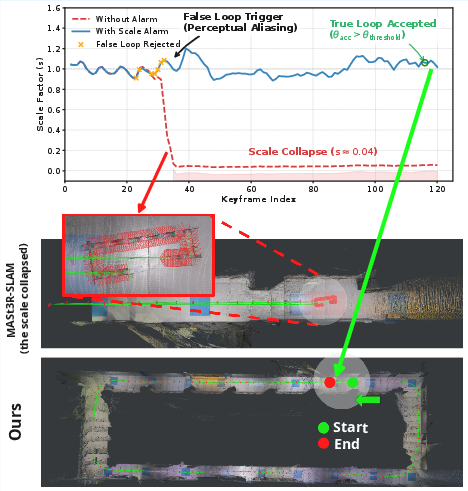
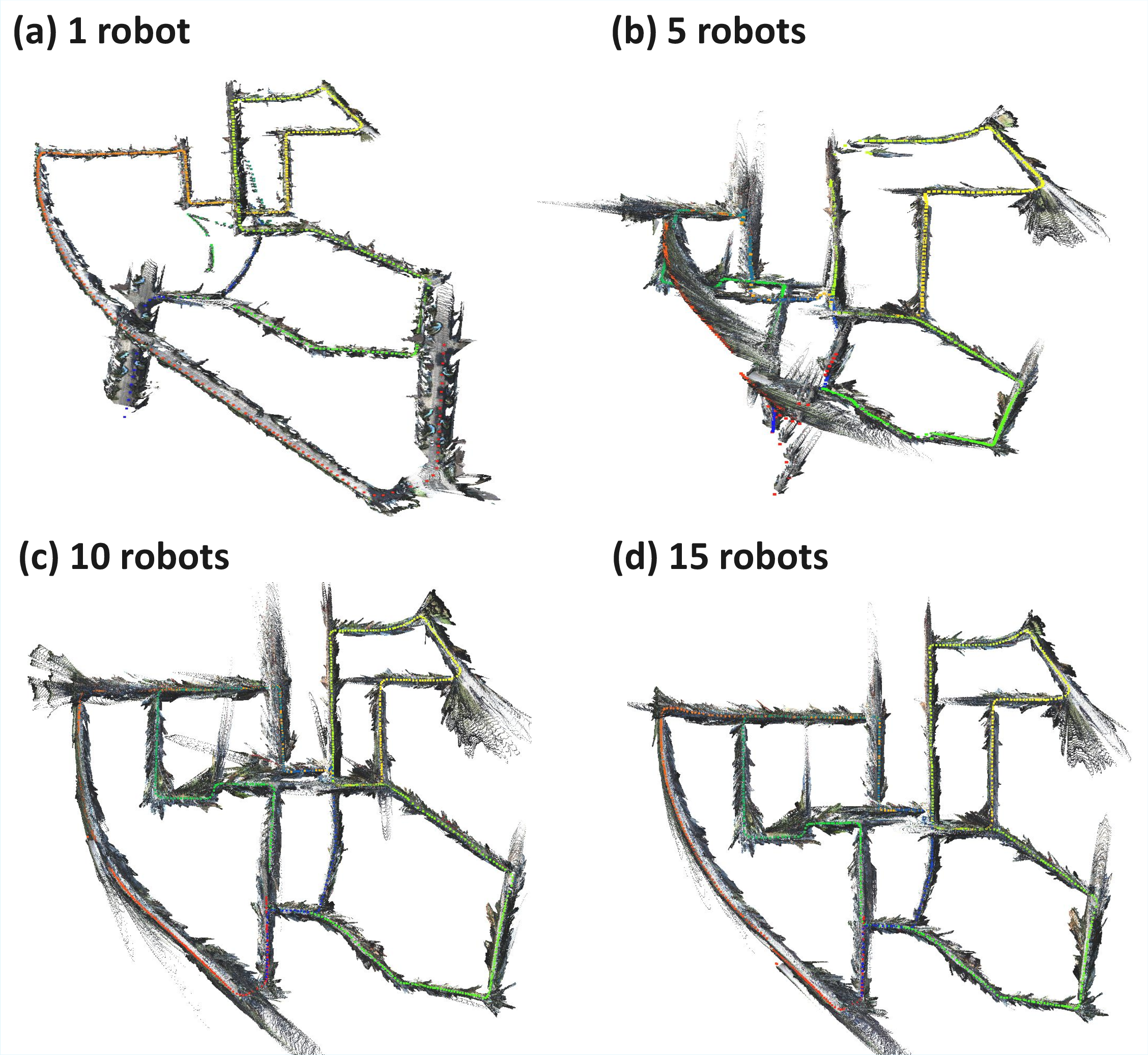
Figure 3: The alarm robustly distinguishes between true and spurious loop closures, as demonstrated by its rejection of all false positives while retaining all true inter-session constraints.
The core mathematical innovation is the deployment of anchor nodes in Sim(3), directly modeling each robot/session’s unknown scale and enabling joint optimization over rotation, translation, and scale. The pose-graph vertices comprise session-local keyframes and session-global Sim(3) anchor nodes. Intra-session odometry and inter-session loop closures are represented as Sim(3) edges, enabling explicit modeling and correction of both accumulated scale drift and inter-session discrepancies. Analytic Jacobians are derived using the Sim(3) adjoint and right Jacobian inverse, ensuring numerical efficiency and optimizer stability.
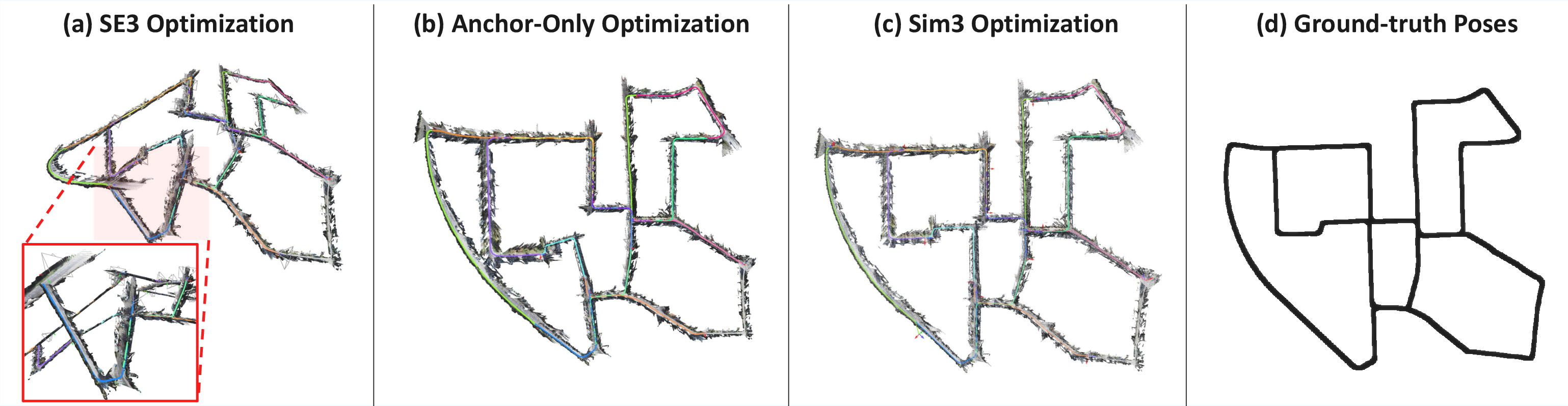
Figure 4: Visualization of scale estimation strategies on KITTI 00; only the full Sim(3) optimization (MR.ScaleMaster) eliminates physically implausible inter-session distortions and achieves global consistency.
Front-end Agnostic Interface
MR.ScaleMaster is designed for seamless integration with diverse 3D vision foundation models. Different agents may contribute trajectories generated with MASt3R-SLAM, π3, or VGGT-SLAM 2.0, with scale and alignment resolved in the backend optimization. The packetized interface ensures compatibility and scalability as new models emerge.
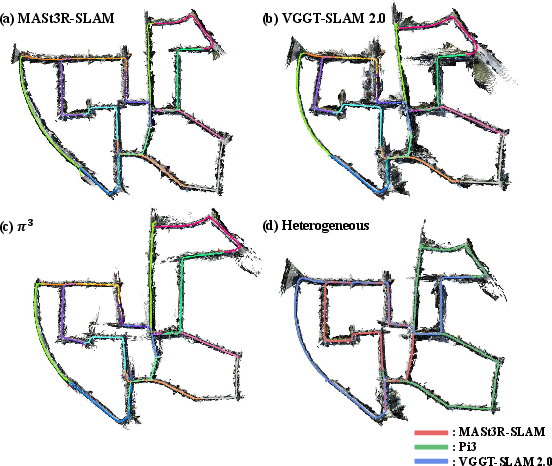
Figure 2: Validation with MASt3R-SLAM, VGGT-SLAM 2.0, π3, and heterogeneous deployments demonstrates backend robustness and generality.
Experimental Evaluation
Scale Failure Mode Mitigation
Ablation studies and targeted experiments on KITTI odometry and indoor sequences quantify the impact of the Scale Collapse Alarm and Sim(3)-based backend. The alarm rejects all false-positive loops without affecting genuine ones, maintaining correct global scale and reducing ATE from 17.08 m to 0.69 m on challenging indoor data. The Sim(3) anchor architecture yields a 7.2× ATE reduction (from 88.5 m to 12.3 m) versus SE(3)-only baselines on KITTI with 15 simulated robots.
Scalability and Robustness
Partitioning long trajectories among many agents (simulating crowd-sourced mapping) effectively bounds intra-session scale drift, resulting in increasingly accurate global reconstructions as the number of sessions grows—reaching ATE as low as 10.2–12.3 m on 2–3 km traversals with 15 robots. Sim(3) scale estimation is robust to per-session scale variations up to 3×, with failure only under adversarially clustered outliers.
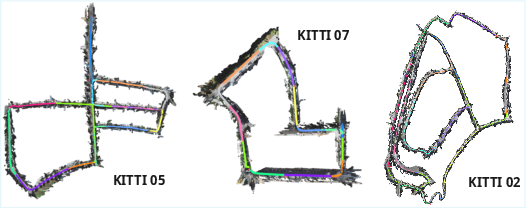
Figure 6: Color-coded qualitative results on KITTI 05, 07, and 02 confirm spatial consistency and map coherence across multiple agents and loop topologies.
Heterogeneous Front-End Fusion
The framework maintains consistent mapping performance across deployments with homogeneous or heterogeneous mixes of front-ends, with ATE variations reflecting native front-end reconstruction quality but always yielding globally aligned maps. Stronger front-ends contribute corrective constraints that compensate for weaker agents.
Theoretical Implications and Future Directions
This work makes a substantive contribution to the theory and practice of scalable robotic mapping in unstructured, sensor-diverse settings:
- Explicit Scale Modeling in pose-graph optimization is shown to be mandatory for multi-agent monocular systems. The introduction of Sim(3) anchor nodes generalizes established multi-robot SE(3) frameworks and demonstrates superior empirical stability and accuracy.
- Modular Algorithmic Components such as the Scale Collapse Alarm and plug-and-play packet interface pave the way for rapid exploitation of emerging 3D vision models in collaborative robotics.
Potential directions for further work include:
- Developing automated cross-front-end scale normalization to handle extreme scale outliers,
- Extending the scale collapse mechanisms to feed-forward (non-optimization-based) front-ends,
- Improving pose-graph loop recovery for settings with challenging viewpoint changes (e.g., reversals),
- Incorporating Sim(3)-aware pairwise consistency maximization for additional robustness.
Conclusion
MR.ScaleMaster systematically addresses both abrupt and drift-based scale failures in collaborative map fusion from monocular videos, providing proven mechanisms for robust, accurate, and scalable multi-agent SLAM without reliance on metric sensors or pre-calibration. The general Sim(3) anchor pose-graph framework, combined with the Scale Collapse Alarm and agnostic interface, establishes a new standard for crowd-sourced mapping backends and creates a foundation for the future deployment of device-agnostic, real-time 3D spatial intelligence platforms.
Reference: "MR.ScaleMaster: Scale-Consistent Collaborative Mapping from Crowd-Sourced Monocular Videos" (2604.11372)