- The paper proposes HOLD as a principled extension to standard diffusion processes by incorporating auxiliary variables that capture higher-order derivatives.
- It demonstrates via Laplace and Fourier domain analysis that HOLD acts as a low-pass filter, effectively attenuating high-frequency components to reduce memorization.
- Empirical results on CelebA and CIFAR-10 reveal that higher-order HOLD significantly lowers memorization (Fmem) while maintaining competitive sample quality (FID).
Reducing Memorization in Diffusion Models via Higher-Order Langevin Dynamics
Introduction
Diffusion models, notably Denoising Diffusion Probabilistic Models (DDPMs) and other score-based generative approaches, have demonstrated state-of-the-art sample fidelity across diverse domains. Despite their efficacy, these models display a pronounced tendency to memorize training examples, posing significant copyright and privacy concerns. This essay critically analyzes "Reducing Diffusion Model Memorization with Higher Order Langevin Dynamics" (2605.19170), which introduces Higher-Order Langevin Dynamics (HOLD) as a principled extension to standard diffusion processes, theoretically and empirically demonstrating HOLD's effectiveness in mitigating memorization without compromising generation quality.
Theoretical Contributions
Score Regularization through HOLD
The principal theoretical advance of this work is the analysis of the regularization induced by HOLD on the generative process. HOLD generalizes the standard (first-order) Langevin dynamics by augmenting the state space with auxiliary variables interpreted as higher-order derivatives (e.g., velocity, acceleration). The core finding is that in HOLD, the generated sample trajectories are determined by a low-pass filtered version of the learned score function, with the filter's strength increasing with model order.
This result is formalized via Laplace and Fourier domain analysis, demonstrating that the “forcing” term in the reverse-time ODE for the data variable xt is related to the score function sθ through convolution with an impulse response ht(n) whose frequency response sharply attenuates high-frequency components as n increases. The critically-damped parameter regime is shown to optimize the filtering effect, and improper parameterization (non-critical damping) leads to suboptimal high-frequency attenuation.
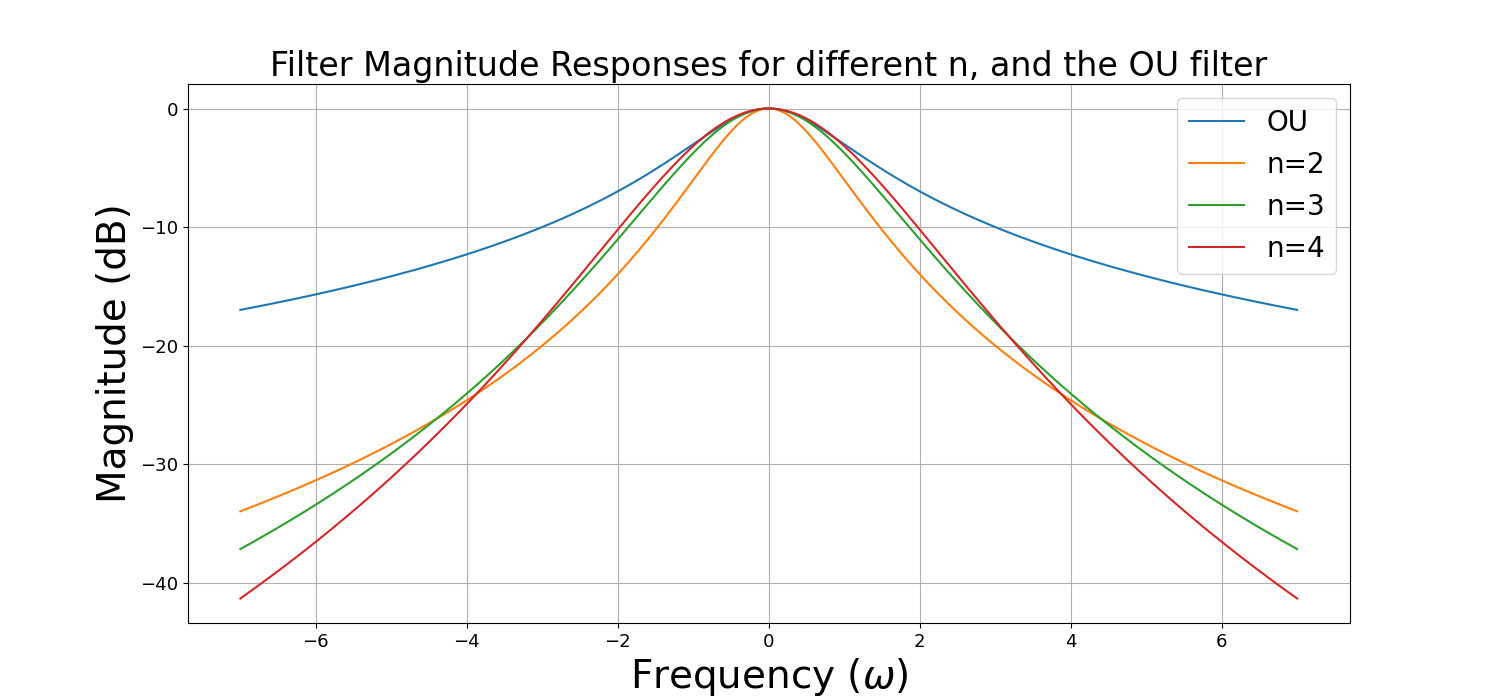
Figure 1: Magnitudes of the Fourier Transforms ∣H(iω)∣ for different HOLD orders n and the Ornstein–Uhlenbeck filter; higher-order HOLD yields sharper attenuation of high frequencies.
Empirical Score and Prevention of Distribution Collapse
The analysis extends to the optimal empirical score under HOLD: when minimizing the empirical score-matching loss over training data, the unconstrained optimum must represent the joint distribution over observed data and auxiliary variables. Since the auxiliary variables are independently resampled, this construction complicates the memorization of training data alone, as the score network cannot collapse solely onto the empirical data distribution.
Notably, as t→0, the Mahalanobis distance between a training sample and the learned distribution remains bounded or diverges (for n≥2), in contrast to first-order diffusion where it vanishes and the learned distribution collapses onto the training sample. The determinant of the inverse covariance matrix increases with model order, confirming enhanced resistance to distribution collapse.
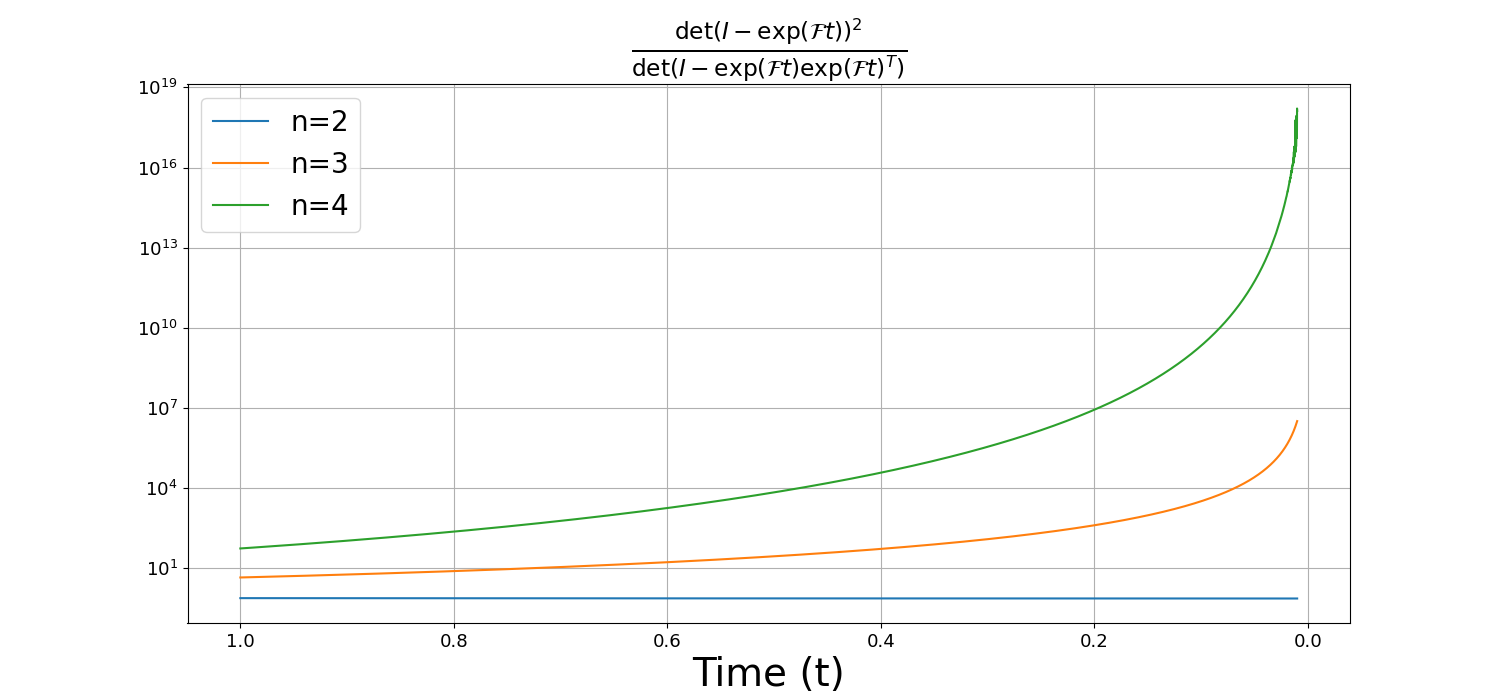
Figure 2: Determinant of the inverse covariance matrix as a function of model order, demonstrating increasing resistance to distribution collapse via higher-order HOLD.
Experimental Validation
Datasets and Protocol
Experiments are conducted on CelebA (grayscale, 32×32 center crops) and CIFAR-10 (grayscale). Models are trained with identical UNet architectures, differing only in the inclusion of auxiliary variables for HOLD. Memorization is measured using the "gap ratio" metric: for each generated sample, the ratio of distances to its nearest and second-nearest training samples is compared to a threshold, yielding the fraction of memorized samples (Fmem). Generation quality is assessed with Fréchet Inception Distance (FID).
CelebA Results
Across varying dataset sizes, standard first-order diffusion (e.g., VPSDE) rapidly memorizes training examples, whereas HOLD with increasing order (n=2,3) dramatically lowers Fmem at similar FID levels.
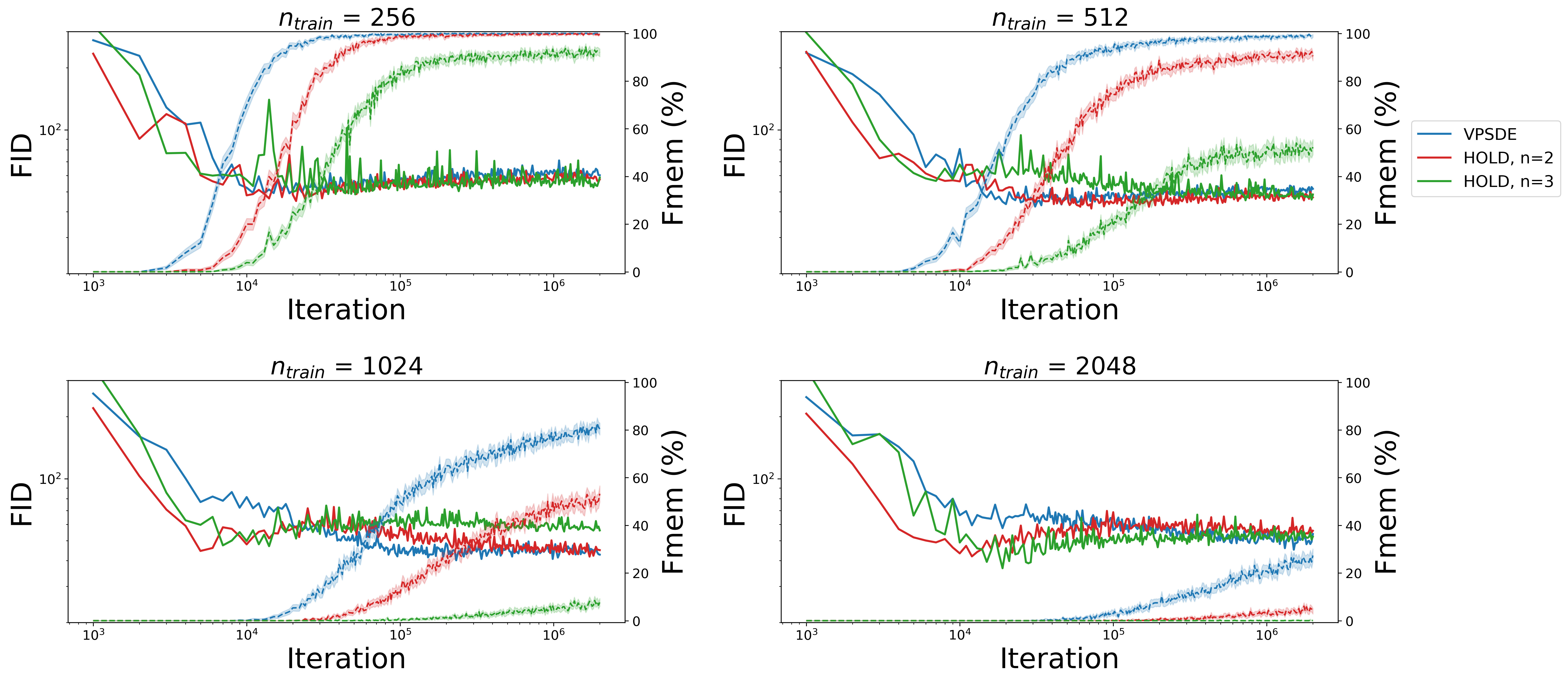
Figure 3: CelebA FIDs and fraction memorized (Fmem) versus number of training samples, showing substantial reduction in memorization for higher-order HOLD at matched sample quality.
Qualitative analysis further confirms this result: generated samples from standard diffusion closely replicate—or are indistinguishable from—training data, whereas HOLD yields diverse samples with minimal direct replication.
CIFAR-10 Results
Experiments on CIFAR-10 exhibit the same trend; increasing the order of HOLD diminishes memorization at constant or only slightly increased FID scores, despite the dataset’s increased heterogeneity. The effect is robust to changes in category distribution and dataset size.
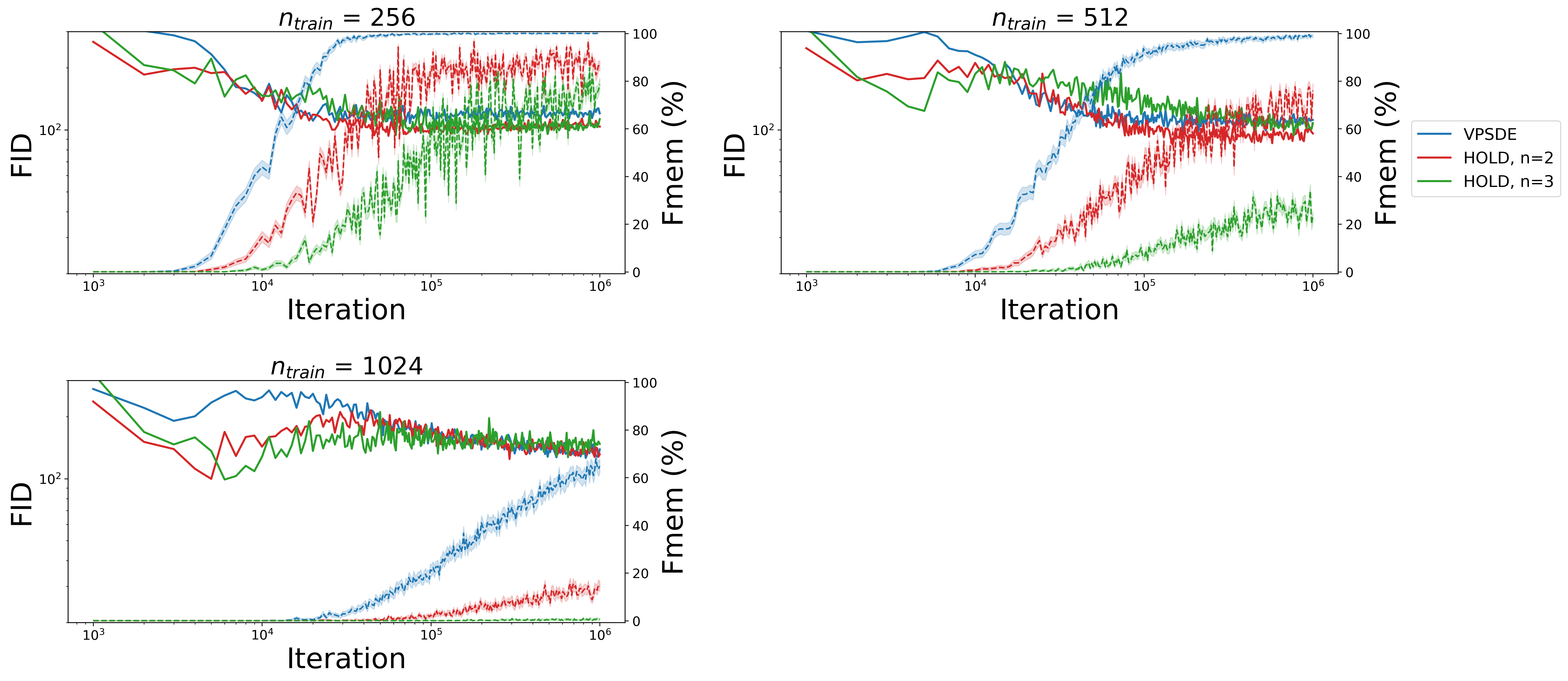
Figure 4: CIFAR-10 FIDs and memorization fraction with respect to number of training samples, with HOLD achieving lower memorization without unacceptable loss in FID.
Ablation: Auxiliary Variable Initialization and Training Loss
Additional experiments show that whether auxiliary variables are assigned once per data point or resampled at each epoch does not significantly alter memorization trends, validating the practicality of the HOLD formulation. Training losses are slightly higher for HOLD, reflecting the increased complexity of learning the regularized score.
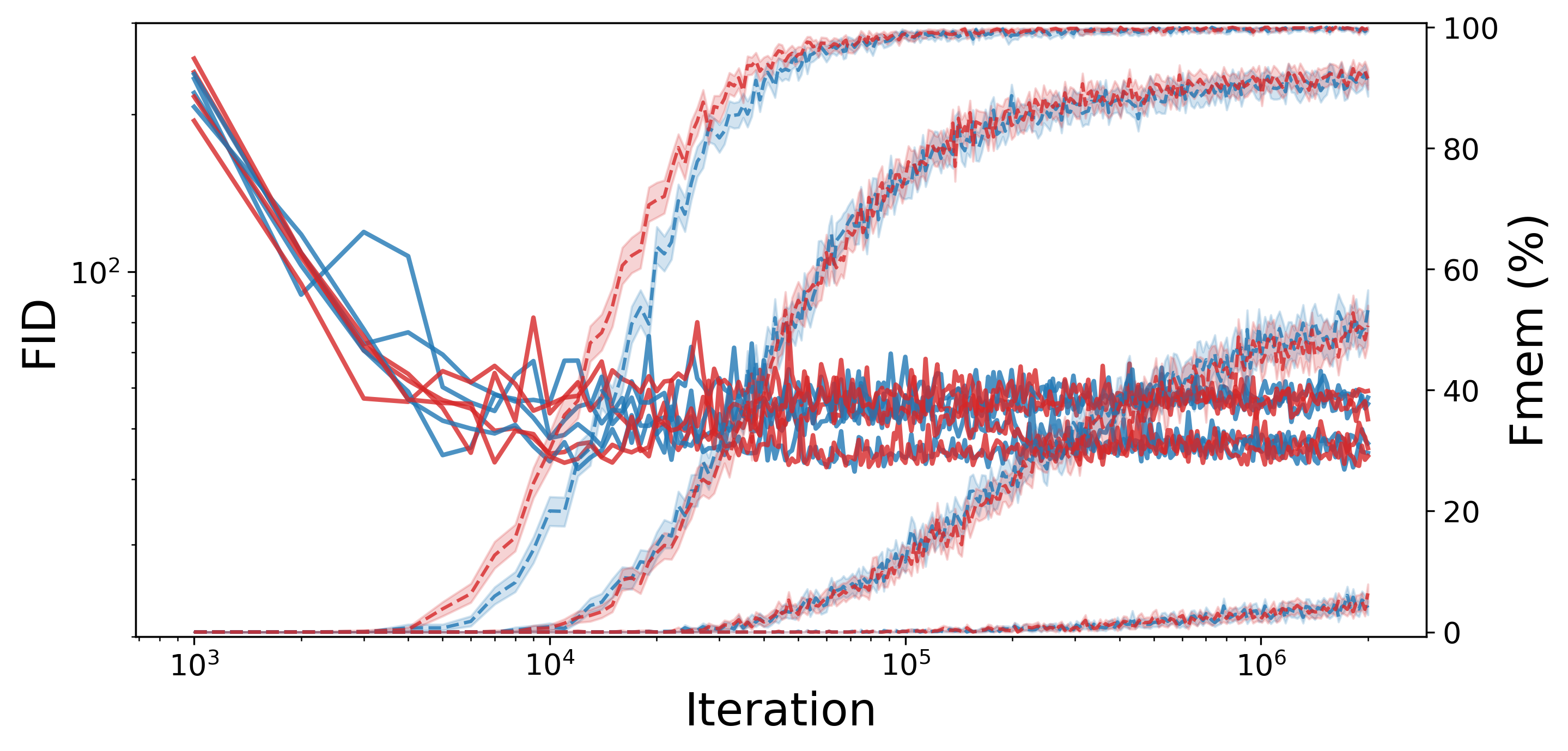
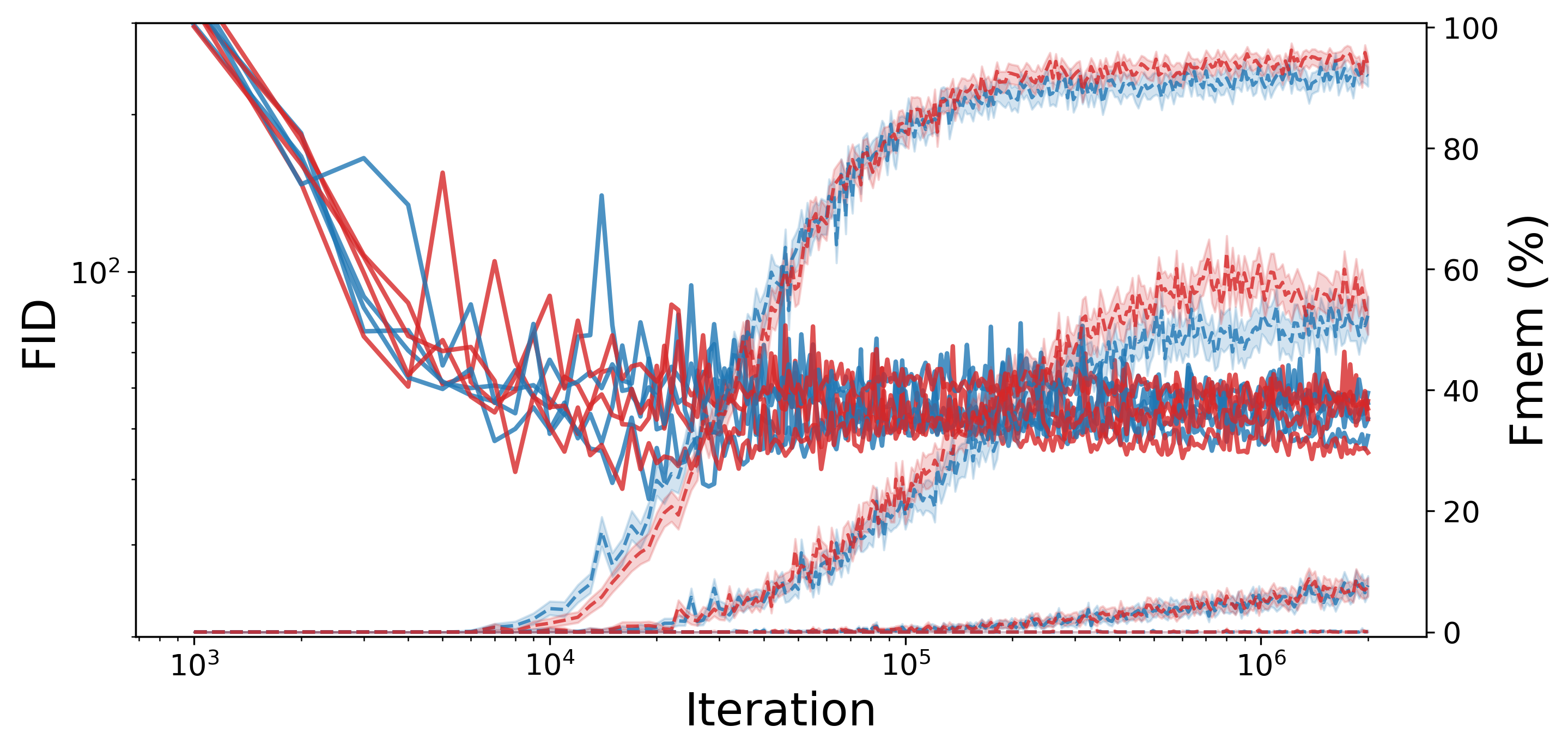
Figure 5: Initial auxiliary variable assignment comparison for sθ0; curves show negligible impact on memorization or FID.
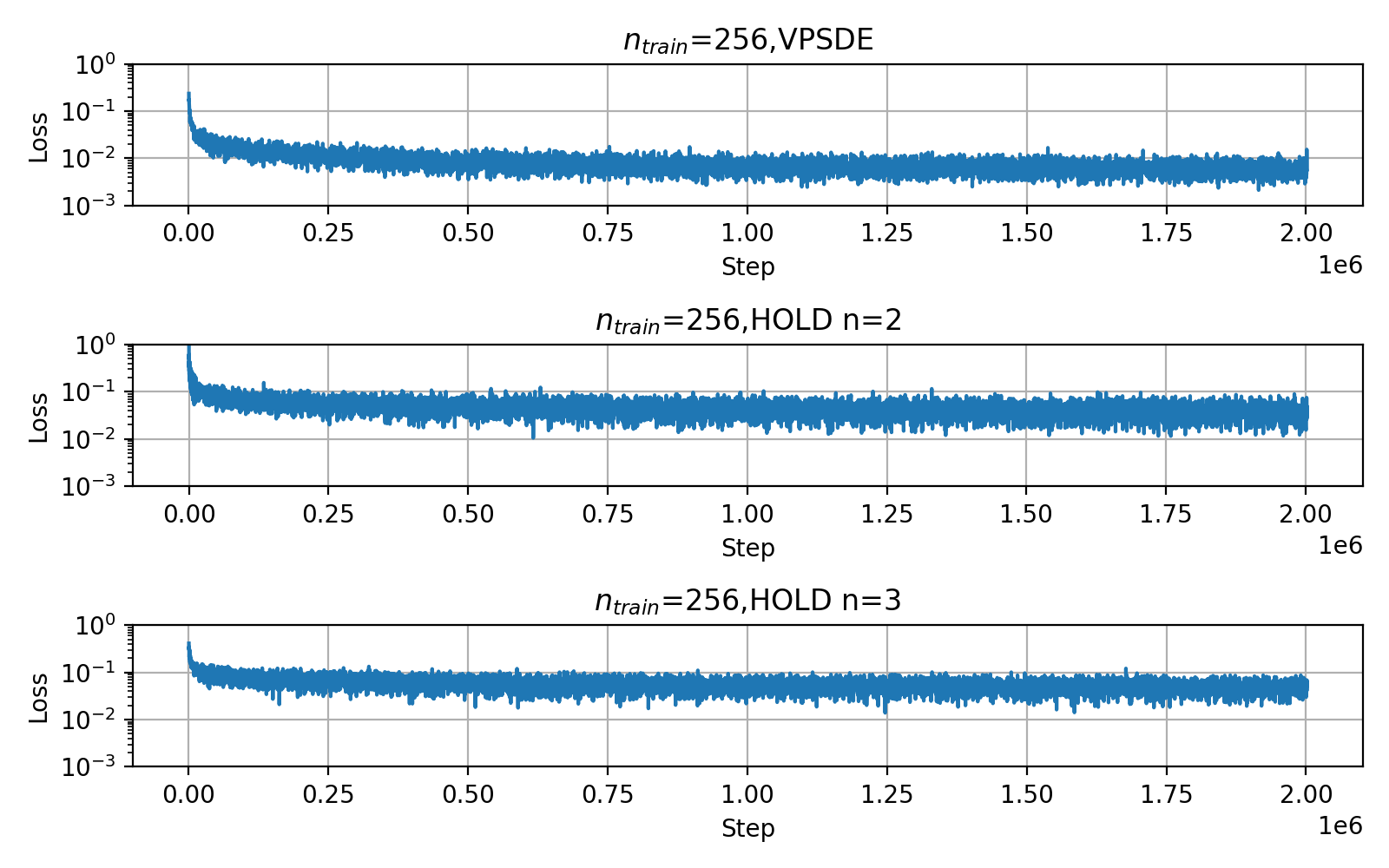
Figure 6: Training losses for VPSDE and HOLD models; higher-order models exhibit modestly higher training loss due to the added complexity.
Discussion and Implications
The proposed HOLD formalism provides both theoretical guarantees and empirical evidence that higher-order Langevin dynamics can be leveraged to attenuate memorization in diffusion models. By acting as a strong intrinsic low-pass filter on the score, HOLD suppresses the model's capacity to commit training sample information to memory, fundamentally altering its statistical generalization properties.
Practically, HOLD can be implemented with minor architectural extensions (additional inputs for auxiliary variables), incurring only a slight increase in computational cost. The findings suggest that diffusion models for privacy-sensitive applications—such as medical image generation or data synthesis from proprietary corpora—can benefit from adopting higher-order dynamics. Moreover, these results provide new insights into the implicit regularization of diffusion dynamics, inviting further exploration of forward SDE design for optimal filtering and generalization.
Theoretically, these results challenge the dichotomy of memorization versus generalization in generative models, and suggest that model architecture—specifically, dynamics order—can enforce generalization even in overparameterized or small data regimes.
Conclusion
This work rigorously establishes that Higher-Order Langevin Dynamics impose an effective, order-dependent low-pass filter on the trajectory of score-based generative models, significantly reducing memorization while preserving sample quality. The theoretical framework and empirical validation provide a robust foundation for further developments in privacy-preserving generative modeling and open new avenues for diffusion process design to optimize both ethical and generalization properties.

