Understanding diffusion models requires rethinking (again) generalization
Abstract: This position paper argues that understanding generalization in diffusion models requires fundamentally new theoretical frameworks that go beyond both classical statistical learning theory and the benign overfitting paradigm developed for supervised learning. In diffusion models, unlike in supervised learning, memorization of training data and generalization to novel samples are incompatible: a model that has fully memorized its training set generates copies rather than novel data. Several theoretical explanations for why practical diffusion models nevertheless generalize have been proposed, based on capacity limitations, implicit regularization from optimization, or architectural inductive biases, but their interactions remain unclear. We argue that the field should pivot from explaining why the diffusion models do not memorize to investigating what the model actually learns during pre-memorization phase. To highlight our stance, we conduct empirical study of diffusion models trained on CIFAR-10, and we distill the findings into concrete open questions that we believe are key to improve understanding of generalization in diffusion models.



Paper Prompts
Sign up for free to create and run prompts on this paper using GPT-5.
Top Community Prompts
Explain it Like I'm 14
What this paper is about
This paper looks at how and why diffusion models (the AI systems that can generate images, audio, and more) make new, high‑quality results without just copying their training data. The authors argue that the usual ideas we use to explain learning in AI don’t fully work here. They say we need new ways of thinking, especially because, in diffusion models, “memorizing” the training data and “generalizing” (creating new, similar things) can’t both happen at the same time.
The main questions, in simple terms
The authors focus on these questions:
- Why don’t large, practical diffusion models simply memorize and spit back training images?
- What exactly do these models learn before they would start memorizing?
- How do choices like dataset size, model size, batch size, and learning rate change whether the model creates new images or copies?
- Do our common evaluation scores actually tell us if the model is copying or creating something truly new?
- What new ideas or tools do we need to properly explain generalization in diffusion models?
How they studied it (and what the terms mean)
They ran careful experiments on a small image dataset (CIFAR‑10: tiny 32×32 pictures of objects like cats, cars, etc.) using a standard diffusion model architecture called a U‑Net. They changed several knobs:
- Dataset size: how many training images (from about 2,000 up to about 16,000).
- Model size: how many parameters (think of this as the model’s “brain size”).
- Batch size: how many examples the model sees at once during training.
- Learning rate: how big each step is when the model updates itself.
What is a diffusion model? Imagine taking a clear photo and slowly adding noise (like static) until it’s just fuzz. A diffusion model learns to reverse that process: starting from fuzz, it learns to remove noise step by step to produce a realistic image. Training it means showing it noisy images and teaching it how to denoise them correctly at many noise levels.
Key ideas explained:
- Memorization vs. generalization:
- Memorization: like tracing—producing near copies of training images.
- Generalization: like painting in the same style—new images that fit the training data’s “look,” but aren’t copies.
- Novelty and fidelity:
- Novelty: how different a generated image is from any exact training image (not a copy).
- Fidelity: how good and realistic the image looks, matching the overall style and variety of the real data.
- Early stopping: stopping training before the model starts to memorize.
- Scores they measured:
- Loss: how well the model denoises during training.
- FID and Sliced Wasserstein: numbers that try to measure how close the generated images are to real images overall.
- Memorization score: checks how many generated images are suspiciously close to specific training images (possible copies).
What they found and why it matters
Here are the main takeaways from their experiments:
- Common scores don’t reveal copying vs. creating new things.
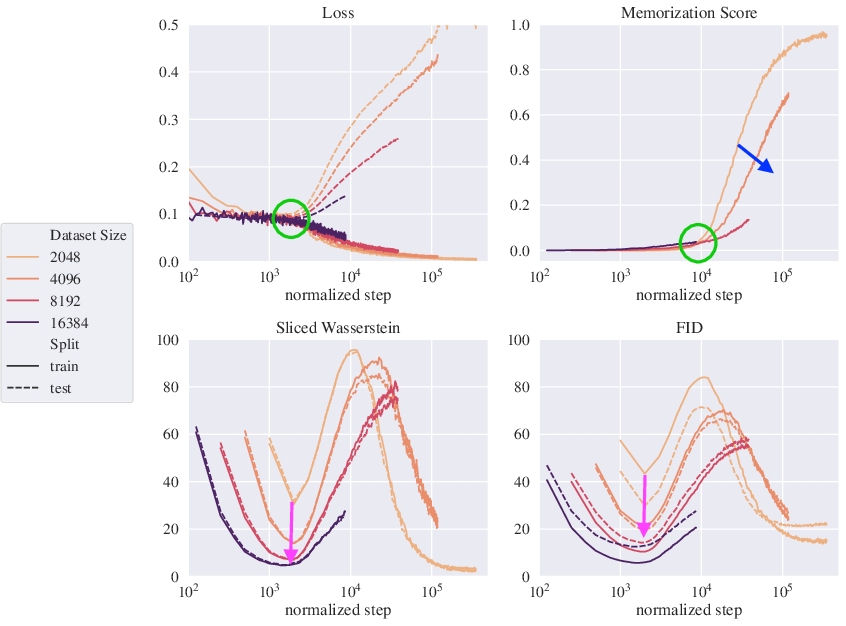
- The usual distance scores (like FID) looked almost the same whether the model was compared to the training set or the test set. That means these scores can say “these images look realistic overall,” but they can’t tell you if the model is quietly copying the training images. So, these metrics aren’t enough to judge true generalization.
- A surprising “double dip” in quality over time.
- As training goes on, some quality measures first get better, then worse, then better again. This “double descent” happened for both training and test comparisons. It suggests that training dynamics (the path the model takes while learning) matter a lot and don’t match older, simpler theories. The cause isn’t fully understood yet.
- More data delays memorization and improves best quality.
- With larger datasets, the time it would take to start memorizing grows roughly in proportion to the dataset size. So, with big real‑world datasets, the model wouldn’t reach the memorization phase within a normal training budget. This helps explain why practical systems don’t obviously memorize.
- Larger datasets also improved the best image quality the model achieved before any memorization kicked in.
- Bigger models reach higher quality but memorize sooner.
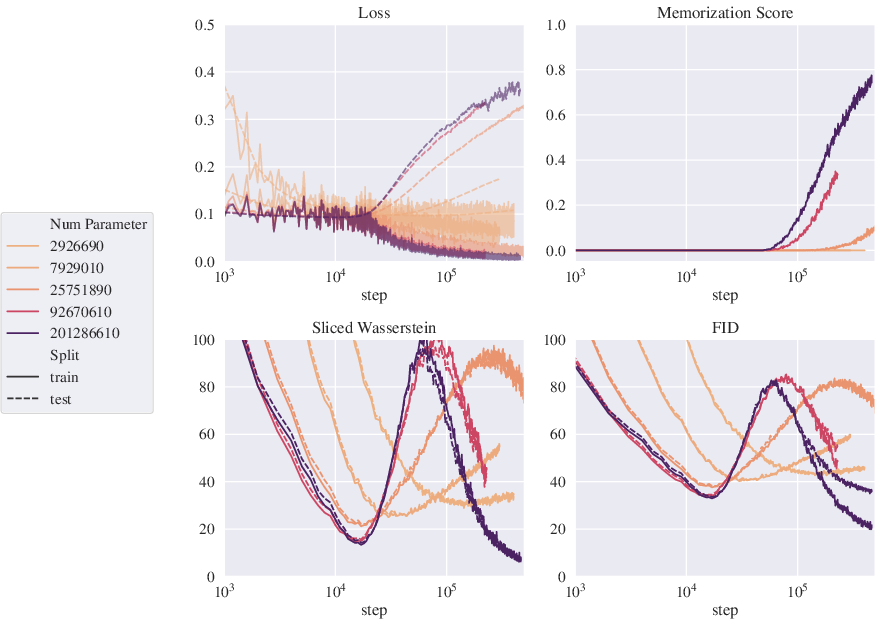
- Increasing model size improved the best results but also made memorization start earlier (if training continued long enough). So, there’s a trade‑off: bigger models are powerful but need careful training control (like early stopping).
- Smaller batch size can improve best quality (before memorization).
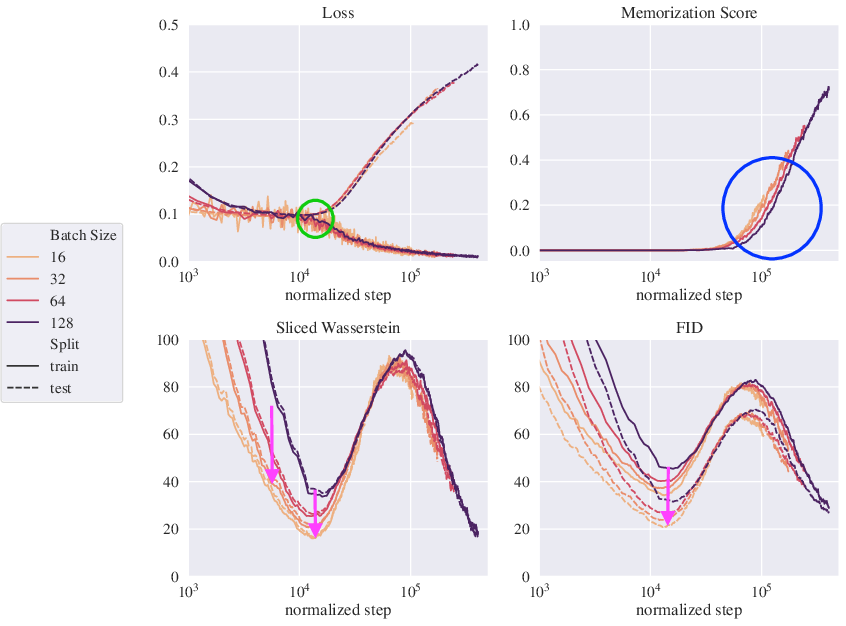
- Using smaller batches led to better peak quality, even though it didn’t really change how fast the model memorized once that phase began.
- Higher learning rates can improve best quality and delay memorization (in normalized time).
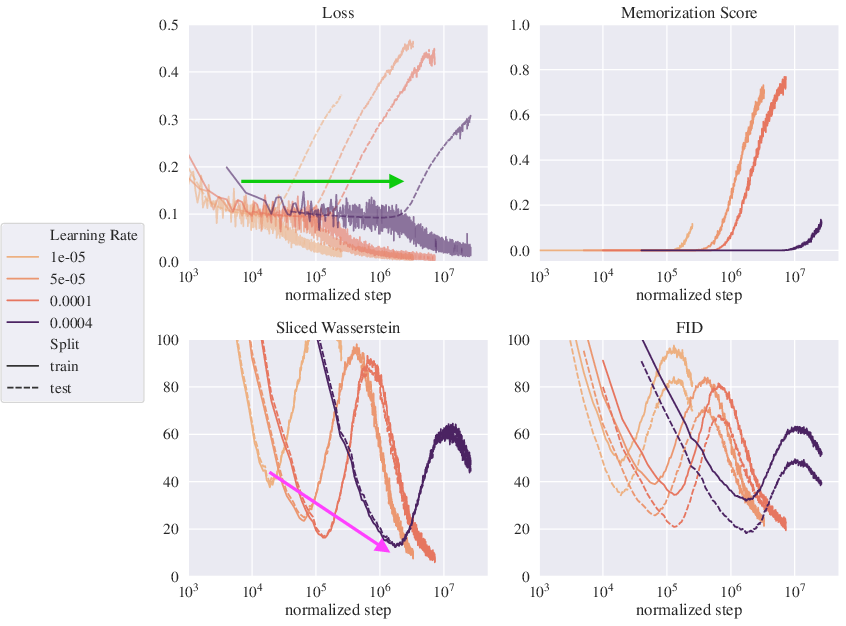
- Training with larger learning rates often reached better quality before memorization and, in a certain sense, pushed memorization farther away along the training timeline.
- The big picture:
- The authors argue that “Why don’t large diffusion models memorize?” is mostly solved: because we stop training before they would, and because with lots of data it would take a very long time to reach memorization.
- The deeper, unsolved question is “What exactly are these models learning before memorization, and how do novelty and fidelity arise together?”
What this means going forward
- For researchers:
- We need better metrics that clearly separate “this looks realistic” (fidelity) from “this is not a copy” (novelty). Current scores (like FID) don’t catch copying well.
- We need new theory that explains what happens during training, not just at the end. Choices like learning rate and batch size shape quality before memorization, and current theories don’t fully explain that.
- We should study how the structure of real data (like shapes, textures, and patterns—the “geometry” of data) and the model’s design together make generalization possible.
- For practitioners (people training models):
- Use large datasets and early stopping to avoid memorization.
- Smaller batch sizes and somewhat larger learning rates can improve best quality before memorization.
- Be aware of privacy and copyright: since memorization can happen if you train long enough on small datasets, monitoring for near‑duplicates matters.
- For society:
- Better understanding of when models copy vs. create is important for creativity, fairness, and legal issues (like copyright and privacy).
- Clearer tools and tests for novelty will help build trustworthy, responsible generative AI.
In short: This paper says we need to rethink how we explain learning in diffusion models. It shows that big datasets and careful training typically prevent memorization, but our current scores don’t reliably tell us when models are copying. The authors call for new measures and theories that focus on what models learn before memorization and how they produce both new and high‑quality outputs.
Knowledge Gaps
Knowledge gaps, limitations, and open questions
Below is a single consolidated list of specific gaps and unresolved questions that the paper surfaces or implicitly leaves open, framed to guide actionable follow-up research.
- Mechanism behind double descent in distributional distances: Identify the dynamical cause of the observed double descent (simultaneous on train and test) in FID/sliced Wasserstein, determine when it appears (datasets, architectures, objectives), and decompose which signal components (e.g., frequency bands, layers, timesteps/noise levels) drive it.
- Metrics that disentangle novelty from fidelity: Design evaluation metrics that reliably detect copying vs genuine generalization (beyond FID/precision–recall) at scale, are robust to feature-space choices, and have provable links to statistical divergences; standardize copy-detection thresholds and benchmarks.
- Trajectory-level implicit regularization: Develop theory for how batch size and learning rate shape intermediate iterates (pre-memorization “sweet spot”) under score matching, including predictive models for peak fidelity and principled early-stopping rules tied to optimizer hyperparameters.
- Unifying interactions among capacity, optimization, and architecture: Build frameworks that quantify how these three factors jointly set memorization onset, memorization rate, and peak fidelity—beyond simple capacity-to-sample-size ratios.
- Data geometry effects: Theoretically and empirically characterize how manifold dimension, curvature, and support regularity affect the order and speed of what is learned pre-memorization; create synthetic datasets with controllable geometry to test predictions.
- External validity and scaling: Validate whether findings (e.g., linear scaling of memorization time with dataset size, batch-size effects, double descent) hold for larger datasets (e.g., ImageNet, LAION), larger or different architectures (Transformers, latent diffusion), and real training budgets.
- Batch size paradox: Explain why memorization rate appears insensitive to batch size while peak fidelity improves for smaller batches; test across optimizers and noise scales, and derive theory tying gradient-noise properties to curvature encountered along the trajectory.
- Learning rate regimes and schedules: Precisely map the safe/beneficial learning-rate region near the edge of stability for score matching, and assess whether schedule designs (warmup, cosine, cyclical) can systematically improve peak fidelity without hastening memorization.
- Per-noise-level learning dynamics: Create better probes (beyond per-noise loss decomposition) to detect staggered learning across timesteps (e.g., frequency analyses, feature-space alignment, task-probing) and link them to the observed double descent.
- Architectural inductive biases beyond U-Nets: Systematically compare convolutional vs transformer models, weight sharing, normalization schemes, receptive fields, and positional encodings on memorization onset, rate, and peak fidelity.
- Objective and noise schedule variants: Evaluate how different SGM formulations (VP/VE SDEs, EDM, rectified flow variants, timestep weightings) and time parameterizations affect memorization dynamics and fidelity.
- Sampling procedure effects: Quantify how sampler choice (deterministic vs stochastic), number of steps, variance-exploding vs variance-preserving sampling, and guidance methods alter novelty/fidelity and copy risk.
- Classifier-free guidance and conditioning: The study fixes guidance to 0; measure how guidance strength and conditioning signals (class/text) change the novelty–fidelity balance and memorization risk, especially for unseen prompts/labels.
- Optimizer and regularizer design: Go beyond Adam to test SGD/AdamW, momentum, weight decay, gradient clipping, dropout, data augmentation, and label/score smoothing; isolate which interventions delay memorization without degrading peak fidelity.
- EMA’s role: Quantify how EMA decay values alter the pre-memorization trajectory, peak fidelity, and copy risk; compare EMA vs non-EMA checkpoints systematically.
- Robust, standardized memorization onset detection: Compare definitions (train–test loss divergence, copy-rate thresholds, membership-inference signals) and calibrate their agreement; propose a reproducible protocol for onset and rate measurement.
- Privacy/IP risk over training time: Map membership-inference and extraction attack success vs training step to identify the window where leakage risk rises, and how hyperparameters shift this window.
- Theory for linear scaling of memorization time: Move beyond empirical scaling to derive constants and dependencies on gradient noise, curvature spectra, data dimension, and model capacity; test predictions experimentally.
- Practical early-stopping criteria: Devise reliable, compute-light signals (e.g., curvature proxies, gradient-noise scale, alignment metrics) to stop at peak fidelity before memorization, with guarantees or validated heuristics.
- Evaluation protocol design when train/test are distributionally close: Create holdout designs (e.g., curated rare classes, disjoint attribute sets, synthetic shifts) where novelty vs copying is empirically distinguishable despite small train–test distribution gaps.
- Generalization guarantees for non-converged iterates: Extend consistency and convergence analyses to early-stopped, trajectory-based solutions under SGD noise for score matching objectives.
- Run-to-run variability: Quantify variance across random seeds for memorization onset, rate, and peak fidelity; report confidence intervals and identify hyperparameters that reduce variance.
- Scaling laws for fidelity and memorization: Fit and test predictive scaling relationships for peak fidelity and memorization onset/rate across dataset size, model size, batch size, and learning rate; identify breakpoints and interaction terms.
- Causal interventions to decouple fidelity from memorization: Evaluate targeted regularizers (e.g., gradient penalties, manifold-preserving priors, copy-averse losses) that improve fidelity while explicitly discouraging pointwise memorization.
- Feature-space dependence of copy detection: Assess sensitivity of memorization scores to chosen feature extractors (SSCD, CLIP, Inception, DINO), and define a consensus or ensemble approach with calibration.
- Dataset curation and near-duplicate effects: Audit train/test splits for (near-)duplicates; measure how duplication levels bias copy metrics and memorization onset, and propose de-duplication standards.
- Conditioning and label effects: Compare unconditional vs class-conditioned models to determine whether conditioning accelerates or mitigates memorization, and whether conditioning aids novelty in underrepresented modes.
- Reweighting across timesteps: Test whether timestep reweighting or curriculum strategies can defer memorization while improving fidelity, and provide theoretical support for their effects.
- Beyond near-exact copies: Develop detectors and metrics for partial, patch-level, or style-level memorization to capture subtler forms of copying that current cosine-similarity thresholds may miss.
Practical Applications
Immediate Applications
Below are actionable uses that practitioners can deploy now by leveraging the paper’s empirical findings and clarified mechanisms behind memorization and generalization in diffusion models.
- Training pipelines that explicitly target the pre-memorization regime
- What: Integrate early stopping keyed to dataset size, leveraging the empirical linear scaling of memorization onset with N and the observed onset signal (divergence of test vs. train loss) to halt training before copying starts.
- Sectors: Software/creative industries (image, audio, video generation), healthcare (medical image synthesis), finance (synthetic tabular/time-series), robotics (sim-to-real data generation).
- Tools/Products/Workflows: “Pre-Memorization Trainer” that monitors loss gaps and SSCD-based memorization score; automated stop/gating policy in MLOps; dashboards that alert when nearing memorization onset.
- Assumptions/Dependencies: Linear scaling validated primarily on CIFAR-10/UNet-scale; requires access to training set or proxy for copy-detection; memorization signals and thresholds may vary by domain and architecture.
- Hyperparameter policies for better peak fidelity before memorization
- What: Prefer smaller batch sizes and moderately larger learning rates (near but inside the edge of stability) to improve peak fidelity in the pre-memorization phase.
- Sectors: Software/creative industries, healthcare, robotics.
- Tools/Products/Workflows: “Edge-of-Stability Tuner” that jointly tunes batch size and LR to maximize pre-memorization FID/SwD; guardrails that auto-detect divergence and back off LR.
- Assumptions/Dependencies: Gains shown at intermediate training—not necessarily at convergence; stability margins are model/data dependent; uses Adam and UNet in the paper.
- Capacity planning and data-first scaling strategies
- What: Use observed roles of model size and dataset size to plan training: increase N to delay memorization and improve fidelity; grow model size for fidelity gains but expect faster memorization onset.
- Sectors: All sectors training generative models at scale.
- Tools/Products/Workflows: “Memorization Onset Estimator” that predicts training budget and onset given N, model size, batch, LR; procurement and labeling planning tools prioritizing data growth for safer training windows.
- Assumptions/Dependencies: Scaling laws inferred from mid-scale experiments; domain shift and architecture changes can alter trade-offs.
- Memorization risk auditing and release gating
- What: Add a memorization score (e.g., SSCD-based nearest-neighbor similarity) to model release criteria alongside FID/precision-recall; gate deployment on acceptable novelty levels.
- Sectors: Policy-sensitive sectors (healthcare, finance, public sector), creative industries (copyright/IP).
- Tools/Products/Workflows: “Memorization Risk Dashboard” integrated into CI/CD; scheduled audits during training and at checkpoints; evidence logs for compliance.
- Assumptions/Dependencies: Requires suitable feature space and thresholds; may have false positives/negatives; needs access to (or hashed fingerprints of) training data.
- Evaluation protocols that separate novelty and fidelity
- What: Report both novelty (copy-detection rates) and fidelity (FID/Sliced Wasserstein) because train/test distribution distances look similar and do not reveal copying; track metrics throughout training to capture double-descent phases.
- Sectors: Industry R&D, academia.
- Tools/Products/Workflows: “Nov-Fid Twin-Metric Reporting” templates; experiment trackers plotting train/test loss, memorization score, FID/SwD against normalized steps; benchmark suites with fixed train/test splits and similarity thresholds.
- Assumptions/Dependencies: Existing metrics imperfect (FID, SwD); SSCD or similar embedding choices affect sensitivity; needs community-accepted protocols.
- Privacy/IP risk mitigation via training governance
- What: Combine early stopping, LR/BS choices, and memorization monitoring to reduce copying risks when training on sensitive or proprietary data.
- Sectors: Healthcare, finance, legal/public sector, media.
- Tools/Products/Workflows: Model cards including “novelty risk” sections; training SOPs requiring memorization checks before model export; legal/compliance checklists referencing memorization thresholds.
- Assumptions/Dependencies: Not a substitute for differential privacy or legal safeguards; copying risks can still arise for rare/unique examples.
- Academic benchmarks and reproducibility checklists
- What: Adopt standardized sweeps over N, model size, batch size, and LR; plot metrics over normalized steps to compare generalization windows and memorization onset across studies.
- Sectors: Academia, open-source consortia.
- Tools/Products/Workflows: Reproducible benchmark scripts; shared logging schemas; datasets with published training/test splits and feature extractors for memorization scoring.
- Assumptions/Dependencies: Compute costs; consistency of architectures/optimizers; extensions needed for modalities beyond images.
Long-Term Applications
These opportunities require further research, scaling studies, or new tooling before broad deployment.
- Novel metrics that jointly capture novelty and fidelity
- What: Develop evaluation measures that detect copying while reflecting perceptual quality and distributional alignment (beyond FID/SwD), ideally with links to statistical divergences and theoretical guarantees.
- Sectors: All sectors using generative models; standard bodies (MLCommons, ISO).
- Tools/Products/Workflows: “Novelty–Fidelity Curve” metrics; improved precision–recall variants; reference toolkits that benchmark copy risk vs. quality.
- Assumptions/Dependencies: Needs community consensus and validation across modalities; robust feature spaces; datasets with known duplicates.
- Trajectory-aware optimizers and schedulers
- What: Design optimization methods that explicitly regularize along the training trajectory to maintain high-fidelity, high-novelty states and avoid the mid-training double-descent pitfall.
- Sectors: Software, creative industries, safety-critical domains.
- Tools/Products/Workflows: “Trajectory-Regularized Diffusion Training” (TRDT) optimizers; adaptive LR/BS schedules governed by novelty/fidelity signals; checkpoint routing that rewinds from pre-memorization minima.
- Assumptions/Dependencies: Requires theory of implicit regularization along trajectories; stability proofs; large-scale validation.
- Architecture designs with built-in inductive biases for novelty and fidelity
- What: Engineer backbones (conv/transformer hybrids, symmetry-aware modules) that favor manifold-level generalization over pointwise memorization.
- Sectors: Media generation, scientific imaging, simulation.
- Tools/Products/Workflows: “Privacy-Preserving Diffusion Backbones”; layer designs that prioritize geometry-adaptive smoothing; architecture audits quantifying copy risk.
- Assumptions/Dependencies: Needs generalized evidence beyond UNets/CIFAR-10; trade-offs with capacity and efficiency.
- Automated training budget calculators driven by scaling laws
- What: Predict memorization onset, expected peak fidelity, and safe training windows given estimated data geometry, N, model size, and optimizer settings; use for compute and data acquisition planning.
- Sectors: All compute-intensive practitioners.
- Tools/Products/Workflows: SaaS or internal tools integrating logs and historical runs to forecast schedules; APIs that warn when planned runs risk memorization.
- Assumptions/Dependencies: Reliable scaling laws across domains; calibrated on real-world datasets and architectures.
- Regulatory standards and compliance frameworks for generative models
- What: Define industry standards for assessing and reporting memorization/IP risks (e.g., thresholds, tests, disclosures), potentially forming the basis for certifications.
- Sectors: Policy/legal, healthcare, finance, media.
- Tools/Products/Workflows: Standardized audit suites; compliance documentation templates; third-party certification services.
- Assumptions/Dependencies: Agreement on definitions of memorization and acceptable risk; validated measurement tools; evolving legal norms.
- Privacy risk quantification that links training dynamics to leakage
- What: Connect memorization onset and rates to formal privacy risks; combine with differential privacy or regularization schedules to bound leakage for sensitive datasets.
- Sectors: Healthcare, finance, public sector.
- Tools/Products/Workflows: “Privacy–Memorization Risk Assessors”; training regimes that enforce pre-memorization termination plus DP noise schedules.
- Assumptions/Dependencies: Theoretical mapping from memorization indicators to privacy leakage; practical DP budgets for high-dimensional data.
- Noise-phase curricula and phase-aware training
- What: Use insights about multi-phase learning dynamics (e.g., double descent across training) to design curricula over noise levels or tasks (coarse-to-fine) that avoid poor intermediate states.
- Sectors: Media/generative content, scientific imaging, robotics sim.
- Tools/Products/Workflows: “Noise-Phase Curriculum” schedulers that allocate compute across noise scales based on measured progress; adaptive sampler step sizing.
- Assumptions/Dependencies: Requires clearer causal understanding of phase transitions; verification beyond CIFAR-10; integration with text-/conditioned setups.
- Data-centric strategies to extend safe generalization windows
- What: Curate and expand datasets (including high-quality augmentation, deduplication, diverse coverage) to push memorization further out and improve fidelity.
- Sectors: All sectors; especially domains with sensitive or limited data.
- Tools/Products/Workflows: Data quality pipelines; deduplication/fingerprint tools; active data collection targeting underrepresented modes.
- Assumptions/Dependencies: Budget and access to data; careful handling to avoid bias amplification; efficacy depends on domain data geometry.
- Conditioned-evaluation frameworks for novelty and fidelity
- What: For text-/attribute-conditioned diffusion, build evaluation that tests novelty and fidelity conditional on prompts (e.g., unseen prompt sets, prompt-based copy detection).
- Sectors: Media, advertising, gaming, e-commerce.
- Tools/Products/Workflows: Prompt banks with novelty controls; conditional precision–recall with copy-detection overlays; campaign-specific safety tests.
- Assumptions/Dependencies: Reliable prompt coverage; scalable detection for multi-modal content; benchmarks that reflect production use.
These applications translate the paper’s key insights—linear memorization-time scaling with dataset size, the distinct roles of data/model size, the effect of batch size and learning rate on pre-memorization fidelity, and the inadequacy of classical train–test gaps for generative evaluation—into concrete practices and future tools for industry, academia, policy, and everyday AI development.
Glossary
- Benign overfitting: A regime where highly overparameterized models can perfectly fit training data yet still generalize well. "The theory of benign overfitting"
- Central flow theory: A theoretical framework for characterizing the trajectory of optimization dynamics in deep learning. "central flow theory"
- Classifier-free guidance (CFG): A sampling technique for diffusion models that improves perceptual quality by guiding generation without an explicit classifier. "classifier-free guidance with strength~$0.0$."
- Convergence rates: Formal rates describing how quickly a model’s distribution approaches the target distribution under training. "proving convergence rates in distributional distance"
- Denoising score matching: A training objective where the model learns the score (gradient of log-density) of data corrupted with noise by denoising. "Diffusion models are trained by denoising score matching"
- Distributional distance: A quantitative measure of discrepancy between probability distributions. "convergence rates in distributional distance"
- Double descent: A phenomenon where a performance metric first improves, then worsens, and improves again as capacity or training progresses. "we observe a double descent in distribution space"
- Early stopping: An optimization tactic that halts training before full convergence to prevent overfitting or memorization. "early stopping acts as a crucial implicit regularizer"
- Edge of stability: The regime where gradient descent operates near the boundary of divergence, often linked to large learning rates. "the edge of stability"
- Empirical risk: The average loss computed on the training set, typically minimized during learning. "reaching the global minimum of the empirical risk in denoising score matching is fundamentally detrimental."
- Exponential Moving Average (EMA): A parameter-averaging technique that smooths updates to stabilize training and sampling. "EMA decay"
- FID (Fréchet Inception Distance): A metric that compares generated and real data distributions in a feature space to assess sample quality. "sliced Wasserstein distance and FID"
- Gaussian mixtures: Probabilistic models that represent data as a combination of multiple Gaussian components. "memorization capacity needed for the case of Gaussian mixtures."
- Generalization gap: The difference between performance on training data and unseen test data. "the generalization gap scales"
- Hessian: The matrix of second derivatives of a loss function; its spectrum relates to sharpness and stability. "largest eigenvalue of the Hessian"
- Implicit regularization: Regularization effects that arise from the optimization process or dynamics rather than explicit penalties. "implicit regularization from optimization"
- Inductive bias: Architectural or algorithmic preferences that steer learning toward certain solutions. "inductive biases of the architecture"
- Manifold: A lower-dimensional geometric structure embedded in high-dimensional space that data may lie near. "capture the manifold structure of the data"
- Memorization score: A metric quantifying how often generated samples closely match training examples. "Memorization score"
- Minimum stability: A property limiting which minima gradient descent with a given learning rate can reach based on sharpness. "minimum stability"
- Noised empirical measure: The empirical data distribution convolved with noise, used in score matching for diffusion models. "the noised empirical measure"
- PAC-Bayes framework: A probabilistic approach to deriving generalization bounds by combining PAC learning with Bayesian ideas. "PAC-Bayes framework"
- Rademacher complexity: A measure of a function class’s capacity based on its ability to fit random labels. "VC dimension and Rademacher complexity"
- Rectified Flow: A formulation/noise schedule for diffusion models that simplifies training and sampling trajectories. "the rectified flow formulation of diffusion models"
- Score-based generative models: Generative models that learn the score (gradient of log-density) of data distributions to sample via diffusion/flows. "score-based generative models"
- Score function: The gradient of the log-density of a probability distribution. "the score function of the noised empirical measure"
- Score matching loss: The objective minimized in score-based models to align the model’s score with the true (noised) data score. "empirical score matching loss"
- Sliced Wasserstein distance: A transport-based metric computed via 1D projections to compare distributions. "Sliced Wasserstein distance:"
- Statistical consistency: The property that a learning procedure converges to the true distribution or parameter as data grows. "These works establish the statistical consistency of diffusion models"
- U-Net: A convolutional neural network architecture with encoder–decoder and skip connections, commonly used in diffusion models. "We use U-Net architectures"
- VC dimension: A combinatorial measure of model capacity based on the largest set it can shatter. "VC dimension and Rademacher complexity"
Collections
Sign up for free to add this paper to one or more collections.

