- The paper delivers state-of-the-art NLO SMEFT corrections to Higgs decay observables and gauge boson processes in a standardized POPxf format.
- It details operator-level QCD and electroweak corrections, highlighting renormalization scheme effects in key channels such as H→bb.
- Results support comprehensive global fits and future collider analyses with both differential and total rate predictions.
Introduction
The implementation of Standard Model Effective Field Theory (SMEFT) at next-to-leading order (NLO) plays a critical role as experimental precision increases at the LHC and anticipated lepton collider facilities. This work provides state-of-the-art NLO QCD and electroweak (EW) results for all relevant 2- and 4-body Higgs decay observables, Z and W decay properties, and associated EW precision observables (EWPOs), as well as Higgstrahlung (e+e−→ZH) cross sections at various center-of-mass energies, within the dimension-6 SMEFT framework. The results are supplied using the POPxf data exchange formalism, optimized for incorporation in experimental and phenomenological analyses.
The calculation builds on the linear expansion of the SMEFT Lagrangian with all baryon- and lepton-number conserving operators up to dimension six in the Warsaw basis. Physical observables are expanded in both the SMEFT power counting (1/Λ2) and loop counting (1/16π2). Consistent NLO SMEFT predictions are assembled: QCD corrections are automated via existing tools, whereas NLO EW effects—requiring operator-by-operator computations—are synthesized and standardized into POPxf JSON files. All results retain consistency in power counting, truncating at linear order (O(1/Λ2)).
Higgs Decays: Renormalization Scheme Dependence and SMEFT Corrections
The analysis provides a complete set of inclusive and differential results for Higgs boson partial widths and branching ratios. Both the on-shell (OS) and MS renormalization prescriptions for quark mass parameters are supplied. For key channels, especially H→bb, the scheme choice can yield non-negligible shifts in the predicted branching ratio, influencing all derived quantities.
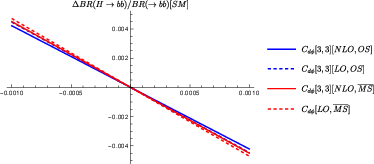
Figure 1: SMEFT contributions to the branching ratio of Higgs decay to bb, showing the impact of CϕD and W0 and differences under OS versus W1 quark mass renormalization.
This difference is particularly manifest for operators with large tree-level OS counterterms, while for others (e.g., W2) the numerical scheme sensitivity is minimal.
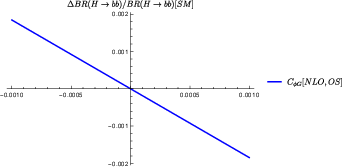
Figure 2: Sensitivity of the W3 branching ratio to the OS and W4 schemes for W5.
The cumulative correction to the total Higgs width is also provided, critically relevant for global analyses and especially so given that W6 dominates the total width.
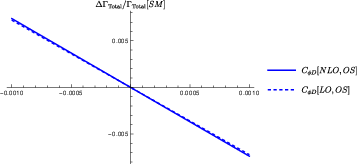
Figure 3: SMEFT corrections to the total Higgs width normalized to the best SM value, with virtually indistinguishable LO/NLO curves under W7.
Modest but measurable NLO shifts are found for several Wilson coefficients when considering four-lepton final states, and OS/W8 dependence in observables involving light fermions is also demonstrated.
Differential Observables: Multilepton Final States
Beyond total rates, the analysis incorporates NLO SMEFT corrections to W9 decay spectra, including experimental-motivated cuts on the off-shell e+e−→ZH0 invariant mass.
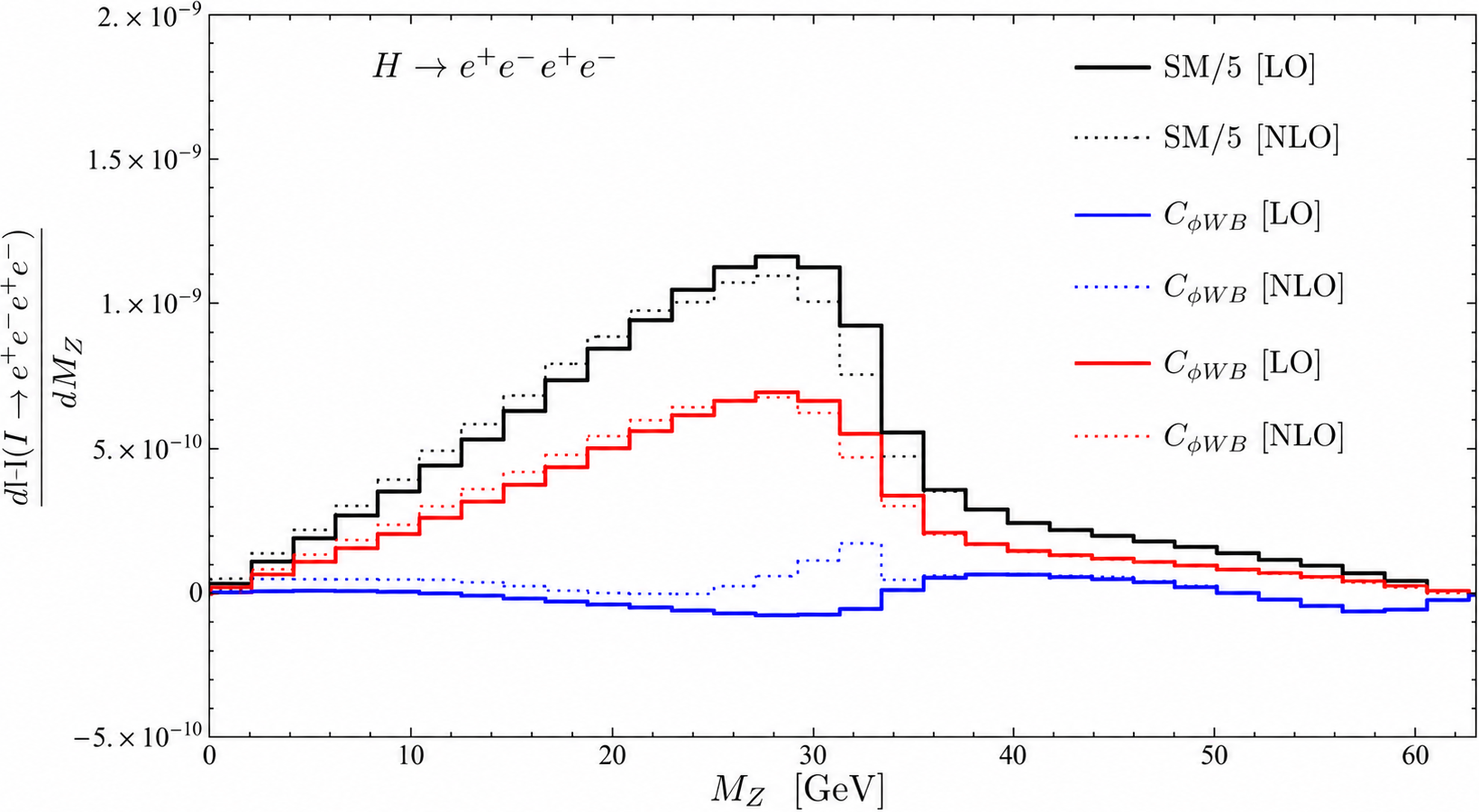
Figure 4: SMEFT corrections to the e+e−→ZH1 differential spectrum for e+e−→ZH2 at NLO.
Such differential results are essential for experimental fits sensitive to shape distortions, not merely total rate modifications.
The inclusion of a complete suite of EWPOs at NLO QCD/EW, parameterized in the relevant SMEFT Wilson coefficients, supports global fits at the Tera-Z precision level. The results explicitly compare two main input parameter schemes (e+e−→ZH3 and e+e−→ZH4), demonstrating that operator sensitivity and input dependence can be substantial, especially for tree-level EW vertex corrections.
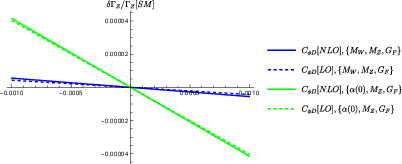
Figure 5: e+e−→ZH5 dependence of the e+e−→ZH6 total width at LO and NLO, emphasizing input scheme dependence.
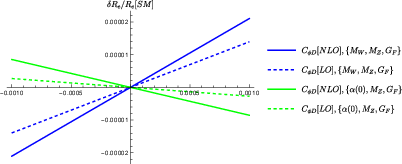
Figure 6: Correction to e+e−→ZH7 proportional to e+e−→ZH8 at LO and NLO for different input schemes.
For operators contributing only at one-loop, like e+e−→ZH9, input scheme dependence is strongly suppressed.
Higgstrahlung Cross-Sections
NLO SMEFT corrections for 1/Λ20 are reported for both polarized and unpolarized beams at over three energy points, facilitating combined analyses for future lepton collider programs. Both QCD and EW corrections are included; QED corrections are referenced separately. All results are organized in the same POPxf format for seamless integration.
Implications and Outlook
The results provide an essential backbone for comprehensive NLO SMEFT fits incorporating all available precision Higgs and EW measurements. POPxf standardization ensures reproducibility and interoperability between analyses. As full NLO EW corrections for LHC production processes become available, these ingredients set a consistent baseline for both HL-LHC-era SMEFT constraints and for FCC-ee precision program readiness. The methodology also identifies operators and measurable observables where input scheme dependence or higher-order corrections could critically impact global fit sensitivity, informing theoretical prioritization for future SMEFT development.
Conclusion
This work systematically consolidates NLO QCD and electroweak SMEFT corrections to Higgs and gauge boson decay observables, provides comprehensive coverage for all experimentally crucial channels, and standardizes dissemination in POPxf format. The results allow immediate application in global SMEFT fits at current and future collider facilities, marking a critical advancement toward theory-experiment synergy at the highest level of electroweak precision.