Effective field theory interpretation of ATLAS measurements involving the Higgs boson, electroweak bosons and the top quark
Published 23 Apr 2026 in hep-ex and hep-ph | (2604.21670v1)
Abstract: Wilson coefficients in dimension-six effective field theory are constrained in a combined fit to several ATLAS measurements. These inputs probe Higgs-boson processes across multiple production and decay modes, di-Higgs signatures in the $b\bar{b}γγ$ and $b\bar{b}ττ$ final states, $WW$ and $WZ$ diboson signatures, electroweak $Zjj$ final states, high-mass Drell-Yan interactions, and top-antitop events in both resolved and boosted topologies. Precision electroweak observables from LEP, SLD, and ATLAS are also included. A total of 48 parameters, including individual Wilson coefficients in the Warsaw basis and linear combinations of Wilson coefficients, are constrained simultaneously. Constraints on two-Higgs-doublet models and heavy-vector-boson models are also obtained by matching a relevant sub-set of the results with their parameters. This combined fit provides the most comprehensive effective field theory interpretation of experimental data by the ATLAS Collaboration to date. No significant deviations from the Standard Model are observed.
The paper presents the most extensive global SMEFT fit using ATLAS Run 2 data, simultaneously constraining 47 independent operator directions in the Warsaw basis.
It employs both linear and quadratic Wilson coefficient terms to capture detailed deviations in Higgs, electroweak, and top-quark observables.
Results show no significant deviations from the Standard Model, setting stringent limits on new physics scales above 10 TeV and providing insights for UV model reinterpretation.
Comprehensive SMEFT Constraints from ATLAS: Higgs, Electroweak, and Top-Quark Measurements
Introduction
This work presents the most extensive Standard ModelEffective Field Theory (SMEFT) interpretation of LHC Run 2 data by the ATLAS Collaboration, pursuing simultaneous constraints on 48 parameters (Wilson coefficients and their linear combinations) in the Warsaw basis. The dataset encompasses single- and di-Higgs processes, electroweak boson production, high-mass Drell–Yan, precision electroweak observables (EWPO), and differential top-quark production, in addition to legacy LEP and SLD measurements. The analysis advances prior ATLAS global SMEFT fits by increasing the measurement breadth and incorporating new sectors (notably differential top and di-Higgs) while providing explicit experimental and theoretical correlations necessary for robust global interpretations.
Methodology and Theoretical Framework
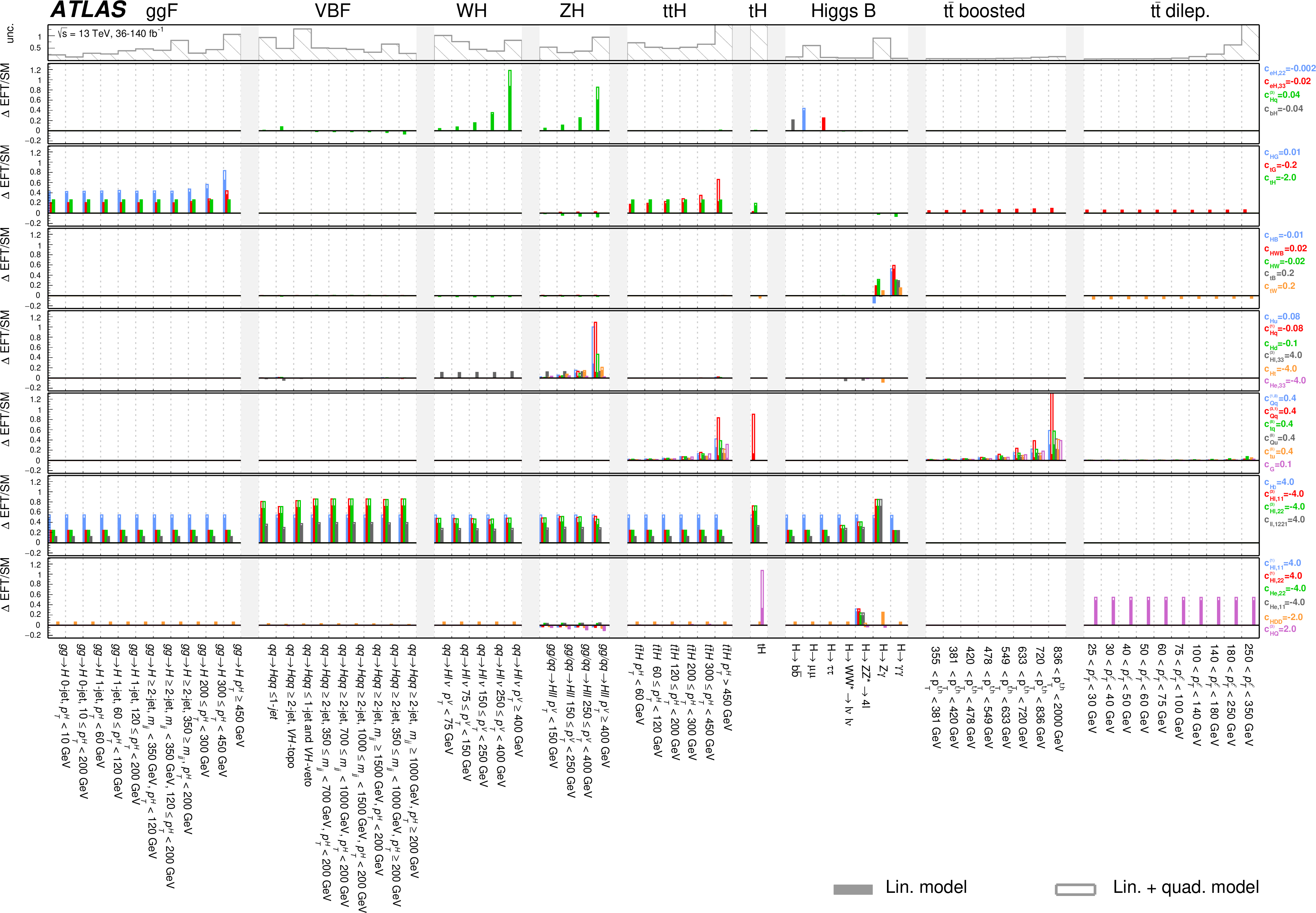
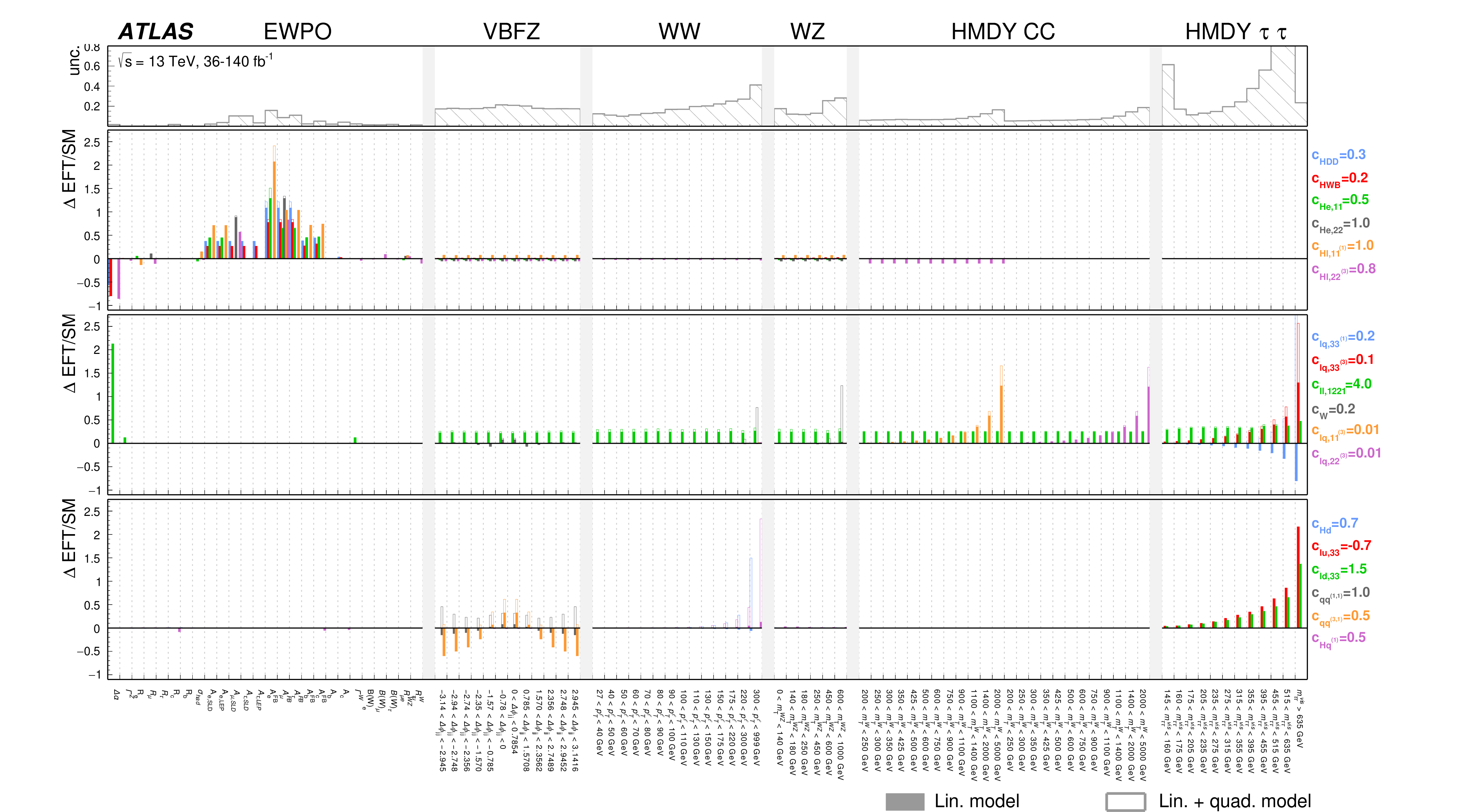
The global fit employs the SMEFT up to dimension-six, parameterizing observable deviations as an expansion in E/Λ, where Λ denotes the heavy BSM mass scale. Both linear (interference) and quadratic (squared BSM) terms in the Wilson coefficients are considered, with the latter increasingly important in high-energy tails (see Figures 1 and 2).
Figure 1: Impact of key SMEFT operators on Higgs and top observables. Shaded histograms: linear-only; open: linear-plus-quadratic models; uncertainties denote experimental precision per bin.
Figure 2: Relative effect of SMEFT operators on electroweak, HMDY, and EWPO observables, with measurement uncertainties displayed in the upper panel.
The global combination uses simulated SMEFT events (via MG5_aMC + SMEFTsim, with NLO QCD for key processes) and implements process-dependent acceptance corrections where operator-induced distortions are non-negligible (notably for multi-body Higgs and WW final states). The fit uses as input the most up-to-date ATLAS differential distributions, and the covariance structure for experimental and theoretical systematics is represented consistently across all measurements.
Fit Architecture and Operator Coverage
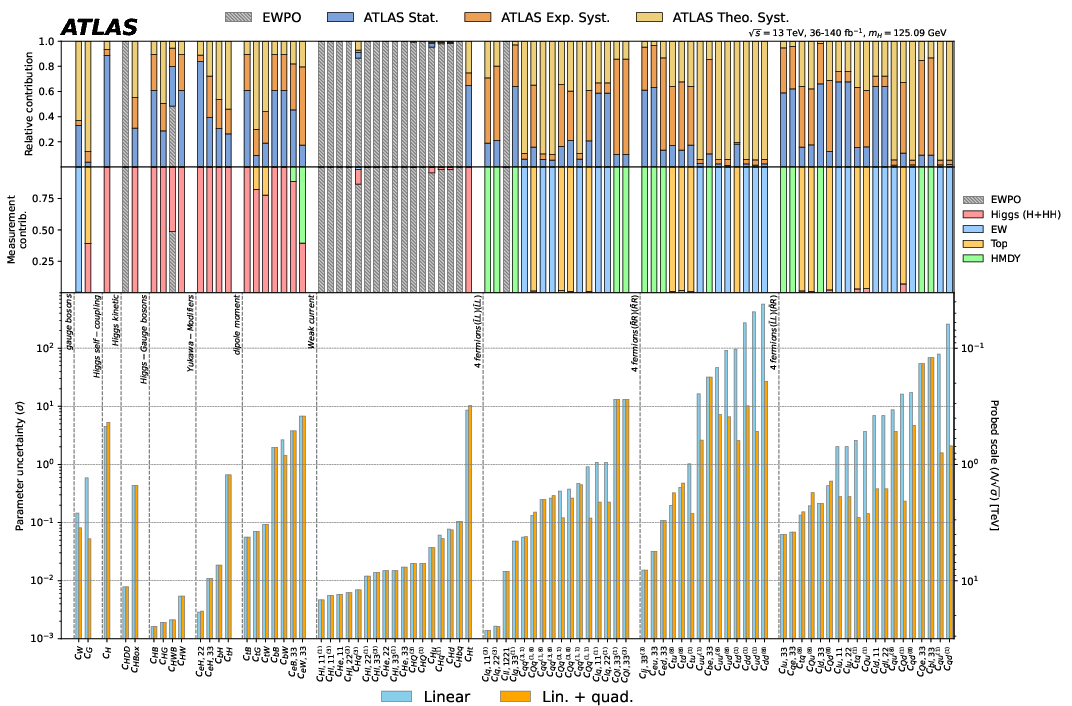
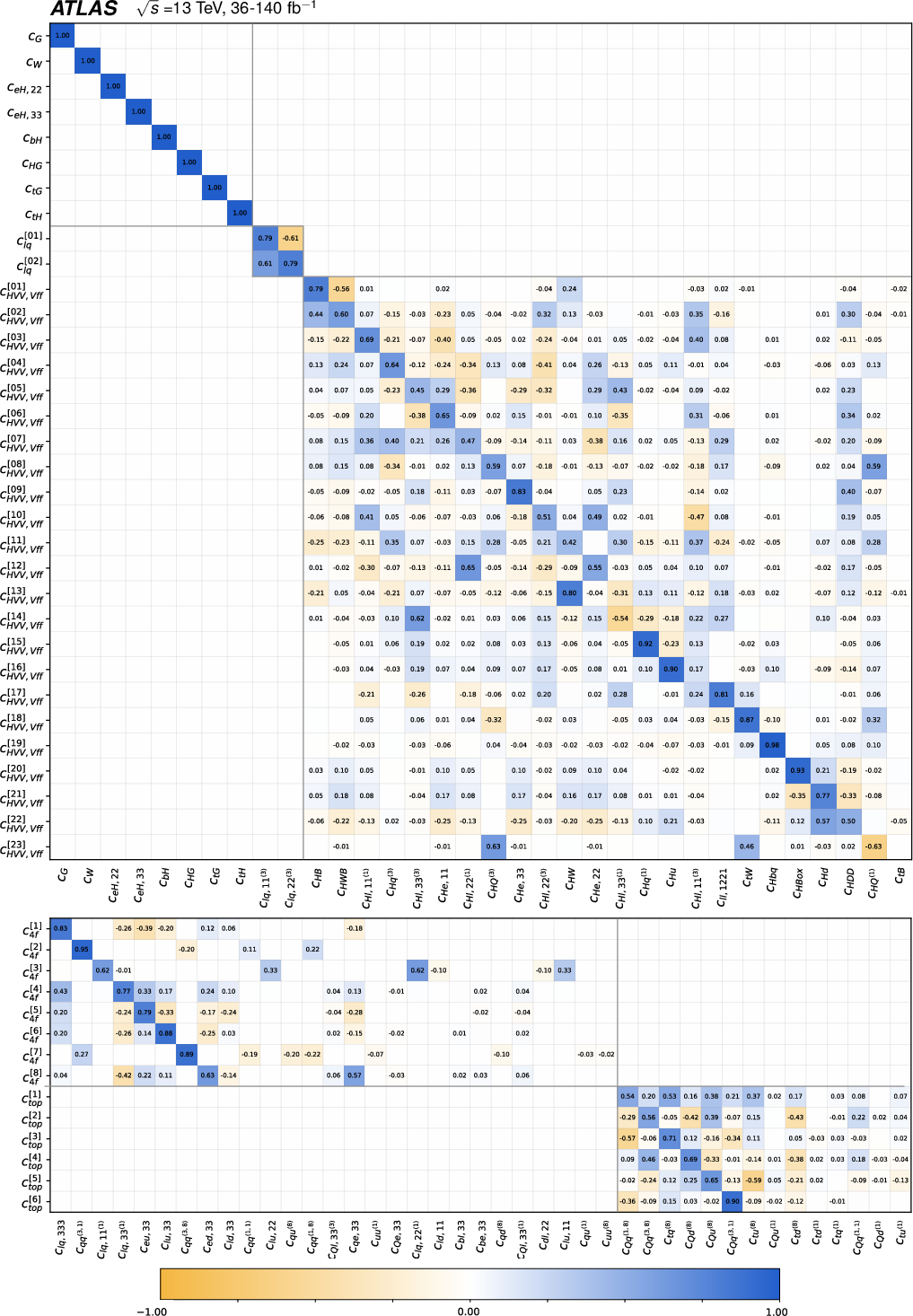
A principal limitation of prior global fits has been insufficient experimental information to constrain all directions in the high-dimensional SMEFT parameter space due to multi-operator correlations and approximate "blind" directions. Here, a principal component analysis of the Fisher information matrix yields an orthogonal basis of 47 simultaneous fit parameters (c′), optimized for experimental sensitivity (see Figures 3 and 4).
Figure 3: Expected limits per individual Warsaw-basis coefficient for both linear and linear-plus-quadratic scenarios. Panels: uncertainty breakdown, analysis contributions, and probed NP scale Λ/σ.
Figure 4: Structure of the 47-dimensional fit basis: each row is a linear combination of Warsaw-basis operators (“fit directions”). Only coefficients with ∣ci∣>0.01 are depicted for clarity.
Key operator families—Yukawa, four-fermion (including those involving heavy quarks), triple gauge, Higgs self-coupling, and dipole terms—are well-resolved by the fit owing to complementary sensitivity from Higgs, EW, HMDY, and top-quark data. Quadratic BSM contributions are consistently included to address regions where linearized SMEFT is insufficient. Event overlap between analyses is carefully controlled and assessed as negligible compared to luminosity and acceptance uncertainties.
Main Results and Statistical Inference
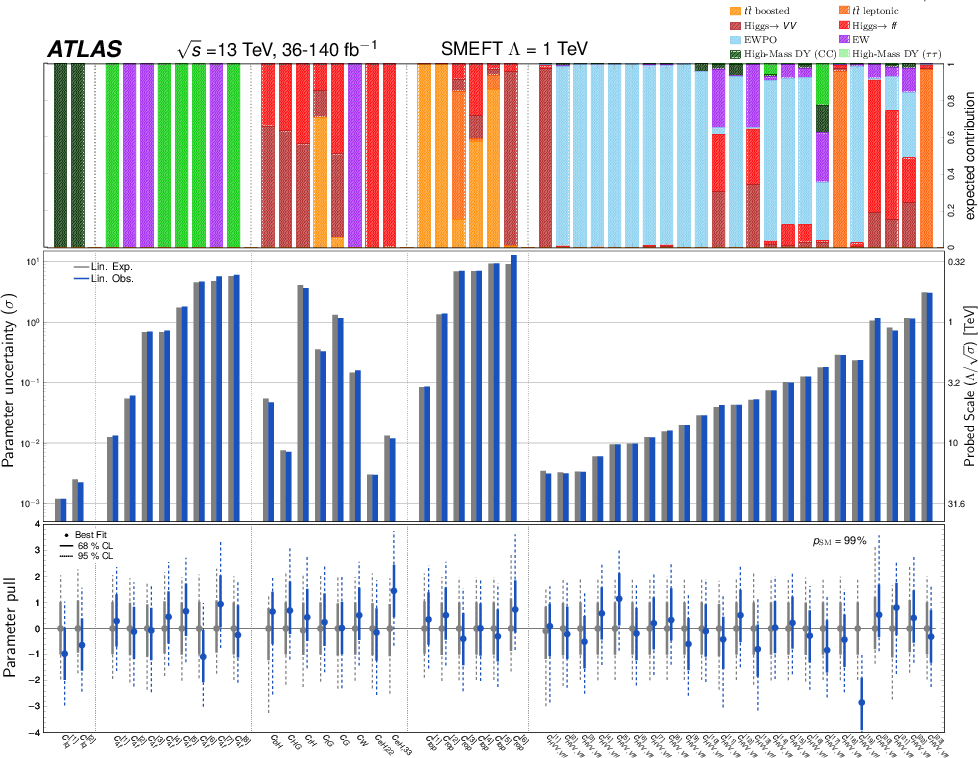
No statistically significant deviation from the Standard Model is observed in any fit direction, with the exception of the known AFB0,b and AFB0,c legacy anomalies, visible in the mild tension in $\cHVVEWnineteen$. The measured coefficients and their expected uncertainties are presented in Figure 5.
Figure 5: Comparison of expected versus observed SMEFT coefficient constraints (c′) for the linear model; 68% and 95% CL intervals; breakdown of experimental sensitivity per measurement group.
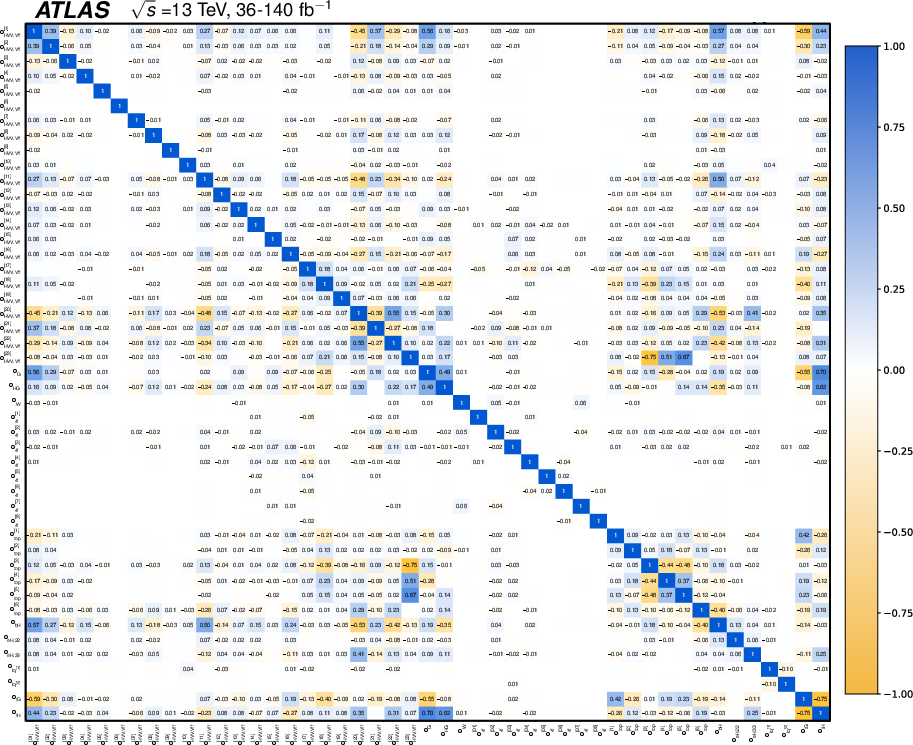
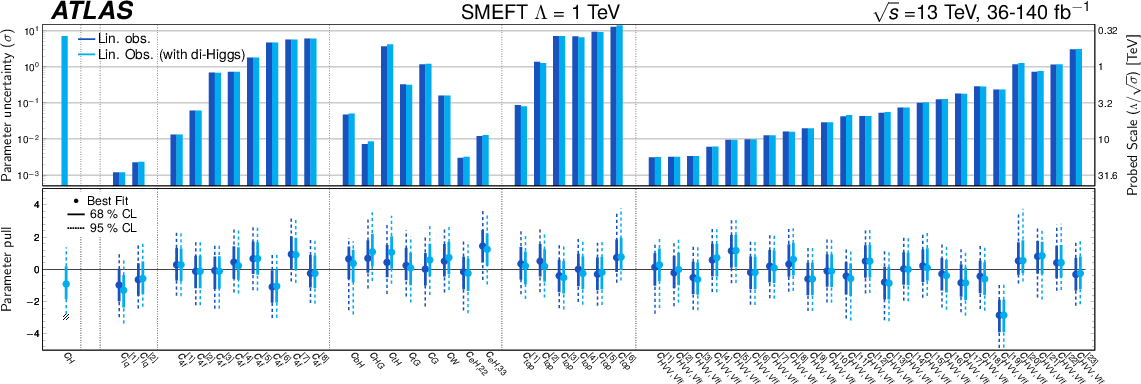
The di-Higgs channels enable unique, model-independent constraints on the Higgs self-coupling Wilson coefficient (Λ0), included only when the full likelihood (beyond Gaussian approximation) is computationally viable. Their inclusion has little impact on other operators. Correlations among fit parameters, generally modest but nonzero, are displayed in Figure 6.
Figure 6: Correlation matrix among 47 fit directions for the linear (no di-Higgs) fit. Dominant correlations are observed between directions constrained by common top/Higgs measurements.
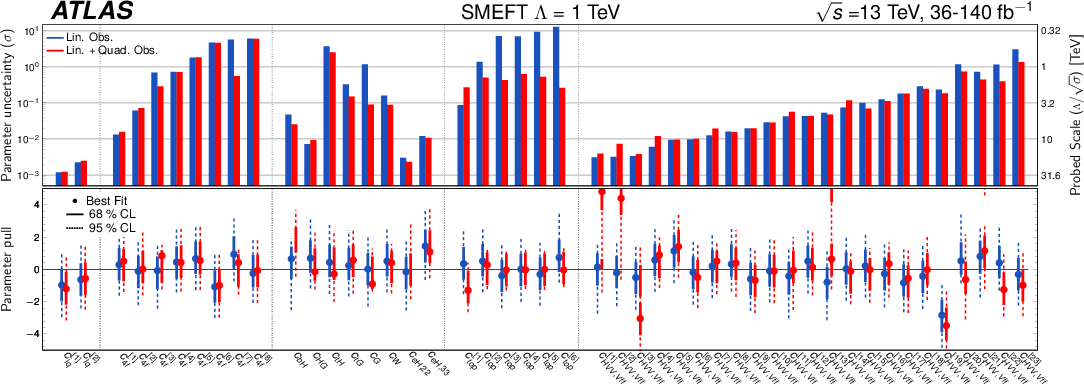
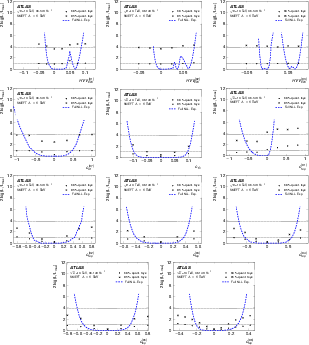
Inclusion of quadratic (order Λ1) SMEFT corrections tightens several operator limits (notably in the four-fermion and top sectors), but induces nontrivial likelihood structures with multiple minima (see Figure 7). Regions dominated by quadratic terms deviate from the Λ2 distribution assumed by Wilks’ theorem; profile likelihood corrections via toys are discussed (Figure 8).
Figure 9: Impact of incorporating di-Higgs data on SMEFT coefficient intervals. Only Λ3 is strengthened; other coefficients are stable.
Figure 7: Comparison between bounds from fits using linear-only (blue) and linear-plus-quadratic (red) SMEFT models. Uncertainty bands and probed NP scales are overlaid.
Figure 8: PLR scan for quadratically-dominated coefficients; black markers indicate toy-calibrated 68%/95% intervals vs. standard Wilks-derived regions.
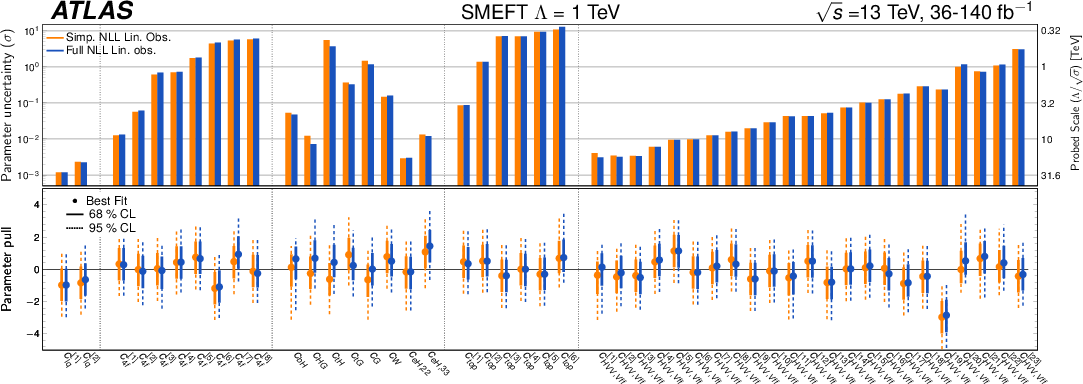
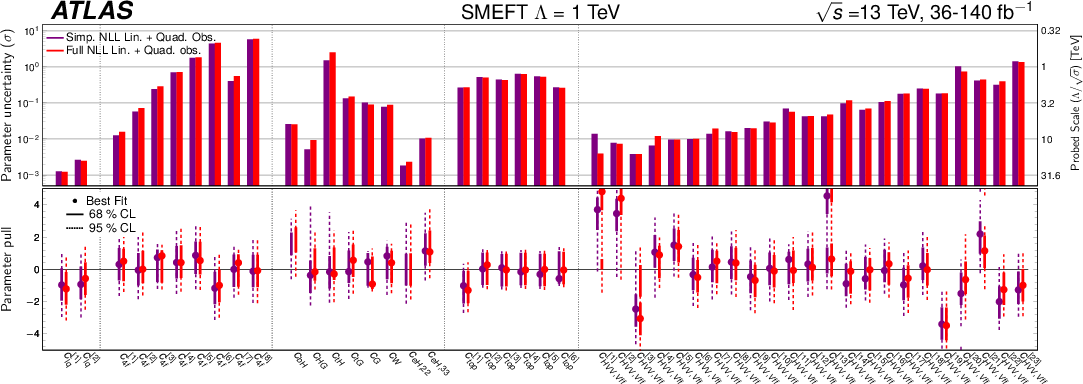
A simplified Gaussian likelihood model for reinterpretation is shown to reproduce the main likelihood-based results for nearly all operators of interest—exceptions occur in non-Gaussian tails or strongly correlated coefficients (Figure 10).
Figure 10: Full (blue/red) vs. simplified (orange/purple) likelihood interval comparison for the linear (top) and linear-plus-quadratic (bottom) models.
Implications for UV Scenarios
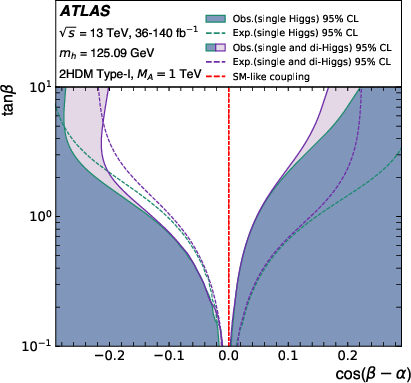
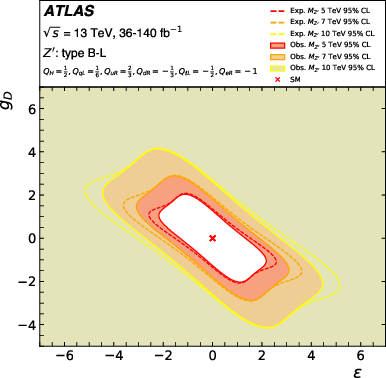
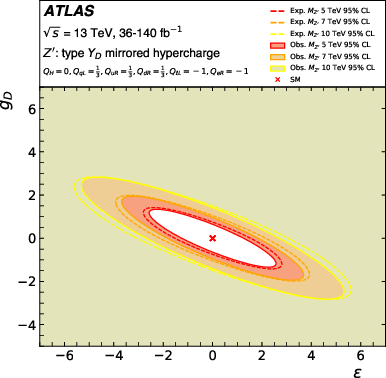
This framework facilitates mapping SMEFT constraints onto ultraviolet-complete extensions such as the two-Higgs-doublet model (2HDM) and heavy neutral vector boson (Λ4) scenarios. The 2HDM matching (Figure 11) shows di-Higgs data substantially enhances exclusion at high Λ5 for Type-I due to improved constraints on the Higgs self-coupling. In Λ6 models, combining EWPO and Drell–Yan tails probes the Λ7 kinetic mixing and gauge coupling parameter space up to Λ8 masses of 10 TeV (Figure 12).
Figure 11: Exclusion contours in the 2HDM Λ9 plane, with and without di-Higgs inclusion.
Figure 12: 95% CL exclusion in the WW0 (WW1, WW2) plane for WW3 (left) and mirrored hypercharge (right) models, for WW4 of 5, 7, and 10 TeV.
Conclusion
The ATLAS Run 2 global SMEFT fit delivers the most extensive set of model-independent constraints on dimension-six operators to date, linking high-precision LHC observables with legacy LEP/SLD measurements. With 47 independent directions (out of 86 probed) constrained simultaneously, this approach sets stringent limits on new physics scales WW5 TeV in several operator classes and provides a robust statistical basis for reinterpretation in a range of BSM scenarios. The observed null deviations from the SM impose strong constraints on both general EFT effects and on concrete UV models such as the 2HDM and heavy WW6. Future progress will benefit both from higher-luminosity data, more differential measurements sensitive to currently blind directions, and advanced statistical treatments for non-Gaussian likelihoods in multi-parameter SMEFT fits.
“Emergent Mind helps me see which AI papers have caught fire online.”
Philip
Creator, AI Explained on YouTube
Sign up for free to explore the frontiers of research
Discover trending papers, chat with arXiv, and track the latest research shaping the future of science and technology.Discover trending papers, chat with arXiv, and more.