- The paper demonstrates that semi-leptonic h→VV* channels enable precise quantum tomography while preserving a robust two-qutrit description under suitable kinematic conditions.
- It employs NLO QCD and electroweak corrections, finite mass effects, and MadGraph5_aMC@NLO simulations to extract angular coefficients and entanglement observables.
- Findings indicate that precision extraction of quantum information in Higgs decays provides a benchmark for probing new physics and refining experimental techniques.
Quantum Tomography and Entanglement in Semi-Leptonic Higgs Decays: Precision and Higher-Order Effects
Introduction: Semi-Leptonic h→VV∗ as a Laboratory for Quantum Observables
The exploration of quantum information properties in high-energy physics processes has recently extended to angular observables in Higgs decays to electroweak gauge bosons, specifically h→ZZ∗ and h→WW∗. The semi-leptonic modes h→VV∗→ℓ+ℓ−qqˉ and ℓ±νℓqqˉ′, bridging the advantages of leptonic cleanliness with hadronic statistics, provide a promising testbed for quantum tomography (QT) and entanglement measurements at the LHC and future colliders.
This work presents a systematic and detailed study of higher-order corrections—inclusive of finite quark mass, next-to-leading order (NLO) QCD, and NLO electroweak (EW) contributions—on the reconstruction of the spin density matrix and entanglement observables via quantum tomography in these semi-leptonic channels. Special focus is given to the validity of the two-qutrit approximation and the viability of extracting robust quantum information observables in realistic scenarios.
Quantum Tomography Framework and the Two-Qutrit Paradigm
The VV∗ system from h→VV∗ can be effectively modeled as a two-qutrit (spin-1 × spin-1) system, described by a 9×9 density matrix expanded in terms of irreducible tensor operators TML. The coefficients ALMi (single-boson polarizations) and h→ZZ∗0 (spin-spin correlations) encode all accessible quantum correlations, forming the basis for assessing polarization and entanglement via the analysis of final-state angular distributions.
Higher-order corrections—finite mass effects, QCD, and EW radiative corrections—can distort the idealized two-qutrit structure. This is especially relevant when off-shell vector bosons generate scalar polarization components coupling to massive quarks, a feature absent for the light leptonic modes. In these cases, the mapping between angular moments and multipole coefficients is only valid upon the suppression of such contributions via kinematic selection.
Leading Order Analysis: Mass Effects and Kinematic Considerations
Precise evaluation of finite quark mass effects demonstrates that, for the channels h→ZZ∗1 and h→ZZ∗2 with h→ZZ∗3, the two-qutrit description is preserved when the hadronic vector boson decay is required to be near on-shell (h→ZZ∗4). Mass effects are strongly suppressed in this regime, resulting in per-mille to percent-level deviations in all dominant angular moments and multipole coefficients.
More inclusive kinematic selections—allowing the hadronic system to be far off-shell—substantially enhance mass-induced deviations, violating two-qutrit conditions and generating significant distortions in the reconstructed density matrix structure for heavy final-state quarks.
Robust numerical evaluation of angular coefficients and quantum information observables is achieved via event generation with MadGraph5_aMC@NLO and full statistical uncertainty propagation. The bounds on entanglement, as quantified by the concurrence h→ZZ∗5, consistently indicate a non-separable state in both h→ZZ∗6 and h→ZZ∗7 semi-leptonic decays after imposition of the appropriate kinematics.
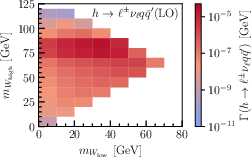
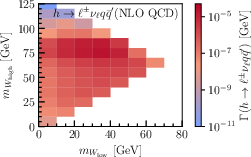
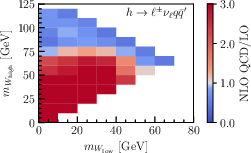
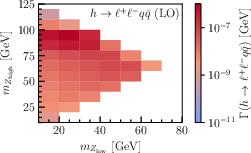
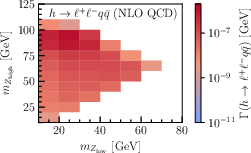
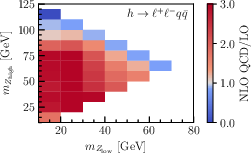
Figure 1: Differential decay distribution for h→ZZ∗8 showing the dependence of decay rate in the plane of hadronic and leptonic vector boson invariant masses.
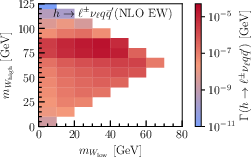
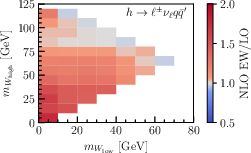
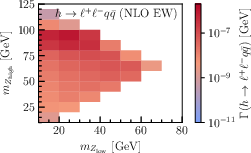
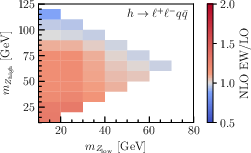
Figure 2: Decay distribution for h→ZZ∗9 at NLO EW as a function of reconstructed invariant masses, illustrating the regional impact of EW corrections.
Higher-Order Corrections: QCD and Electroweak Effects
QCD Corrections
NLO QCD corrections are found to induce modest, channel-dependent shifts in angular coefficients: typically at the percent level for h→WW∗0 semi-leptonic decays and up to several percent for h→WW∗1, especially when employing standard small-h→WW∗2 jet clustering. The use of larger jet radii (e.g., h→WW∗3) mitigates these effects by capturing more final state radiation and stabilizing the angular basis.
Corrections primarily deform the polarization coefficients associated with the hadronic vector boson, with negligible generation of higher-rank multipoles or multipoles that are forbidden at LO due to angular momentum and parity constraints.
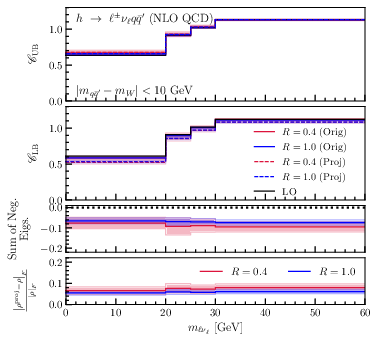
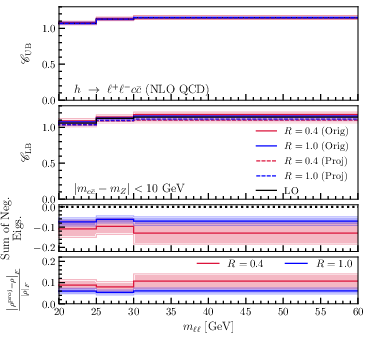
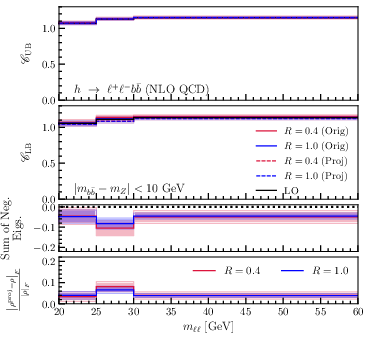
Figure 3: Differential decay distributions and the effect of NLO QCD corrections in the h→WW∗4 process.
Electroweak Corrections
NLO EW corrections pose a more significant challenge to the two-qutrit description, particularly due to box/pentagon and photon radiation topologies that do not align with the canonical h→WW∗5 resonance structure. Quantitatively, the impact is below h→WW∗6 in h→WW∗7-type decays and can reach h→WW∗8 in h→WW∗9-type, dependent primarily on the observable and the choice of kinematic phase space used for tomography.
Crucially, the h→VV∗→ℓ+ℓ−qqˉ0 angular coefficients in h→VV∗→ℓ+ℓ−qqˉ1 decays exhibit strong sensitivity to the radiatively-corrected weak mixing angle, as the spin analyzing power for leptonic h→VV∗→ℓ+ℓ−qqˉ2 decays experiences significant shifts. The effective mixing angle h→VV∗→ℓ+ℓ−qqˉ3 must be employed in the QT procedure for consistent mapping at NLO EW, otherwise systematic biases are introduced in the extracted density matrix.
Stability of Two-Qutrit Description and Physical Validity
While fully leptonic channels such as h→VV∗→ℓ+ℓ−qqˉ4 are susceptible to large two-qutrit-violating contributions at NLO EW, the semi-leptonic channels analyzed retain a stable density matrix structure, with projected and reconstructed matrices in close agreement throughout relevant kinematic regions. The magnitude of negative eigenvalues and the Frobenius norm separation between h→VV∗→ℓ+ℓ−qqˉ5 and its projected, physical counterpart remain at or below h→VV∗→ℓ+ℓ−qqˉ6, indicating the high fidelity of the QT reconstruction for these final states.
Implications for Experimental Quantum Tomography and New Physics Searches
The practical implications are twofold:
- Precision Benchmarking for Quantum State Reconstruction: The semi-leptonic h→VV∗→ℓ+ℓ−qqˉ7 channels, subject to suitable hadronic invariant mass cuts, provide theoretically robust benchmarks for quantum information analyses at the LHC, supporting extraction of polarization, correlation, and entanglement observables with controlled theoretical uncertainties.
- Sensitivity to New Physics: The entanglement structure encoded in the reconstructed density matrix and the angular coefficients is highly sensitive to deviations from Standard Model couplings and new operators in the Higgs sector, including CP violation and higher-dimensional SMEFT contributions. The methods outlined serve as a critical foundation for leveraging heavy boson decays as quantum probes in precision and BSM searches.
Future Directions
With the HL-LHC and prospective future colliders, the anticipated statistical power will facilitate differential and multi-dimensional studies of quantum observables in semi-leptonic Higgs decays. The systematic treatment of higher-order corrections and mass effects as detailed herein will enable model-independent constraints on fundamental interactions and potentially new symmetry structures or entanglement-related phenomena.
Looking ahead, this work motivates extensions toward:
- Differential tomography including flavor and charge tagging uncertainties;
- Tripartite and multipartite quantum information analyses for more complex final states;
- Automated inference engines incorporating theoretical uncertainties at the density matrix level for direct data-theory comparisons in experimental analyses.
Conclusion
This study establishes the semi-leptonic h→VV∗→ℓ+ℓ−qqˉ8 channels as a theoretically clean environment for the extraction of quantum information observables, with the two-qutrit paradigm remaining valid under higher-order corrections when appropriate kinematic regimes are imposed. The impact of finite fermion mass and radiative effects is quantified to percent accuracy, with explicit guidance provided for robust experimental implementation of quantum tomography and entanglement measurements. These results set the stage for future precision studies and the systematic use of quantum information tools in the characterization and discovery program of the Higgs sector.