- The paper introduces an automated framework for computing NNLO two-loop electroweak corrections at NLL accuracy, crucial for high-energy SM processes.
- It employs pseudo-counterterm techniques in amplitude generators to factorize and resum LL and NLL contributions with effective two-point vertices.
- The study quantifies significant impacts on LHC observables, with corrections reaching -35% at NLO and up to +6% at NNLO, influencing precision measurements and new physics searches.
Motivation and Background
The paper "Logarithmic EW corrections at two-loop" (2604.14320) addresses the calculation and implementation of next-to-next-to-leading order (NNLO) electroweak (EW) virtual corrections at next-to-leading logarithmic (NLL) accuracy. The focus is on automated and process-independent evaluation of logarithmic EW corrections for high-energy Standard Model processes involving massless fermions and transversely polarized vector bosons, a regime where large logarithms log(Q2/M2) (with Q≫MW,MZ) dominate radiative effects.
At leading order (LO), EW processes at large Q show little sensitivity to Sudakov logarithms. However, next-to-leading order (NLO) and NNLO corrections are enhanced by powers of these logs, reaching several tens of percent at NLO and several percent at NNLO in the tails of LHC observables. These corrections critically influence the interpretation of precision measurements and backgrounds for new physics searches.
Logarithmic Structure of EW Corrections
Radiative corrections at high energy can be expanded in towers of LL and NLL terms: (4πα)klogn(M2Q2),0≤n≤2k
with n=2k as LL and n=2k−1 as NLL. Double logarithms stem from both UV (renormalization group) and IR (soft/collinear emission) origins, allowing for universal factorization and resummation of logarithmic corrections.
Resummation is achieved either via the IREE method, which treats Q>M in a symmetric SU(2)⊗U(1) phase and Q<M in unbroken U(1)em, or via SCET, which organizes soft and collinear effects systematically. Both analytic (diagrammatic) and effective field theory approaches confirm exponentiation of LL and NLL terms.
Two-Loop Logarithmic Expansion: Factorization and Operators
The two-loop EW corrections are written as: Q≫MW,MZ0
where Q≫MW,MZ1 is angular-independent and Q≫MW,MZ2 is angular-dependent.
The angular-independent NLL resummation generates Sudakov form factors for each external leg, exponentiating LL and NLL corrections. Angular-dependent NLL terms arise from wide-angle soft emission between external legs and require non-trivial operators in Q≫MW,MZ3 space.
Implementation in Amplitude Generators: OpenLoops
The translation of analytic results into efficient computational tools is realized via pseudo-counterterm techniques, where the insertion of effective two-point vertices on external lines automates the evaluation of Q≫MW,MZ4-flipped Born amplitudes needed for both LL and NLL corrections.
Two-loop diagrams, after Ward identity cancellations, reduce to compact expressions involving products of one-loop Sudakov-type integrals and Q≫MW,MZ5-function coefficients. This enables a factorized implementation with three classes of topologies—insertions on two, three, or four external legs—using pseudo-counterterms.
Validation against analytic results for representative processes confirms exact agreement at amplitude-squared level for all logarithmic orders, including angular-independent and angular-dependent terms.
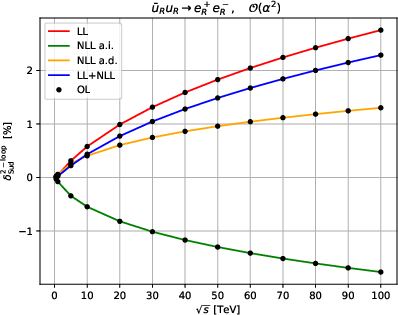
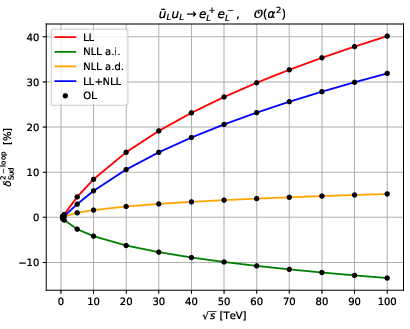
Figure 1: Energy scan for Q≫MW,MZ6 and Q≫MW,MZ7, showing the decomposition and magnitude of two-loop EW corrections.
Numerical Results for LHC Observables
The authors provide a survey of NNLO EW corrections in key LHC processes, comparing one-loop and two-loop contributions for Q≫MW,MZ8jets, Q≫MW,MZ9jets, and Q0 production. Maximum EW corrections reach Q1 at NLO and up to Q2--Q3 at NNLO for transverse-momentum distributions in the TeV regime.
The analysis demonstrates a clear hierarchy in logarithmic terms: LL corrections dominate two-loop EW effects in inclusive transverse momentum distributions, while NLL corrections remain subleading (a factor five smaller). However, for observables violating LA (logarithmic approximation), such as invariant mass distributions with separated scales, angular-dependent NLL terms can overshoot the LL, leading to negative total two-loop corrections as large as Q4 in the tails.
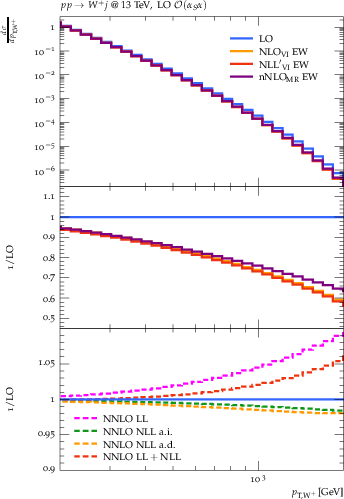
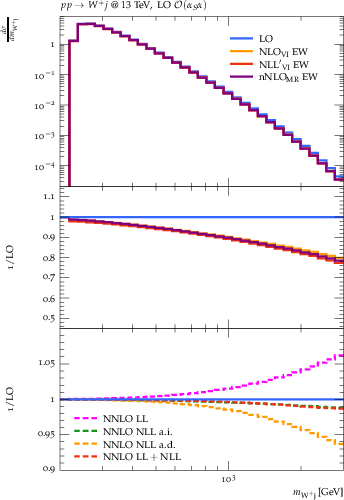
Figure 2: Differential distributions in Q5 for Q6 jet processes, illustrating the relative size of one- and two-loop logarithmic EW corrections.
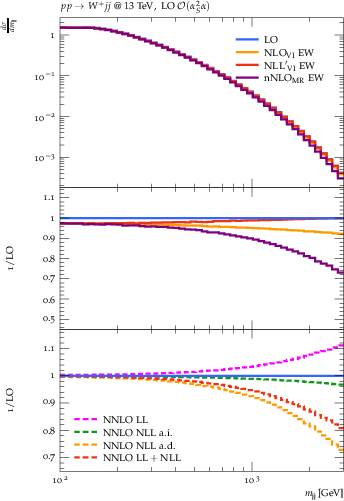
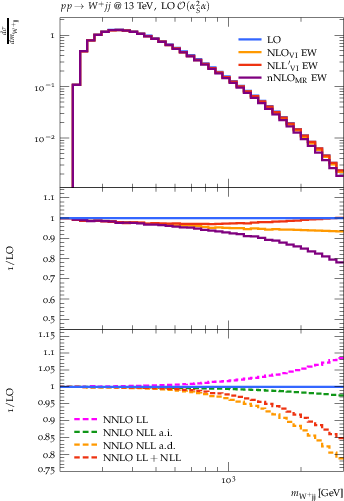
Figure 3: Two-loop EW corrections to di-jet invariant mass distributions, with breakdown of LL and NLL angular-dependent contributions.
Theoretical and Practical Implications
The process-independent and automated implementation of two-loop EW logarithms streamlines the inclusion of precision EW effects in collider phenomenology, significantly reducing theoretical uncertainties from missing higher-order terms. Accurate treatment of Sudakov logarithms is necessary for extracting signals in high-Q7 regions and for assessing backgrounds in new physics searches at current and future colliders.
For processes and observables where all kinematic invariants are of similar scale, the LA—and therefore the log hierarchy—is reliable. However, observables sensitive to forward or unbalanced configurations (e.g., large invariant mass with soft components) require careful treatment as angular-dependent NLL terms can violate the anticipated hierarchy.
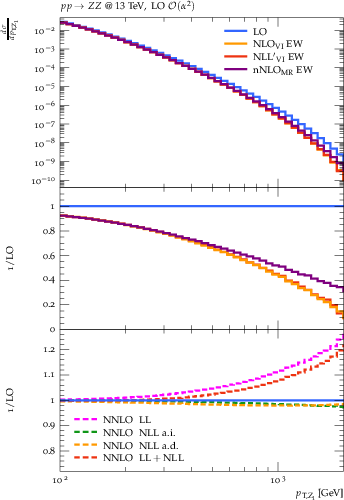
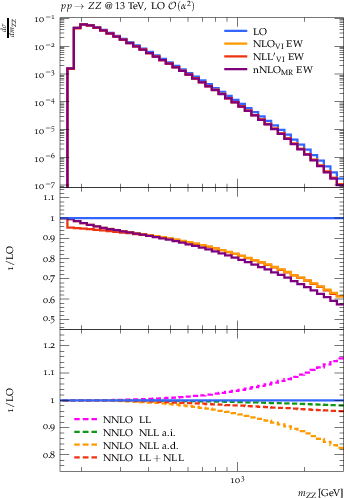
Figure 4: Transverse momentum distributions for Q8, contrasting the dominance of LL in Q9 versus the compensation by NLL in (4πα)klogn(M2Q2),0≤n≤2k0.
Future Directions
The presented implementation supports massless fermions and transversely polarized gauge bosons. Extending the framework to include longitudinal vector bosons, massive external fermions, and scalars will demand careful handling of symmetry breaking, Goldstone equivalence, and additional mixing effects. Further uncertainty quantification is advisable for exclusive LHC observables and QCD+EW matching.
Automation facilitates the study of two-loop EW Sudakov logarithms in exclusive Monte Carlo simulations. As energy scales at colliders rise, the relevance of two-loop EW effects will increase, making such systematic and general tools indispensable for both SM precision and BSM searches.
Conclusion
The paper provides a comprehensive framework for the inclusion of two-loop EW logarithmic corrections at NLL accuracy in amplitude generators. The analytic and computational approach is validated against the literature and enables practical evaluation of these corrections in a wide array of phenomenological applications. Two-loop EW corrections at LL+NLL are several percent in the high-(4πα)klogn(M2Q2),0≤n≤2k1 regime, essential for precision studies at the LHC and future colliders. The methodology establishes a new standard for the systematic treatment of high-order EW effects in exclusive observables, with expected extensions covering longitudinal modes and massive particles in subsequent work.