- The paper demonstrates that the phase structure of the Hartle–Hawking wave function in AdS and dS depends critically on whether boundary conditions are fully gravitational (dynamical) or partially frozen.
- The paper employs semiclassical minisuperspace reductions in AdS3 and analytic techniques in AdS2 JT gravity to reveal saddle point transitions and complex phase behavior linked to boundary geometry.
- The paper links the fully gravitational and partially frozen prescriptions to the quantum cosmology phase problem, suggesting that partial freezing may yield physically interpretable, positive-definite norms.
Introduction and Conceptual Framework
This work, "A Tale of Two Hartle–Hawking Wave Functions: Fully Gravitational vs Partially Frozen" (2605.13970), provides a detailed comparative analysis of two different generalizations of the Hartle–Hawking (HH) wave function for quantum gravity in asymptotically AdS spaces. The key motivation is the recognition that, unlike in de Sitter space, generic spatial slices in AdS are open rather than closed, which fundamentally alters the gravitational path integral (GPI) prescription for constructing cosmological wave functions.
The central observation is that for open spatial slices, each Euclidean "history" must terminate not only on a prescribed spatial slice Σ, but also on an additional spacetime boundary component whose geometry may either be fixed (as in Dirichlet/AdS/CFT protocols), or integrated over (restoring full gravitational dynamics at the boundary). This distinction leads to two inequivalent definitions:
- Fully gravitational HH wave function: the boundary is dynamical; the GPI integrates over both bulk geometries and boundary configurations.
- Partially frozen HH wave function: the boundary geometry is fixed; this is the standard prescription connected to AdS/CFT.
The difference is schematically depicted in the figure below, which is essential for understanding the topological and functional distinctions in the GPI approach.
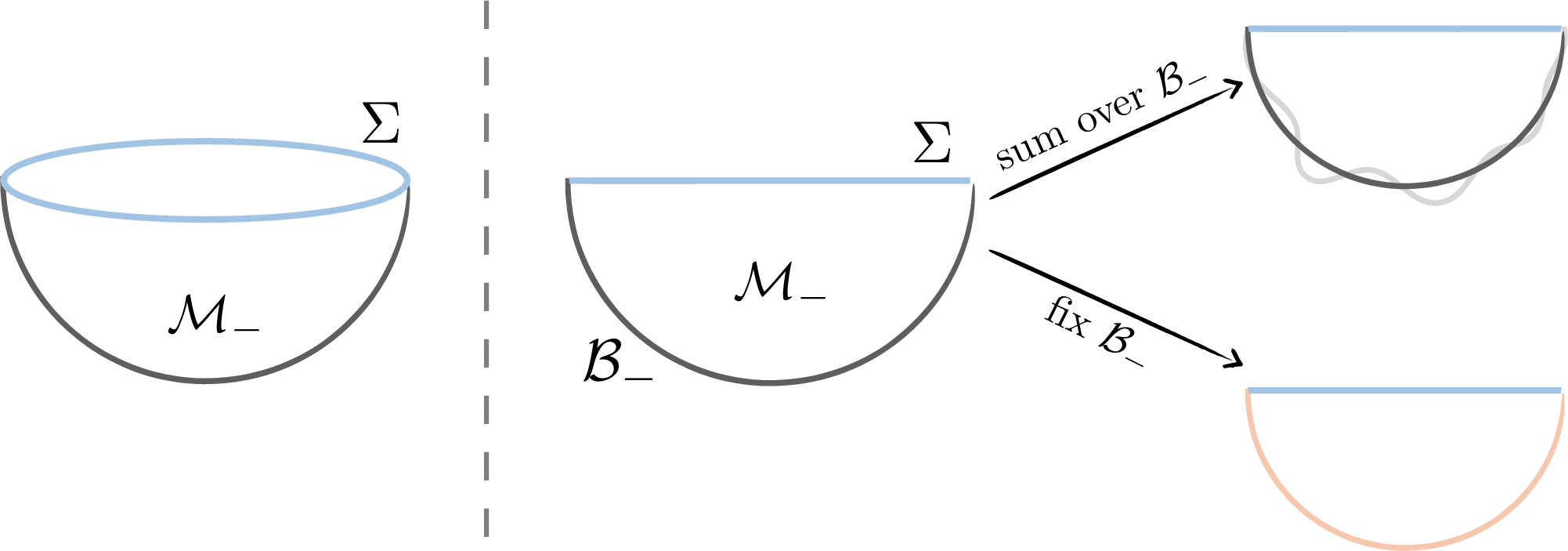
Figure 1: Schematic of the two HH prescriptions: fixed-boundary (right) vs. dynamical boundary (left) for open spatial slices in AdS, with the spatial slice Σ (blue) and boundary component B− (grey).
Minisuperspace Analysis in AdS3 Gravity
The paper first addresses the fully gravitational version in AdS3 Einstein gravity using a minisuperspace reduction, whereby the spatial slice Σ is taken as a hyperbolic disk characterized by its area A and boundary length L. The calculation proceeds by evaluating the semi-classical GPI over compact Euclidean 3-manifolds bounded by Σ and a compact dynamical boundary B− with tension T>1.
Key features:
- The on-shell boundary B− is always a sphere equidistant from the origin in H3, with its position fixed by solving a Neumann-type boundary condition that arises from varying the full action, including appropriate corner (Hayward) terms.
- For fixed B−0, there generically exist up to four saddle points, differing by their covering of the B−1 boundary and the sign of the extrinsic curvature.
The explicit geometry and saddle structure are illustrated:
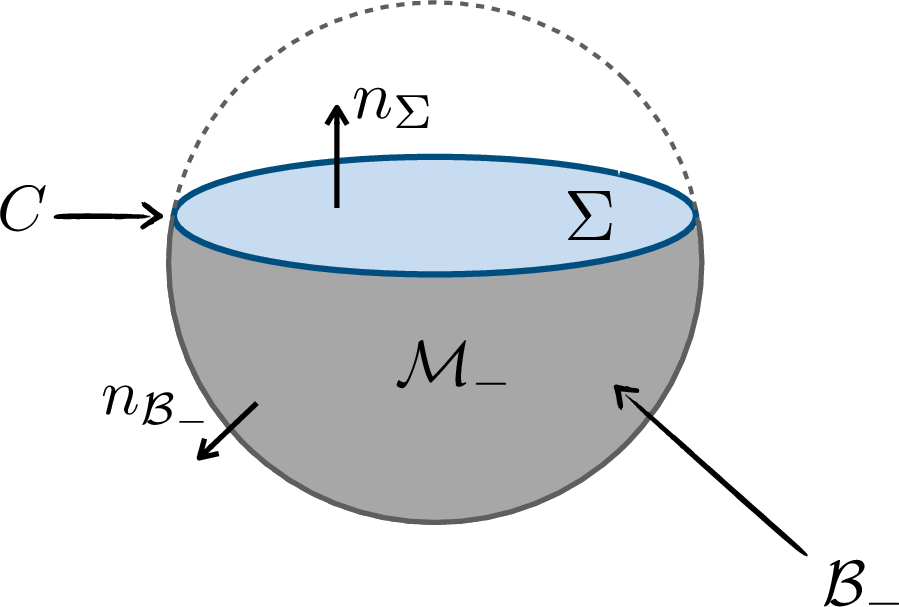
Figure 2: Geometric setup of the GPI in AdSB−2: Σ (light blue) is fixed, B−3 (gray) is dynamical. Corner B−4 (dark blue) is their intersection.
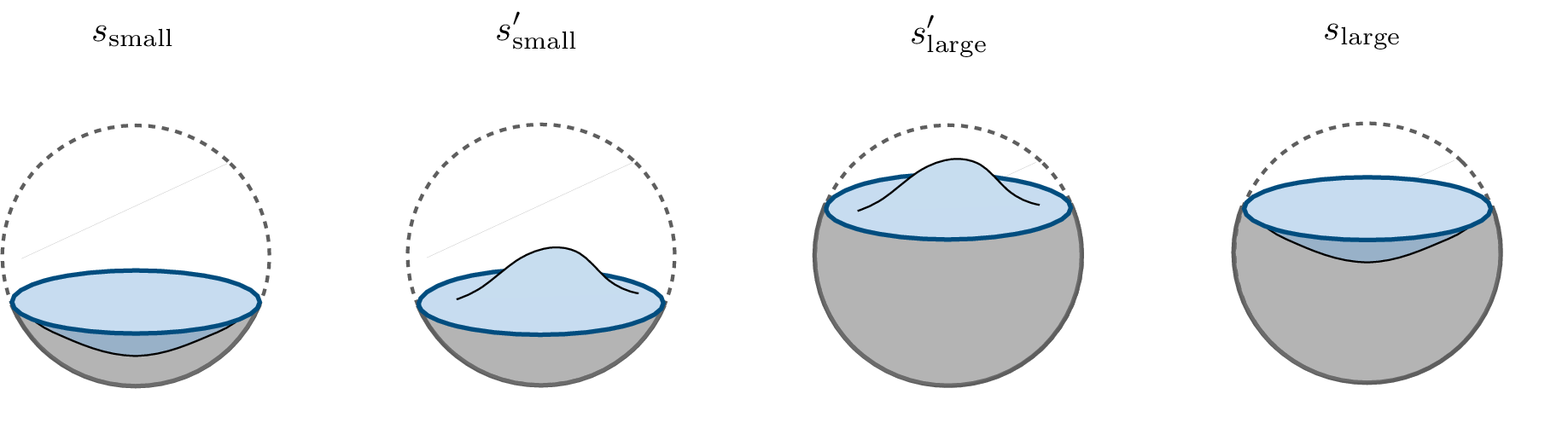
Figure 3: The four possible saddle configurations for fixed Σ and B−5.
Of crucial technical importance is the identification of a "critical length" B−6 for the intersection B−7, beyond which saddles become complex and the dominant contribution involves a Lorentzian segment glued to a Euclidean cap, mirroring analogous findings in dS wave function studies.
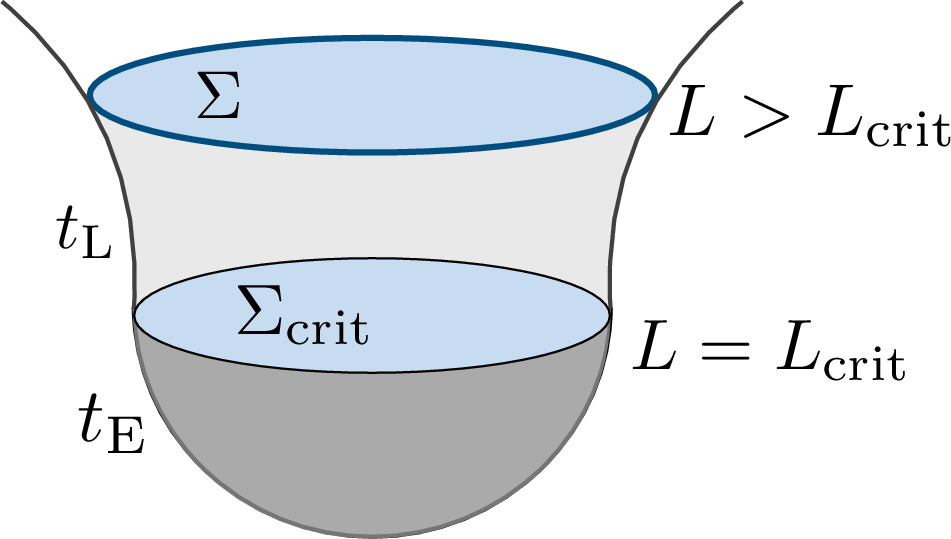
Figure 4: For B−8, the boundary saddle becomes complex, necessitating analytic continuation and gluing between Euclidean and Lorentzian geometries.
The semi-classical action for the dominant saddle and its dependence on B−9 are computed explicitly, revealing that the probability distribution for the geometry peaks sharply at 30, with the value agreeing with expectations from the normalization of the full state.
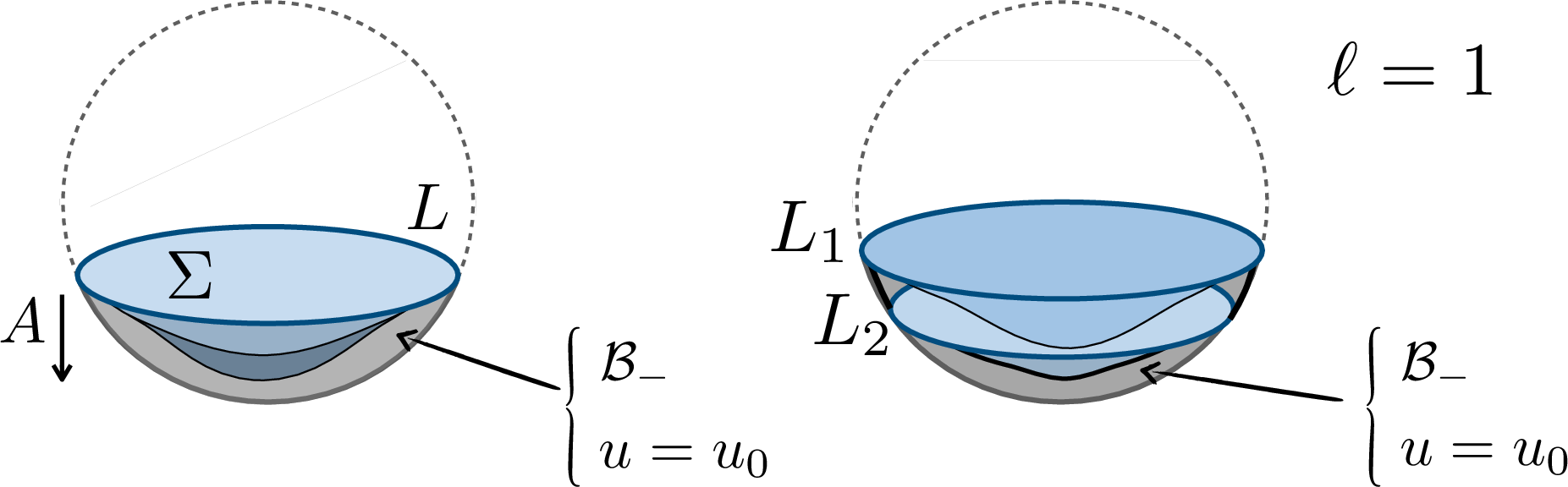
Figure 5: Visualization of hyperbolic ball slicing and the resultant HH wave function in AdS31 as functions of parameters 32 and 33.
Fully Gravitational Hartle–Hawking Wave Function in AdS34 JT Gravity
The study is paralleled in AdS35 Jackiw-Teitelboim gravity, where the analogous path integral involves integration over both the bulk metric and dilaton, bounded by a spatial slice Σ (generally a curve of constant extrinsic curvature 36) and a compact dynamical brane.
For geodesic spatial slices (39), the explicit form of the dilaton field and the semiclassical action admit analytic expressions. Notably, as in the AdS30 analysis, there exists a critical length 31 for the spatial slice, with the wave function again peaking sharply at this critical value.
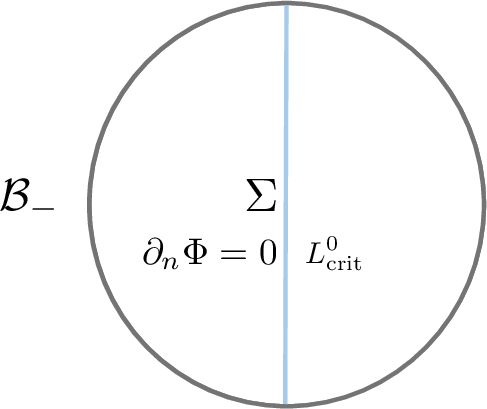
Figure 7: HH wave function at the 32-saddle, peaking for 33.
For generic 34, active numerics are required; still, the semi-classical structure is qualitatively preserved (Figure 8 depicts the relevant curves).
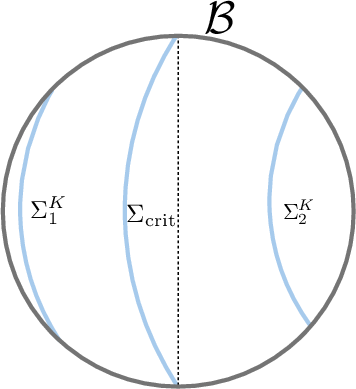
Figure 8: For generic 35, two spatial slices with the same 36, merging at the critical slice 37.
One-Loop Structure and the Norm: Phase Problem and Boundary Conditions
A primary technical goal is the computation of the norm of the HH wave function, realized as the partition function on a hyperbolic ball (38) in AdS with fluctuating (dynamical) boundary geometry.
- For dynamical boundaries (Neumann-like conditions), the one-loop effective action contains 39 negative modes, yielding a phase in the norm:
A0
as derived via explicit linearized analysis of boundary graviton modes.
- For fixed boundaries (standard Dirichlet/AdS/CFT), the norm is strictly positive:
A1
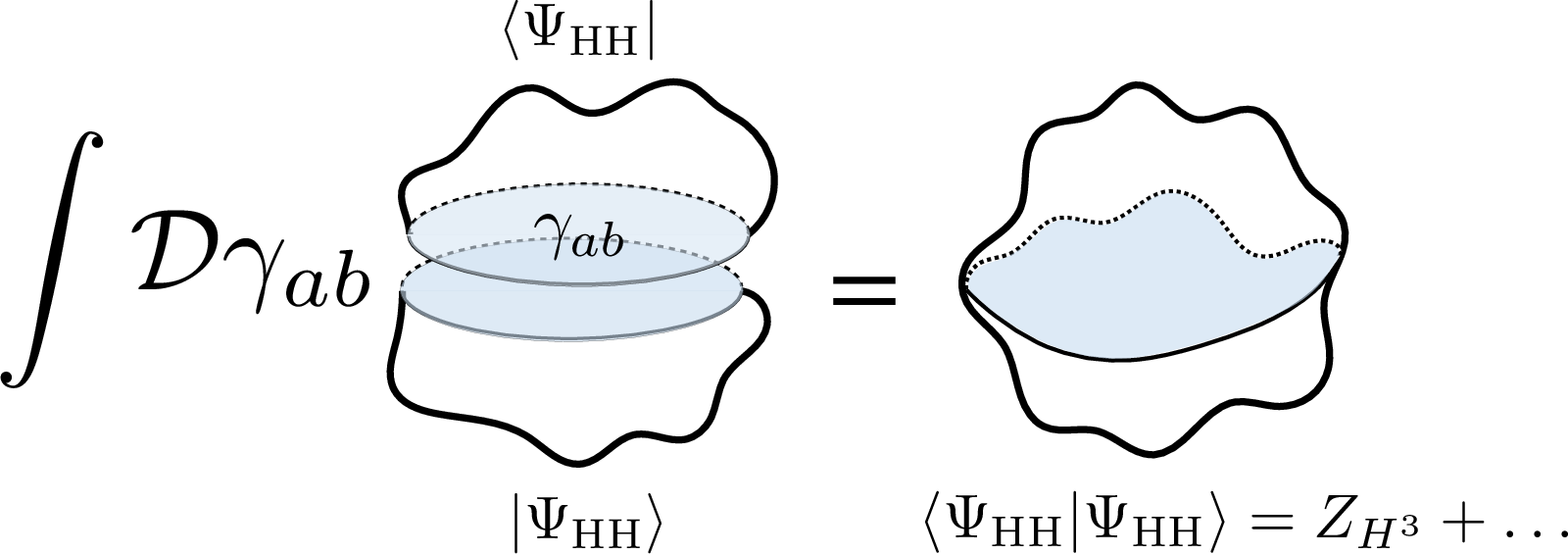
Figure 9: Norm of the HH wave function realized as the partition function on A2 with free (Neumann) boundary conditions.
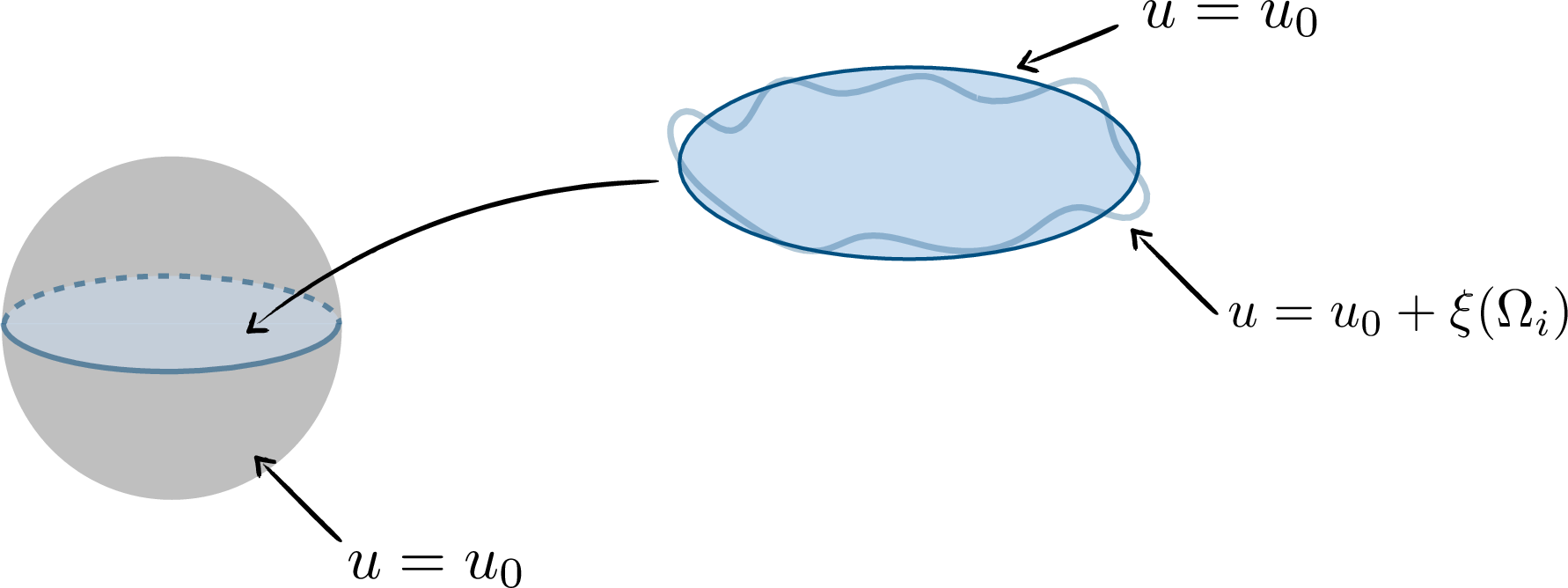
Figure 10: Schematic of boundary metric perturbations relevant for the one-loop effective action.
This nontrivial phase in the fully gravitational case tracks the longstanding "phase problem" observed in the dS context for the sphere partition function.
Analogue Analysis in dS: Partially Frozen Sphere Partition Function
Motivated by the AdS analysis, the work explores a partially frozen treatment in dS: evaluating the partition function on A3 with the metric fixed on an equator (codimension-1 surface A4).
- For the fully gravitational dS case, the one-loop determinant over the sphere yields a phase proportional to A5, conflicting with positive-norm interpretations.
- For the partially frozen path integral with a fixed-equator, the negative modes are projected out except for one A6 mode for each hemisphere, so when the two hemispheres are glued with consistent time orientation, the phases cancel and a real, positive result for the norm is obtained.
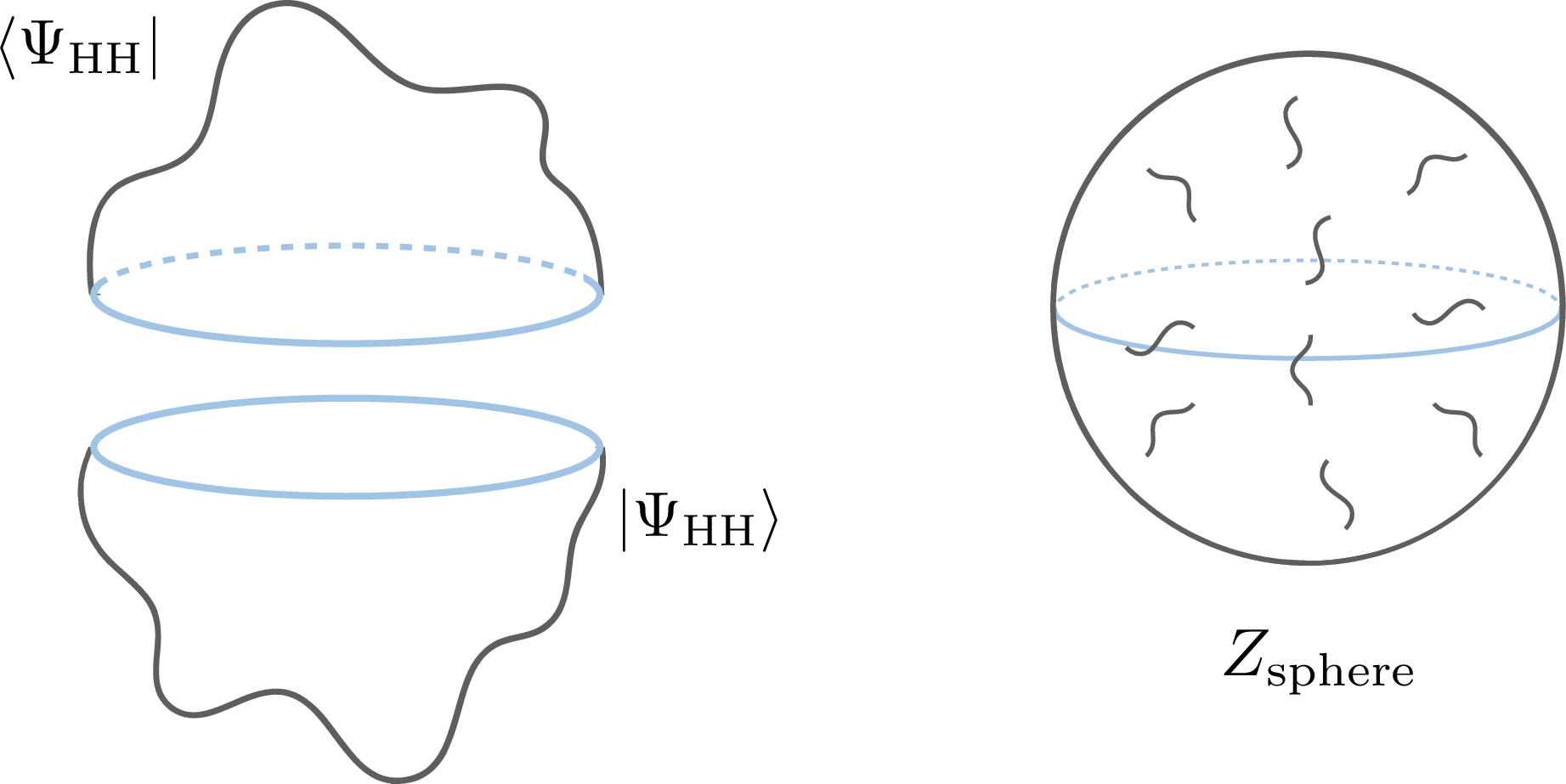
Figure 11: In the fully gravitational GPI, the sphere partition function has a nontrivial phase arising from the one-loop correction.
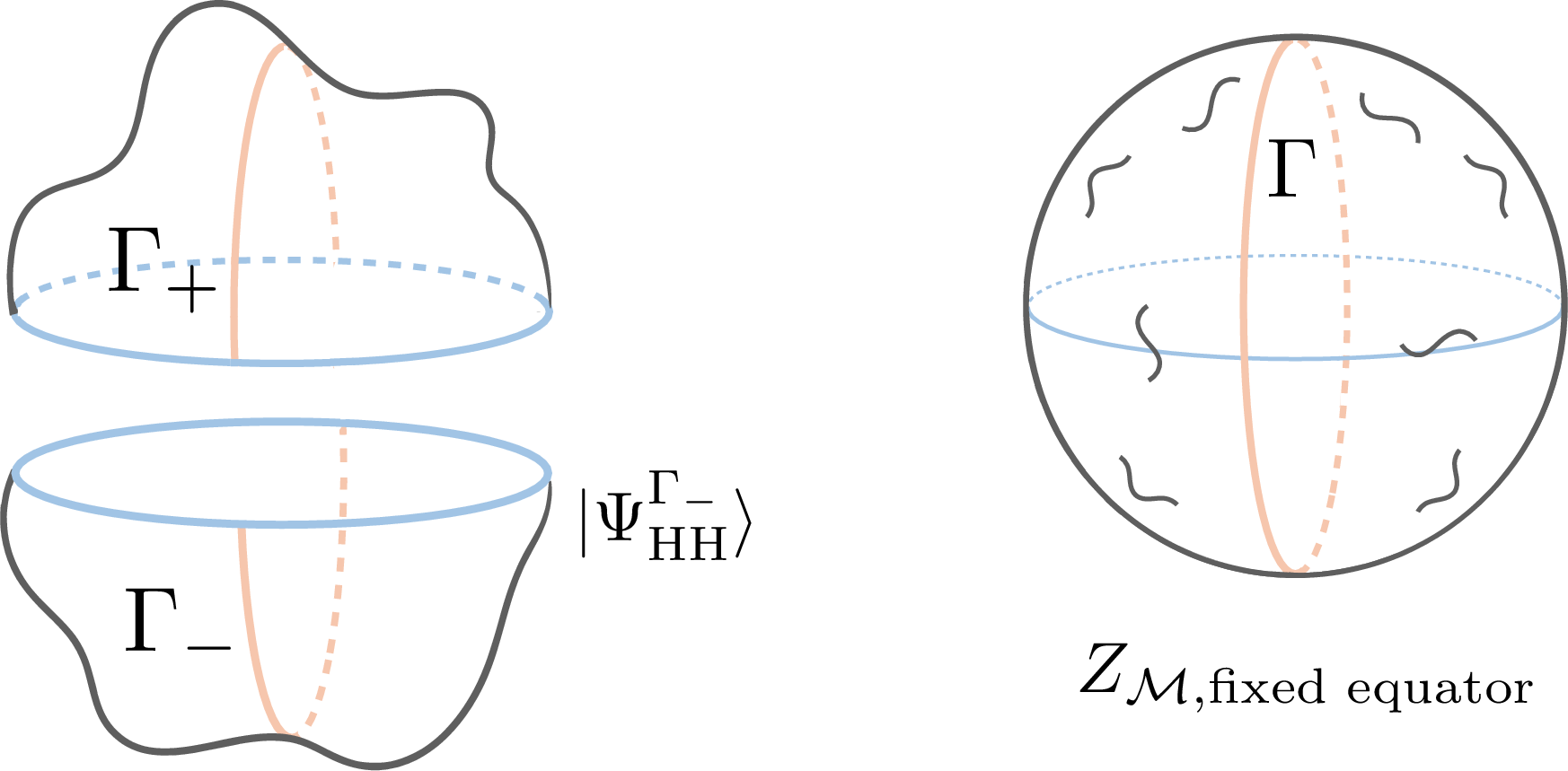
Figure 12: Partially frozen sphere partition function in dS with a fixed equator, resulting in cancellation of the problematic phase.
Theoretical and Practical Implications
The primary theoretical conclusion is that the phase structure in the norm of the HH wave function is controlled not by the sign of the cosmological constant, but directly by whether the GPI is "fully gravitational" (integrating over all boundary data) or "partially frozen" (fixing some spatial or spacetime regions). The AdS/CFT correspondence strongly favors the partially frozen prescription for AdS—yielding positive, physically interpretable results.
Conversely, in dS, the fully gravitational prescription universally propagates the phase problem, but partially freezing appropriate subregions (e.g., the equator) leads to a cancellation of nontrivial phases at one-loop, suggesting a route for constructing well-defined bulk quantum gravitational Hilbert spaces and norm computations even absent a complete holographic dictionary.
This distinction, especially in the context of the general role of reflection positivity, boundary conditions, and the breaking of time reparametrization invariance, could prove pivotal for future non-perturbative constructions of quantum gravity in cosmological settings.
Conclusion
This paper rigorously establishes that the presence or absence of a nontrivial phase in the norm of the HH wave function—both for AdS and dS—crucially depends on whether boundary geometries are fully dynamical or partially frozen. The AdS analyses, corroborated by detailed semiclassical and one-loop computations, make manifest the parallel with dS cosmology and clarify the nature of the so-called phase problem. These findings suggest that physical, positive-definite wave functions in quantum gravity may generically require partial freezing of spacetime data, with significant implications for attempts to define cosmological measures and quantum gravitational inner products via path integrals.
The explicit connection between boundary conditions, negative modes, and the structure of quantum states in gravitational path integrals established here will inform future research on holography in non-AdS spacetimes, observer-dependent Hilbert space definitions, and the deeper structure of quantum cosmological measures.