- The paper presents a rigorous analysis of one-loop infrared divergences in ℝ×S³ complex metrics using Picard-Lefschetz theory and Hurwitz-Zeta regularization.
- It demonstrates that exponential parametrization leads to simplified, strictly linear boundary conditions, streamlining the one-loop path-integral computations.
- The study reveals that IR divergences persist universally across both Hartle-Hawking and Lorentzian de Sitter saddles, highlighting robust secular growth.
One-Loop Infrared Behavior of Complex R×S3 Saddles in Lorentzian Quantum Gravity
Overview
This essay provides a technical summary of "IR behaviour of one-loop complex R×S3 saddles" (2604.21736), which analyzes the gravitational path-integral for R×S3 complex metrics in four-dimensional Einstein-Hilbert gravity, with a focus on IR properties of complex semiclassical saddles under various boundary conditions. The study rigorously treats fluctuations, boundary constraints from covariance, and both analytic and numerical aspects of one-loop determinants.
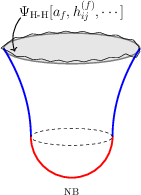
Figure 1: The Hartle-Hawking (H-H) no-boundary wave function ΨH−H, with small metric fluctuations on the final hypersurface.
Boundary Condition Constraints and Parametrization
General covariance imposes stringent restrictions on permissible boundary conditions for both the background metric and spatial fluctuations. The paper introduces a comprehensive analysis using the ADM decomposition, exploring two final boundary scenarios: (1) Dirichlet and (2) fixed extrinsic curvature. Enforcing the no-boundary initial condition, boundary choices for metric fluctuations are dictated by background constraints. A key technical result is that exponential parametrization (ε=1) yields simpler, strictly linear boundary conditions for fluctuations, significantly streamlining one-loop path-integral computations compared to the more generic linear split (ε=0).
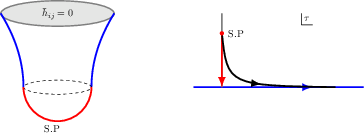
Figure 2: Diagram of background no-boundary universe, highlighting the saddle geometry in the complex time plane.
Semiclassical Saddle Analysis
The Universe transitions from Euclidean to Lorentzian phases; dominant Euclidean saddles correspond to purely imaginary time metrics, whereas Lorentzian evolution is mediated by a superposition of two complex saddle metrics. The allowed saddles are classified using Picard-Lefschetz (PL) theory, with explicit checks of their KSW-allowability to ensure path-integral convergence and physical legitimacy.
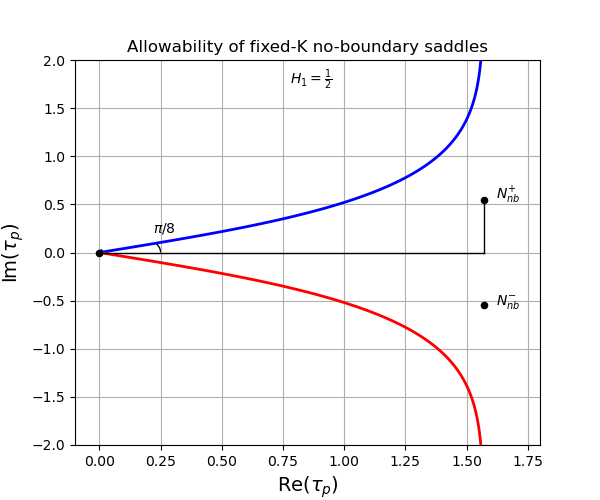
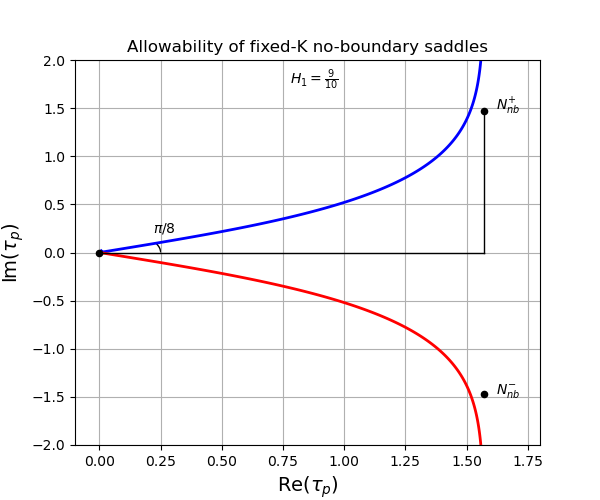
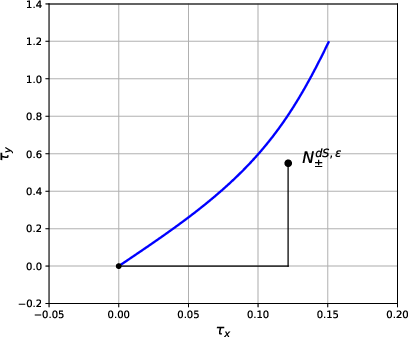
Figure 3: KSW allowability plots for no-boundary saddles at varying H1<H, demonstrating the available time path below the extremal curve for all H1.
The Picard-Lefschetz method is combined with a supplementary i-prescription (complexifying the cosmological constant) to resolve technical obstacles in the one-loop computation, particularly in the Lorentzian regime.
One-Loop Determinant, UV Renormalization, and Zeta Regularization
The path-integral is evaluated up to one loop using Hurwitz-Zeta regularization. UV divergences from the metric-fluctuation sector are extracted and canceled by analytically derived counterterms. The resultant one-loop renormalized lapse action is employed to construct the Hartle-Hawking wavefunction.
A salient numerical result is that the one-loop fluctuation determinant demonstrates secularly growing IR divergences as the Universe expands, scaling with spatial volume in the asymptotic regime. This phenomenon is quantitatively analyzed via zeta-regularized infinite sums and Hurwitz-Zeta function techniques, giving the explicit structure of leading and subleading terms in both fixed size and fixed extrinsic curvature boundary cases.
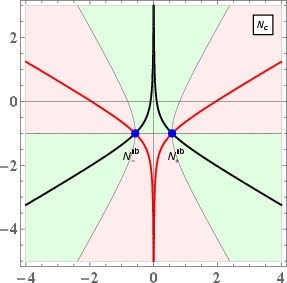
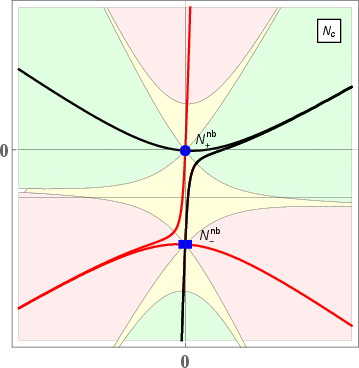
Figure 4: PL plots for saddles in Lorentzian (H1<H) and Euclidean (R×S30) regimes, using complexified Newton's constant to resolve Stokes degeneracy.
Comparative Analysis with Lorentzian de Sitter
The paper benchmarks the Hartle-Hawking no-boundary results against pure Lorentzian de Sitter (dS) wavefunctions, computed with initial vanishing conjugate momenta and fixed extrinsic curvature on the final hypersurface (real saddles). Picard-Lefschetz contours with R×S31-prescription are found necessary to resolve pinch singularities in the functional determinant at real dS saddles. Crucially, the UV-renormalized one-loop dS wavefunction shares the same leading IR divergence as the Hartle-Hawking universe, indicating the IR pathology is not a boundary artifact and is robust to saddle selection.
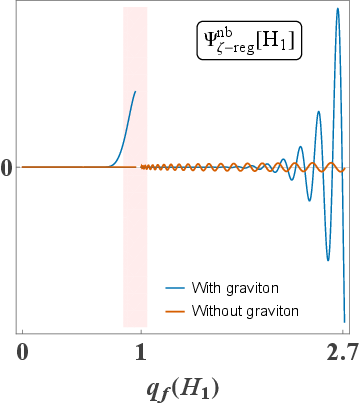
Figure 5: Plot of R×S32 showing increasing amplitude as R×S33, dominated by one-loop gravity fluctuation growth.
KSW Allowability and Physical Implications
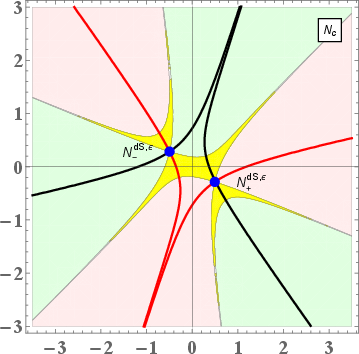
Analysis via the KSW (Kontsevich-Segal-Witten) criterion confirms that all considered saddles—complex no-boundary and complexified dS—remain within the physically allowable domain for all boundary choices, including nonlinear conformal boundary conditions. The allowable region is demonstrated visually and algebraically for a wide range of parameters.
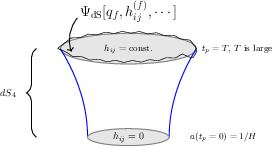
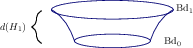
Figure 6: Saddle geometry of expanding real de Sitter (R×S34): from throat at R×S35 to large R×S36, with initial surface fluctuation vanishing.
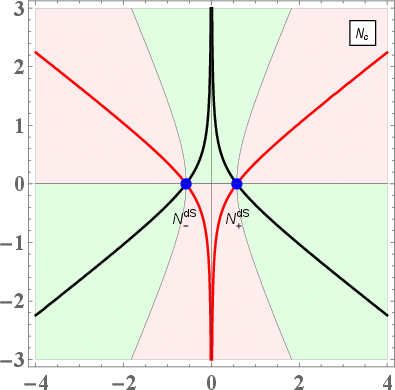
Figure 7: Picard-Lefschetz analysis for real de Sitter, showing relevant saddles lying on the integration contour.
IR Divergence: Quantitative Results
Strong quantitative findings include:
Future Directions
The study opens several technical avenues for further exploration:
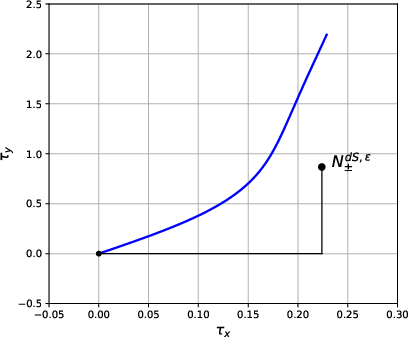
Figure 10: KSW allowability plots for complex de Sitter saddles under various parameters: saddles remain below extremal curve and are allowable.
Conclusion
This paper delivers a rigorous treatment of the gravitational path-integral over R×S39 complex metrics and fluctuations in Lorentzian quantum gravity. It establishes, through careful boundary analysis, covariance, and one-loop techniques, that secular IR divergences in the wavefunction are inherent and boundary-condition-independent for both Hartle-Hawking and Lorentzian de Sitter universes. Technical tools including Picard-Lefschetz, Hurwitz-zeta regularization, and KSW analysis are used to provide explicit, numerically precise descriptions of these phenomena. The work has broader implications in cosmological quantum gravity, particularly regarding the robustness of IR divergences and the sensitivity of physical wavefunctions to the choice of fluctuation parametrization and boundary constraints.
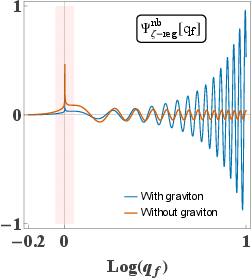
Figure 11: R×S30 evaluated as a function of R×S31, illustrating IR divergence and matching one-loop dominance in both Hartle-Hawking and de Sitter cases.