- The paper demonstrates a precise holographic mapping between the DSSYK soft mode and 3D near-de Sitter gravity through Israel junction conditions.
- The methodology translates the one-dimensional DSSYK effective action into a dual 2D de Sitter slice embedded in global dS3, matching boundary correlators.
- It reveals implications for two-time holography and non-AdS dualities, offering insights into finite temperature effects and shockwave geometries.
Dual Gravity Description of the DSSYK Soft Mode in 3D Near-de Sitter Gravity
Introduction and Motivation
This paper establishes a holographic correspondence between the complex soft mode ψ(u) governing the double-scaled Sachdev-Ye-Kitaev (DSSYK) model under time-dependent Maldacena-Qi (MQ) coupling and a gravitational system described by 2+1-dimensional Einstein-de Sitter (dS3) gravity. The construction translates the effective one-dimensional DSSYK action, which generalizes Schwarzian quantum mechanics, into a dual description involving a 2D de Sitter slice Σ embedded in global dS3, with all dynamics localized on this surface. The mapping is precise: the soft mode equations of motion match Israel junction conditions on Σ, and the boundary correlators in DSSYK correspond to geodesic/boundary-to-boundary correlators in dS3, up to squaring.
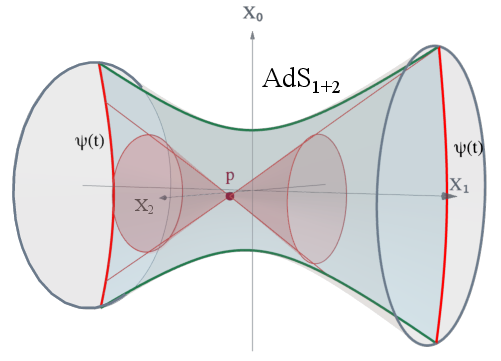
Figure 1: Schematic depiction of the AdS1+2 holographic perspective with two time directions. The ψ(t) mode traces a 1D path on the 2D boundary of the emergent 3D geometry, with the gluing surface Σ spanning between.
Soft Mode Effective Theory in DSSYK
At large N and 30, with 31 and energies rescaled as 32, the non-linear dynamics are captured by a complex reparametrization mode 33. The effective action
34
with Hamiltonian (for time-dependent 35 and MQ coupling 36):
37
38 and 39 are canonically conjugate via Σ0. Semi-classical trajectories of Σ1 are given by Hamilton's equations, with Σ2 determined from Σ3 as
Σ4
The observable two-point function is
Σ5
Holographic Duality: dSΣ6 Gravity and the Soft Mode
The central proposal is that the dynamical variable Σ7 corresponds to the embedding of a codimension-one dSΣ8 hypersurface Σ9 in global dS30. All non-trivial gravity dynamics are thus supported on this surface, which acts as the non-linear dynamical screen for the 3D bulk. Specifically, the equations of motion for the soft mode are shown to be equivalent to Israel junction conditions across 31 in dS32:
33
Here, 34 is directly sourced by the boundary MQ coupling 35.
The reduced 1D effective action for 36 is derived via explicit evaluation of all gravitational and boundary (Gibbons-Hawking-York, Hayward corner) terms in the dS37 Einstein-Hilbert action, imposing 38 conformal (hyperbolic slicing) boundary conditions at 39. The resulting action exactly matches the SYK effective action, identifying Σ0.
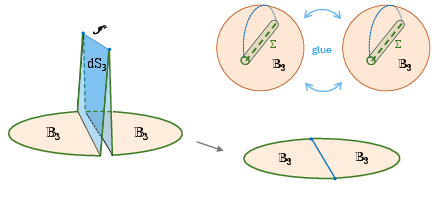
Figure 2: Schematic depiction of the standard Euclidean gravity path integral for Schwarzschild-de Sitter; overlaps of Hartle-Hawking wave functions produce the relevant glued geometry.
Geometry: Thermal and Shockwave Solutions
For special symmetric solutions, the dual geometries admit transparent interpretation:
- Thermal Solutions: The soft mode solution at inverse temperature Σ1 maps onto a Schwarzschild-dSΣ2 (SdSΣ3) with conical deficit angle Σ4 at the poles, controlled by the DSSYK parameter Σ5. Deficit angle–energy–entropy relations are explicitly matched.
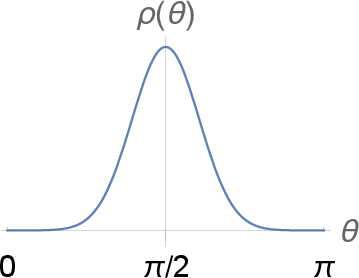
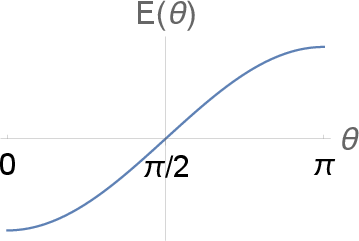
Figure 3: The DSSYK spectral density and energy parametrized by Σ6. Positive and negative temperature regimes correspond to different monotonicity of density with energy.
- Delta Function Source: A shockwave in the coupling Σ7 creates a local conical defect on Σ8. The orientation of the conical wedge determines which region of the dSΣ9 spacetime is identified as physical/removable.
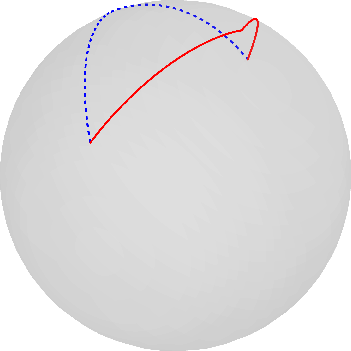
Figure 4: The gluing surfaces 30 and 31 for a shockwave with 32, exhibiting the creation of a localized conical defect.
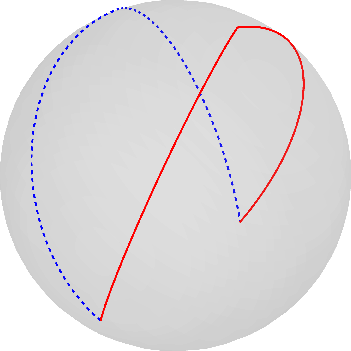
Figure 5: The gluing surfaces 33 and 34 with 35, leading to distinct spacetime identifications.
- Constant 36: Cutting the spatial sphere at fixed 37 corresponds in the boundary model to 38 with constant imaginary part and leads to geometry with disconnected trajectories, further confirming the dictionary.
Spectral Density and Entropy
The path-integral evaluation of microcanonical entropy in the 1D theory, via the phase-space integral 39, reproduces the exact spectral density and entropy formula
1+20
as opposed to the standard Gibbons-Hawking entropy expression for dS1+21. The difference is traced to the 1+22 conformal boundary conditions, and is manifested as extra contour contributions (Figure 6).
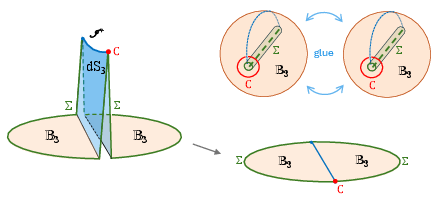
Figure 6: The Euclidean path integral for near-dS1+23 gravity, with gluing of Hartle-Hawking wavefunctions via 1+24 conformal boundary conditions; semiclassical entropy follows from contributions to the Hayward and bulk action.
Holographic Two-Point Functions
A central result is the identification of the boundary-to-boundary Green function in dS1+25 with the square modulus of the DSSYK two-point function (the gravity result corresponds to combining both the right and left soft mode sectors):
1+26
with geodesic distance
1+27
This identification of the dS propagator with the modulus squared of the chiral DSSYK correlator reflects the necessity to combine both “left” and “right” copies (chiral and anti-chiral), analogous to how full CFT correlators assemble from products of chiral blocks.
Signature Ambiguity and Two-Time Perspective
There exists a structural ambiguity: the emergent 3D geometry may be viewed either as a dS1+28 (with one time, two space) or as AdS1+29 (two time, one space), as the signature can be flipped by redefining the roles of ψ(t)0 and the holographic direction. In both cases, the soft mode action and its equation of motion are unchanged, but the physical interpretation of boundary locality and operator ordering changes. This points towards "two-time physics" perspectives for holography, and could influence bulk causality constructs.
Theoretical and Practical Implications
The proposal demonstrates that:
- A 1D quantum mechanical model (DSSYK) with specific couplings encodes the gravitational dynamics of 3D (near-)de Sitter gravity, expanding the scope of holography and non-AdS dualities.
- The mapping works for all energies, not just near the Schwarzian/AdSψ(t)1 limit, by a well-controlled non-linear generalization.
- The soft mode “gravitational” dynamics is made explicit via the matching of effective actions and equations of motion.
- The full boundary-to-boundary propagators in the bulk receive contributions from both chiral sectors, with important implications for the structure of quantum state spaces, operator algebra (including non-trivial braiding/commutation), and the emergence of time in holography.
Potential extensions involve the incorporation of finite ψ(t)2 (i.e., ψ(t)3) corrections, generalization to finite temperature/energy configurations, and investigation of the precise operator and bulk locality structure for higher-point functions or out-of-time-order correlators. There are possible ties with quantum group/6j-symbol algebraic structures and connections to dynamical gravity in both de Sitter and AdS signatures.
Speculations and Future Directions
- The construction enables the study of quantum gravity in de Sitter backgrounds using solvable boundary models, with applications to cosmology and quantum information in expanding universes.
- The observed necessity to square modulus the chiral boundary correlator, as imposed by the bulk gravitational path integral, may indicate a universal feature of de Sitter-like holography: the emergence of the so-called "modular square" structure at the boundary.
- The mathematical equivalence between the double scaling limit of SYK and quantum group symmetries observed in both boundary and bulk may unlock the pathway towards constructing exact quantum gravity duals in more general non-AdS spacetimes.
Conclusion
This work presents a precise non-linear holographic correspondence between the dynamics of the complex soft mode in the DSSYK model (with time-dependent MQ coupling) and 2+1-dimensional Einstein-de Sitter gravity, mediated by a single complex embedding mode ψ(t)4. The mapping is exact at the classical level and current evidence supports its quantum completion. It extends the Schwarzian/JT/AdSψ(t)5 holography paradigm to its double-scaled and de Sitter gravity counterparts, clarifies the spectral properties, and motivates exploration into higher-dimensional, non-AdS, and two-time holography. The results deepen the connection between exactly solvable quantum mechanical models and semiclassical/quantum gravity in the de Sitter context.