- The paper presents a novel self-evolving graph-memory engine that integrates reinforcement learning-based memory writing with a dual-channel, structure-aware memory reader.
- It achieves superior retrieval performance in multi-hop QA and open-domain tasks by leveraging global soft addressing, structural gating, and context–schema fusion.
- Experimental results demonstrate marked improvements in evidence recall, dynamic memory correction, and zero-shot generalization across multiple benchmarks.
A Self-Evolving Agentic Graph Memory Engine with Structure-Aware Associative Memory: SAGE
Motivation and Core Challenges
Long-term memory is now a principal bottleneck in agentic language systems. Preceding architectures—particularly Retrieval-Augmented Generation (RAG) and GraphRAG—treat graph memory primarily as static external retrieval indices. This restricts the system’s ability to reconstruct full evidence chains from partial or ambiguous cues, leverage deep graph structure beyond static indices, or incorporate dynamic downstream feedback to improve the memory substrate.
Three principal challenges are articulated:
- Global associative reading from fragmented cues: Queries often reference sparse, indirect, or aliased cues, requiring the recovery of multi-hop, cross-entity, and cross-session reasoning chains. Local semantic methods or graph-first expansion from superficially matched anchors frequently fail to bridge these gaps.
- Structure-aware learning instead of fixed expansion: Existing GraphRAG pipelines apply graph topology as a post-construction operator, relying on fixed expansion rules; this static usage fails to adapt to evolving memory distributions and domain-specific structural patterns.
- Memory self-evolution: Most systems optimize only retrieval, not the ongoing evolution and improvement of the memory substrate. Failures in retrieval seldom trigger corrective updates to the memory graph.
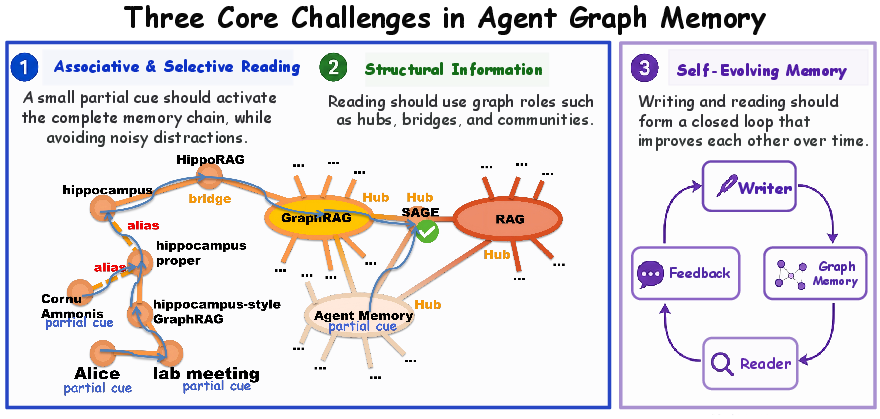
Figure 1: SAGE addresses associative/selective reading, exploits topological roles (aliases, bridges, hubs), and self-evolves via a closed feedback loop between writing and reading.
SAGE: Model and Closed-loop Self-evolution
SAGE introduces a dual-component architecture that couples a memory writer and a foundation-model-based memory reader via a closed feedback loop.
- Memory Writer: Modeled as a sequential decision-making policy with state-conditioned writing actions. The writer constructs and incrementally updates a heterogeneous, multi-relational memory graph by extracting entity-relation triples from observations and anchoring evidence to their source contexts. Literature, bridge nodes, and context granularity are all directly addressed.
- Memory Reader: Built on a Graph Foundation Model (GFM) pre-trained across multiple graphs and domains, the reader supports query-conditioned activation, selective evidence propagation, and complex schema/context fusion. It performs query-dependent evidence retrieval with propagation controlled via vector-valued structural gating, soft addressing, and planning-inspired probe decomposition.
The interaction between writer and reader is operationalized as a multi-round, alternating improvement process: the writer updates the memory graph to optimize downstream retrieval utility as scored by the reader; the reader updates to better adapt to the evolving graph distribution generated by the writer.
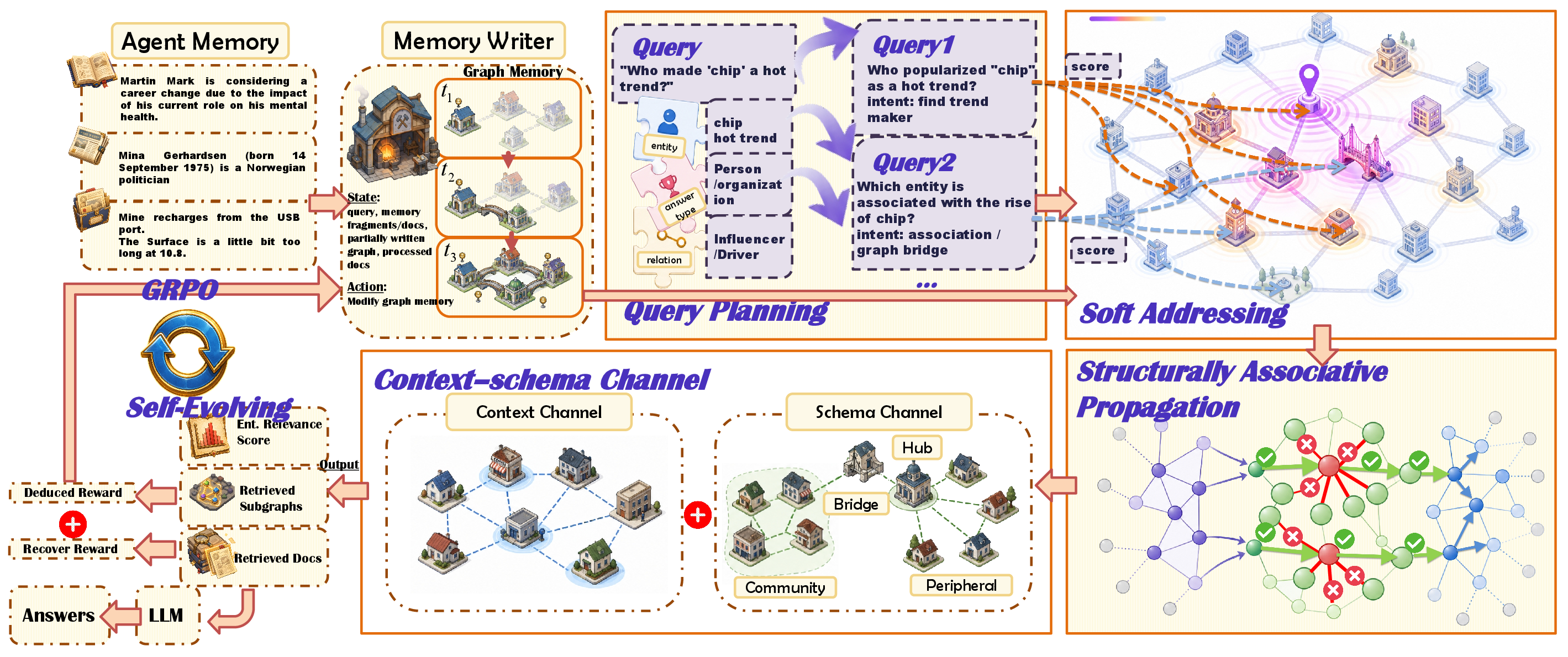
Figure 2: SAGE’s pipeline: the memory writer constructs and updates graph memory via RL, guided by retrieval feedback from the memory reader; this closes the loop for robust self-evolving memory.
Key Architectural and Theoretical Components
Reader: Cognition-Inspired and Structure-Aware Retrieval
The SAGE reader introduces several critical mechanisms:
- Structured Query Planning: Decomposes queries into multiple associative probes (explicit entities, aliases, relations, hard/soft constraints) and generates pseudo-queries for robust activation of relevant nodes, addressing the "tip-of-the-tongue" retrieval challenge.
- Global Soft Addressing and Synaptic Structural Gating: Assigns a multidimensional activation score to entities using cues (explicit/alias matching, embeddings, type constraints), simulating semantic priming. Propagation within the memory graph is then selectively gated by vector gates parameterized by local, pairwise, and graph-level structural metrics, enabling adaptive inhibition of hubs, support for bridges, and suppression of noisy clusters.
- Context–Schema Dual Channel: Combines target-graph-specific context calibration with transferable cross-graph structural priors, enabling rapid adaptation to evolving memory graphs while leveraging stable, learned retrieval schemas.
Writer: RL-based Policy for Evidence-Chain Utility
The writer is trained via reinforcement learning (using clipped Generalized Reward Policy Optimization) with a custom reward encompassing:
- Evidence coverage (recall/precision of retrieval),
- Multi-hop answer deducibility (task-level support for downstream reasoning),
- Auxiliary answer reward via an LLM,
- Penalties for graph inflation (duplication) and reward structure regularization.
Crucially, the reward is computed using the retrieval results and feedback from the fixed or iteratively updated reader, tightly coupling writing quality with retrieval utility. The interaction loop yields self-improvement cycles capable of correcting writing deficiencies exposed by retrieval failures.
Experimental Results
SAGE’s evaluation spans multi-hop QA (HotpotQA, MuSiQue, 2WikiMultiHopQA), open-domain retrieval (NQ, PopQA), domain-specific review QA (AmazonQA), and long-horizon agent memory benchmarks (LongMemEval, HaluMem).
Performance Highlights:
Ablation and Sensitivity
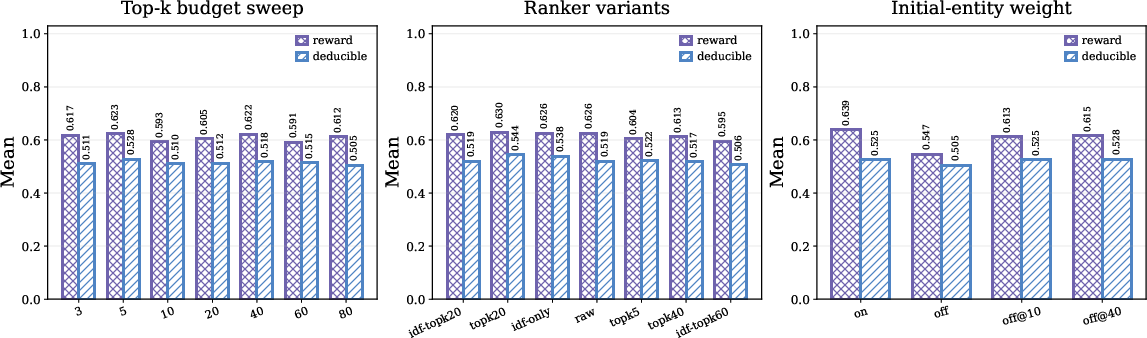
Theoretical and empirical ablations evidence the importance of structural gating, query-planning, and dual-channel calibration. Key observations:
Training regularization, interaction budgets, and writer protocol configurations were also systematically explored.
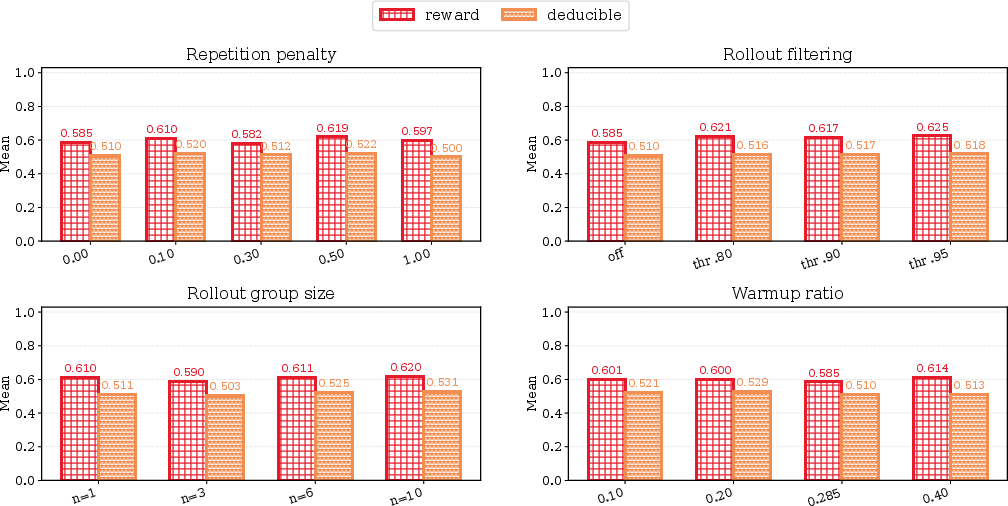
Figure 5: Training regularization and scaling analysis: rollout group size and warmup ratio have moderate impact; core gains arise from reward and protocol design.
Theoretical Insights
The paper provides rigorous formal analysis to substantiate its architectural choices:
- Signal-to-noise ratio (SNR) and effective retrieval budget: Under aggregate propagation models, soft addressing and structural gating jointly increase evidence SNR, reducing the required top-k retrieval budget.
- Reader stability: Context–schema dual channel regularization ensures bounded variation in retrieval scores under graph distribution shift induced by evolving writer policies.
- Self-evolution coordination: Alternating writer-reader optimization with reward bias correction and target-graph calibration approximates coordinate descent in joint memory utility, yielding monotonic improvement under bounded reward surrogate error.
Implications and Future Directions
Implications:
- SAGE demonstrates that dynamic, structure-aware, and self-evolving graph memory is a scalable substrate for long-horizon agentic reasoning, far surpassing static-memory RAG paradigms.
- The closed writer–reader learning loop tightly couples memory construction, evidence-path induction, and retrieval efficiency, opening new approaches to life-long, correctable agent memory, with observed transferability to zero-shot domains.
Theoretical Impact:
- The formal SNR and budget bounds generalize analysis of noise resilience and compositional inference under evolving memory topologies.
- The context–schema framework provides a blueprint for managing distributional shift in dynamic agent systems.
Practical Impact:
- SAGE’s pipeline combines high efficiency and retrieval speed, making large-scale, interpretable deployment feasible for real-world agent platforms, customer support, and review-based QA settings.
- The architecture is robust to the noisy, high-variance environments of long-term conversational interaction.
Future Research:
- Enhancing memory updating, high-coverage extraction, and hallucination control in even more volatile or user-driven memory settings.
- Extending the self-evolution paradigm to multi-agent collaborative memory, temporal graph evolution, and meta-learning of memory writing policies.
Conclusion
SAGE presents a principled, empirically validated agent memory system that integrates dynamic graph construction, structure-aware associative retrieval, and closed-loop self-evolution, addressing all major challenges in long-term agentic memory design. Empirical and theoretical results confirm that dynamic, feedback-driven graph memory is a scalable and robust solution for long-horizon language agents—representing a major step forward in the realization of consistent, adaptable, and interpretable AI memory systems.
Reference:
Juntong Wang et al. "SAGE: A Self-Evolving Agentic Graph-Memory Engine for Structure-Aware Associative Memory" (2605.12061)