Learning to Foresee: Unveiling the Unlocking Efficiency of On-Policy Distillation
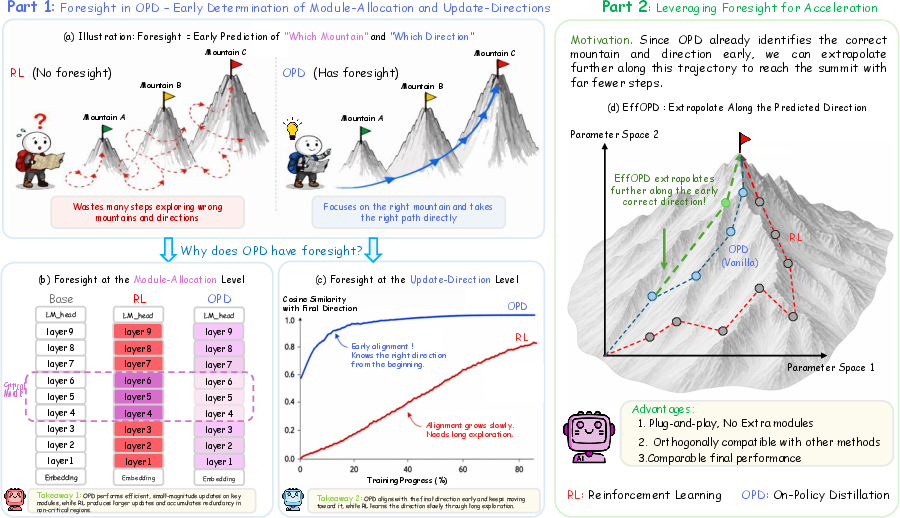
Abstract: On-policy distillation (OPD) has emerged as an efficient post-training paradigm for LLMs. However, existing studies largely attribute this advantage to denser and more stable supervision, while the parameter-level mechanisms underlying OPD's efficiency remain poorly understood. In this work, we argue that OPD's efficiency stems from a form of ``foresight'': it establishes a stable update trajectory toward the final model early in training. This foresight manifests in two aspects. First, at the \textbf{Module-Allocation Level}, OPD identifies regions with low marginal utility and concentrates updates on modules that are more critical to reasoning. Second, at the \textbf{Update-Direction Level}, OPD exhibits stronger low-rank concentration, with its dominant subspaces aligning closely with the final update subspace early in training. Building on these findings, we propose \textbf{EffOPD}, a plug-and-play acceleration method that speeds up OPD by adaptively selecting an extrapolation step size and moving along the current update direction. EffOPD requires no additional trainable modules or complex hyperparameter tuning, and achieves an average training acceleration of $3\times$ while maintaining comparable final performance. Overall, our findings provide a parameter-dynamics perspective for understanding the efficiency of OPD and offer practical insights for designing more efficient post-training methods for LLMs.
Paper Prompts
Sign up for free to create and run prompts on this paper using GPT-5.
Top Community Prompts
Explain it Like I'm 14
What is this paper about?
This paper studies a fast way to improve LLMs called on-policy distillation (OPD). The authors ask: why does OPD train models so efficiently compared to reinforcement learning (RL)? They discover that OPD has “foresight”: very early in training it figures out which parts of the model to change and in which directions to move, so it wastes less effort. Using these insights, they design a simple add-on called EffOPD that speeds up OPD training by about 3× without hurting final performance.
What questions did the researchers ask?
- Can we explain OPD’s efficiency not just by “better supervision,” but by looking directly at how the model’s parameters change?
- Does OPD focus its effort on the most useful parts of the network and avoid updating parts that don’t help much?
- Do OPD’s updates quickly line up with the final best direction, so later training mainly just “pushes harder” in the same direction?
- If OPD has this early “foresight,” can we safely take bigger steps along that direction to finish training faster?
How did they study it?
Think of training a model like improving a huge robot with many parts (layers and modules). You can measure:
- Where you’re making changes (which parts you tighten or loosen).
- The direction you’re moving those parts (are you heading straight toward the goal or zig-zagging?).
- How big the changes are.
Here’s what they did, in plain terms:
- Compared OPD and RL from the same starting model across many sizes (1.5B to 32B parameters).
- Measured “update size” and “update direction.” Update size is how much the model’s weights move. Update direction is the “way” they move.
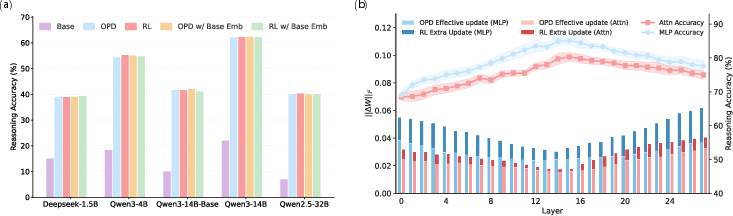
- Checked which parts of the model mattered most for reasoning (like math and code). They found middle layers’ MLP blocks often matter more than embeddings or the very top/bottom layers.
- Used a sliding-window test: temporarily swap in updates for certain layer ranges to see which ranges actually improve reasoning. This is like testing which paragraphs in an essay, when edited, really raise your grade.
- Analyzed directions with tools like SVD (a way to find the few “main moves” that explain most of the change). In everyday terms: if the model’s changes can be described mostly by just a few big moves, it’s “low-rank.”
- Tracked how early the important directions appear and how stable they are over time.
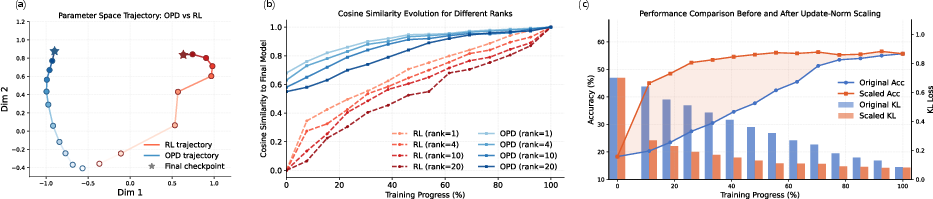
- Tried “norm scaling”: keep the early direction the same but give it the same “strength” as the finished model, to see how much performance you can recover.
- Built EffOPD: every so often, take a bigger step along the current direction (extrapolation), then quickly check on a tiny validation set that things still look good. If yes, keep the bigger step; if not, stop. This is like walking a path faster but checking your map after each long stride.
What did they find?
1) OPD focuses on the right parts early (fewer wasted updates)
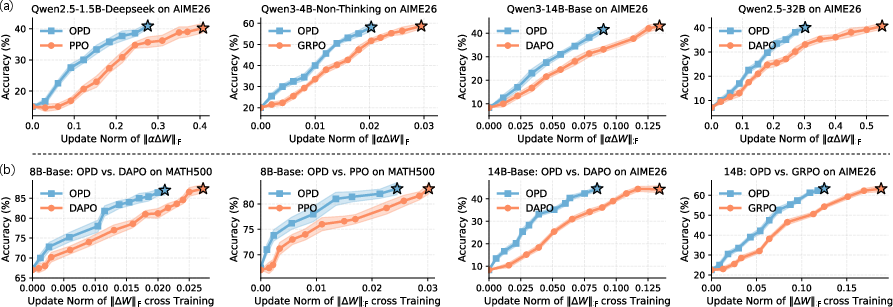
OPD learns to avoid “functional redundancy.” It updates less in low-utility places (like embeddings or far top/bottom layers) and concentrates changes where reasoning improves most (often in middle-layer MLPs). RL, by contrast, spends more effort updating parts that don’t boost reasoning much. With the same total “amount of change,” OPD gains more accuracy.
Why this matters: Less wasted effort means faster, more efficient training.
2) OPD locks onto the right directions early (early low-rank lock-in)
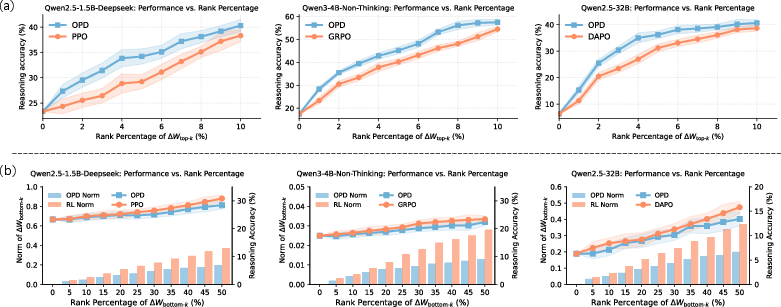
OPD’s changes mostly happen along a few “main directions” very early on, and those directions match the final best solution. Later, OPD mainly increases the strength along those same directions rather than searching around.
Two key signs:
- Strong low-rank structure: most of the useful change is captured by a few main moves.
- Early alignment: the directions seen early look very similar to the final ones.
- When the authors boosted the size of early updates to match the final strength (without changing direction), a checkpoint at just 10% of training recovered about 80% of the final performance.
Why this matters: If you already know the right path early on, you can move along it more boldly and save time.
3) EffOPD speeds up training about 3×
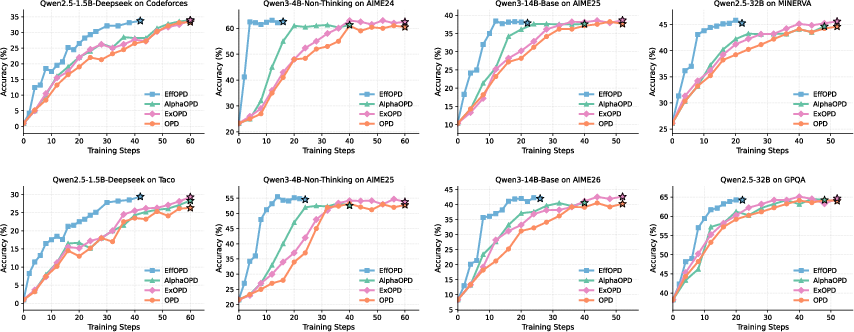
Using the “foresight” insight, EffOPD takes adaptive bigger steps along the current direction and quickly checks if the step is still good. Across multiple model sizes and benchmarks in code and math:
- EffOPD reached strong results in far fewer steps than standard OPD (often 3× faster).
- Final performance stayed comparable or even improved in some cases.
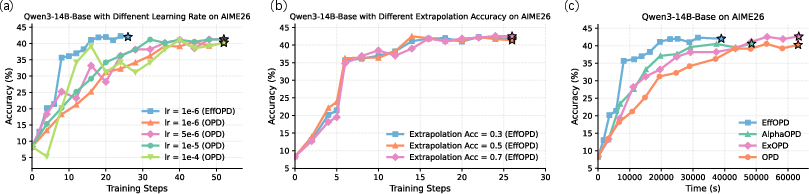
- It needs no extra modules and minimal tuning.
Why this matters: Faster training lowers cost and time-to-results.
Why does this matter?
- Practical gains: Training LLMs is expensive. If OPD can be made 3× faster with similar results, teams can iterate quicker and spend less.
- Better understanding: The paper moves beyond “OPD works because supervision is denser” to a concrete, parameter-level story: OPD finds the right places to change and the right directions early, then sticks to them.
- Guidance for future methods: Knowing that successful training follows a few stable directions early suggests new, simpler acceleration tricks (like EffOPD) and better diagnostics for when training is going off track.
Simple takeaway
- OPD trains LLMs efficiently because it shows “foresight”: it quickly figures out which parts of the model matter and which way to push them.
- Most of the useful change happens along a few stable directions found early, so you can safely “step farther” in those directions to finish faster.
- EffOPD turns this insight into action, making OPD about 3× faster without sacrificing performance.
Knowledge Gaps
Unresolved Knowledge Gaps, Limitations, and Open Questions
Below is a concise, actionable list of what remains missing, uncertain, or unexplored in the paper.
- External validity beyond math/code: Does OPD’s “foresight” and EffOPD’s speedups hold on open‑ended dialogue, multi‑turn tasks, safety alignment, summarization, retrieval‑augmented tasks, and long‑context reasoning?
- Teacher dependence: How sensitive are the observed properties (Functional Redundancy Avoidance, Early Low‑Rank Lock‑in) to teacher quality, temperature, sampling policy, and “pattern alignment”? Do they persist with cross‑family or cross‑architecture teachers, weaker teachers, or teachers with different prompting styles?
- Architectural generality: Are the findings robust across non‑Qwen backbones, decoder/encoder‑decoder models, different attention mechanisms (e.g., MQA/GQA), and models with substantially different depth/width ratios or normalization schemes?
- Scale limits: Do the low‑rank lock‑in and module allocation patterns persist for frontier models (≥70B, ≥100B) and mixture‑of‑experts architectures? Are there scale thresholds where the effects weaken or change qualitatively?
- Initialization and seed variance: The analysis uses a shared initialization; how much do the conclusions vary across random seeds, pretraining checkpoints, or small SFT variations?
- RL baseline fairness: Are PPO/GRPO/DAPO tuned to comparable compute/throughput and reward shaping? Could different RL hyperparameters, trust regions, KL constraints, or curricula reduce the “redundant” tail updates and narrow the alleged efficiency gap?
- Objective mismatch: Comparisons emphasize reasoning accuracy; RL optimizes reward, which may not perfectly correlate with benchmark accuracy. How do conclusions change when measuring reward‑aligned metrics or human‑preference metrics?
- Distillation baselines: How do OPD and EffOPD compare to strong offline distillation or preference‑based post‑training (e.g., DPO/IPO/SimPO/KTO) under matched compute and teacher signals?
- Subspace alignment causality: The paper correlates early subspace alignment with efficiency but does not establish causation. Would perturbing early directions (e.g., random rotations, orthogonal projections, or adversarial noise) causally reduce efficiency?
- Curvature/geometry controls: Analyses rely on SVD of per‑layer weight updates and norm scaling; they do not account for Hessian curvature or trust‑region effects. Are low‑rank patterns still explanatory under curvature‑aware comparisons?
- Layer/module intervention methodology: Sliding‑window “local update injection” may ignore nonlinear cross‑layer interactions. Can more rigorous causal probes (e.g., activation‑patching, causal mediation) confirm the functional importance of middle‑layer MLPs?
- Generality of embedding conclusion: The negligible contribution of embedding updates is shown on a single task (AIME26). Does this hold across tasks, tokenization regimes, multilingual settings, code vs. natural language, and different vocabularies?
- Other components unexamined: The roles of layer norms, positional encodings, and output heads in “foresight” were not analyzed. Do they exhibit similar redundancy or early lock‑in?
- Heterogeneity across layers: Spectral metrics are averaged over MLP/attention matrices; detailed layer‑wise heterogeneity is not reported. Which layers are most responsible for early subspace stabilization?
- Stability under distribution shift: Do OPD’s early‑locked directions remain effective under test‑time distribution shifts, adversarial prompts, or longer/instructionally different inputs?
- Safety/harms: Concentrating on high‑utility directions could entrench teacher biases or unsafe behaviors. How does EffOPD affect toxicity, factuality, calibration, and jailbreak resistance?
- EffOPD validation specifics: The “validation function” on the 50‑example set is not precisely specified (KL? task accuracy? reward proxy?). How do results vary with the metric, sample size, or selection bias in the validation subset?
- Validation noise and overfitting: With only 50 examples, what is the variance of acceptance decisions, and does repeated extrapolation overfit to this tiny set? What safeguards prevent drift on the full distribution?
- Extrapolation schedule robustness: EffOPD extrapolates at steps t=2n with five fixed step multipliers {2k}. How sensitive are gains to checkpoint spacing, number of candidates, and step multipliers across models/tasks?
- Failure modes: When OPD’s early directions are not yet reliable (e.g., noisy teachers, low‑resource domains), how often does EffOPD degenerate to vanilla OPD, and what is the overhead in such cases?
- Longer‑run behavior: EffOPD’s impact on late‑stage over‑optimization, catastrophic forgetting, or semantic drift is not systematically measured. Does extrapolation exacerbate or alleviate these issues in prolonged training?
- Compute accounting: The paper reports speedups despite extra validation, but details of wall‑clock accounting (GPU/TPU utilization, parallel evaluation, IO overhead) are not fully specified—especially at 32B scale.
- Token/sample complexity: Reported “3× acceleration” is step‑based; what is the reduction in tokens generated/consumed and total FLOPs? Are gains consistent across batch sizes and distributed settings?
- Out‑of‑family generalization of EffOPD: Can directional extrapolation accelerate other post‑training paradigms (e.g., SFT, preference optimization, RL fine‑tuning) or multi‑modal LLMs?
- Robustness to prompt format/CoT style: Do early‑locked directions depend on the teacher’s chain‑of‑thought format or prompt templates? What happens if training excludes CoT or mixes multiple reasoning styles?
- Statistical significance: Figures suggest advantages, but standard deviations, confidence intervals, and per‑seed variability are largely absent. Are effects statistically robust across runs?
- Theoretical underpinnings: The linearized view (appendix) is mentioned but not developed in the main text. What formal conditions guarantee early low‑rank lock‑in under OPD objectives, and how do they differ from RL?
- Practical compressibility: If OPD concentrates updates in low‑rank subspaces, can this be exploited for parameter‑efficient fine‑tuning (e.g., LoRA rank selection) or post‑hoc compression without performance loss?
- Cross‑objective tradeoffs: Does focusing updates in “principal” subspaces hurt other desiderata (e.g., calibration, uncertainty, diversity of outputs)? Are there measurable Pareto tradeoffs?
- Reproducibility details: Many experimental specifics (e.g., exact reward configs, intervention setup, metric definitions, data splits) are relegated to appendices; a minimal reproducible configuration would clarify sensitivity to these choices.
Practical Applications
Immediate Applications
Below are actionable, deployable uses that can be implemented with current tooling and the paper’s released code (EffOPD) and insights. Each bullet highlights sectors, potential tools/workflows, and key assumptions/dependencies.
- [Software/AI platforms, MLOps] Plug-and-play acceleration of OPD fine-tuning with EffOPD
- What to do: Integrate EffOPD into existing post-training pipelines to distill from an RL-tuned or stronger teacher with ~3× fewer steps. Use exponentially spaced checkpoints, directional extrapolation, and a lightweight validation set (~50 samples) to adaptively select the step size.
- Tools/workflows: Add an “EffOPD controller” to training loops; wrap training with a small validation sampler and an extrapolation scheduler; monitor validation acceptance criteria to avoid over-extrapolation.
- Benefits: Lower compute cost, faster iteration, reduced carbon footprint, improved stability vs fixed extrapolation methods.
- Assumptions/dependencies: Access to a capable teacher model; on-policy data generation; a small validation set representative of the target distribution; sufficient logging to checkpoint and roll back.
- [Software/PEFT, MLOps] Targeted parameter-efficient fine-tuning (PEFT) focused on high-utility modules
- What to do: Place LoRA/adapters primarily in middle-layer MLPs and reduce or freeze updates in embeddings and low-sensitivity top/bottom layers, reflecting “Functional Redundancy Avoidance.”
- Tools/workflows: Layer-wise sensitivity profiling with sliding-window interventions; module-wise LR schedules (higher for middle MLPs, lower/frozen for peripheral layers); adapter placement heuristics baked into PEFT configs.
- Benefits: Comparable or better reasoning gains per parameter update; smaller update footprints; faster convergence.
- Assumptions/dependencies: Transformer-like architecture with identifiable MLP/attention modules; access to tooling for module-wise norms and interventions.
- [AI research, MLOps] Early stopping and stability checks using subspace metrics
- What to do: Track spectral concentration and the stability of top singular directions of ΔW over training steps. Stop or slow training when dominant subspaces stabilize (“Early Low-Rank Lock-in”).
- Tools/workflows: Periodic SVD or low-cost proxies (e.g., randomized SVD on select layers); dashboards visualizing spectral/Frobenius ratios, effective rank, and cosine alignment across checkpoints.
- Benefits: Avoids over-optimization and semantic drift; saves compute when direction has stabilized and only magnitude remains to grow.
- Assumptions/dependencies: Ability to compute or approximate SVD on selected weight matrices; calibration of thresholds for “stability.”
- [Software, Code assistants] Faster, cheaper model refresh for code and math assistants
- What to do: Use EffOPD to distill new coding patterns or math reasoning improvements from a teacher into smaller assistants, enabling weekly/daily refreshes.
- Tools/workflows: CI/CD for model refresh; streaming on-policy data; tiny validation sets curated from recent tasks.
- Benefits: Lower downtime and infra cost; faster time-to-value from new training data or teacher upgrades.
- Assumptions/dependencies: Reliable teacher; stable distribution of developer/user queries reflected in validation samples.
- [Healthcare, Finance, Legal/Compliance] Institution-specific alignment with minimal compute
- What to do: Distill compliant behaviors and local guidelines from a vetted teacher into a constrained student using EffOPD and module-focused PEFT.
- Tools/workflows: Curate small validation slices representing compliance critical cases; freeze or reduce updates in low-utility layers to minimize drift; track KL to the teacher distribution as a safety signal.
- Benefits: Faster deployment and updates under tight compute/governance constraints.
- Assumptions/dependencies: High-quality, audited teacher; policy-compliant data handling; validation sets that truly reflect high-stakes use cases.
- [Education, Academia, Startups] Low-cost reproducible alignment experiments
- What to do: Use the paper’s code to run OPD and EffOPD on 1.5B–4B models; demonstrate how subspace alignment and module targeting reduce cost.
- Tools/workflows: Teaching labs and hackathons using small models; visualization of module sensitivity and subspace evolution; exercises comparing RL vs OPD updates under equal norms.
- Benefits: Pedagogical clarity; democratized access to alignment techniques.
- Assumptions/dependencies: Commodity GPUs; open weights; permissive licenses.
- [Edge/on-device AI, Energy] Quicker adaptation of small models (1.5B–4B) with lower energy draw
- What to do: Apply EffOPD and focused PEFT to tailor on-device assistants (e.g., customer support scripts, domain lexicons) with minimal steps.
- Tools/workflows: On-prem fine-tuning jobs; periodic small-batch validation; selective layer updates.
- Benefits: Shorter tuning cycles; reduced battery/energy consumption during adaptation.
- Assumptions/dependencies: Memory to store teacher outputs or access to teacher; stable on-device validation.
- [MLOps Tooling] “Directional distillation” dashboards and alerts
- What to do: Ship dashboards that plot effective rank, top-k subspace energy ratio, and module-wise norm growth; trigger alerts when tail subspace energy inflates or middle-layer focus weakens.
- Tools/workflows: Lightweight analytics routines; rules for freezing layers or reducing LR when redundancy indicators rise.
- Benefits: Better control of update quality; automated prevention of redundant updates.
- Assumptions/dependencies: Access to weights/gradients; agreement on indicator thresholds.
- [Sustainability, Corporate reporting] Compute and carbon savings reporting for alignment phases
- What to do: Attribute ~3× training speedups to OPD+EffOPD; incorporate subspace-stability-based early stop criteria into sustainability KPIs.
- Tools/workflows: Job schedulers that end runs upon lock-in; carbon meters integrated with training logs.
- Benefits: Cost and emissions reductions; audit-friendly metrics.
- Assumptions/dependencies: Accurate energy telemetry; governance-approved reporting standards.
- [Safety, Risk management] Guardrails against semantic drift via validation-gated extrapolation
- What to do: Keep extrapolation gated by lightweight validation; monitor teacher KL and safety checklists (e.g., refusal behaviors) at extrapolation checkpoints.
- Tools/workflows: Safety probe prompts in the 50-sample validation pool; block extrapolation if safety scores fall.
- Benefits: Maintains alignment while accelerating training.
- Assumptions/dependencies: Reliable, compact safety probes; teacher remains a valid safety reference.
Long-Term Applications
These opportunities likely require further research, scaling, or productization beyond the paper’s immediate code release.
- [AI algorithms, Foundation models] Generalized directional extrapolation beyond OPD (RLHF, DPO, KTO)
- What to explore: Extend early lock-in detection and extrapolation to other post-training paradigms; develop theoretical guarantees for stability and convergence.
- Potential products: A unified “Acceleration Layer” for alignment methods with adaptive extrapolation controllers.
- Assumptions/dependencies: Stable dominant subspaces in non-OPD settings; robust proxies for direction quality without dense teacher supervision.
- [Model architecture, Systems] Architectures and kernels optimized for low-rank update trajectories
- What to explore: Co-design PEFT layers and accelerators to exploit concentrated top-k subspaces (e.g., fused low-rank ops, on-the-fly randomized SVD, block-sparse routing to middle layers).
- Potential products: “Lock-in aware” PEFT libraries; GPU/ASIC kernels for subspace tracking and rank-limited updates.
- Assumptions/dependencies: Hardware support for efficient SVD/low-rank ops; stable APIs across model families.
- [AutoML, MLOps] Controllers that learn to schedule freezing, LR, and rank adaptively
- What to explore: Meta-controllers that predict when to freeze layers, bump LR on middle MLPs, and adjust adapter rank based on subspace and validation signals.
- Potential products: AutoPEFT schedulers; “smart” trainer agents with subspace-aware policies.
- Assumptions/dependencies: Reliable reward signals; cross-task generalization of learned schedules.
- [Model fusion/ensembles, Marketplaces] Subspace-alignment guided model merging and capability exchange
- What to explore: Use dominant subspace similarity as a criterion to merge/fuse specialist models or to “transplant” capabilities via OPD.
- Potential products: Capability marketplace scoring APIs; “subspace compatibility” badges for models.
- Assumptions/dependencies: Measurable and task-relevant subspace overlap; safe transfer without unwanted behaviors.
- [Continual and federated learning] Fast capability refresh with distributed teachers
- What to explore: Federated OPD with early lock-in to propagate updates efficiently; reduce tail-subspace redundancy across clients.
- Potential products: Federated OPD frameworks with subspace-aware bandwidth reduction (send only top-k components).
- Assumptions/dependencies: Privacy-preserving teacher signals; communication-efficient subspace serialization.
- [Cross-modal models, Robotics] Apply foresight principles to VLMs and policy networks
- What to explore: Check if vision-language or control policies exhibit early low-rank lock-in; design distillation/extrapolation controllers for planning/robotics.
- Potential products: Faster adaptation of household or warehouse robots to new tasks via on-policy distillation from expert teachers.
- Assumptions/dependencies: Availability of dense supervisory teachers in multimodal/control domains; safety validation in the loop.
- [Curriculum and data strategy] Active selection of tiny validation sets for stable extrapolation
- What to explore: Methods to curate 50–200 sample validation pools that are maximally predictive of direction quality; dynamic refresh of this pool over time.
- Potential products: “MicroVal” data selection services; validation pool optimizers.
- Assumptions/dependencies: Transferability of micro-validation gains to full-task performance; defenses against overfitting to the pool.
- [Governance and policy] Standards and incentives for efficient alignment and reporting
- What to explore: Benchmarks and disclosure norms for alignment-phase efficiency (e.g., effective rank trajectories, top-k energy ratios, convergence with extrapolation).
- Potential products: Compliance checklists for “efficient alignment practice”; green-AI credits tied to demonstrable lock-in–based early stopping.
- Assumptions/dependencies: Community consensus on metrics; third-party verification.
- [Monitoring and diagnostics] “Directional fingerprints” for drift and regressions
- What to explore: Use changes in dominant subspaces as early-warning signals for regressions across releases; relate tail-subspace inflation to quality decay.
- Potential products: Release-gating diagnostics; regression triage that maps failures to layer/module drift.
- Assumptions/dependencies: Stable mapping from subspace changes to downstream quality; scalable per-release analysis.
- [Theoretical foundations] Intrinsic dimensionality and optimal control of post-training
- What to explore: Formal links between intrinsic dimension, OPD foresight, and convergence rates; bounds for safe extrapolation magnitudes.
- Potential products: Theory-informed controllers with provable safety margins.
- Assumptions/dependencies: Stronger theory for nonconvex, high-dimensional alignment dynamics; empirical validation across families.
Notes on feasibility across items:
- The core dependency for most immediate uses is a high-quality teacher and on-policy data. EffOPD’s gains hinge on early directional stability; large distribution shifts, noisy teachers, or tasks lacking dense supervision may reduce benefits.
- Subspace metrics can be approximated to reduce overhead; however, poorly chosen proxies may mis-signal “lock-in,” risking under- or over-training.
- Sectoral deployments (healthcare, finance) require safety validation and governance overlays; extrapolation is always gated by domain-specific risk checks.
Glossary
- AlphaOPD: A previously proposed accelerated on-policy distillation baseline used for comparison. "We compare EffOPD with Vanilla OPD, AlphaOPD~\citep{cai2025predictability}, and ExOPD~\citep{Yang2026LearningBT}."
- Attention modules: Transformer components that compute token–token interactions via self-attention; analyzed for their contribution to reasoning updates. "MLP modules are overall more sensitive to reasoning-related updates than attention modules, indicating that MLPs serve as the primary carriers of knowledge representation and relational reasoning."
- Block-wise intervention: An analysis technique that injects or swaps parameter updates within contiguous layer blocks to assess functional contribution. "Following prior block-wise intervention studies~\citep{cai2024locatingmitigatinggenderbias, meng2023locatingeditingfactualassociations}, we partition the model into consecutive layer blocks and inject local OPD or RL updates into each block to evaluate their impact on reasoning performance"
- Bottom- subspace: The subspace spanned by the least significant singular vectors (tail directions) of an update matrix. "Bottom- subspace: RL incurs significantly larger norm cost for marginal performance gains."
- Cosine similarity: A measure of alignment between vectors or subspaces, used to quantify directional similarity over training. "compute the cosine similarity, and then average over ."
- DAPO: A reinforcement learning algorithm variant considered among RL baselines for LLM training. "For RL, we consider PPO, GRPO, and DAPO~\citep{yu2025dapoopensourcellmreinforcement}."
- Dominant subspaces: Leading low-dimensional subspaces capturing most update energy and governing effective directions. "with its dominant subspaces aligning closely with the final update subspace early in training."
- Early Low-Rank Lock-in: A property where training rapidly stabilizes on a small set of low-rank update directions that persist thereafter. "We term this Property~2: Early Low-Rank Lock-in, which structurally explains Property~1: Functional Redundancy Avoidance."
- EffOPD: The paper’s plug-and-play acceleration framework that extrapolates along stable update directions to speed up OPD. "we propose EffOPD, a plug-and-play acceleration framework."
- Effective Rank: A measure of the number of significant singular values of a matrix; lower values indicate stronger low-rank structure. "lower effective rank (2341 vs.\ 2754)"
- Embedding layer: The model component mapping tokens to continuous vectors; shown to contribute little to reasoning gains here. "We first examine the embedding layer by replacing the embeddings of OPD and RL models with those from the base model while keeping all other parameters unchanged."
- ExOPD: A baseline on-policy distillation method employing fixed extrapolation strategies. "We compare EffOPD with Vanilla OPD, AlphaOPD~\citep{cai2025predictability}, and ExOPD~\citep{Yang2026LearningBT}."
- Exponentially spaced checkpoints: Training steps scheduled at powers of two to estimate and extrapolate local update directions. "EffOPD triggers an extrapolation search at exponentially spaced checkpoints"
- Frobenius norm: The Euclidean (L2) norm of a matrix entries; used to quantify update magnitude and to rescale low-rank approximations. "rescale its Frobenius norm to match between RL and OPD."
- Functional Redundancy Avoidance: A property where OPD suppresses updates in low-utility regions and focuses on modules that drive reasoning. "We refer to this property as Functional Redundancy Avoidance."
- GRPO: A reinforcement learning algorithm variant included among the RL baselines. "For RL, we consider PPO, GRPO, and DAPO~\citep{yu2025dapoopensourcellmreinforcement}."
- KL divergence: Kullback–Leibler divergence; measures how one probability distribution diverges from another (e.g., student vs. teacher). "We also observe a reduction in the KL divergence between the rescaled checkpoints and the teacher model"
- Linear extrapolation: Extending parameters along an estimated update direction by a scalar multiple to accelerate training. "EffOPD performs linear extrapolation along the current update direction"
- Low-rank concentration: The phenomenon where most update energy lies in a few singular directions; linked to efficiency. "OPD exhibits stronger low-rank concentration"
- MLP modules: Transformer feed-forward layers; identified as primary carriers of reasoning-related updates. "MLP modules are overall more sensitive to reasoning-related updates than attention modules"
- Module-Allocation Level: An analysis perspective focusing on how update magnitudes are distributed across architectural modules. "First, at the Module-Allocation Level, OPD identifies regions with low marginal utility and concentrates updates on modules that are more critical to reasoning."
- Module-wise norm-scaling intervention: A manipulation that rescales each module’s update norm to a target value while keeping its direction fixed. "we perform a module-wise norm-scaling intervention on intermediate OPD checkpoints."
- On-policy distillation (OPD): A post-training paradigm where a student model learns from a teacher using student-generated data, providing dense supervision. "On-policy distillation (OPD) has emerged as an efficient post-training paradigm for LLMs."
- Pattern-aligned teacher: A teacher model whose outputs match the student’s response format or reasoning patterns. "the student is trained with a pattern-aligned teacher, typically a stronger model from the same family"
- PPO: Proximal Policy Optimization; a standard RL algorithm used as a baseline. "For RL, we consider PPO, GRPO, and DAPO~\citep{yu2025dapoopensourcellmreinforcement}."
- Principal subspace: The subspace spanned by top singular vectors that captures the main task-relevant update directions. "In contrast to the principal subspace, tail subspaces provide only limited performance recovery for both RL and OPD."
- Reinforcement Learning (RL): Optimization based on reward signals; used for LLM post-training and compared against OPD. "performance comparable to Reinforcement Learning (RL) with substantially reduced training time"
- Sliding-window intervention: Injecting updates within moving layer windows to localize functionally important regions. "(b) Layer-wise update norms (bars, left axis) for RL/OPD-trained Qwen3-8B-Base models, and corresponding OPD reasoning accuracy after sliding-window intervention (line, right axis) on MATH500."
- Spectral / Frobenius Norm Ratio: The ratio between spectral and Frobenius norms; higher values indicate stronger dominance of leading singular directions. "Spectral / Frobenius Norm Ratio~\citep{ALNATOOR2024e30056}"
- Spectral Concentration of Update Matrix: The analysis of how update energy is distributed across singular values of the update matrix. "Spectral Concentration of Update Matrix"
- Spectral Norm: The largest singular value of a matrix; measures the strongest linear amplification. "Spectral Norm~\citep{MATHIAS1990269}"
- SFT-tuned: Supervised fine-tuning applied to a pretrained model before further alignment or distillation. "including pretrained, SFT-tuned, and Thinking-series models"
- Singular Value Decomposition (SVD): A matrix factorization into UΣVᵀ used to analyze update spectra and subspaces. "we perform singular value decomposition (SVD)~\citep{5197422} on the update matrix"
- Subspace alignment analysis: Quantitative evaluation of how closely intermediate subspaces align with the final solution subspaces. "which we next examine quantitatively through subspace alignment analysis."
- t-SNE: t-distributed Stochastic Neighbor Embedding; a nonlinear method for visualizing high-dimensional trajectories. "we visualize the Top-1 subspace using t-SNE"
- Tail subspaces: Subspaces formed by directions with small singular values that have low marginal utility. "tail subspaces provide only limited performance recovery for both RL and OPD."
- Top-1\% Subspace Norm Ratio: The fraction of total update norm captured by the top 1% singular directions. "Top-1\% Subspace Norm Ratio~\citep{cai2025predictability}"
- Top- subspace: The subspace formed by the top k% singular directions; primary carrier of performance improvements. "Top- subspace: Directional Quality under Equal Norm Budget."
- Update direction: The direction of parameter change (often normalized) that determines the trajectory of learning. "moving along the current update direction."
- Update trajectory: The temporal path of parameter updates during training toward the final solution. "it establishes a stable update trajectory toward the final model early in training."
Collections
Sign up for free to add this paper to one or more collections.

