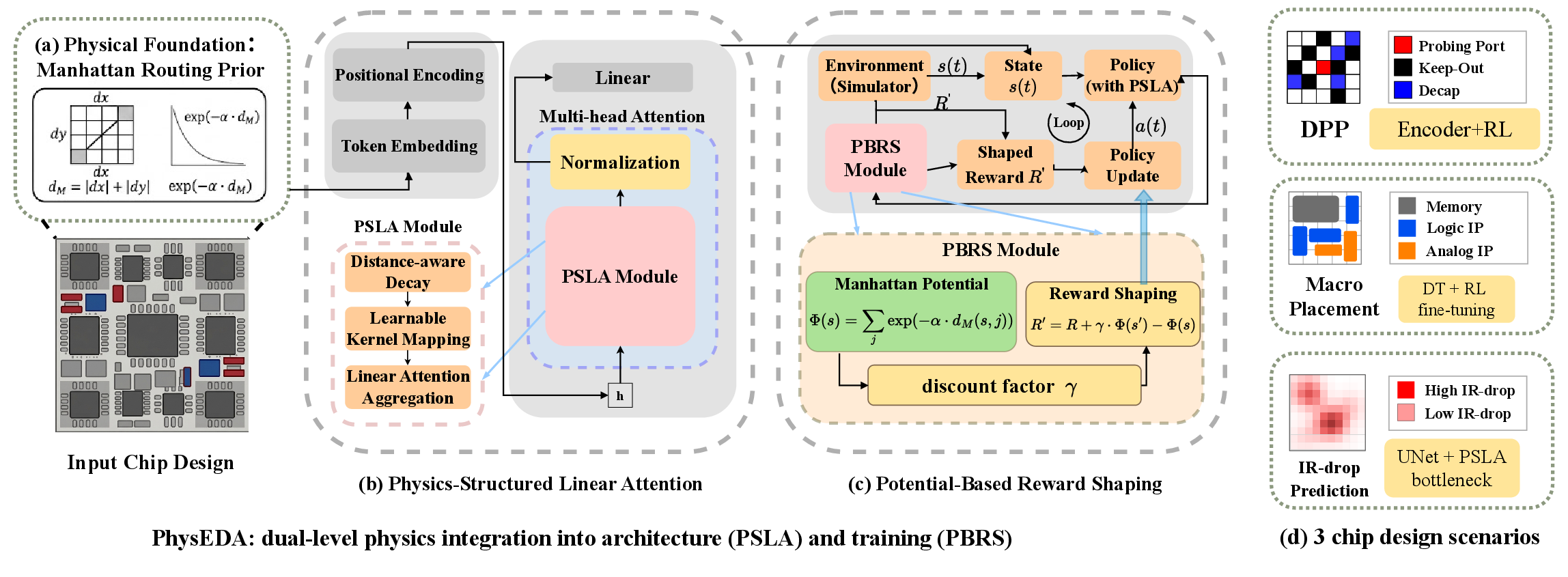
- The paper introduces a framework that integrates a physics-inspired Manhattan decay prior into attention mechanisms to regularize spatial interactions in EDA tasks.
- It leverages Physical-Structured Linear Attention (PSLA) and Potential-Based Reward Shaping (PBRS) to reduce complexity and alleviate reward sparsity in reinforcement learning.
- Experimental results show significant improvements in placement cost, inference speed, and generalization across varying grid sizes and low-data regimes.
PhysEDA: Physics-Aware Learning for Efficient EDA with Manhattan Distance Decay
Introduction and Motivation
"PhysEDA: Physics-Aware Learning Framework for Efficient EDA With Manhattan Distance Decay" (2605.10547) presents a unified framework that directly incorporates physical principles—specifically, the exponential decay of pairwise electrical and routing interactions along the Manhattan (L1) distance—into both the architecture and learning process for electronic design automation (EDA) tasks. The motivation arises from three core bottlenecks in state-of-the-art EDA learning methods: (1) the quadratic complexity of standard attention restricts scalability, (2) the lack of physical priors leads to overfitting in data-scarce regimes, and (3) RL formulations for EDA suffer severe reward sparsity, impeding convergence.
The central insight is that many chip-design tasks share a separable, direction-specific, exponential Manhattan-decay prior. This prior is encoded in PhysEDA at two levels:
PSLA: Physics-Structured Linear Attention
The exponential decay of pairwise interactions along Manhattan distance is justified both empirically and via the on-chip PDN's transmission-line mesh model, yielding impedance decay as:
∣Ztr(i,j)∣∝exp(−αx∣xi−xj∣−αy∣yi−yj∣)
PSLA encodes this prior into the linear attention kernel via multiplicative, position-dependent bias terms:
PSLA(Q,K,V)=(ϕ(Q)⊙DQ)(ϕ(K)⊙DK)⊤1(ϕ(Q)⊙DQ)[(ϕ(K)⊙DK)⊤V]
with DQ[i]=exp(−αxxi−αyyi), DK[j]=exp(+αxxj+αyyj), and αx,αy as learnable parameters (per head, per layer).
While prior efficient attention methods (e.g., Linformer, FAVOR+, CosFormer, ALiBi) target generic sequence structure or 1D positional relationships, PSLA is unique in encoding a 2D, physically-motivated, learnable decay directly tied to the chip's spatial coordinates.
Representational and Computational Advantages
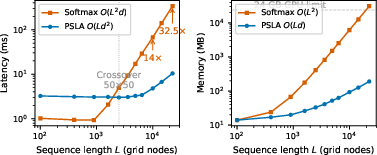
PSLA ensures that, even with scarce data, the spatial attention weights respect the Manhattan decay characterized by semiconductor physics, mitigating overfitting to spurious long-range dependencies. Practically, PSLA's complexity is O(Ld2), enabling scaling to chip-sized grids (L≫104), while conventional quadratic attention fails due to prohibitive memory and latency demand.
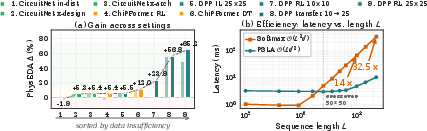
Figure 2: PhysEDA’s delta performance across scenarios and speedup as sequence length increases—showing accuracy gains rise with data scarcity and PSLA’s linear scaling.
PBRS: Potential-Based Reward Shaping
RL-based chip design faces extreme reward sparsity, especially in sequential tasks such as decoupling capacitor placement (DPP), where only terminal states yield rewards computed via full PDN simulation. PBRS counteracts this by augmenting rewards with the change in a shaped potential, Φ:
R′(s,a,s′)=R(s,a,s′)+γΦ(s′)−Φ(s)
Choosing Φ as a sum of Manhattan-decayed interactions ensures that intermediate steps receive dense, physically meaningful feedback. Critically, the policy-invariance property of PBRS ensures that the optimal policy is unchanged—only the speed of learning is affected.
Empirically, PBRS adds up to 10.8% gain in RL for sparse-reward DPP scenarios.
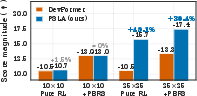
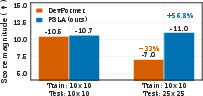
Figure 3: DPP RL with PBRS. As grid scales from PSLA(Q,K,V)=(ϕ(Q)⊙DQ)(ϕ(K)⊙DK)⊤1(ϕ(Q)⊙DQ)[(ϕ(K)⊙DK)⊤V]0 to PSLA(Q,K,V)=(ϕ(Q)⊙DQ)(ϕ(K)⊙DK)⊤1(ϕ(Q)⊙DQ)[(ϕ(K)⊙DK)⊤V]1, PSLA's accuracy gain rises from 1.5% to 49.1%, demonstrating the dependence on spatial data insufficiency.
Experimental Results Across EDA Tasks
Decoupling Capacitor Placement (DPP)
- Supervised: On PSLA(Q,K,V)=(ϕ(Q)⊙DQ)(ϕ(K)⊙DK)⊤1(ϕ(Q)⊙DQ)[(ϕ(K)⊙DK)⊤V]2 grids, PSLA achieves 5.5% lower (better) placement cost than the quadratic-complexity DevFormer. Competing linear-attention approaches without the physical prior underperform.
- Reinforcement Learning: As grid size increases, PSLA’s gain over vanilla RL (w/o PBRS) jumps from 1.5% (PSLA(Q,K,V)=(ϕ(Q)⊙DQ)(ϕ(K)⊙DK)⊤1(ϕ(Q)⊙DQ)[(ϕ(K)⊙DK)⊤V]3) to 49.1% (PSLA(Q,K,V)=(ϕ(Q)⊙DQ)(ϕ(K)⊙DK)⊤1(ϕ(Q)⊙DQ)[(ϕ(K)⊙DK)⊤V]4); PBRS further extends this to 65.2% combined gain.
- Zero-Shot Transfer: Training on small grids and evaluating on larger grids, PSLA displays only a marginal drop in performance compared to catastrophic failure of learned embeddings, a 56.8% relative improvement.
- Decision Transformer Pretraining: Replacing standard attention with PSLA reduces HPWL by up to 12.0% after 300 epochs.
- RL Fine-tuning: PBRS logit bias achieves a 5.4% additional improvement. Notably, hard architectural priors (PSLA) may restrict RL exploration compared to soft constraints (PBRS).
IR-Drop Prediction (CircuitNet)
- In-distribution: PSLA marginally underperforms UNet (PSLA(Q,K,V)=(ϕ(Q)⊙DQ)(ϕ(K)⊙DK)⊤1(ϕ(Q)⊙DQ)[(ϕ(K)⊙DK)⊤V]5), indicating that when data suffices, manual spatial priors may restrain model flexibility.
- Cross-domain/architecture: PSLA outperforms the baseline by 5.3%–5.4% Pearson correlation, with consistent win rates (12/15, 11/15), demonstrating its value under severe distribution shift/data scarcity.
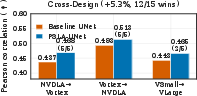
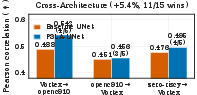
Figure 4: CircuitNet cross-design generalization, where PSLA-UNet outperforms baseline by +5.3% and wins 12 out of 15 cross-seed tests.
Efficiency Gains
PSLA’s architectural design brings significant computational benefits:
Analysis of the Prior’s Impact and Interpretability
The benefit of PSLA and PBRS monotonically increases as data becomes insufficient to recover spatial structure from examples alone. In data-rich settings, the prior’s effect fades; in highly data-scarce, transfer, or extrapolation regimes, the prior dominates performance gains.
Ablations validate that PSLA’s effect comes from the physically meaningful, learnable decay—it is not replicable by generic position encoding or by using an improper decay metric.
The learned DQ[i]=exp(−αxxi−αyyi)1 parameters are interpretable as inverse physical length-scales, and adapt per scenario, head, and layer, evidencing the flexibility and task-adaptiveness of the approach.
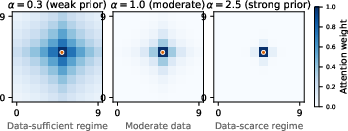
Figure 6: Attention heatmaps visualizing effect of DQ[i]=exp(−αxxi−αyyi)2; larger DQ[i]=exp(−αxxi−αyyi)3 yields more local attention reflecting strong prior, while small DQ[i]=exp(−αxxi−αyyi)4 recovers uniform attention under rich data.
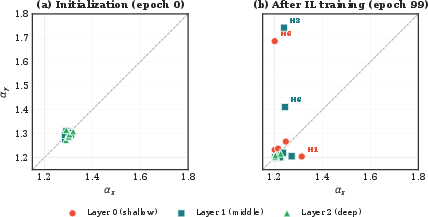
Figure 7: Divergence of per-head DQ[i]=exp(−αxxi−αyyi)5 parameters during training demonstrates adaptation to spatial anisotropy and specialization.
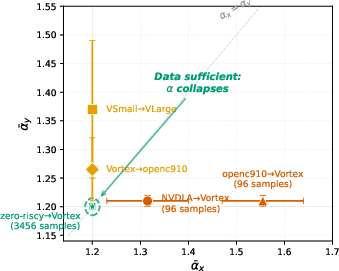
Figure 8: Learned DQ[i]=exp(−αxxi−αyyi)6 values on cross-domain CircuitNet transfer settings reflect anisotropy and correlate with data sufficiency, collapsing in data-rich regimes as the Bayesian “prior-fades-as-data-grows” prediction suggests.
Theoretical and Practical Implications
PhysEDA’s approach exemplifies the impact of integrating domain-specific physical structure into neural architectures and training protocols. Architecturally, it enables previously infeasible scaling with direct memory and latency savings while maintaining or improving accuracy. Algorithmically, it enhances generalization and sample efficiency, particularly in low-data, cross-scale, and transfer scenarios common in chip design.
Practically, these results suggest that similar physical or domain priors could be systematically injected into models for other structured engineering problems—beyond EDA, potentially encompassing areas such as CFD, structural optimization, and even graph-structured bioinformatics—where spatial decay, locality, or invariant properties can be encoded in a tractable, learnable way.
Open directions for further research include:
- Implementing an exact, symmetric Manhattan decay via bidirectional prefix-sum decomposition in linear attention to improve non-causal encoder settings.
- Extending the physical prior to model other spatial correlations, such as parasitic capacitance, signal integrity, and clock network phenomena.
- Evaluating the approach on broader classes of EDA tasks and other physics-driven domains.
Conclusion
PhysEDA introduces a compelling physics-aware learning paradigm for EDA, integrating a unified Manhattan-decay prior into attention mechanisms and RL reward shaping. Its gains are pronounced in data-scarce, cross-domain, and scaling-challenged scenarios, with demonstrated improvements in accuracy, generalization, and computational efficiency across multiple EDA benchmarks. The work highlights the strategic value of leveraging physical knowledge in AI design for engineering applications, with broad implications for the scalability and transferability of deep learning in scientific domains.