Hyperparameter Transfer for Dense Associative Memories
Abstract: Dense Associative Memory (DenseAM) is a promising family of AI architectures that is represented by a neural network performing temporal dynamics on an energy landscape. While hyperparameter transfer methods are well-studied for feed-forward networks, these methods have not been developed for settings in which weights are shared across layers and within the layer, which is common in DenseAMs. Additionally, DenseAMs utilize rapidly peaking activation functions that are rarely used in feed-forward architectures. The confluence of these aspects makes DenseAM a challenging framework for using existing methods for hyperparameter transfer. Our work initiates the development of hyperparameter transfer methods for this class of models. We derive explicit prescriptions for how the hyperparameters tuned on small models can be transferred to models trained at scale. We demonstrate excellent agreement between these theoretical findings and empirical results.
Paper Prompts
Sign up for free to create and run prompts on this paper using GPT-5.
Top Community Prompts
Explain it Like I'm 14
What is this paper about?
This paper is about how to set the “knobs” (hyperparameters) for a special kind of AI model called a Dense Associative Memory (DenseAM) when you make the model much bigger. DenseAMs work by imagining a landscape of hills and valleys (an “energy” landscape) and then moving a point downhill to find good answers. Tuning these knobs on giant models is expensive, so the authors ask: can we tune them on a small model and then “transfer” those settings to a big one in a reliable way?
The big idea in one sentence
Find simple, math-guided rules that tell you how to scale learning rate and initialization when you scale up a DenseAM model and dataset, so training behaves the same at small and large sizes.
What questions do the authors ask?
To make their results practical, the authors focus on a few plain questions:
- If a small DenseAM trains well, how should we change its hyperparameters so a bigger DenseAM trains similarly well?
- Which parts (like learning rate and initialization size) should change with input size, hidden size, and dataset size?
- Do we need small architectural tweaks to keep training stable as we scale up?
- Do these rules work for different activation functions (like ReLU and softmax) and different optimizers (SGD vs. Adam)?
- Do the rules still help on more realistic data, not just simple random data?
How do they study the problem?
The authors use a simple but representative DenseAM unit that updates a vector by applying:
- the same weight matrix twice (this is called “tied weights”),
- with an activation in the middle,
- and some scaling factors that can be tuned.
You can picture this like a sandwich: weights → activation → same weights again.
They train this unit to “denoise” examples: given a clean input plus some noise, the model tries to predict the clean input. That makes it easy to measure how well it learns.
To keep things understandable, they:
- Start with simple settings (like linear activations and random data) where math can give clear answers, then check the answers with experiments.
- Use two common optimizers: SGD (simple and fast) and Adam (more adaptive).
- Introduce “centering,” which means subtracting the average from signals before and after the activation. Intuitively, that keeps things balanced so signals don’t drift too far in one direction.
- Study “proportional scaling”: they scale input size, hidden size, dataset size, and batch size by the same factor—like zooming a picture up or down without changing its proportions. This makes it meaningful to ask if a small and large model learn “the same way.”
They also test beyond the simplest case:
- Nonlinear activations (ReLU and powers of ReLU).
- Softmax activations (common in attention and classification).
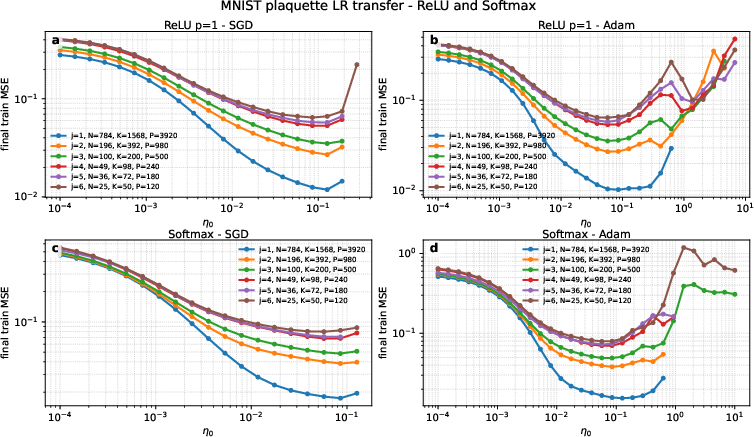
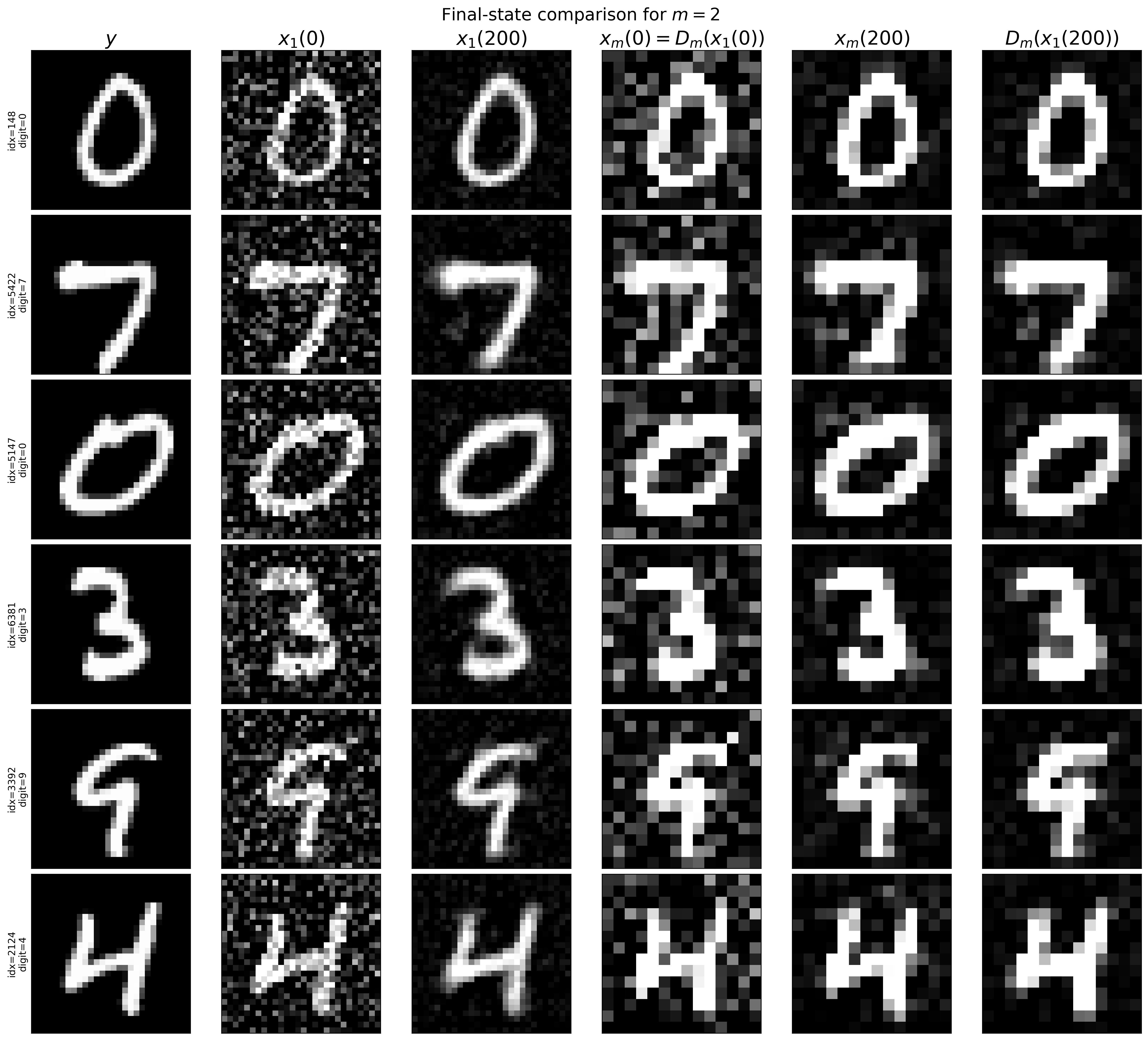
- More realistic, “uneven” data and even MNIST (a classic digit dataset).
What did they find?
Here are the main takeaways, expressed simply:
- Clear scaling rules for hyperparameters:
- For ReLU-like activations (with either SGD or Adam), initialize the first weight pass with scale about 1/√(input size) and the second pass with scale about 1/√(hidden size).
- For softmax with Adam, keep the first pass at about 1/√(input size) but make the second pass larger, about √(hidden size).
- Learning rate for weights:
- With SGD (ReLU-like), make the weight learning rate grow with the hidden size (proportional to hidden size).
- With Adam, keep the weight learning rate roughly constant when you scale up.
- Learning rates for biases can stay the same across scales.
- Centering is crucial:
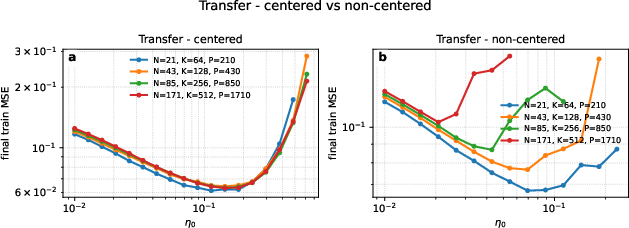
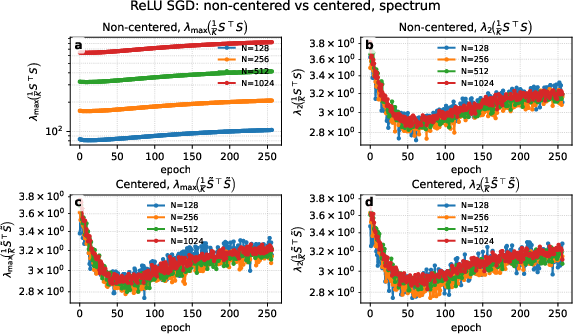
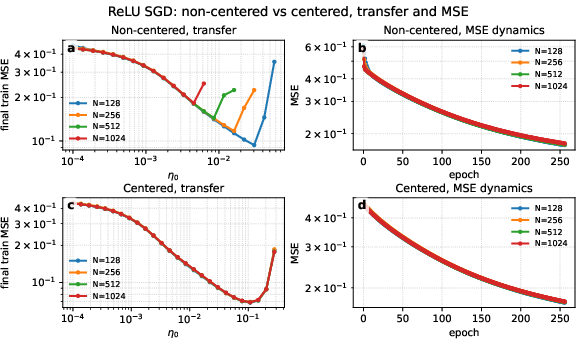
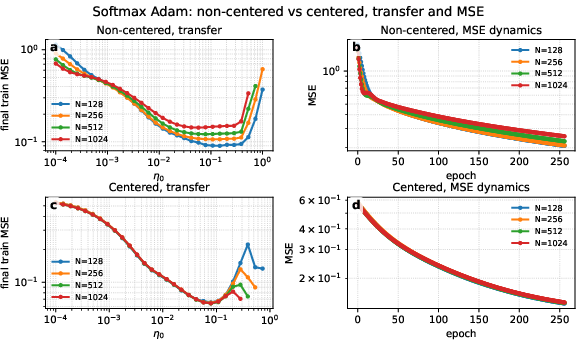
- Subtracting the layer-wise mean before and after the activation (they call this “centering”) makes training stable and consistent when you scale up.
- Without centering, training can blow up or fail to transfer well from small to large models.
- Consistent learning behavior across sizes:
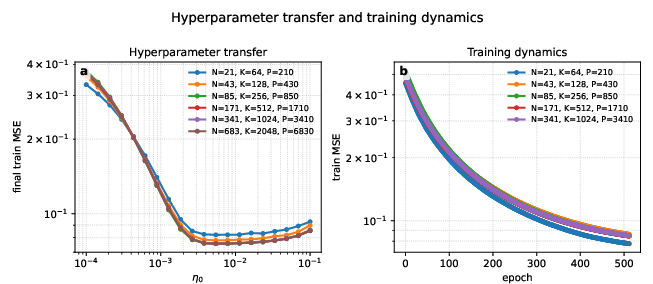
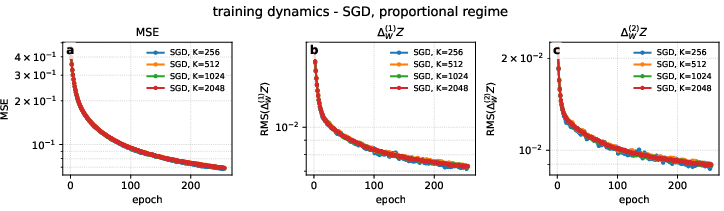
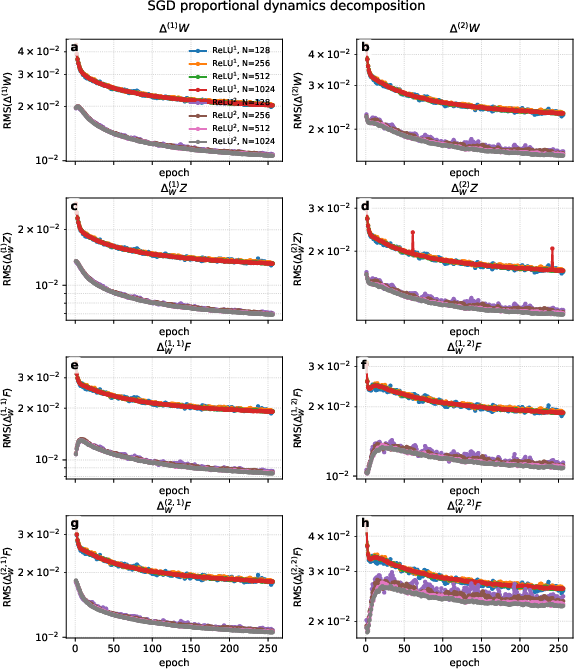
- When you scale model and data proportionally, and follow the scaling rules above, small and large models show very similar training curves and internal statistics. It’s like watching the same movie at different screen sizes.
- Optimizer matters for softmax:
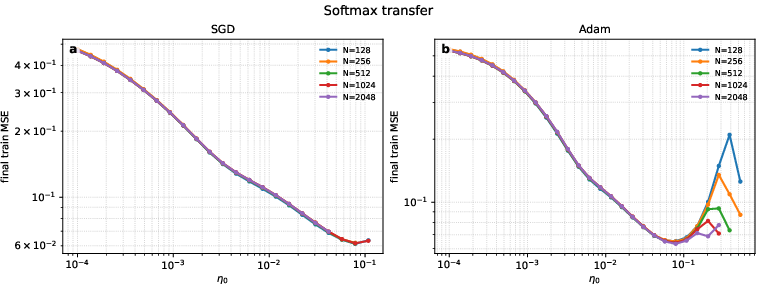
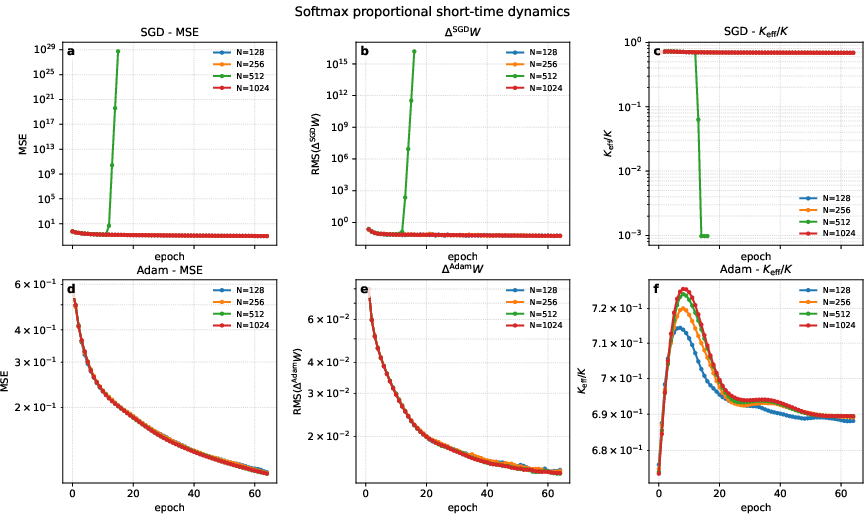
- With softmax activations, SGD often becomes unstable as models get big (gradients can get very lopsided).
- Adam is much more stable and gives good hyperparameter transfer with softmax.
- It works beyond simple settings:
- The rules discovered for the linear case also work well for nonlinear ReLU-type activations (even for steeper versions like ReLU to a power).
- The approach still helps on more realistic, uneven data and on MNIST, not just on neat random data.
Why is this important?
Training big AI models takes a lot of time and money, and hyperparameter tuning is a big part of that cost. This paper gives practical, easy-to-apply rules for DenseAMs so you can:
- Tune on a small model and transfer settings to a big model with confidence.
- Avoid training failures caused by the wrong scales or learning rates.
- Use centering to keep signals well-behaved as models grow.
- Choose the right optimizer for the activation (Adam for softmax).
DenseAMs are being used in new kinds of models (like energy-based transformers and energy-based LLMs). Having reliable scaling rules helps these models train smoothly and predictably as they get larger.
Bottom line
The authors show that with a few simple rules—how to scale initialization, how to scale learning rates, and the importance of centering—you can make DenseAMs train in almost the same way at small and large sizes. This saves tuning time and makes it easier to build bigger, better energy-based AI systems. Future work can extend these ideas to deeper, more complex architectures, but this paper lays a solid foundation.
Knowledge Gaps
Knowledge gaps, limitations, and open questions
Below is a concise, actionable list of what remains missing, uncertain, or unexplored in the paper.
- Analytic theory beyond linear activations
- A full, rigorous characterization of DenseAM training dynamics (e.g., limiting ODE/PDE or mean-field description) is only provided for linear activations under isotropic data; non-linear cases (ReLUp, softmax) rely largely on empirical evidence and heuristic arguments.
- The observed “dynamical collapse” across scales for non-linear models lacks a theoretical proof and precise characterization (e.g., invariants, sufficient conditions, rates).
- Necessity and optimality of centering
- While pre/post-activation centering is shown to be practically necessary for stability and transfer, the paper does not provide a general theoretical statement of necessity (beyond specific calculations) or prove optimality compared to alternatives (e.g., LayerNorm, mean-only centering, per-batch vs per-token centering).
- The impact of centering on the energy-based interpretation and on the convexity/regularity conditions of the underlying Lagrangians is only partially addressed in the appendix.
- SGD instability for softmax
- The analysis shows empirical instability of SGD with softmax and recommends Adam, but does not establish whether an alternative parameterization, temperature scaling (softmax β), or learning-rate schedule can make SGD stable in the proportional regime.
- No guidance is given on how to scale β (softmax temperature) with K or N to preserve training stability or ensure transfer.
- Optimizer scope and prescriptions
- Prescriptions focus on learning-rate scaling for SGD and Adam; there is no analysis for other optimizers (e.g., RMSProp, AdaFactor, Adagrad, Lion) or for momentum/beta hyperparameters (Adam’s β1, β2, ε) and their scale transfer.
- Weight decay and its interaction with HP transfer (especially in light of known conflicts with μP) are not studied; no scaling rules are given for decoupled weight decay or regularization coefficients.
- Data assumptions and transfer across real, anisotropic inputs
- Core derivations assume isotropic Gaussian inputs; transfer to anisotropic or real data (e.g., MNIST) is only empirically illustrated without a principled mapping of data-generating processes across N (e.g., how to define “proportional scaling” for non-Gaussian, structured inputs).
- Robustness to heavy-tailed, non-Gaussian, or correlated noise, and to varying noise levels σ_ε, is not analyzed.
- Scope limited to shallow, single-step updates
- The model is a single (discrete) step of energy descent with tied weights. Extensions to multi-step/T-step unrolled DenseAM dynamics (depth scaling), their HP transfer, and stability as T grows are not developed.
- Interactions of HP transfer with time discretization (dt vs τx), step size, and residual dynamics across multiple iterations remain open.
- Scaling regimes beyond “proportional” and width-only
- Only two regimes are considered: proportional (N, K, P, B scale together) and K-only (width scaling). How to transfer HPs when only P, B, or N scale (individually) is not addressed.
- Behavior and transfer rules in unbalanced regimes (e.g., K ≫ N but P small, or P ≫ N with moderate K) are not characterized.
- Generalization and task diversity
- The study focuses on a denoising MSE objective; it does not explore whether the same HP transfer rules apply to other objectives (classification, contrastive, autoregressive, energy-model likelihoods) or downstream tasks (e.g., PDE solving, sequence modeling).
- No analysis of generalization, robustness, or memory capacity under the proposed parameterization, despite DenseAMs’ original motivation in associative memory.
- Hyperparameter constants and practical tuning
- The theory specifies asymptotic scalings (e.g., s1 ∼ 1/√N, s2 ∼ 1/√K or √K) but leaves the base constants (s1,0, s2,0, η0, ηb,0, ηc,0) to empirical sweep; no zero-shot prescription or calibration method is provided.
- There is no discussion of learning-rate schedules, warmups, or how training duration (steps/epochs) should scale with P and B to maintain compute- or optimization-compatibility.
- Bias parameters and nonlinearity g(·)
- The interplay of the bias terms (b, c) with centering and scaling is not fully explored (e.g., whether bias scaling or separate normalization improves stability/transfer).
- The choice g = tanh is motivated by boundedness, but how results depend on g (e.g., identity, GELU, piecewise-linear bounded functions) is not analyzed.
- Tied-weight “balance” in non-linear settings
- The balanced decomposition of updates (ensuring equal-order contributions from the two appearances of W) is derived for linear σ but not proven for non-linear σ under centering; it remains unclear when and why the balance holds exactly in non-linear regimes.
- Batch-size and gradient-noise effects
- Although B scales proportionally in the main regime, the effect of gradient noise on transfer (e.g., variance scaling, small-batch vs large-batch behavior, noise-induced dynamics) is not theoretically treated.
- The consequences of microbatching, gradient accumulation, and non-iid batching for HP transfer are not examined.
- Input/output growth and data pipelines
- Practical methods to scale N for complex modalities (e.g., images, graphs, text tokens) are not formalized beyond simple projection or MNIST plaquette coarsening; how to design scalable data pipelines that preserve “proportionality” remains open.
- Compatibility with larger energy-based architectures
- The paper focuses on a minimal DenseAM block; how to compose HP transfer rules within larger systems (e.g., Energy Transformers, NRGPT) with multiple modules, attention, gating, or recurrence is left unexplored.
- Numerical stability at high nonlinearity (large p)
- While Adam is empirically stable for large ReLU powers (e.g., p = 10), no theoretical bounds characterize stability regions or predict failure modes as p grows.
- The interaction between steep activations and finite-precision arithmetic (e.g., saturation, overflow) is not characterized under the proposed scalings.
- Initialization assumptions
- Analyses assume standard Gaussian initialization; it is unclear how alternative initializations (He, Xavier, orthogonal) interact with the proposed scalings and whether they improve stability or transfer quality.
- Formal guarantees and limits
- There are no formal convergence or consistency guarantees (e.g., proving that losses or internal statistics converge to scale-independent limits as N, K, P, B → ∞ under the given scalings).
- Finite-size corrections and their impact on transfer quality are not quantified; conditions for when transfer breaks (e.g., small N or K) are not specified.
Practical Applications
Immediate Applications
Below are concrete ways practitioners can use the paper’s prescriptions today, with sectors, candidate tools/workflows, and key assumptions noted.
- Compute-efficient hyperparameter (HP) transfer for DenseAM modules
- Sectors: software/ML platforms, NLP, vision, scientific computing
- What: Tune a small DenseAM (or DenseAM submodule) once, then transfer learning rates and initialization scales to larger N (input/output dimension), K (width), P (dataset size), and B (batch size) using the paper’s scaling rules and two regimes (simultaneous model+data scaling; model-only scaling).
- Tools/workflows:
- “HP-transfer” utility that logs a single effective learning rate η₀ and maps it to large-scale settings (including η_W∝K for SGD, Adam invariance, and s₁/s₂ scaling).
- Training configs that switch to Adam for softmax-based DenseAMs.
- Assumptions/dependencies:
- Best guarantees in the proportional regime (N,K,P,B scaled together); for fixed data, width-only scaling is supported but without full dynamics collapse.
- Derivations assume isotropic inputs; empirical evidence suggests robustness to anisotropy but requires care (e.g., projection, whitening).
- Stable training of energy-based layers via pre/post-activation centering
- Sectors: software, NLP (e.g., energy-based GPT variants), vision (Energy Transformers), robotics (associative memories)
- What: Wrap DenseAM hidden layers with the centering operator (σ_C = C ∘ σ ∘ C) to subtract the layer-wise mean before and after the nonlinearity, preventing divergence and enabling LR transfer.
- Tools/workflows:
- Reusable “CenterLayer” module in PyTorch/JAX that applies the C projection.
- Unit tests monitoring centered statistics and gradient norms.
- Assumptions/dependencies:
- Centering preserves a valid learned energy (shown in the paper’s appendix).
- Required for consistent HP transfer with ReLU-type and softmax activations.
- Robust softmax DenseAM training with Adam (not SGD)
- Sectors: contrastive learning, retrieval, attention-like energy modules
- What: Use Adam for softmax activations to avoid scale-induced instabilities (SGD gradients are unevenly amplified by tied weights in softmax). Apply the paper’s s₁/s₂ and η rules for Adam.
- Tools/workflows:
- Optimizer policy that automatically switches to Adam for softmax-based hidden layers.
- Mixed-precision settings validated for gradient stability (bf16/fp32 as appropriate).
- Assumptions/dependencies:
- Requires centering for stability.
- Adam’s scale-invariance is key; SGD may be unstable at large N,K,P,B.
- Width-only scaling for DenseAM upgrades in existing systems
- Sectors: NLP (inference-time memory), vision (memory-augmented models), finance/time-series modules
- What: Keep N,P fixed and scale K using the width-only prescription to expand associative memory capacity with minimal re-tuning.
- Tools/workflows:
- “Width-scaler” that adjusts s₂ and η_W as K changes (per table/prescriptions).
- Smoke tests tracking metrics for stability and retrieval/denoising quality.
- Assumptions/dependencies:
- No full dynamics collapse is expected unless K≫N,P or the proportional regime is used.
- Data-preprocessing to enter proportional scaling for transfer
- Sectors: vision (image up/down-sampling), tabular (random projections), scientific ML (dimensional reductions)
- What: Adjust input dimension N via principled projections to induce proportional scaling, enabling zero-shot transfer of tuned HPs across scales.
- Tools/workflows:
- Vision: deterministic coarse-graining / upsampling pipelines (as in MNIST experiments).
- Tabular/scientific: PCA/whitening or random projections; maintain trace normalization to match variance assumptions.
- Assumptions/dependencies:
- Closer to isotropic statistics simplifies transfer; for anisotropic distributions, preprocessing reduces mismatch.
- Faster iteration for Energy Transformers and energy-based GPTs (NRGPT)
- Sectors: NLP, vision, scientific computing/PDE solvers
- What: Reduce training cycles by tuning on small models and transferring HPs when scaling the energy-based token-evolution modules.
- Tools/workflows:
- Module-level recipes: (1) center activations, (2) apply s₁/s₂ scaling, (3) use Adam for softmax, (4) pick η₀ at small scale and transfer.
- CI pipelines that validate “dynamics collapse” metrics across two scales before full-scale training.
- Assumptions/dependencies:
- The submodules follow the tied-weight, single-step (or few-step) DenseAM structure; deeper/iterative variants may require additional validations.
- AutoML/MLOps integration for DenseAM scaling
- Sectors: ML platforms, enterprise MLOps
- What: Embed the scaling prescriptions into AutoML to automatically rescale LRs and initializations as users change N, K, P, B, and nonlinearity.
- Tools/workflows:
- “Scaling-aware” config generators (η_W, η_b, η_c, s₁, s₂) with guards for activation types.
- Dashboard for monitoring collapse of training curves and internal covariances across scales.
- Assumptions/dependencies:
- Users must identify if they are in proportional or width-only scaling regime.
- Edge-to-cloud model transfer and cost-aware training
- Sectors: edge AI, embedded systems, enterprise platforms
- What: Tune on-device (small N,K,P,B) and transfer HPs to cloud-scale training, reducing cloud compute burn.
- Tools/workflows:
- Configuration exporters capturing η₀ and centering settings.
- Validation suite comparing small-scale and large-scale early training trajectories.
- Assumptions/dependencies:
- Requires consistent preprocessing across devices (e.g., matching projections/normalizations).
- Education and research reproducibility for DenseAMs
- Sectors: academia, open-source
- What: Use the proportional scaling protocol to create reproducible baselines where training dynamics collapse across scales, enabling controlled experiments.
- Tools/workflows:
- Open-source notebooks with small/large runs demonstrating collapse of MSE and feature covariances.
- Reference datasets and projection scripts for isotropic and anisotropic cases.
- Assumptions/dependencies:
- Careful adherence to centering and scaling details is necessary to reproduce collapses.
Long-Term Applications
These applications build on the paper’s methods but require additional research, engineering, or scaling.
- Extending HP transfer to deep/iterative DenseAMs and full Energy Transformers
- Sectors: NLP, vision, scientific computing, robotics
- What: Generalize the prescriptions from one-step updates to multi-step energy descent and deep stacks of DenseAM blocks (full energy-based architectures).
- Potential tools/products:
- “Energy-stack” libraries with layerwise centering, scaling schedulers, and optimizer policies.
- Cross-depth “CompleteP-like” transfer frameworks for tied-weight systems.
- Dependencies/risks:
- Need new theory for interacting layers/iterations; additional balancing constraints with deeper weight sharing.
- General hyperparameter transfer framework for energy-based models (EBMs) with tied weights
- Sectors: software/ML platforms, foundation model R&D
- What: A unified μP-style framework adapted to EBMs, covering diverse nonlinearities (incl. steep/contrastive), optimizers, and dataset anisotropy.
- Potential tools/products:
- Plug-ins for popular training libraries that enforce balance conditions across multiple appearances of tied weights.
- Dependencies/risks:
- Requires formalizing “balanced” updates for arbitrary architectures; more theory for anisotropic data regimes.
- Task- and data-aware proportional scaling for realistic domains
- Sectors: healthcare imaging, geospatial, finance/time-series
- What: Domain-specific projections and scalings (e.g., physics-informed embeddings in PDE solvers) to approximate proportional regimes for HP transfer.
- Potential tools/products:
- Projection builders (PCA, domain-specific transforms) that maintain variance structure and facilitate transfer.
- Dependencies/risks:
- Must validate that projections preserve task-relevant information; data anisotropy may undermine collapse.
- Optimization and activation design for EBMs inspired by centering
- Sectors: AI research, hardware co-design
- What: New activation/normalization layers for EBMs that guarantee balanced gradients with tied weights; hardware-friendly centering primitives.
- Potential tools/products:
- “Centered-softmax” variants; fused centering kernels on accelerators.
- Dependencies/risks:
- Requires empirical/hardware validation; potential numerical trade-offs with mixed precision.
- Compute- and carbon-efficient training policies informed by HP transfer
- Sectors: policy/governance, enterprise sustainability
- What: Organizational guidelines recommending small-scale tuning with proportional scaling to reduce large-scale trial-and-error.
- Potential tools/products:
- Estimators projecting energy/emissions savings from transfer-based training.
- Dependencies/risks:
- Benefits depend on faithful adherence to scaling/centering and applicability to the organization’s model class.
- AutoML for EBMs with zero-shot HP transfer across tasks
- Sectors: ML platforms, enterprise AI
- What: Learn task-agnostic “dimensionless” HPs (η₀-style) on proxy tasks and transfer across applications (denoising, retrieval, generation).
- Potential tools/products:
- Cross-task HP repositories and controllers that map proxy-optimized η₀ to target scales.
- Dependencies/risks:
- Need broader empirical validation across tasks and data distributions.
- Foundation models with associative-memory submodules trained at scale
- Sectors: NLP (energy-based GPTs), multimodal models, agents/robotics
- What: Incorporate larger DenseAM-based memory modules with predictable behavior under scaling, improving recall/retrieval without prohibitive retuning.
- Potential tools/products:
- Memory-augmented LLMs with HP transfer-aware recipes for periodic capacity upgrades.
- Dependencies/risks:
- Integration complexity with existing training recipes (e.g., sequence length scaling, optimizer schedules).
- Hardware-aware scheduling for tied-weight gradients
- Sectors: accelerators, systems software
- What: Runtime/compilers that account for two gradient paths through tied weights (outer and hidden updates), balancing memory/compute and numerical stability at scale.
- Potential tools/products:
- Compilers that automatically insert centering and adjust scaling in forward/backward passes.
- Dependencies/risks:
- Requires close co-design with training stacks; benefits contingent on adoption.
- Federated and low-resource training via small-to-large HP transfer
- Sectors: edge/federated learning, privacy-preserving AI
- What: Use local, small-scale DenseAM tuning (privacy-preserving) to select HPs deployed at larger, central training scales without sharing raw data.
- Potential tools/products:
- Federated HP-transfer protocols that only share η₀-like dimensionless parameters and centering flags.
- Dependencies/risks:
- Heterogeneous client data may violate proportional-scaling assumptions; requires robust aggregation strategies.
Notes on Assumptions and Dependencies (cross-cutting)
- Derivations are exact for linear activations with isotropic Gaussian inputs; nonlinear and anisotropic cases are empirically validated but need further theory.
- Centering of pre/post activations is critical for stability and transfer in nonlinear (ReLUp, softmax) DenseAMs.
- For softmax, Adam is recommended at scale; SGD can be numerically unstable due to unbalanced gradient amplification through tied weights.
- Proportional regime requires a way to adjust input dimension N and dataset size P; where infeasible, use width-only scaling and expect partial transfer (no full dynamics collapse).
- Mixed-precision and large p (steep nonlinearities) may require careful numerical safeguards even with Adam.
Glossary
- Adiabatic limit: A regime where hidden neurons evolve much faster than feature neurons, allowing them to be treated as at steady state when analyzing the slower dynamics. "Now consider the adiabatic limit, so that hidden neurons evolve on a much faster time scale compared to feature neurons."
- Anisotropic data: Data whose covariance is not proportional to the identity matrix, so statistical properties depend on direction. "anisotropic inputs "
- Balanced parameterization: A scaling choice ensuring that contributions to updates from different occurrences of tied weights and biases are comparable in magnitude. "The requirement for a balanced parameterization as in \eqref{eq:balanced} --particularly the requirement that $\Delta_W^{_{(1)}F$ and $\Delta_W^{_{(2)}F$ match in scale -- is therefore novel."
- Centering: Mean subtraction of pre- and post-activations at a layer to stabilize training and enable transfer. "this mean-subtraction, which we refer as ``centering'', still gives a valid learned energy function."
- Centering operator C: A projection matrix that removes the layer-wise mean by projecting onto the subspace orthogonal to the all-ones vector. "Notice that the matrix (which stands for ``centering'') is the projection in the latent space to the orthogonal complement of the all ones vector ."
- Contrastive Lagrangian: A hidden-layer Lagrangian that couples units via a log-sum-exp form, yielding softmax activations. ""
- Contrastive non-linearity: An activation that normalizes across units (e.g., softmax) rather than acting independently per neuron. " may be either a neuron-wise non-linearity or a contrastive non-linearity, such as softmax."
- Dense Associative Memory (DenseAM): An energy-based neural architecture whose forward pass performs temporal dynamics over an energy function. "Dense Associative Memory (DenseAM) is a promising family of AI architectures that is represented by a neural network performing temporal dynamics on an energy landscape."
- Denoising objective: A training objective to reconstruct clean inputs from noisy versions, typically via MSE. "Learning rate transfer for a ReLU DenseAM trained by minimizing the denoising objective \eqref{eq:loss}"
- Effective energy: The reduced energy function obtained by eliminating fast variables (hidden neurons) under the adiabatic assumption. "and the effective energy -- substitute Eq. (\ref{Eq: adiabatic steady-state}) into the definition of energy (\ref{Eq: two-layer system energy}) -- is given by"
- Effective learning rate: A scalar summarizing the tuned step size after scaling rules, used to compare learning rates across scales. "Here is the effective learning rate (see Table \ref{tab:results})."
- Energy-based associative memory networks: Models that define a global energy over states and perform retrieval by descending this energy. "DenseAMs are energy-based associative memory networks"
- Energy-based GPT (NRGPT): A GPT-like model where token updates are governed by energy descent rather than conventional autoregressive forward passes. "Energy-based GPT models (NRGPT) use dynamical evolution of tokens on the energy landscape"
- Energy descent dynamics: Update dynamics that move the system state toward lower energy, typically following the negative energy gradient. "according to non-linear dynamical equations describing energy decent dynamics."
- Energy landscape: A scalar function over network states whose topology encodes the computation performed by the model. "performing temporal dynamics on an energy landscape."
- Energy Transformers: Architectures that evolve tokens by descending a learned energy, enabling tasks like image or graph completion. "Energy Transformers \cite{hoover2023energy} evolve a collection of tokens on a learned energy landscape"
- Hopfield networks: Classic associative memory models retrieving stored patterns via energy-minimizing dynamics; DenseAMs generalize them. "They generalize the celebrated Hopfield networks"
- Hyperparameter transfer (HP transfer): The practice of mapping hyperparameters tuned on small models/datasets to larger-scale settings. "it is common instead to aim for hyperparameter transfer, in which one first finds empirically good settings of HPs on small models and datasets and uses them to estimate performant HPs at larger scale."
- Isotropic data: Data with covariance proportional to the identity matrix, having identical statistics in all directions. "isotropic data "
- Lagrangian (neuron-wise): A per-neuron function whose derivative defines the activation; convexity ensures energy decreases along dynamics. "The Lagrangian for the feature neurons, , is neuron-wise and the Lagrangian for the hidden neurons, , can be neuron-wise or contrastive"
- Mixture-of-Experts (MoE): A modular architecture where a gating mechanism routes inputs to a subset of expert networks. "sparse transformers with MoE layers"
- μP heuristic: A scaling framework (mu-Parameterization) to preserve and transfer training dynamics across model sizes. "often built on the P heuristic"
- Neuron-wise non-linearity: An activation applied independently to each unit without coupling across units. " may be either a neuron-wise non-linearity or a contrastive non-linearity, such as softmax."
- Proportional scaling regime: An asymptotic regime where N, K, P, and B grow in fixed ratios, yielding consistent dynamics and transfer. "collapse in the proportional scaling regime"
- Scale invariance: An optimizer property where certain rescalings of parameters or activations leave the update dynamics unchanged. "In contrast, Adam is scale-invariant"
- Softmax: A contrastive activation that exponentiates and normalizes across units, often used to model categorical distributions. "In the important setting of "
- Tied weights: The practice of reusing the same weight matrix in multiple parts of the model, as required by energy formulations. "Due to the presence of tied weights, the output and input dimensions agree."
Collections
Sign up for free to add this paper to one or more collections.