- The paper demonstrates that deterministic orchestration yields superior worst-case robustness and reduced token consumption compared to LLM-controlled methods.
- Results show LLM orchestration achieves a higher success rate of runnable translations at the expense of increased execution variance and cost.
- Implications suggest employing deterministic pipelines in structured workflows to ensure stability, scalability, and economic viability in legacy modernization.
Deterministic and LLM-Controlled Orchestration for Legacy Code Modernization: An Empirical Assessment
Introduction
Legacy system modernization, especially for COBOL-to-Python migration, has garnered significant interest due to operational, economic, and workforce constraints in critical sectors. Recent advances in LLMs have enabled complex agentic workflows involving multi-step tool integration, yet the effectiveness of delegating execution control to LLMs in structured modernization remains ambiguous. This study ("Deterministic vs. LLM-Controlled Orchestration for COBOL-to-Python Modernization" (2605.09894)) systematically compares deterministic orchestration with agentic LLM-controlled orchestration in a controlled framework, isolating execution control as the experimental variable. The ATLAS system provides the backbone for this empirical analysis.
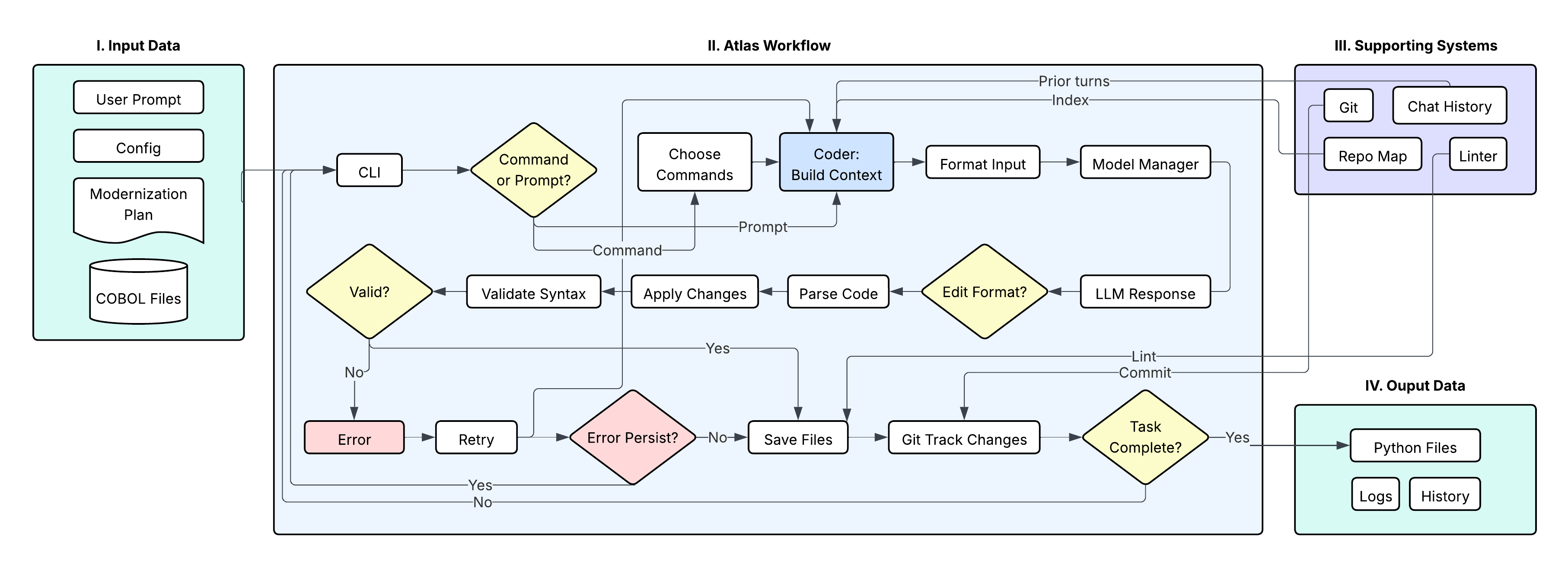
Figure 1: ATLAS system architecture supporting end-to-end COBOL-to-Python modernization through fixed or adaptive orchestration strategies.
Orchestration Paradigms
Deterministic orchestration refers to a pipeline where tool invocation, execution order, and validation stages are statically defined. Tool ordering and retry logic are invariant across runs, and the LLM is limited to code generation; all orchestration decisions leverage explicit control logic. In contrast, LLM-controlled orchestration delegates tool selection, execution ordering, retries, and termination to the LLM. This agentic paradigm dynamically adapts trajectories based on intermediate output and stochastic sampling, introducing non-determinism into execution traces even with identical base configurations.
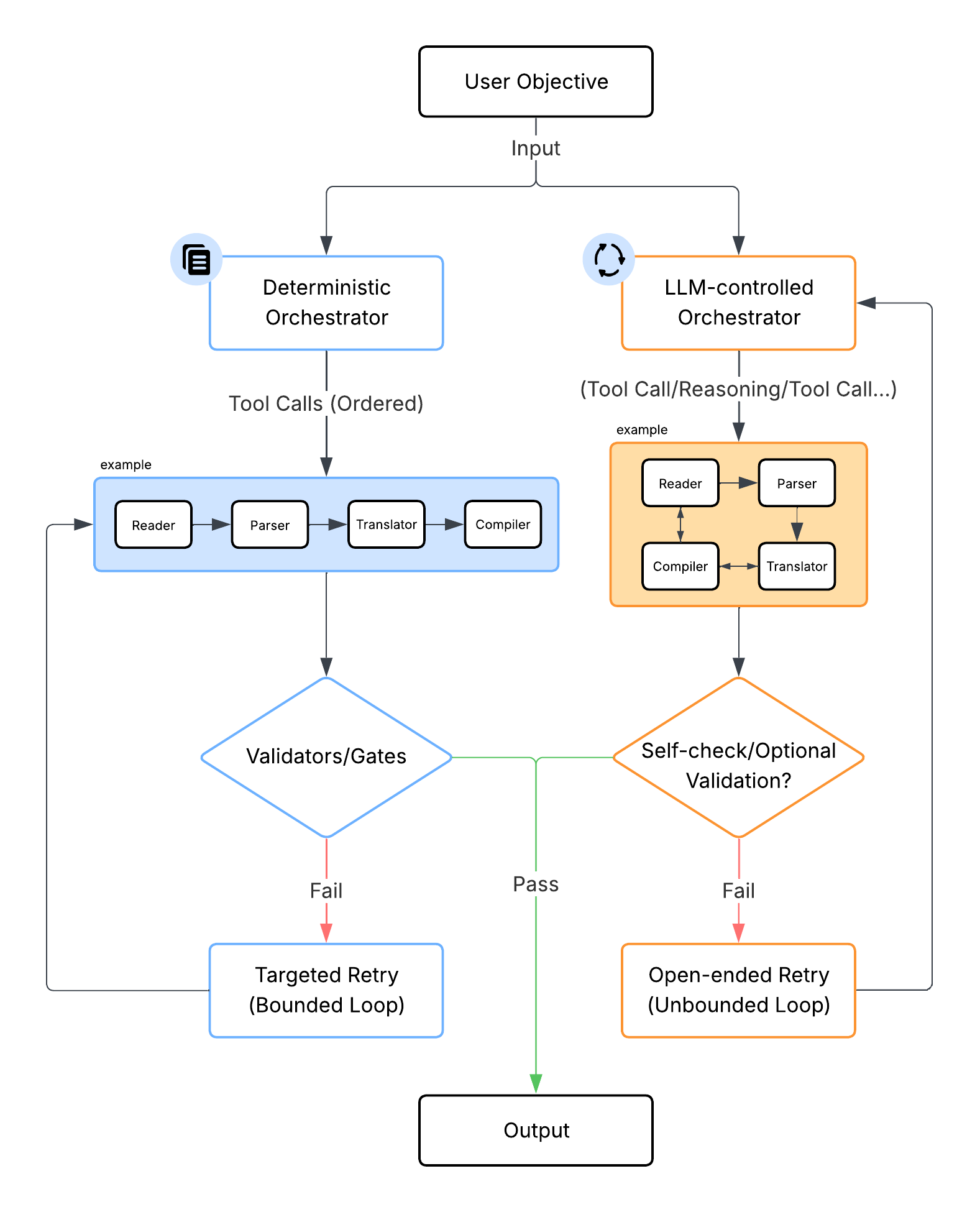
Figure 2: Workflow comparison between deterministic and LLM-controlled orchestration, highlighting static vs. adaptive task sequencing and branching.
Experimental Framework
Using the ATLAS platform, experiments are conducted with identical models, prompts, tools, source programs, and configurations, isolating orchestration as the sole variable. The evaluation leverages the NIST COBOL85 Test Suite, encompassing hundreds of COBOL programs with structured test cases. Metrics include:
- Computational Accuracy (CA): Measures semantic equivalence.
- Success Rate (SR): Fraction of runs yielding runnable, correct outputs.
- Worst-case robustness: P5-CA (5th percentile accuracy) and CVaR0.1 (severity in failure tails).
- Efficiency: Token consumption per successful translation and associated operational costs.
Results and Analysis
Correctness and Robustness
Both orchestration paradigms attain nearly identical mean translation correctness for finalized outputs. Notably, deterministic orchestration achieves higher CA, P5-CA, and CVaR0.1 across all evaluated models, indicating reduced error propagation and higher output stability. LLM-controlled orchestration yields higher SR across repeated stochastic runs, demonstrating more frequent generation of runnable, test-passing translations, but with heavier performance tails and increased execution variance.
Computational Efficiency
Deterministic orchestration achieves substantial reductions in token consumption—up to 3.5× lower compared to LLM-controlled runs, notably in complex COBOL modules (Numeric, Sequential I/O). LLM-controlled orchestration incurs increased token expenditures due to variable-length execution and repeated agentic reasoning steps.
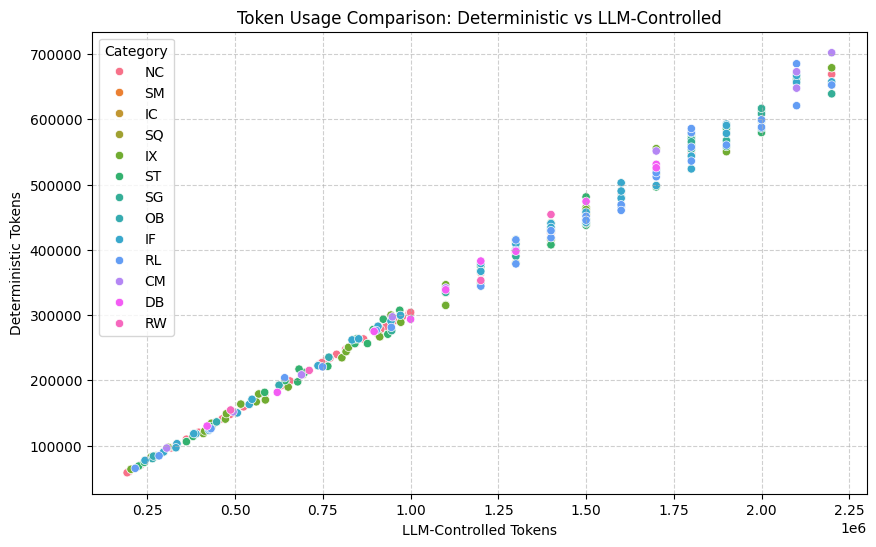
Figure 3: Token usage per successful translation, showing deterministic orchestration minimizes token requirements across COBOL modules.
This resource inefficiency translates directly into operational cost, with deterministic pipelines consistently yielding lower costs per successful translation. The planning-tax associated with agentic orchestration produces significant financial penalties without offsetting quality gains.
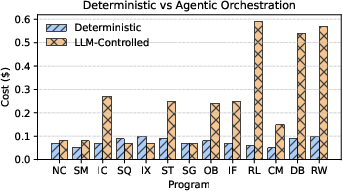
Figure 4: Cost comparison by orchestration strategy for COBOL benchmark programs, emphasizing deterministic orchestration's economic advantages.
Test Suite Coverage
Aggregate statistics reveal near parity between approaches in numbers of program executions, errors, and test cases inspected. Minor differences in pass/fail counts align with observed correctness and robustness trends, suggesting deterministic orchestration offers marginally improved reliability for the same set of translated programs.
Limitations
The study's scope is limited to COBOL-to-Python modernization. Potential generalizability issues include distinct language features, workflow dependencies, and integration requirements not captured by standardized benchmarks. Furthermore, correctness is measured relative to test suite coverage, which may omit latent semantic errors. The advantages of deterministic orchestration presuppose explicit validation stages; in less structured workflows, agentic control may provide additional flexibility. Efficiency metrics are framed by token usage and API pricing, not full production deployment costs.
Implications and Future Directions
The empirical results demonstrate that execution control profoundly shapes outcome distribution in LLM-powered modernization workflows. Deterministic orchestration constrains error drift, improves worst-case behavior, and minimizes cost, making it preferable for mature, verifiable workflows. LLM-controlled strategies maximize solution frequency at the expense of efficiency and reproducibility. The findings indicate system architects should decouple generative reasoning from execution control in enterprise modernization tasks, embedding LLMs within deterministic frameworks to attain stable, scalable, and economically viable solutions.
Hybrid orchestration architectures, combining deterministic pipelines with bounded agentic interventions, warrant further exploration. Extending this analysis to heterogeneous environments, mixed-language dependencies, and real-world operational constraints remains an important direction. Long-horizon execution, runtime envelope, and production deployment tradeoffs should be systematically characterized to refine orchestration strategies for broader AI-driven software engineering.
Conclusion
This study rigorously isolates orchestration strategy within LLM-based COBOL-to-Python modernization, revealing that deterministic execution achieves comparable correctness, superior robustness, and lower operational cost relative to agentic LLM-controlled orchestration. The research clarifies the value of fixed execution policies in structured modernization workflows and underscores execution control as a critical systems design parameter. Future work should generalize these results to alternative domains and hybridize orchestration modes to balance adaptivity, reproducibility, and efficiency in large-scale AI-driven software modernization.

