Higher-order local constraints from reciprocal symmetry and entanglement entropy of charged-particle multiplicity distributions in pp collisions
Published 9 May 2026 in hep-ph | (2605.08736v1)
Abstract: The reciprocal symmetry fs(z)=fs(1/z) of the KNO-violating term in proton--proton charged-multiplicity distributions, observed at s=7, $8$ and $13$ TeV, implies that the function h(u)≡fs(e<sup>u) is even in u=lnz. Each odd derivative of h at u=0 then provides a local algebraic constraint on the multiplicity distribution at n=⟨n⟩. The k=0 constraint $P'(\langle n\rangle)=-P(\langle n\rangle)/\langle n\rangle$ has been verified previously. We derive the k=1 constraint, $\langle n\rangle<sup>3</sup> P'''(\langle n\rangle)+6\langle n\rangle<sup>2</sup> P''(\langle n\rangle)=5\,P(\langle n\rangle)$, equivalent to the unconditional residual δ3≡1−2ρ0+ρ1=0, and test it in the ATLAS data: at $13$~TeV with the largest fit window we find δ3=−0.02±0.11, consistent with the leading-order symmetric value, while the $7$ and $8$~TeV results are inconclusive at the available precision. A χ<sup>2 test of the global symmetry across the window $1/3<z<3$ is consistent with the symmetry at $7$ and $8$~TeV but rejects it decisively at $13$~TeV, where the smaller experimental uncertainties expose a residual departure from z→1/z invariance away from z=1. The overall picture is therefore that the symmetry holds at the leading two non-trivial orders near z=1 but breaks down globally at the precision afforded by the $13$~TeV data, suggesting that fs(z)=fs(1/z) is at best an approximate symmetry. We derive a model-independent expression for the entanglement entropy S=ln⟨n⟩+1−21∫0<sup>∞</sup>e<sup>−zfs<sup>2(z)dz+O(fs<sup>3), in which the linear term in fs cancels by virtue of normalisation and the constraint ⟨z⟩=1, and evaluate it numerically on the ATLAS data.
The paper establishes a hierarchy of local constraints derived from approximate reciprocal symmetry in KNO-violating charged-particle multiplicity distributions.
It rigorously verifies these constraints with high-fidelity local polynomial fits to ATLAS data at 7, 8, and 13 TeV, providing quantitative null tests for QCD models.
It develops a model-independent entropy expansion linking multiplicity fluctuations to quantum entanglement, offering new insights into QCD cascade dynamics.
Higher-Order Local Constraints, Reciprocal Symmetry, and Entanglement Entropy in Charged-Particle Multiplicity Distributions
Introduction
This work undertakes a systematic investigation into the algebraic and physical consequences of the approximate reciprocal symmetry fs(z)=fs(1/z) in KNO-violating charged-particle multiplicity distributions, specifically for proton-proton (pp) collisions at LHC energies. The symmetry, emerging empirically from ATLAS data at s=7,8,13 TeV, leads to an infinite hierarchy of local constraints imposed on the probability distribution near the mean multiplicity, and further informs a model-independent expansion for the entanglement entropy in QCD-motivated event structures. The manuscript rigorously tests these algebraic constraints in experimental data, discriminates candidate dynamical mechanisms, and quantifies implications for entropy and information-theoretic interpretations.
Reciprocal Symmetry and the Tower of Local Constraints
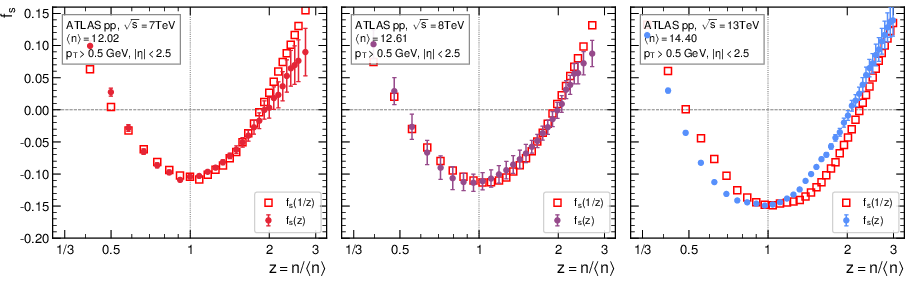
Defining the KNO deviation function fs(z)≡⟨n⟩Pn−e−z in the scaling variable z=n/⟨n⟩, earlier analyses established that this function exhibits approximate invariance under z→1/z in LHC multiplicity data within $1/3 < z < 3$. This symmetry is sharply encoded in the variable transformation h(u)=fs(eu) with u=lnz, which renders h an even function. Consequently, all odd derivatives at pp0 must vanish, producing a series of algebraic constraints on pp1 and its derivatives evaluated at pp2.
The leading constraint (pp3) is the previously validated first-derivative relation,
pp4
while the pp5 constraint, analytically derived in this work, enforces a non-trivial third-derivative algebraic identity:
pp6
Expressed via experimentally accessible dimensionless ratios pp7, and residual pp8, these provide concrete null tests for the presence of the symmetry and KNO scaling violations.
Figure 1: The function pp9 (filled circles) and s=7,8,130 (open squares) plotted versus s=7,8,131 for ATLAS s=7,8,132 data at different energies, demonstrating the empirical reciprocal symmetry in s=7,8,133.
Experimental Verification in ATLAS Data
The manuscript implements high-fidelity local polynomial fitting over unit-width bins near s=7,8,134 at 7, 8, and 13 TeV, extracting derivatives and ratios s=7,8,135, s=7,8,136, and the unconditional constraint s=7,8,137. The analysis finds:
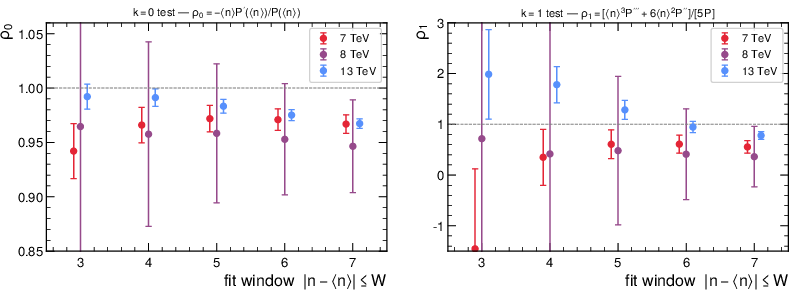
For s=7,8,138 (s=7,8,139), all energies and fit windows yield values consistent with unity within a few percent, corroborating the local extremum near fs(z)≡⟨n⟩Pn−e−z0.
For the higher-order constraint (fs(z)≡⟨n⟩Pn−e−z1), at 13 TeV (largest window), fs(z)≡⟨n⟩Pn−e−z2, matching the symmetric prediction. At 7 and 8 TeV, larger experimental uncertainties and systematic instabilities limit the statistical power, with deviations being inconclusive given the method sensitivity to fit choices and bin correlations.
Crucially, a global symmetry test using fs(z)≡⟨n⟩Pn−e−z3 across fs(z)≡⟨n⟩Pn−e−z4 finds that while reciprocal symmetry is consistent at 7 and 8 TeV, it is significantly violated at 13 TeV, with high precision revealing residual asymmetries predominantly away from fs(z)≡⟨n⟩Pn−e−z5. Thus, the symmetry is robust locally but not globally maximal in the data.
Figure 2: Local-fit extraction of fs(z)≡⟨n⟩Pn−e−z6 and fs(z)≡⟨n⟩Pn−e−z7 as functions of fit window fs(z)≡⟨n⟩Pn−e−z8 for ATLAS data, showing stability of fs(z)≡⟨n⟩Pn−e−z9 and the fit-range sensitivity of z=n/⟨n⟩0.
Model Discrimination: Cascade Dynamics and Noise
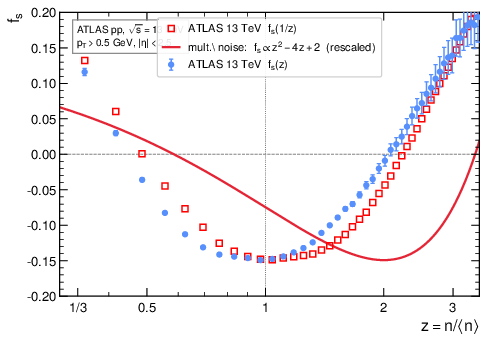
The work probes the dynamical origin of the observed symmetry by constructing a multiplicative-noise extension of Mueller's Markov color-dipole cascade, incorporating log-symmetric rate fluctuations. The leading perturbative correction yields z=n/⟨n⟩1, a function that is manifestly not symmetric under z=n/⟨n⟩2, and exhibits a minimum displaced from z=n/⟨n⟩3.
Further, mixture models (e.g., two-component geometric, negative binomial) are also inconsistent with the observed symmetry except in trivial limits (pure geometric). Thus, neither Markovian noise nor conventional particle production models generate the necessary reciprocal structure, indicating that any viable microscopic description must transcend these frameworks, possibly via mechanisms involving dipole merging, Pomeron loops, or effective AGK-type resummation.
Figure 3: Comparison of the multiplicative-noise polynomial z=n/⟨n⟩4 with empirical z=n/⟨n⟩5 and z=n/⟨n⟩6 from ATLAS 13 TeV data, highlighting absence of reciprocal symmetry in the noise model.
Entanglement Entropy: Expansion and Empirical Tests
A second main result is the development of a model-independent expansion for the entanglement (Shannon) entropy in terms of the small KNO-violating deviation z=n/⟨n⟩7. The linear term in z=n/⟨n⟩8 is shown to cancel identically due to normalization and mean constraints on z=n/⟨n⟩9, yielding the formula:
z→1/z0
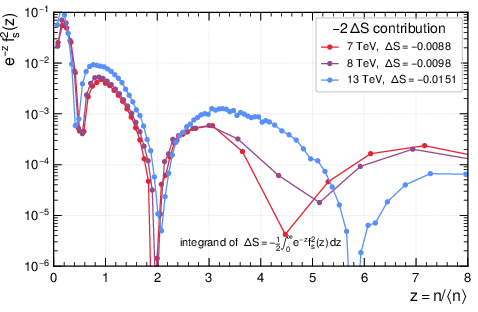
where z→1/z1 accounts for finite support in the data. The dominant entropy correction is always negative, reflecting the decrease in entropy relative to the maximal value for a pure geometric cascade.
Numerical evaluation using ATLAS data finds excellent agreement (within z→1/z2) between entropy extracted via direct summation and the analytic expansion, validating the truncation and quantifying the contribution from the central multiplicity window.
Figure 4: Integrand z→1/z3 entering the entropy correction, peaking near z→1/z4 with significant contributions from high-z→1/z5 tails, for ATLAS data at three LHC energies.
Theoretical Implications and Future Directions
Filter for QCD Dynamics: The tower of local algebraic constraints now provides a systematic filter for QCD-based or phenomenological parton cascade models; any viable model must reproduce z→1/z6 locally, a stringent requirement not met by current geometrical or negative-binomial scenarios.
Origin of Symmetry: The dynamical source of the approximate reciprocal symmetry is likely non-Markovian. Its possible relationship to deeper structures (e.g., Möbius invariance of the BFKL kernel in transverse space) remains an open theoretical problem.
Universality and Extensions: Testing similar constraints and entropy expansions in other experimental settings (DIS, z→1/z7, z→1/z8) could clarify the universality or system-specificity of the symmetry.
Information-Theoretic Frontier: The analytic entropy expansion provides a rigorous quantitative bridge between event-by-event hadronic observables and partonic quantum entanglement scenarios underpinning QCD at high energy.
Conclusion
This study meticulously develops and validates a hierarchy of local algebraic constraints implied by reciprocal symmetry in KNO-violating multiplicity distributions, establishes their validity in LHC data, and uses them to robustly exclude conventional sources of deviation in parton cascades. The model-independent entropy expansion, with precise empirical validation, further strengthens the link between precision collider phenomenology and quantum information theory. Open questions surrounding the emergent origin and systematics of reciprocal symmetry, as well as its embedding into QCD evolution or duality symmetries, motivate substantial future research trajectories.