- The paper establishes S(ln⟨n⟩) as a universal observable that links entropy with average multiplicity in high-energy QCD collisions.
- The paper employs both the 1D Mueller and a generalized dipole model, where the latter’s negative binomial distribution better fits collider data.
- The paper highlights the critical role of precise pseudorapidity window definitions and higher conformal weights in accurately modeling partonic cascade dynamics.
Entropy and Multiplicity Analysis in High-Energy QCD via Dipole Models
Introduction
The study focuses on charged particle multiplicity and entropy observables derived from dipole cascade models in the asymptotic high-energy limit of QCD. Motivated by conjectures linking final-state multiplicity and initial-state entanglement entropy, the analysis centers on two key models: the 1D Mueller dipole cascade and its recently proposed generalization. The investigation quantifies both the mean multiplicity and entropy across rapidity intervals, establishing S(ln⟨n⟩), the entropy expressed as a function of the log-average multiplicity, as a universal observable to address ambiguities in experimental pseudorapidity windowing.
1D Mueller Dipole Model
The 1D Mueller model describes partonic cascade evolution in rapidity space using a master equation whose solution yields a geometric multiplicity distribution. The model is characterized by two parameters: the emission kernel α, governing BFKL-like evolution, and a normalization constant C. Analytical expressions link the mean multiplicity and entropy to the parameters and rapidity, yielding asymptotically S≈ln⟨n⟩+1 in the most entangled regime, upholding the conjecture of maximal entanglement in the high-energy limit.
Generalized Dipole Model
A generalized model extends the Mueller formalism by incorporating a new parameter h, tied to conformal symmetry representations (SL(2,R)). The resulting multiplicity distribution acquires a negative binomial form, with kNBD=2h controlling the dispersion and thus better fitting experimental multiplicity distributions. The mean multiplicity grows as ⟨n⟩=2h(Ceαy−1), and deviations from the geometric case (h=1/2) reflect the higher-order correlations in the partonic cascade.
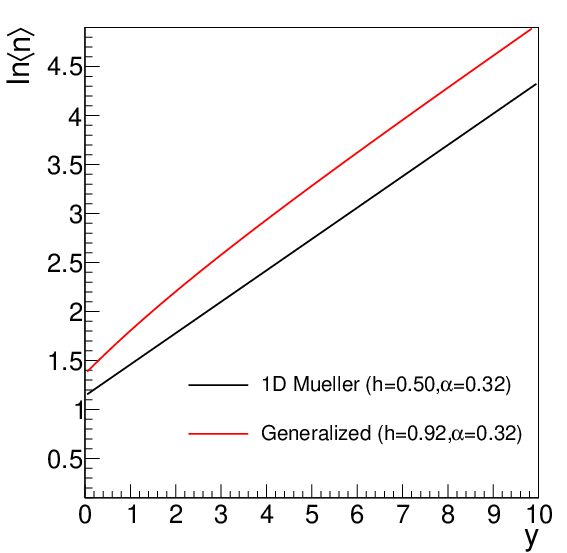
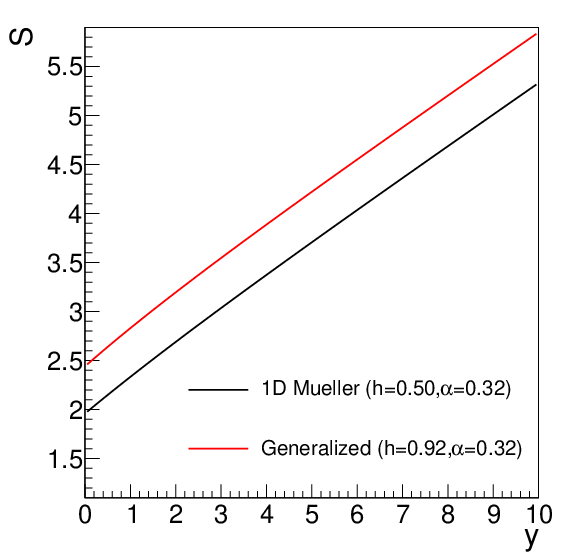
Figure 1: (Left) The log-average multiplicity; (Right) Entropy, as functions of rapidity for both the Mueller and generalized dipole models.
Universal Observable: Entropy–Multiplicity Relation
S(ln⟨n⟩) is constructed directly from measured α0 distributions via Shannon entropy and directly compared across experimental platforms and model predictions. As proposed, this function circumvents issues arising from varying pseudorapidity window definitions—enabling direct comparison of LHC, HERA, and legacy measurements. Theoretical calculations demonstrate that, relative to rapidity, the generalized model yields higher mean multiplicity and entropy across the accessible kinematic span. This indicates greater state-space complexity and non-trivial correlations encoded by the α1 parameter.
Confrontation with Collider Data
The models are confronted with α2 data ranging over center-of-mass energies from α3 GeV to α4 TeV and rapidity windows spanning the central to forward regimes. The entropy-multiplicity profile is extracted from data, and model parameters are obtained via fit minimization.
Notably, the generalized model (with α5) produces excellent agreement with data (α6), while the Mueller model significantly overestimates low-multiplicity entropy (α7), confirming its limitations in the high-dispersion, large-multiplicity regime. This result is robust across wide kinematic ranges.
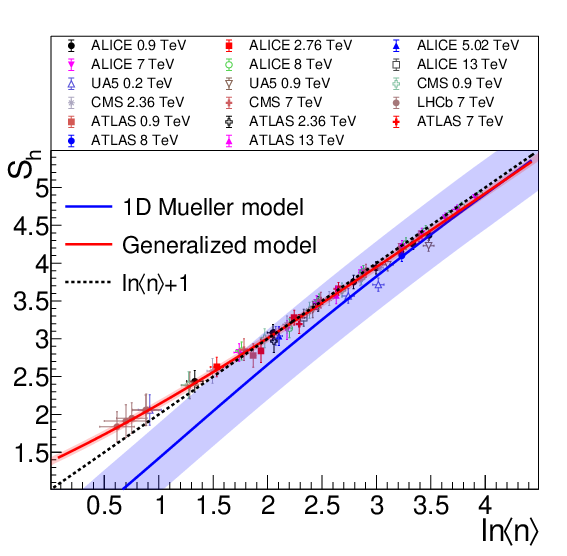
Figure 2: Data versus theoretical predictions for the universal entropy–multiplicity observable α8 in α9 collisions.
Implications and Outlook
The pronounced improvement of the generalized dipole model, evident in both global fit quality and entropy scaling, highlights the necessity of incorporating higher conformal weights and negative binomial structures in models of high-energy QCD multiplicities. The demonstration of a universal C0 offers a robust tool for both the phenomenology of entanglement entropy and the analysis of initial-state correlations in hadronic collisions. The analysis also underlines the critical impact of precise pseudorapidity window definitions on experimental–theory comparisons and the utility of universal observables to mitigate associated ambiguities.
Theoretically, the framework connects techniques from quantum chaos (via Krylov complexity) with partonic evolution, suggesting avenues for integrating saturation (gluon recombination) and mapping to more complex collisional environments beyond DIS and C1. Experimentally, future work should further quantify vacuum contributions, extend analyses to heavy-ion systems, and employ finer-grained rapidity binning to test model universality.
Conclusion
This work establishes C2 as a robust observable for QCD multiplicity-entropy studies and demonstrates, via comparison to collider data, that generalized dipole cascade models with negative binomial distributions are essential for accuracy in the high-energy limit. These findings inform future theoretical developments in QCD cascade dynamics and experimental analysis strategies involving entropy in high-multiplicity events.

