- The paper demonstrates that the ERW on D∞ always exhibits diffusive scaling, fully suppressing superdiffusive reinforcement present in abelian settings.
- It employs a Doob-type decomposition and martingale techniques to accurately quantify memory effects and analyze variance corrections.
- The study shows that the local algebraic relations in the non-abelian group cancel reinforcement, fundamentally altering the walk’s long-term behavior.
Elephant Random Walks on the Infinite Dihedral Group Z2∗Z2
Introduction and Motivation
The study addresses the Elephant Random Walk (ERW) on the infinite dihedral group D∞≅Z2∗Z2, extending the classical ERW framework from abelian groups such as Z to a non-abelian, virtually abelian group. Unlike the classical ERW on Z, where the transition kernel is time-inhomogeneous but Markovian, the ERW on D∞ is intrinsically non-Markovian due to the involutive nature of its generators. This group serves as a minimal example where the Cayley graph (the bi-infinite path) does not determine the limiting behavior of reinforced random walks: although D∞ shares this graphical structure with Z, its algebraic structure fundamentally alters memory effects.
Model Description
The ERW is defined on D∞=⟨a,b∣a2=b2=e⟩ with symmetric generating set {a,b}. The walk wn starts at the identity and evolves via steps D∞≅Z2∗Z20. With probability D∞≅Z2∗Z21, D∞≅Z2∗Z22 repeats a randomly chosen previous increment, and with probability D∞≅Z2∗Z23, it applies the complementary generator (D∞≅Z2∗Z24, D∞≅Z2∗Z25).
The signed position D∞≅Z2∗Z26 is defined relative to the bi-infinite path structure, marking the branch associated with generator D∞≅Z2∗Z27 as positive. The walk is coupled with ERW on D∞≅Z2∗Z28 through the process D∞≅Z2∗Z29, representing the signed sum of steps analogous to the classical urn-reinforced walk. However, only an explicit lower-order coupling persists due to the cancellation properties of group multiplication in Z0.
Main Results: Limit Theorems and Doob Decomposition
The central result is an explicit Doob-type decomposition: Z1
with Z2 an Z3-martingale of bounded increments and predictable quadratic variation Z4 satisfying Z5. The memory parameter Z6 (or Z7) only appears in the second term, interpreting the memory effect as a lower-order fluctuation.
A crucial qualitative outcome is that, in contrast to the superdiffusive regime for Z8 in Z9, the ERW on Z0 always exhibits diffusive scaling, matching the simple symmetric random walk (SSRW) limit in both first and second moments for any Z1. Superdiffusive behavior is entirely suppressed by the group structure.
Quantitative Results
- Strong Law: Z2 almost surely.
- Functional CLT: Z3, i.e., convergence in law to standard Brownian motion.
- Law of Iterated Logarithm: Z4 a.s.
- Quadratic Strong Law: Z5 a.s.
The variance of the limiting correction term Z6 admits an explicit (albeit intractable) integral expression. This variance diverges only slowly as Z7, characterizing the approach to the degenerate case Z8.
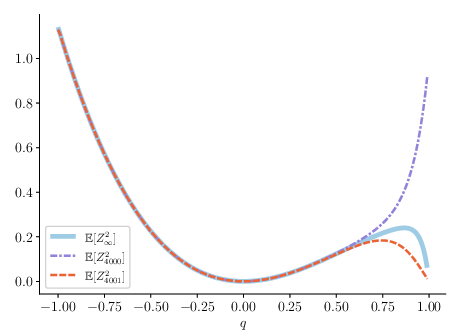
Figure 1: The function Z9 as a function of D∞0, illustrating the suppressed growth even for strong memory parameters.
Mechanism: Group Relations Neutralize Reinforcement
A marked contrast is established with the behavior of ERW on abelian groups. In D∞1, repeated application of involutive generators results in local cancellation. This property means that, even when the memory parameter D∞2 is high, the walk's evolution is "reflective" rather than reinforcing; the group structure cancels out long-term memory buildup. The interplay between the step selection mechanism and group relations, concretely the interlacing of reinforcement with the D∞3 identities, behaves as a strong "null drift" mechanism absent in the abelian case.
Analytical Techniques
The results employ martingale theory, complex-analytic computations, and a coupling with urn models. Central is the explicit calculation of variance growth and the lower-order fluctuation term, which is controlled via Stirling-type estimates, generating function manipulations, and analytic properties of special functions (notably, hypergeometric functions).
The technical depth is further highlighted by uniform convergence results in complex domains for the auxiliary analytic functions involved in bounding D∞4.
Implications and Theoretical Significance
The main theoretical implication is that memory-reinforced processes are extremely sensitive to local group structure, not merely to the geometry of the underlying Cayley graph. The classic correspondence between transience/recurrence properties and the presence of virtual abelian subgroups fails for non-Markovian dynamics like ERWs. As such, reinforced walks cannot be understood solely through large-scale geometry—algebraic relations actively suppress phenomena (like superdiffusion) that reinforcement fosters in the abelian case.
Practical ramifications extend to statistical mechanics and stochastic processes on group extensions, suggesting that memory effects may be nullified in models formulated on spaces with local involutions or non-abelian symmetry. This insight may prove relevant for stochastic modeling in physics (random media with symmetry constraints) or information theory (storage mechanisms on group-structured data), where memory-induced anomalies are undesirable.
Prospects for Future Work
Several open questions emerge:
- Extension to more general virtually abelian groups, potentially higher-rank dihedral or free products with many involutive generators.
- Investigation into other types of reinforcement (beyond full memory) and their sensitivity to group relations.
- Computational analysis of the rate of convergence and fine asymptotics for the correction term, particularly for D∞5.
- Exploring analogous behavior for reinforced Lévy flights or continuous-time ERWs on non-abelian settings.
Conclusion
The paper delivers a rigorous and technically comprehensive analysis proving that the ERW on D∞6, while superficially similar to its behavior on D∞7 at the level of its Cayley graph, is rendered diffusive across all memory parameters by the local involutive structure of its generators. The result disables the classic reinforcing mechanisms of the ERW and demonstrates that small-scale algebraic properties decisively impact the macroscopic behavior of non-Markovian walks. These findings challenge prevailing intuition derived from Markovian theory and underscore the necessity of combining probabilistic, algebraic, and analytic perspectives in the study of reinforced stochastic processes.

