The Interplay of Data Structure and Imbalance in the Learning Dynamics of Diffusion Models
Abstract: Real-world datasets are inherently heterogeneous, yet how per-class structural differences and sampling imbalance shape the training dynamics of diffusion models-and potentially exacerbate disparities-remains poorly understood. While models typically transition from an initial phase of generalization to memorizing the training set, existing theory assumes homogeneous data, leaving open how class imbalance and heterogeneity reshape these dynamics. In this work, we develop a high-dimensional analytical framework to study class-dependent learning in score-based diffusion models. Analyzing a random-features model trained on Gaussian mixtures, we derive the feature-covariance spectrum to characterize per-class generalization and memorization times. We reveal the explicit hierarchy governing these dynamics: class variance is the primary determinant of learning order-consistently favoring higher-variance classes-while centroid geometry plays a secondary role. Sampling imbalance acts as a modulator that can reverse this ordering and, under strong imbalance, forces minority classes to acquire distinct, delayed speciation times during backward diffusion. Together, these results suggest that diffusion models can memorize some classes while others remain insufficiently learned. We validate our theoretical predictions empirically using U-Net models trained on Fashion MNIST.
Paper Prompts
Sign up for free to create and run prompts on this paper using GPT-5.
Top Community Prompts
Explain it Like I'm 14
Overview: What this paper is about
This paper asks a simple but important question: when you train a diffusion model (a popular AI model that generates images) on a dataset with different kinds of items—like shoes and bags—do all kinds get learned equally well and at the same time? The authors show that the answer is “no.” Some kinds get understood and memorized earlier than others, depending on how varied they are, how they’re arranged, and how many examples the model sees.
The main questions the researchers asked
- In what order does a diffusion model learn different classes (like “sneakers” vs. “bags”)?
- How do three factors—how spread out a class is (variance), where its “center” sits (centroid geometry), and how many examples it has (imbalance)—change that order?
- Can we predict when a model starts to “tell classes apart” during generation, and when it starts to “memorize” exact training images?
- Do these predictions match what happens in real image models like U-Nets trained on Fashion MNIST?
How they studied it (in plain language)
Think of a dataset as a scatter plot in a huge space. Each class (say, “sneakers”) is a blob of points. Two simple ideas help:
- Class variance: how “spread out” a blob is. High variance means the images in that class vary a lot; low variance means they’re very similar.
- Centroid: the average point of a blob. Its distance from the origin (the “centroid norm”) tells you how far, on average, that class sits from blank/neutral.
Diffusion models learn by first adding noise to images (the forward process) and then learning how to remove it (the backward process). The paper tracks two clocks:
- Diffusion time: how much noise is left to remove while generating.
- Training time: how long the model has been trained.
To make the math solvable, the authors used:
- A simplified neural network called a random-features model (think: a neural net with lots of fixed random connections and a simple, learnable final layer).
- Synthetic data made of Gaussian mixtures (blobs), which is a common, realistic approximation for clustered datasets.
- Tools that look at the “spectrum” of a big matrix (its eigenvalues), which you can think of as the “speeds” at which different patterns are learned.
They also tested the theory with real diffusion models (U-Nets) on Fashion MNIST, a dataset of clothing images, to see if the patterns hold in practice.
What they found (and why it matters)
Here are the core takeaways:
- The model learns classes in a predictable order.
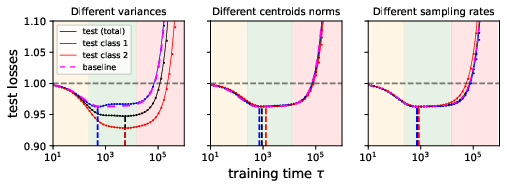
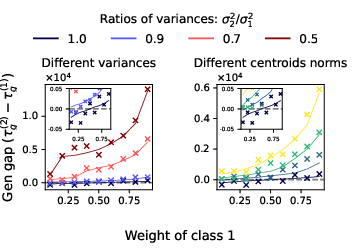
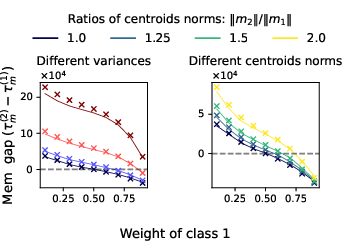
- Class variance dominates: classes with higher variance (more variety) are learned earlier and are memorized earlier.
- Centroid geometry is secondary: classes whose average image is “closer to neutral” (smaller centroid norm) tend to be learned earlier.
- Imbalance can flip the order: if one class has many fewer examples, it can be learned later—even if it should have come earlier based on variance or centroid.
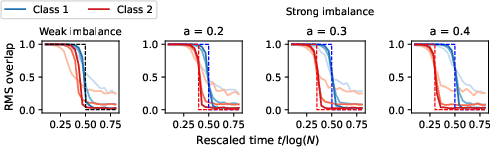
- “Speciation” happens at different times for different classes under strong imbalance. Speciation is the moment, during generation, when the model starts to resolve specific classes (like telling sneakers apart from bags). With balanced data, classes “appear” around the same diffusion time. But if some classes are rare, they show up later in the generation process.
- Training has two phases—and class diversity changes how long each lasts.
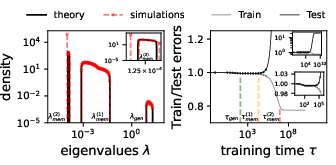
- Generalization (the model learns the overall idea of a class) happens first.
- Memorization (the model starts reproducing exact training examples) happens later.
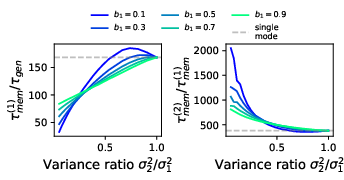
- If classes are very different from each other (big variance differences), the generalization window shrinks and the memorization window grows. This means it gets harder to stop training at a fair point for all classes.
- A trade-off with imbalance:
- Undersampling a high-variance class: it generalizes later (bad for that class).
- Oversampling a high-variance class: the other class may be memorized earlier (bad in a different way).
- Adjusting class balance to fix one gap often worsens another.
- Real models match the theory qualitatively.
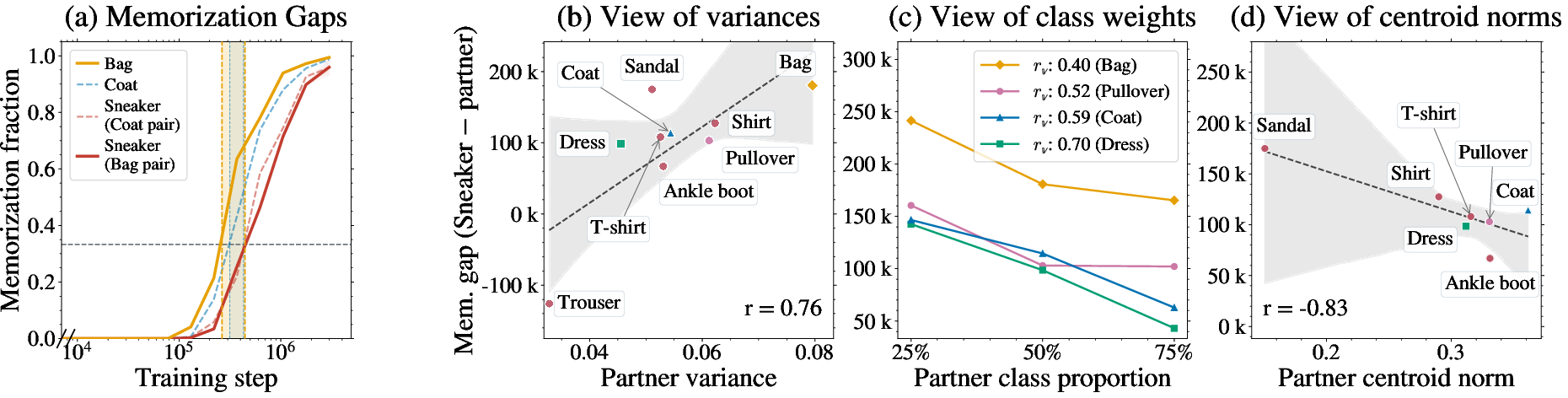
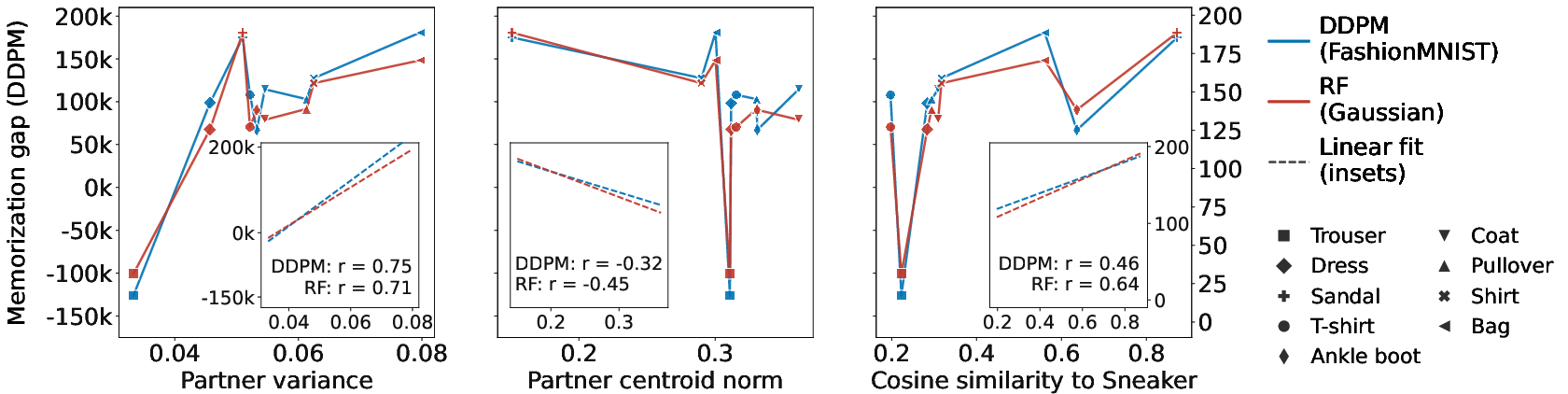
- Higher-variance classes are memorized earlier.
- Changing class proportions (imbalance) shifts the gaps as predicted.
- Centroid effects show up too.
- A simple Gaussian-blob model using just per-class variance and centroid statistics could predict these trends.
Why this is important
- Fairness and quality across classes: If some classes are learned much earlier or are memorized sooner, the model’s outputs can be uneven—great for one class, poor or overfit for another.
- Early stopping isn’t one-size-fits-all: Stopping training at a single time might be too early for some classes and too late (overfitting) for others.
- Practical fixes: Reweighting classes, balancing your dataset, or using class-aware early stopping could reduce per-class disparities.
- Bridge from theory to practice: The fact that a simple, mathematically tractable model predicts what happens in real U-Net diffusion models helps us trust and build on these insights.
In short, the paper shows that not all classes are learned equally in diffusion models—and it explains when and why. This understanding can help researchers and practitioners train models that treat different classes more fairly and generate better, more balanced results.
Knowledge Gaps
Knowledge gaps, limitations, and open questions
The paper leaves several aspects missing, uncertain, or unexplored. Below is a concrete list of gaps and questions to guide future research:
- Extension beyond binary mixtures: Develop theory and experiments for multi-class Gaussian mixtures (C > 2), including cross-class interactions and full centroid geometry (norms and pairwise cosine similarity matrices), and assess how learning/memorization hierarchies scale with the number of classes.
- Non-isotropic covariances: Replace isotropic class covariances with class-specific full covariance matrices (anisotropy and low-rank structure), derive the feature-covariance spectrum, and quantify how directional variance and covariance alignment drive per-class generalization/memorization.
- Higher-order structure and multimodality: Move beyond first- and second-order statistics to model intra-class multimodal structure (mixtures within classes), skewness/kurtosis, texture, and spatial correlations; test whether variance remains dominant or if higher moments reorder learning.
- Outliers and rare modes: Analyze how outliers and rare submodes influence speciation and memorization (e.g., acting as strong attractors), and develop procedures to detect and mitigate mode collapse or over-attraction during training and sampling.
- Conditional diffusion and guidance: Extend the framework to conditional training (class labels, text conditioning) and classifier-free guidance; quantify how conditioning reshapes speciation times and class disparities, and whether guidance suppresses minority modes.
- Joint dependence on diffusion time t and training time τ: The analysis treats speciation at large t and learning at small t separately; derive a unified two-time theory linking t-schedules (noise schedules) to τ-dependent training dynamics and windows, and validate on real models.
- Speciation scaling in real models: Test whether the predicted speciation times scaling as O(log N) hold empirically in U-Nets across feature resolutions and layers, and identify which representation dimension N is operationally relevant.
- Strong-imbalance regime realism: Theoretical strong imbalance is modeled as b_c ~ N{-a}; determine practical regimes that mimic this in finite-N settings and verify class-specific speciation in real datasets with severe undersampling.
- Universality across activations and architectures: Examine sensitivity of the hierarchy to activation functions (e.g., ReLU, GELU, Swish) and to learned features (moving beyond random features) by characterizing how feature learning alters the spectrum and timescales.
- Optimizer and learning-rate effects: Quantify how finite learning rates, momentum, and optimizer noise impact traversal of small-eigenvalue directions (especially the late memorization phase), and derive prescriptions for schedules that reduce per-class disparities.
- Dataset size and capacity scaling: Systematically characterize how χ_p = P/N and χ_m = M/N control window widths (w_g, w_m) and class gaps, and validate on real networks by varying capacity (width/depth) and dataset size.
- Training objective variants: Compare score matching with noise-prediction and velocity parameterizations (ε, v objectives), discrete-time training vs. continuous-time analysis, and different beta/noise schedules; assess robustness of the hierarchy across objectives.
- Fairness metrics beyond memorization: Connect per-class generalization/memorization gaps to generation quality metrics (FID, IS, precision/recall, coverage) and fairness metrics (demographic parity of quality/mode coverage), and establish practical evaluation protocols.
- Measurement robustness: Test sensitivity of memorization detection to the nearest-neighbor ratio threshold (1/3), distance metrics (L2 vs. perceptual), and classifier assignment errors; provide confidence intervals and bias corrections.
- Early stopping and interventions: Design and evaluate class-aware training interventions (reweighting, resampling, curriculum, per-class early stopping, τ(t)-dependent loss weighting) to minimize both generalization and memorization gaps; quantify trade-offs.
- Noise schedule design: Investigate how altering the diffusion noise schedule (forward and sampling) affects class-specific speciation and memorization, and whether tailored schedules can equalize learning across heterogeneous classes.
- Collapse dynamics: Analyze collapse transitions (post-speciation) in mixtures, identify conditions that trigger mode suppression or merging, and link them to spectral features and training regimes.
- Spatial and semantic structure: For image data, incorporate spatial locality and semantic attributes (e.g., parts, textures) into the mixture model, and study whether the variance/centroid hierarchy persists in more realistic, structured generative settings.
- Cross-dataset generalization: Replicate and stress-test findings on richer datasets (CIFAR-10/100, ImageNet, CelebA, LSUN) and modalities (audio, text), and quantify how dataset diversity modifies class hierarchies.
- Quantitative mapping from descriptors to times: Calibrate a model that maps empirical class descriptors (variance, centroid norm, cosine similarity, imbalance) to predicted generalization/memorization times for real architectures, with uncertainty estimates.
- Feature-space vs. pixel-space variance: Determine the appropriate representation space for variance and centroid measurements (e.g., learned latent features vs. pixels), and re-evaluate the hierarchy when measured in feature space.
- Validation of generalization-window contraction: Empirically verify the predicted contraction of the generalization window w_g under strong class diversity in real diffusion models, not only the memorization gap.
- Multi-class interactions under imbalance: Study how reweighting one class affects others (non-local effects), identify Pareto frontiers for balancing generalization/memorization across all classes, and propose multi-objective training strategies.
- Theoretical guarantees with learned features: Develop theory for networks that learn features (e.g., two-layer or deep models) to determine whether the spectral edge-based timescale separation persists or changes under representation learning.
Practical Applications
Immediate Applications
These applications can be deployed with today’s diffusion model toolchains (e.g., PyTorch/TF, U-Net DDPMs, Stable Diffusion variants), using existing logging, sampling, and evaluation workflows.
- Bold: Class-aware early-stopping and training dashboards
- Sectors: software, healthcare, finance, robotics, media
- What: Monitor per-class test error and memorization fraction over training time; stop globally or per-class when each class reaches an acceptable generalization window without entering the memorization regime.
- Tools/workflows:
- A training callback that computes per-class variance and centroid norms from minibatches; logs per-class loss curves, nearest-neighbor memorization fractions, and gap metrics (Δτg, Δτm).
- “Memorization heatmaps” over classes; alerts when minority/low-variance classes lag in generalization or hit early memorization.
- Assumptions/dependencies: Requires class labels or robust clustering; nearest-neighbor search on the train set to measure memorization; extra compute for per-class metrics; gap thresholds must be selected per domain.
- Bold: Adaptive class reweighting and sampling schedules
- Sectors: software, healthcare (rare pathologies), finance (fraud), education (rare topics)
- What: Dynamically reweight data loaders to prioritize low-variance or minority classes early (to shrink generalization gaps), then rebalance later to avoid premature memorization.
- Tools/workflows:
- Batch sampler that adjusts mixing weights b_c during training based on observed per-class gaps.
- Curriculum: front-load low-variance/minority classes in early epochs; gradually anneal to true distribution.
- Assumptions/dependencies: Needs reliable online estimates of per-class variance and centroid norms; must manage the trade-off identified in the paper (scarcity delays generalization but accelerates memorization).
- Bold: Class-weighted loss and regularization
- Sectors: software, healthcare, finance
- What: Apply class-dependent loss weights and regularizers (e.g., weight decay, noise augmentation) that preferentially slow memorization or accelerate generalization for targeted classes.
- Tools/products:
- Loss wrapper with dynamic weights α_c(τ) driven by per-class test error trends.
- Per-class augmentation intensity (increase effective variance of low-variance classes).
- Assumptions/dependencies: May require hyperparameter search; strong augmentations must preserve class semantics; downstream quality must be validated per class.
- Bold: Per-class sampler controls at inference
- Sectors: media, advertising, design tools, education
- What: For class-conditional generation, adjust classifier-free guidance scale, temperature, and number of steps per class to lift low-variance/minority classes that are insufficiently learned.
- Tools/workflows:
- A sampler module that allocates more steps for “hard” classes, uses slightly higher guidance, or starts closer to class-specific speciation times (if estimated).
- Assumptions/dependencies: Helps but cannot fully compensate for training-time disparities; needs reliable class conditioning and calibration to avoid artifacts.
- Bold: Dataset diagnostics and documentation (model cards/data cards)
- Sectors: industry/academia, policy
- What: Report per-class variance, centroid norms, sampling weights, and resulting generalization/memorization gaps; include speciation-time estimates where feasible.
- Tools/workflows:
- “Variance–Geometry Profiler”: computes first/second moments and cosine similarities between class centroids; exports plots/tables and recommended rebalancing strategies.
- Assumptions/dependencies: Requires labeled data or trustworthy pseudo-labels; centroid estimates depend on chosen feature space (raw pixels vs. embeddings).
- Bold: Privacy risk triage by subpopulation
- Sectors: healthcare, finance, legal/compliance
- What: Identify classes at higher memorization risk (e.g., scarce classes may memorize earlier even while generalizing later). Prioritize privacy safeguards (e.g., DP, sample filtering) for these classes.
- Tools/workflows:
- Per-class memorization fraction curves; automatic flagging when f_mem exceeds thresholds.
- Integration with DP-SGD or per-class gradient clipping.
- Assumptions/dependencies: Memorization detection requires access to training data or privacy-preserving proxies; thresholds must align with organizational privacy policy.
- Bold: Active data collection and augmentation targeting
- Sectors: healthcare (underdiagnosed diseases), robotics (rare scenes), finance (edge cases)
- What: Use the learned hierarchy (variance > centroid geometry; imbalance modulates) to prioritize acquisition or augmentation for classes predicted to underperform.
- Tools/workflows:
- Acquisition scoring = f(low variance, large centroid norm, low b_c).
- Augmentations that increase effective variance for low-variance classes.
- Assumptions/dependencies: Labeling costs; augmentations must not introduce bias or label leakage.
- Bold: Benchmarking and evaluation suites for generative fairness
- Sectors: academia, standards bodies, industry eval teams
- What: Evaluate class-specific generalization and memorization windows, and the generalization–memorization trade-off under controlled imbalance.
- Tools/workflows:
- A standardized suite with per-class FID/KID, memorization gap Δt_mem, and test-loss minima times τgc.
- Assumptions/dependencies: Needs community agreement on metrics and thresholds; compute cost for per-class FID/KID can be high.
- Bold: Workflow templates for sensitive domains
- Sectors: healthcare, public sector
- What: Prescribe default class-aware training/evaluation templates for synthetic data generation (e.g., equalize per-class generalization before deployment).
- Tools/workflows:
- Prebuilt configs (samplers, reweighting policies, dashboards) that ship with domain packs (e.g., radiology modalities).
- Assumptions/dependencies: Domain adaptation required; requires domain experts to validate class definitions and targets.
Long-Term Applications
These applications require further research, scaling, or productization to reach robust deployment.
- Bold: Speciation-aware training and sampler schedulers
- Sectors: software, media, robotics
- What: Optimize time discretization, noise schedules, and per-class guidance to align class-specific speciation and learning times, mitigating under-learning of minority/low-variance classes.
- Potential products:
- “Speciation Scheduler”: jointly tunes forward/backward SDE discretization and per-class sampling budgets.
- Assumptions/dependencies: Needs reliable estimation of class-specific speciation times; current theory assumes Gaussian mixtures and high-dimensional limits.
- Bold: Algorithms that equalize per-class learning dynamics
- Sectors: software, fairness/safety
- What: New optimizers or objectives that explicitly minimize the variance of τgc across classes, or constrain memorization gaps while maintaining aggregate quality.
- Potential products:
- Variance-aware preconditioning; per-class EMA, per-class learning rate schedules; constrained optimization layers (e.g., Lagrangian penalties on gap metrics).
- Assumptions/dependencies: Stability and scalability in large models; needs theory beyond isotropic GMMs to cover complex, non-Gaussian class structure.
- Bold: Architecture-level capacity allocation
- Sectors: software, robotics
- What: Mixture-of-experts or multi-head score networks that allocate capacity to lagging classes in training; dynamic routing based on class difficulty.
- Potential products:
- Class-gated U-Nets; per-class adapters/LoRA modules that can be warmed up independently.
- Assumptions/dependencies: Requires reliable class conditioning; risks parameter bloat and overfitting; needs careful regularization.
- Bold: Class-conditional differential privacy (DP) and safety budgets
- Sectors: healthcare, finance, policy/compliance
- What: Assign stronger privacy budgets to classes predicted to memorize faster (e.g., scarce or very low variance), while relaxing where safe to preserve utility.
- Potential workflows:
- DP-SGD with class-aware noise multipliers; class-level redaction of near-duplicates detected by memorization monitors.
- Assumptions/dependencies: DP accounting at class granularity; managing utility–privacy trade-offs; regulatory alignment.
- Bold: Standards and audits for generative fairness and memorization
- Sectors: policy, standards bodies (e.g., NIST/ISO), public sector procurement
- What: Require per-subpopulation reporting of variance/centroid statistics, speciation-time estimates, generalization/memorization gaps, and mitigations.
- Potential tools:
- Audit packages that reproduce the paper’s metrics; certification checklists for class-aware evaluation prior to deployment.
- Assumptions/dependencies: Agreement on definitions of “class/subpopulation”; access to representative evaluation data; legal/privacy constraints on sharing metrics.
- Bold: Curriculum designs over diffusion time
- Sectors: software, academia
- What: Train with time-warped noise schedules that “teach” low-variance/minority classes earlier in the backward process (e.g., more weight on time regions where these classes become inferable).
- Potential products:
- Time-warping layers or loss reweighting over diffusion timesteps that are class-conditional.
- Assumptions/dependencies: Requires better estimators of when each class becomes inferable; careful integration with existing samplers.
- Bold: Generalization to realistic multi-modal, anisotropic, and hierarchical data
- Sectors: academia, software
- What: Extend the theory and tooling beyond isotropic GMMs to cover internal class multimodality, anisotropic covariances, and hierarchical labels common in real datasets.
- Potential outputs:
- Next-generation profilers that measure intra-class modes, outliers, and hierarchical gaps; improved mitigations for weak intra-class modes.
- Assumptions/dependencies: Substantial methodological research; richer statistics than first/second moments; scalable estimation in large models.
- Bold: End-user controls for bias-aware generation
- Sectors: consumer creative apps, education
- What: UI “balance” sliders that internally adjust per-class guidance, step counts, or sampling seeds to reduce disparity in outputs across requested categories.
- Potential products:
- “Class Balance” control in image generation apps; presets for “ensure minority-class quality.”
- Assumptions/dependencies: Requires reliable class detection in prompts/outputs; can only partially offset training-time imbalances.
- Bold: Domain-specific pipelines for rare-event world models
- Sectors: robotics, autonomous systems, simulation
- What: Training and evaluation pipelines that guarantee sufficient learning of rare but safety-critical events using the paper’s diagnostics and class-aware schedulers.
- Potential products:
- Synthetic rare-event boosters; scenario banks with controlled variance/centroid properties; verification harnesses for per-event memorization risk.
- Assumptions/dependencies: High data curation costs; safety validation and regulatory acceptance.
Cross-cutting assumptions and dependencies
- The paper’s theory is derived for random-feature models trained on Gaussian mixtures in high dimensions; real-world success depends on the empirical robustness observed with U-Net DDPMs and may degrade for complex, non-Gaussian, multi-modal classes.
- Applications that require “classes” depend on labels or accurate clustering; mislabeled or blurry boundaries reduce effectiveness.
- Measuring memorization relies on access to the training set or privacy-preserving proxies; nearest-neighbor thresholds are heuristic and domain-dependent.
- Some mitigations (e.g., aggressive reweighting/augmentation) can harm overall fidelity; systematic per-class validation is required.
- Compute overhead for per-class metrics and adaptive schedulers must be budgeted, especially at scale.
Glossary
- Ancestral sampler: A generation procedure in diffusion models that samples by reversing the noise-adding process step by step. "the DDPM ancestral sampler \cite{ho2020denoising} is used to generate 500 samples per pair."
- Bulk of the spectrum: The continuous part of a matrix’s eigenvalue distribution, distinct from isolated outlier eigenvalues. "escapes the continuous bulk of the matrix spectrum."
- Centroid geometry: The arrangement and norms of class mean vectors that influence learning order and dynamics. "while centroid geometry plays a secondary role."
- Conditional Gaussian equivalence: A technique that treats complex features as Gaussian under conditioning on low-dimensional structure to analyze random feature models. "we adopt a conditional Gaussian equivalence viewpoint (Appendix \ref{sec:GEP_non_centered})"
- DDPM: Denoising Diffusion Probabilistic Model; a class of generative models that learns to reverse a diffusion process to generate data. "A standard DDPM \cite{ho2020denoising} was employed on the Fashion MNIST dataset"
- Denoising Score Matching: A training objective for diffusion models that fits the score function of noisy data to recover the data distribution. "by studying denoising score matching on Gaussian-mixture data"
- Eigenspectrum: The set or distribution of eigenvalues of a matrix that governs convergence and learning timescales. "The learning dynamics are governed by the eigenspectrum of \mathbf{U}"
- Feature-covariance spectrum: The eigenvalue spectrum of the covariance of learned features, used to characterize class-specific learning times. "we derive the feature-covariance spectrum to characterize per-class generalization and memorization times."
- Gaussian equivalence: Analytical methods that replace complex random features with Gaussian substitutes to enable tractable spectral analysis. "We leverage Gaussian equivalence techniques for random feature models in a mixture setting"
- Gaussian Mixture Model (GMM): A probabilistic model representing data as a mixture of multiple Gaussian components. "sampled from a Gaussian Mixture Model (GMM) with components:"
- Gaussian transition kernel: The conditional distribution of the forward diffusion process that maps data to Gaussian noise. "The forward process induces a Gaussian transition kernel "
- Gradient flow: Continuous-time limit of gradient descent described by differential equations governing parameter updates. "the gradient flow equation under the training loss \eqref{eq:empirical_risk_score_denoising} is a linear ODE"
- High-dimensional proportional limit: An asymptotic regime where dimensions and sample sizes grow with fixed ratios to analyze learning behavior. "in the high-dimensional proportional limit where with fixed ratios"
- Implicit regularization: The stabilizing effect where training procedures (like early stopping) control overfitting without explicit penalties. "this separation between generalization and memorization is what allows early stopping to act as an implicit regularizer"
- Isolated eigenvalue: An eigenvalue separated from the spectral bulk, often indicating learnable structure like class centroids. "produces an isolated eigenvalue that escapes the continuous bulk of the matrix spectrum."
- Random Feature (RF) model: A model with fixed random projections and learnable linear readouts used to approximate nonlinear functions like scores. "in our case, a Random Feature (RF) model"
- Random Matrix Theory (RMT): A field studying statistical properties of large random matrices, used to analyze spectra and learning times. "using Random Matrix Theory to characterize the spectrum of in the high-dimensional proportional limit"
- Rank-1 perturbation: A low-rank modification to a matrix (outer product of a vector with itself) that can create spectral outliers. "its corresponding rank-1 perturbation "
- Replica Method: A statistical physics technique for analyzing averages of complex systems, used here to derive spectral densities. "Leveraging the Replica Method (detailed in Appendix \ref{sec:derivation_spectral_equations}), we derive the spectral density of ."
- Score function: The gradient of the log-density of a distribution, guiding the reverse diffusion dynamics. "where is the standard Wiener process and $\mathbf{s}(\bm{x}, t)=\nabla_x \log P{\bm{x}{t}{}$ denotes the score function."
- Score matching risk: The loss function minimized to fit the score function from noisy observations. "The parameters are learned by minimizing the score matching risk"
- Speciation: A dynamical transition where distinct data modes become resolvable during backward diffusion. "Prior work characterizes the speciation transition as the diffusion time at which the generative sampling process begins to resolve specific data modes"
- Speciation time: The diffusion time at which a particular class structure (e.g., centroid) becomes inferable. "We define the class-specific speciation time as the point along the backward diffusion trajectory where a class centroid becomes inferable"
- Stochastic differential equation (SDE): A differential equation driven by stochastic noise, defining forward and reverse diffusion processes. "The forward and backward stochastic differential equations are respectively defined as:"
- U-Net: A convolutional neural network architecture with skip connections widely used as a backbone in diffusion models. "We validate our theoretical predictions empirically using U-Net models trained on Fashion MNIST."
- Wiener process: A continuous-time stochastic process (Brownian motion) driving the noise in SDEs for diffusion. "where is the standard Wiener process"
Collections
Sign up for free to add this paper to one or more collections.

