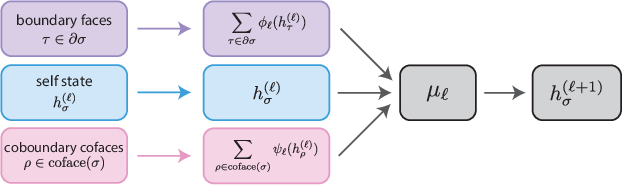
- The paper introduces the Geometric Simplicial Weisfeiler–Lehman (GSWL) test to enhance expressivity in detecting geometric embedding differences in simplicial complexes.
- The authors demonstrate that geometry-aware message passing effectively recovers vertex coordinates and outperforms combinatorial methods in tasks like ECT regression and classification.
- Empirical results on synthetic meshes and real datasets confirm that integrating boundary and coboundary aggregation is essential for capturing higher-order geometric invariants.
Geometry-Aware Simplicial Message Passing: An Expert Summary
Introduction and Motivation
Geometry-aware learning methods are increasingly relevant for tasks involving meshes, triangulations, and other higher-order relational structures where geometric embedding is essential. The paper "Geometry-Aware Simplicial Message Passing" (2605.06061) addresses the limitations of combinatorial message passing frameworks, which fail to distinguish embedded simplicial complexes with identical connectivity but different geometric realizations. By introducing the Geometric Simplicial Weisfeiler–Lehman (GSWL) test, the authors provide a rigorous expressivity characterization for geometry-aware message passing on simplicial complexes, aligning it with geometric invariants such as the Euler Characteristic Transform (ECT).
Theoretical Foundations
The framework builds upon three main pillars:
Expressivity Characterization
The paper proves two central claims:
- Upper Bound: The expressivity of geometry-aware simplicial message passing schemes is strictly bounded above by GSWL. Any architecture based on boundary/coboundary aggregation and injective initialization cannot distinguish more complexes than GSWL, which subsumes both SWL and geometric initialization.
- Exact Matching on Finite Families: For any fixed finite set of embedded complexes, there exist architecture parameters such that geometry-aware message passing achieves exactly the discriminating power of GSWL. In particular, the simplex-wise message aggregation can recover the coordinates of all vertices, enabling exact computation of sampled ECT values.
The connection is formalized via theorems ensuring that, given sufficient message passing steps (depth L≥dimK), the hidden state at any k-simplex determines its vertex coordinates, and thus quantifies geometric invariants such as entry times in directionally filtered subcomplexes.
Empirical Validation and Model Hierarchy
The suite of experiments comprises synthetic mesh deformations, manifold triangulations from MANTRA, and registered human body meshes from FAUST, corroborating the theoretical hierarchy:
- Combinatorial SMP (SWL-based): Unable to distinguish between geometric deformations for complexes with identical connectivity, yielding random or degenerate performance.
- Geometry-Aware SMP: Perfectly recovers geometric information; achieves near-zero mean squared error in ECT regression and outperforms combinatorial and graph-level baselines in classification tasks.
- Graph and Point Cloud Baselines (GCN, GIN, DeepSets): Edge-only or unstructured baselines provide limited inductive bias compared to full simplicial message passing, especially for tasks involving higher-order geometric quantities (e.g., curvature, area, angle defects).
Strong numerical results include 3× MSE reduction for geometry-aware SMP vs. combinatorial SMP in ECT regression and monotonic performance gains with increasing message passing depth, evidencing the necessity of both geometric input and higher-order structure.
Architecture Necessity and Ablations
Experiments demonstrate that coboundary (upper adjacency) aggregation is crucial for geometric tasks, such as per-vertex curvature prediction, where triangle-level information must propagate to lower-dimensional entities. Boundary-only models stagnate irrespective of depth, confirming that full message passing is essential for geometric expressivity.
Practical and Theoretical Implications
The research establishes a rigorous foundation for geometry-aware message passing on simplicial complexes:
- Expressivity: Geometry-aware SMP achieves complete discrimination up to geometric embedding, paralleling the WL–GNN equivalence for graphs but extending to higher-order structures.
- Approximation Framework: Combining coordinate recovery and ECT stability yields ε-approximation guarantees for infinite families and functional ECT recovery, with continuous architectures leveraging universal approximators (MLPs).
- Inductive Bias: Geometry-aware architectures exhibit a strict advantage for tasks encoding geometric invariants, curvature, and localized topological properties, underscoring their necessity in mesh learning and manifold analysis.
- Future Directions: Extensions to function-valued ECT recovery and application to cell complexes are natural avenues for generalization.
Limitations
The experiments, while evidencing expressivity gaps and geometric recovery, are saturated on small synthetic datasets. Larger benchmarks are required for comprehensive evaluation of statistical performance and robustness. The completeness argument assumes access to sufficient direction and threshold sampling for ECT recovery, which may be nontrivial for high-dimensional complexes.
Conclusion
The paper formalizes geometry-aware expressivity in simplicial message passing, directly linking architectural design with complete geometric invariants. It demonstrates both theoretically and experimentally that only architectures sensitive to vertex coordinates and higher-order adjacency attained via boundary and coboundary message passing achieve full geometric discriminating power. This establishes GSWL as the geometric analogue to classical WL for embedded complexes, providing a robust foundation for future advances in topological deep learning.