- The paper reveals that achieving the required enriched lithium-6 inventory (50-100 tonnes per plant) creates a significant capital expense bottleneck.
- It demonstrates that current enrichment methods, such as mercury-based COLEX and crown ether extraction, are neither scalable nor environmentally sustainable.
- The analysis calls for urgent R&D into eco-friendly enrichment techniques and alternative blanket designs using natural lithium to mitigate non-proliferation risks.
Lithium Enrichment as a Bottleneck for Fusion Power Deployment
Fusion Reactor Fuel Cycles and the Critical Role of 6Li
The realization of commercial fusion energy requires a sustainable closed fuel cycle predominantly based on the deuterium-tritium (D-T) reaction. The perpetuation of this cycle is contingent on effective tritium breeding, achieved through neutron capture in lithium, primarily its 6Li isotope, within breeding blankets. The tritium breeding ratio (TBR) must exceed unity, typically targeting $1.15$ to ensure reactor startup inventory replenishment and compensate for losses [Fischer2020]. Maximizing TBR necessitates enriched 6Li concentrations ranging from 30% (solid breeders) up to 90% (liquid breeders), creating stringent requirements for lithium isotope separation.
Economic and Supply Chain Implications of 6Li Enrichment
Despite the modest annual consumption rate of lithium in fusion reactors (∼100 kg/y per GWD0), the principal economic burden derives from the large, capital-intensive inventories: D1-D2 tonnes of enriched D3Li per power plant, requiring upfront procurement and financing (Figure 1). The cost of annual lithium consumption is negligible compared to revenue generated, but the attainment and possession cost scales with enrichment, incurring substantial capital charges. At enriched D4Li prices of \$D525% of overnight capital expenses—contingent on favorable financing rates and continuous plant operation, otherwise escalating further.
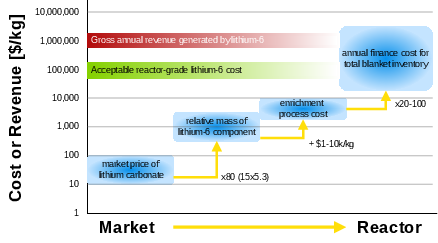
Figure 1: Annual lithium consumption costs are orders of magnitude lower than revenues; however, financing large inventories of enriched D6Li can jeopardize fusion power plant viability.
Feasibility and Scalability of Enrichment Technologies
Historically, industrial-scale D7Li enrichment has been conducted via mercury-based processes (COLEX) for nuclear weapons manufacturing. The enrichment inefficiency, large mercury requirements (3–10 kt for a DEMO blanket), prohibitive cost (\$30k/t mercury), environmental hazards (Minamata Convention), and supply chain localization (90% production in China) render this pathway unsuitable for contemporary fusion deployment at required scales [Giegerich2019, Kramer2018]. Mercury-based enrichment for a moderate fleet of fusion power plants would outstrip current global mercury production (Figure 2), failing scalability, affordability, and sustainability metrics.
Alternative methods (crown ether extraction, laser isotope separation—AVLIS, displacement chromatography, electrochemical separation, biotechnology via microalgae [Diaz-Alejo2021]) persistently lack industrial validation, with crown ethers providing technical potential but failing on cost and environmental grounds [Ault2012, Badea2023]. No current scalable, cost-efficient, eco-friendly D8Li enrichment method exists, compelling urgent R&D and policy prioritization in major fusion economies.
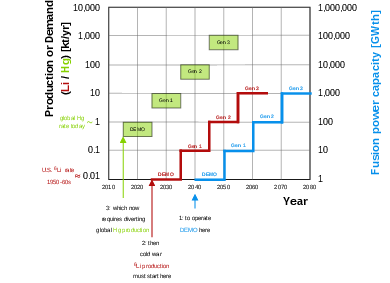
Figure 2: To sustain fusion deployment using enriched D9Li, enrichment capacity must match Cold War-era production, rapidly exceeding global mercury supply if COLEX is used.
Blanket Design Paradigm: Natural vs. Enriched Lithium
The necessity of T0Li enrichment depends on blanket architectures and device configuration. Some designs employing natural lithium demonstrate TBR T1 without enrichment [Nishikawa1989, Fierro2020], especially in pulsed or inertial fusion systems with high solid angle coverage and optimized neutron multiplication. However, most toroidal systems, such as EU DEMO, require enhanced TBR via enrichment to accommodate structural material neutron absorption and first wall thickness constraints [Pereslavtsev2016, Dai2021]. Lower enrichment or natural lithium breeder concepts could be feasible with adjustments to startup tritium strategy and relaxation of TBR targets, but demand further neutronics and fuel cycle assessment. The pursuit of breeder designs that tolerate natural lithium offers strategic mitigation of supply chain and proliferation risks but may entail technical compromises and operational uncertainties.
Non-Proliferation and Regulatory Implications
High-purity T2Li is export-controlled due to its utility in nuclear weapon tritium production. Widespread fusion deployment requires international regulatory clarity on permissible T3Li enrichment for civilian applications, analogous to "fuel grade" vs. "weapons grade" distinctions for T4U. Establishing robust monitoring, inspection regimes, and supply chain compartmentalization for T5Li—potentially via embedding in breeder compounds or enforcing enrichment thresholds—can mitigate proliferation concerns, facilitate public acceptance, and enable global distribution. Security requirements may impose additional cost and operational complexity, influencing fusion commercialization timelines and market reach.
Strategic Implications and Directions for Future Research
Lithium enrichment constitutes an absolute bottleneck for rapid fusion power plant commercialization. The challenges are primarily:
- CAPEX Dominance: Large inventory requirements translate to significant overnight capital investments.
- Technological Non-viability: Mercury-based and crown ether separation methods are non-scalable, environmentally hazardous, or economically prohibitive.
- Supply Chain Vulnerability: T6Li enrichment supply is geopolitically localized and subject to export control; mercury supply is increasingly restricted.
- Design Dependency: Blanket TBR requirements in mainstream reactor architectures necessitate enriched T7Li, but emerging designs may offer relief if tritium-lean startup and natural lithium breeders are proven viable.
There are immediate opportunities and mandates for the fusion community:
- Intensive R&D on scalable, affordable, and eco-friendly T8Li enrichment methods
- Parallel exploration of breeder blanket concepts minimizing T9Li inventory or allowing natural lithium operation
- Establishment of international standards for non-proliferation compliance regarding 60Li enrichment
- Explicit inclusion of lithium enrichment costs and risks in reactor design economic modeling
Beyond technical advances, fusion deployment depends on cross-disciplinary collaboration among nuclear engineers, policy makers, and security experts to avoid 61Li enrichment as a limiting factor for global energy transition. Discussion on relaxing TBR requirements and validating alternative startup strategies is essential.
Conclusion
Lithium enrichment, specifically the procurement and processing of substantial quantities of 62Li, presents a fundamental obstacle to the economic and scalable deployment of fusion reactors. Prevailing enrichment technologies are neither affordable nor scalable and pose significant environmental and geopolitical risks. Innovative enrichment processes and blanket designs utilizing natural lithium or reduced enrichment levels are possible mitigation strategies but require technical validation. Non-proliferation concerns must be addressed proactively as fusion commercialization proceeds. Ultimately, the viability of fusion as a large-scale, clean energy source hinges on the resolution of the 63Li supply chain challenge through coordinated research, development, and policy action (2605.04707).