- The paper establishes a novel framework using fusion-generated 14.1 MeV neutrons to transmute liquid mercury into stable gold through successive (n,2n) reactions.
- It reveals that at neutron fluxes achievable with μCF and ICF, all stable mercury isotopes become economically productive, enabling rapid transmutation within facility lifetimes.
- The study shows that fusion reactors offer self-subsidizing remediation by converting hazardous mercury stocks into high-value gold, transforming an environmental liability into a strategic asset.
Conceptual Framework and Mechanisms
The paper "Self-subsidizing Mercury Remediation with Fusion Reactors" (2604.02590) advances a formal framework in which liquid mercury, an environmental pollutant, serves as both neutron multiplier and transmutational feedstock in deuterium-tritium (D-T) fusion blankets. High-energy (14.1 MeV) neutrons generated by D-T fusion are absorbed via successive (n,2n) reactions in mercury, transmuting the various stable isotopes toward 197Hg, which then decays (half-life: 64.1 h) to stable 197Au (gold). This process is not only irreversible but directly monetizable, as it converts hazardous mercury into gold, thus linking environmental remediation with substantial economic gain.
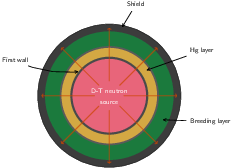
Figure 1: Schematic illustrates blanket geometry, with the D-T neutron source at the core, surrounded by a liquid mercury layer for neutron multiplication and subsequent gold transmutation, followed by a tritium-breeding layer and radiation shield.
Prior analyses, constrained by modest neutron fluxes achievable in magnetic-confinement fusion (MCF), considered only 198Hg as a viable feedstock; heavier isotopes (199Hg–204Hg) were treated as inert. This work rigorously demonstrates that at fluxes accessible by muon-catalyzed fusion (μCF) and inertial confinement fusion (ICF), all stable mercury isotopes become economically productive, traversing multi-step (n,2n) chains through stable intermediates. The characteristic transmutation times decrease to years at ϕ∼1016–1017 n/cm2/s, congruent with facility lifetimes, thus making remediation and gold co-production viable at scale.
Transmutation Chain Structuring and Isotope Economics
Each mercury isotope AHg with A≥198 can be transmuted via ns=A−197 successive (n,2n) steps. The chain proceeds through stable intermediates, except for 204Hg (requiring transit through radioactive 203Hg). The relevant cross-sections (σ∼2.0–$2.3$ b at 14.1 MeV) facilitate high reaction rates for all isotopes; competing channels (e.g., (n,γ), (n,p), (n,α)) are suppressed by several orders of magnitude. At ϕ=1016 n/cmϕ∼10160/s and ϕ∼10161 b, typical chain completion takes ϕ∼10162–11 years, with ϕ∼10163 per kg converging for most isotopes: ϕ∼10164, ϕ∼10165.
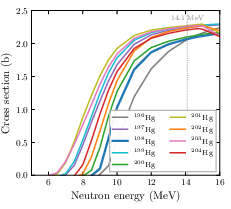
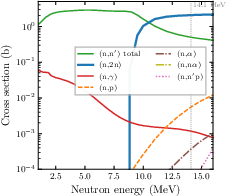
Figure 2: JENDL-5 evaluated (n,2n) cross-sections for Hg isotopes at 14.1 MeV; all relevant isotopes exhibit closely clustered cross-section values supporting uniform transmutation kinetics.
Economic modeling uses Net Present Value (NPV) formalism, discounting delayed gold production via ϕ∼10166 for annual rate ϕ∼10167. Multi-step chains are penalized by ϕ∼10168, but at high flux (ϕ∼10169), the penalty vanishes. Thus, at ICF fluxes, the value of natural mercury converges to 10170 per kg (∼\$10^{17}1174trillioneconomicresource,vastlyexceedingallin−groundgoldreserves.<imgsrc="https://emergentmind−storage−cdn−c7atfsgud9cecchk.z01.azurefd.net/paper−images/2604−02590/resourcehierarchy.png"alt="Figure3"title=""class="markdown−image"loading="lazy"><pclass="figure−caption">Figure3:Resourcehierarchycomparinggoldandmercuryavailabilityatvariousextractiondefinitions;mercurystocksurpassesgoldbyordersofmagnitudeacrossalltiers.</p></p><h2class=′paper−heading′id=′facility−economics−enrichment−and−throughput−regimes′>FacilityEconomics,Enrichment,andThroughputRegimes</h2><p>AnalysisoffusionblanketoperationatGW−scaleD−Tfacilitiesrevealsaregime−dependentvalueproposition:</p><ul><li><strong>Neutron−scarceregime:</strong>Enriched<sup>198Hg</sup>feedstockmaximizesgoldthroughput(10^{17}$23× higher than natural mercury), and the neutron utilization is optimized as the enrichment tax (fraction of neutrons spent on in-situ enrichment) is minimized to ∼21%.
Mercury-scarce regime: Natural mercury blankets preserve nearly all feedstock value ($10^{17}385<imgsrc="https://emergentmind−storage−cdn−c7atfsgud9cecchk.z01.azurefd.net/paper−images/2604−02590/sankey1GWnatHgphi1e16.png"alt="Figure4"title=""class="markdown−image"loading="lazy"></li></ul><p><imgsrc="https://emergentmind−storage−cdn−c7atfsgud9cecchk.z01.azurefd.net/paper−images/2604−02590/sankey1GWenrHgphi1e16.png"alt="Figure4"title=""class="markdown−image"loading="lazy"><pclass="figure−caption">Figure4:Neutronandatombudgetat1GWD−T,10^{17}$4 n/cm$10^{17}$5/s; natural Hg requires substantial neutron allocation to isotope enrichment, whereas enriched feedstock offers ∼3× higher direct gold conversion.</p></p>
<p>Facility-level modeling (30 yr campaigns) demonstrates enriched feedstock facilities consistently deliver higher absolute gold output and NPV (∼\$10^{17}$61.3B for natural mercury) but at a diminishing premium as flux increases. Blanket mass scales inversely with flux ($10^{17}$7), dropping from hundreds of tonnes at MCF down to kilograms at ICF regimes, mitigating capital costs for mercury procurement.
Gold Yield Optimization and Blanket Engineering
Gold yield is fundamentally constrained by precursor burnup at excessive fluxes; optimum $10^{17}$8 scales as $10^{17}$9 for chain length. Above $^2$0, $^21collapsesdueto(n,2n)destructionof<sup>197Hg</sup>beforedecay.Thepaperproposesflow−throughblankets—circulatingmercurythroughtheneutronfieldandextracting<sup>197Hg</sup>externallyfordecay—whichdecoupleresidenceanddecaytimescalesandextendnear−unitygoldyieldtoarbitrarilyhighflux.<imgsrc="https://emergentmind−storage−cdn−c7atfsgud9cecchk.z01.azurefd.net/paper−images/2604−02590/goldyield.png"alt="Figure5"title=""class="markdown−image"loading="lazy"><pclass="figure−caption">Figure5:Goldyield^2$2 versus neutron flux; static blankets suffer sharp yield losses at high flux, while flow-through duty cycles sustain yields approaching unity.
Practical and Policy Implications
Integrated fusion-based remediation transforms mercury from pollutant to strategic asset, incentivizing recovery from legacy stockpiles, industrial waste, and contaminated sites. The paradigm aligns environmental, economic, and energy policy: fusion reactors not only produce power and precious metals but also irreversibly remove mercury from the biosphere. The monetary revaluation of mercury stockpiles far outstrips cleanup costs, suggesting profound implications for industrial and governmental stewardship.
Mercury procurement requirements for fusion plants ($^2$31 t/yr per GW facility) are compatible with global supply rates ($^2$44,000 t/yr), and existing stockpiles can support initial deployments. Policy implications include leveraging remediation value to defray fusion capital costs, potentially accelerating commercialization.
Blanket Evolution and Economic Maturity
Time-resolved modeling demonstrates facility blankets approach maturity rapidly at high flux. At $^2$5 n/cm$^2$6/s, 90% value maturity requires ∼11 years, and up to 93% of a natural mercury inventory is transmuted to gold within a 30-year campaign. Residual mercury value is minimized at high flux, and nearly complete conversion can be achieved via flow-through blankets and supplemental (n,γ) treatment for 196Hg.
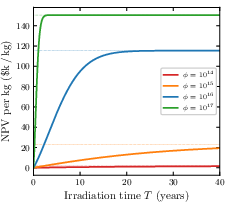
Figure 6: Cumulative discounted gold revenue per kg of natural mercury, demonstrating rapid maturity at high flux and minimal residual mercury value after extended irradiation.
Conclusion
This study rigorously quantifies the dual-use potential of fusion reactors for environmental remediation and economic co-production of gold via mercury transmutation. Activating multi-step (n,2n) chains for all stable Hg isotopes elevates mercury to a strategic, highly valuable resource, completely inverting its environmental hazard status. Facility and blanket engineering, enrichment strategies, and gold yield optimization underpin practical deployment. The broader implication is a fusion-enabled remediation industry wherein pollutant consumption is incentivized by precious metal yield, providing self-subsidizing pathways for large-scale environmental restoration and fundamentally altering the policy calculus for fusion commercialization.