- The paper presents a comprehensive engineering study that overcomes neutron shielding challenges for DT fusion using a levitated dipole design.
- It details the innovative optimization of a REBCO-based core magnet and layered tungsten/boron carbide shielding to ensure stability and rapid replacement of high-exposure components.
- The reactor designs achieve high duty cycles and favorable net electrical outputs (208 MWe and 74.5 MWe) while addressing critical plasma equilibrium and thermal management challenges.
Deuterium–Tritium Levitated Dipole Fusion Power Plants: Authoritative Summary and Technical Analysis
Conceptual Foundations and Physics Rationale
This paper conducts a rigorous systems-level engineering study of Deuterium–Tritium (DT) levitated dipole fusion reactors, a concept originally inspired by planetary magnetospheres. The levitated dipole configuration eliminates the need for extensive structural supports and increases engineering accessibility by physically decoupling the superconducting confinement magnet (REBCO-based) from the vacuum vessel and heat extraction systems. The plasma equilibrium is governed by a reduced Grad–Shafranov equation in a purely poloidal field, yielding unique regions: an innermost first closed flux surface (Ψfcfs), an outer last closed flux surface (Ψlcfs), and a centrally peaked pressure profile with extremely high volume expansion and aspect ratio, further incentivizing large chamber size relative to the magnet. The intrinsic stability limit is set by marginal stability to interchange modes, which fundamentally motivates the adoption of peaked pressure and temperature profiles (see Fig. 3).
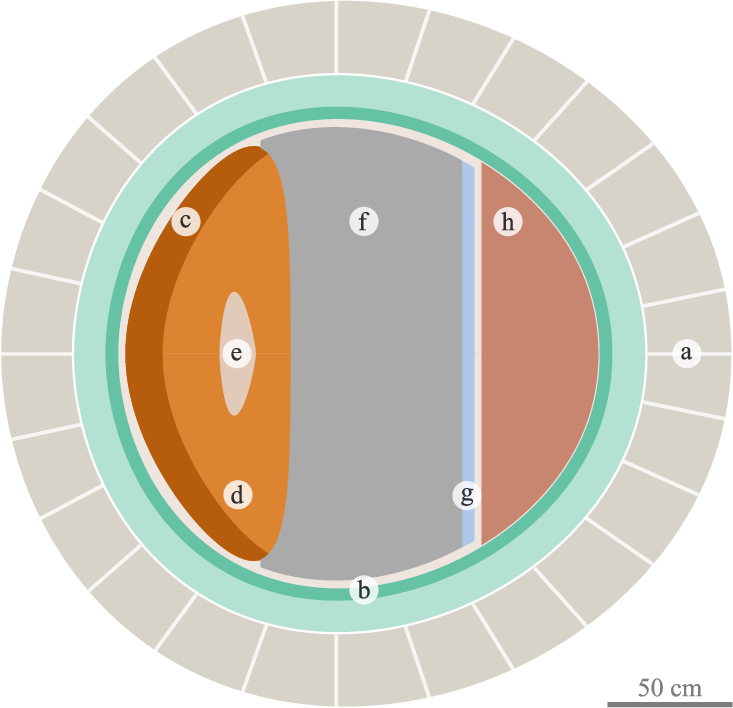
Figure 1: Poloidal magnetic flux contours and pressure profiles in low and high β equilibria; fusion power peaks at moderate β0, as plasma expansion reduces central pressure.
A critical advantage over tokamak and stellarator designs is the absence of plasma disruptions and the inherent accessibility for maintenance. This enables high plant duty factors and potentially minimizes the levelized cost of electricity (LCOE). Previously, DT-fueled levitated dipole designs were considered infeasible due to high neutron fluxes ($14.1$ MeV from DT reactions) incident on the superconducting core magnet, challenging the coil’s lifetime and thermal management.
Systems Engineering and Component Design
Core Magnet and Structural Optimization
The paper provides the first detailed engineering optimization of a dipole core magnet designed for fusion, with constraints on peak REBCO strain (<0.4%), mechanical stresses (<700 MPa), and duty cycle (>90%). The cross-sectional coil geometry is tailored to maximize poloidal flux for plasma confinement while minimizing induced mechanical stress, leveraging a cable-in-conduit (CICC) architecture with a sacrificial REBCO section (≈20%) that experiences the highest neutron exposure and is designed for rapid periodic replacement.
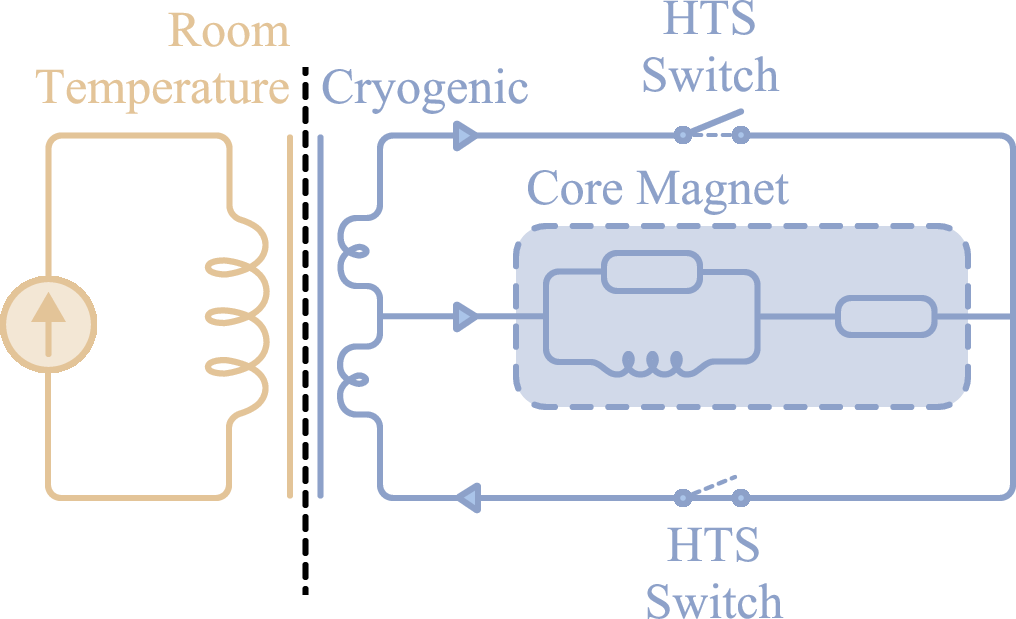
Figure 2: Representative cross-sectional build of the core magnet, including radiatively cooled tungsten neutron shield, sacrificial/persistent REBCO regions, overband structure, and cryogenic reservoir.
The superconducting power supply is realized via a center-tapped transformer-rectifier circuit employing superconducting switches and quasi-persistent flux pumps. Power supply and auxiliary electronics are placed within a self-shielded low-field region inside the magnet, realized entirely with strategic winding geometry (see Fig. 14).
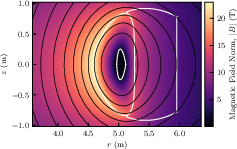
Figure 3: Magnetic field map for the Reactor A core magnet, with peak field up to $23$ T and <100 mT in the interior low-field region for sensitive electronics.
Neutron Shielding and Thermal Management
A major technical barrier addressed is neutron attenuation and magnet lifetime. The shield uses a layered structure of tungsten and boron carbide (B4C), designed for maximal neutron attenuation, high working temperature (>1950 K for radiative cooling), and structural durability against thermal creep and recrystallization. OpenMC neutron transport calculations validate the shielding performance; only ∼25% of neutrons emitted traverse the magnet’s field of view, and the sacrificial REBCO section lifetime (at a fluence limit of 3×1018 cm−2) is ∼1 year.
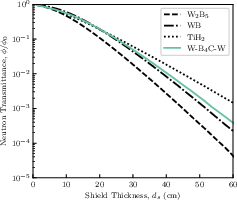
Figure 4: Neutron attenuation performance of optimal layered W-B4C shields compared to standard shielding materials.
Thermal energy deposited in the shield is rejected primarily by black body radiation to the first wall; on-board cryogenic reservoirs employing neon slush provide latent heat buffers for the core magnet during levitated operation, enabling rapid component turnaround (<5 min docking cycles) and sustained plant duty cycles.
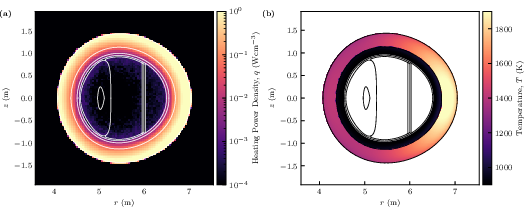
Figure 5: Modeling results for neutron and photon heating distribution in the shield and resulting temperature map; outer tungsten tiles reach $1950$ K steady-state.
Vacuum Vessel and Tritium Breeding
The vacuum chamber is a double-layer structure: an external reinforced concrete shell and an internal plasma-facing high-vacuum vessel, both configured for robust mechanical load management and tritium breeding blanket integration. Tritium breeding ratios (TBR) up to 1.1 are achieved utilizing thick Li2O ceramic blanket modules, facilitated by moderate neutron multiplication in the tungsten shield.
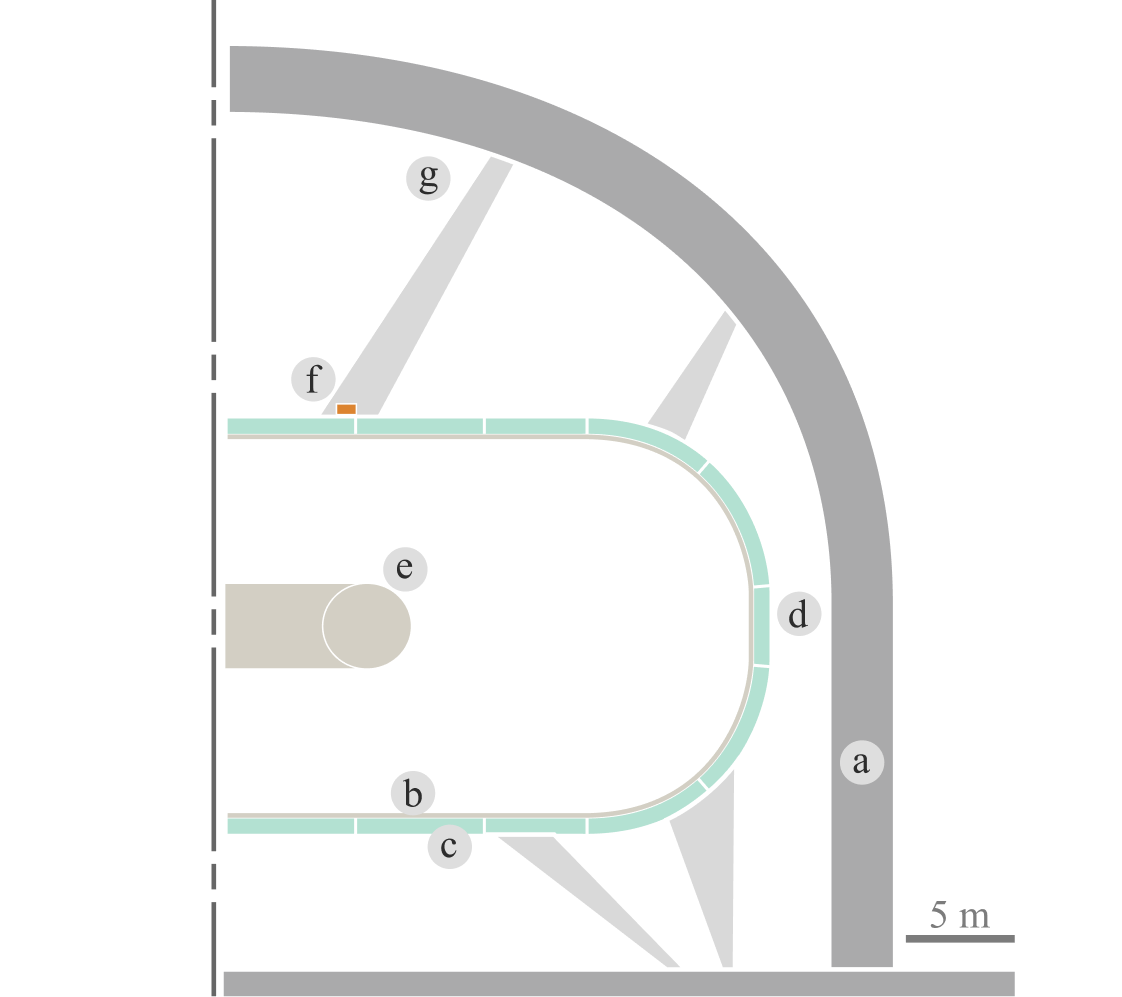
Figure 6: Typical vacuum chamber cross-section, showing structural elements, tritium blanket, maintenance annuli, and magnet supports.
Two design points are detailed (Table: Reactor Overview): Reactor A ($208$ MWe net, $667$ MW fusion) and Reactor B ($74.5$ MWe, $237$ MW fusion), both featuring core magnet outer radii around $7$ m, chamber radii >20 m, and plant availabilities exceeding 95%. The core magnet’s mechanical and thermal stresses are fully within the operational envelope of SS316LN and REBCO, and neutron fluxes on the coil are attenuated by four orders of magnitude.
Prompt alpha losses (ASCOT5 simulations) are negligible, with >99% of fusion product energy retained for plasma heating. Energy confinement times required are $3.5$ s (Reactor A) and $5.9$ s (Reactor B), with triple products set by conservative Bohm scaling and further bounded against current experimental benchmarks (LDX).
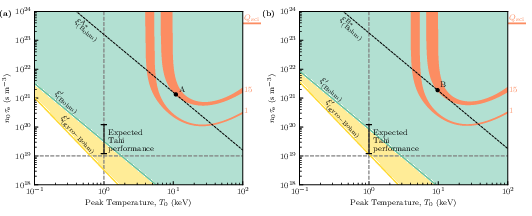
Figure 7: Full plant, plasma, and magnet energy balance Sankey diagrams for Reactor A, illustrating power flows and major loss channels.
Net electrical outputs are calculated using detailed models including conversion efficiencies, heating power, neutron wall loadings, and cryogenic overheads. Optimization is framed as minimizing required confinement time for a sub-scale demonstration (Tahi) device, setting targets for future validation.
Contradictory/Challenging Claims
- The study demonstrates that DT levitated dipole reactors can be designed with achievable engineering constraints, overturning prior assumptions of infeasibility due to neutron shielding challenges.
- Core magnet lifetimes (main coil >10 years, sacrificial section >1 year) are economically acceptable with modular repair strategies, in opposition to previous expectations that neutron fluxes would preclude practical operation.
Implications and Future Developments
The theoretical and practical implications are profound. The levitated dipole approach enables modular fusion power plants with rapid maintenance cycles, high accessibility, and minimal downtime. The plant architecture mitigates key economic drivers such as susceptibility to disruptions and complex integrative maintenance. The demonstration of sustainable magnet lifetimes and high-duty operation opens avenues for scalable grid deployments.
On the theoretical side, future work will refine energy confinement scalings in dipole plasmas, verify edge pedestal physics in diverted equilibria, and explore advanced material science for shield optimization (e.g., tungsten borides, metal hydrides). The reference device (Tahi) will serve as a performance benchmark for validating numerical optimization and subsequent reactor scalability. Advances in REBCO performance and flux pump technology (voltage, energy density, recovery speed) will further determine ultimate practical feasibility and economic competitiveness relative to alternatives (ITER, ARC, Stellaris).
Conclusion
This paper provides the first detailed systems study of DT levitated dipole fusion power plants, offering comprehensive optimization of plasma equilibrium, magnet and shield engineering, maintenance strategy, and economic evaluation. Strong numerical evidence and validated simulations show that previously prohibitive factors concerning neutron shielding and REBCO coil lifetimes can be addressed within contemporary material capabilities. The modular architecture and operational strategies position levitated dipole reactors as a viable path for economic fusion deployment, contingent on forthcoming experimental confirmation of plasma performance scaling in devices such as Tahi.