- The paper demonstrates that incorporating survey design features—such as PSU clustering and weighting—restores near-nominal confidence interval coverage in modern DiD estimators.
- It bridges advanced survey statistics with DiD theory using influence-function representations and Binder’s framework to achieve design-consistent variance estimation.
- Empirical simulations and a NHANES case study reveal that ignoring survey design leads to severe underestimation of variance and altered causal interpretations.
Design-Based Variance Estimation for Heterogeneity-Robust Difference-in-Differences: A Comprehensive Review
Difference-in-differences (DiD) methods are widely used for policy evaluation, often relying on large-scale, nationally representative surveys such as NHANES, ACS, CPS, and MEPS. These surveys employ stratified, multi-stage cluster sampling, resulting in correlated observations within primary sampling units (PSUs) and constrained variance from stratification. Standard error calculations assuming independent and identically distributed (iid) data, as codified in HC1 (heteroskedasticity-consistent covariance matrix estimator), produce misleading inference under such designs, frequently understating uncertainty by factors of 2–17 (and exceeding 100 under informative sampling designs). Treatment assignment often occurs at geographic levels overlapping multiple PSUs, further increasing intra-cluster correlation and amplifying variance distortions in DiD estimators. Despite these complications, practitioners routinely apply heterogeneity-robust modern DiD estimators to complex survey data without explicit accommodation for the sampling design—posing significant risks for validity assessments in policy analysis.
Theoretical Development and Main Contributions
The paper systematically exposes the disconnect between the theoretical foundations and applied practice in modern DiD inference under complex survey sampling. Existing literature on heterogeneity-robust DiD—encompassing works such as Callaway–Sant’Anna, Sun–Abraham, Borusyak–Jaravel–Spiess, and Gardner—typically assumes iid or abstracted designs, lacking explicit consideration for strata, PSU clustering, or finite population corrections (FPC). Software implementations (e.g., R’s did, Stata’s csdid) usually incorporate weights only for point estimation and cluster-robust inference at a single level, not the full survey design.
The central contribution is a formal bridge between advanced survey statistics and modern DiD inference: under standard regularity conditions, the influence-function (IF) representations of these estimators satisfy Binder’s (1983) smoothness criteria. Therefore, stratified-cluster variance formulas applied to the survey-weighted IFs yield design-consistent variance estimators. This assertion is not a novel proposition per se—it follows directly from theory on smooth functionals and survey variance linearization—but the verification that all major modern DiD estimators fall within its scope and the empirical demonstration of well-calibrated inference are new.
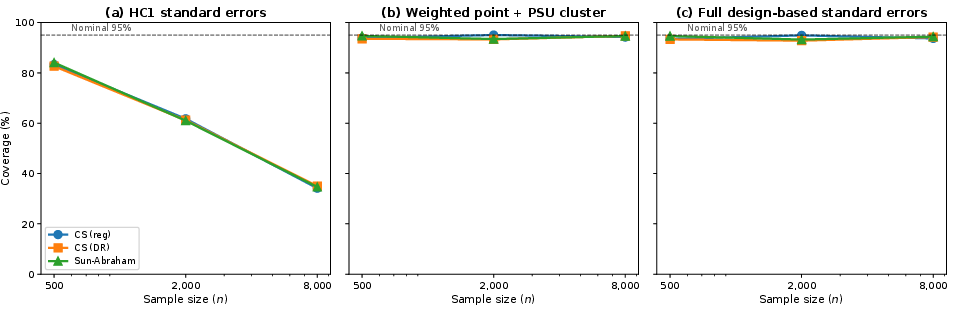
Figure 1: 95% confidence interval coverage for modern DiD estimators under complex survey design; HC1 SEs ignore sampling structure, producing severe under-coverage at increasing sample sizes, while design-based cluster SEs remain near nominal.
The paper employs a Monte Carlo simulation with 66,000 replications across varied scenarios—including informative sampling, repeated cross-sections, and conditional parallel trends—to rigorously document coverage, bias, and design effects. Findings confirm that:
- HC1 standard errors produce confidence interval coverage as low as 34% (nominal 95%) at large sample sizes, and below 11% under informative sampling.
- Properly survey-weighted point estimates combined with PSU-level clustering restore near-nominal coverage in all scenarios—even under informative designs.
- Full design incorporation (strata, PSU clustering, FPC) provides incremental precision but is not essential for valid coverage.
- Survey-weighted DR estimation achieves correct inference under conditional parallel trends.
A real-world illustration using NHANES data on the ACA’s dependent coverage provision demonstrates that ignoring survey design alters both point estimates and inference, with a 48% change in the ATT and a reversal of significance when survey structure is properly accounted for.
Empirical and Simulation Validation
The simulation exercises systematically explore:
- The impact of complex survey design on variance estimation and confidence interval coverage for key DiD estimators (Callaway–Sant’Anna, Sun–Abraham, TWFE).
- Effects of informative sampling where estimator bias is introduced by nonrandom weight-outcome association.
- Extension to repeated cross-sections—affirming generalizability to major federal surveys.
- Validity of survey-weighted DR approaches under covariate-dependent parallel trends.
The results consistently show that:
- Design-based variance estimation nearly eliminates under-coverage, regardless of scenario or estimator, provided survey weights and appropriate clustering are used.
- Strata and FPC components incrementally improve precision but are not strictly required for inferential validity.
- HC1 SEs systematically underestimate variance, especially as intra-cluster correlation and weight variability increase.
The NHANES empirical illustration concretely demonstrates these findings in an applied context: omission of survey design features leads to a qualitatively different causal conclusion, underscoring the risks posed by direct application of non-design-aware DiD estimators in policy settings.
Practical Implications and Software Implementation
To operationalize the theoretical framework, the paper introduces diff-diff, a Python package offering design-based variance estimation for 15 modern DiD estimators. The package supports direct specification of survey weights, strata, PSU identifiers, FPC, and replicate-weight methods, with estimator coverage spanning both regression-based and IF-based approaches. The API design isolates survey design information, providing both flexibility and rigorous integration with estimator logic. The package is available on PyPI and GitHub, accompanied by extensive documentation and user tutorials.
The practical guidance distilled from the results includes:
- Mandatory use of survey weights in point estimation: Ensures targeting of the finite-population parameter, preventing bias from unrepresentative samples.
- PSU-level clustering for variance: Sufficient for nominal coverage; widely used practitioner heuristics are formally justified.
- Strata and FPC for incremental precision: Full design specification tightens variance estimation, but omitted components primarily result in conservative inference.
- Replicate weights as a valid alternative: Direct use of BRR, JK1, SDR, etc., achieves asymptotic equivalence to analytical linearization in settings where underlying design variables are inaccessible.
Limitations include the requirement of sufficient PSUs per stratum, potential anti-conservatism under low degrees of freedom, and assumption of population-level parallel trends or correct specification of nuisance models in DR settings.
Theoretical and Applied Implications, Future Directions
The established connection between survey design variance estimation and the influence function expansions within modern DiD econometrics substantially strengthens both the theoretical foundation and practical reliability of causal inference in survey contexts. This unification ensures that practitioners can deploy the full range of heterogeneity-robust DiD estimators with well-calibrated inference even as survey data complexity increases. The results prompt further inquiry into:
- Incorporation of calibration/post-stratification weights and their interaction with variance estimation.
- Multi-level treatment assignment and appropriate variance aggregation when treatment units cross-cut survey stratification structures.
- Extension to non-smooth estimators—synthetic controls and triply robust panels—using resampling-based survey variance.
- Enhanced support for replicate-weight methods, facilitating valid inference with public-use survey files that lack explicit strata or PSU coding.
Conclusion
This work formally identifies and substantiates the application of design-based variance estimation to modern heterogeneity-robust DiD estimators (via Binder’s framework), bridging critical theoretical and computational gaps in policy evaluation using complex survey data. The results highlight the necessity of weights and clustering, provide empirical confirmation via extensive simulation, and offer actionable guidance and software for researchers. The implications are broad: survey-based DiD analyses will achieve greater inferential validity and transparency, supporting more robust policy conclusions across domains reliant on stratified, multi-stage survey infrastructures.