- The paper demonstrates a hybrid quantum-classical fine-tuning pipeline that replaces classical neural heads with parameterized quantum circuits for improved sentiment analysis.
- It reveals nearly linear energy scaling for QPUs and an energy-to-solution crossover at about 34 qubits, contrasting with exponential scaling in classical simulations.
- The study shows that QPU fine-tuning with advanced error mitigation attains 91.2% accuracy on SST2, reducing classification error by up to 24% over classical baselines.
Measuring Energy-to-Solution and Accuracy of Quantum Fine-Tuning for Foundation AI Models
Introduction
The paper "Measuring Accuracy and Energy-to-Solution of Quantum Fine-Tuning of Foundational AI Models" (2605.02798) presents an empirical investigation into the energy efficiency and functional accuracy of using hybrid quantum-classical pipelines to fine-tune foundational AI models. Specifically, the authors quantify the absolute and relative energy consumption and establish empirical scaling laws for both quantum processing units (QPUs) and classical accelerators (GPUs) across increasing qubit counts, providing direct energy-to-solution (ETS) measurements on a trapped-ion QPU (IonQ Forte Enterprise). They contextualize these results against statevector simulation and tensor network classical baselines, analyzing the regimes where quantum advantage in ETS may manifest. Accompanying these measurements is a thorough accuracy study, utilizing realistic error mitigation and debiasing pipelines to validate that QPU-executed fine-tuning heads can achieve competitive performance against both noisy simulation and classical ML alternatives.
Quantum Fine-Tuning Pipeline: Architecture and Methodological Advances
The hybrid pipeline evaluated builds on previous work [kim2025quantum] integrating parameterized quantum circuits (PQCs) into LLM fine-tuning frameworks such as SetFit. The experimental protocol involves replacing the classical neural network head in a BERT-based sentence transformer with a PQC, which is trained to act as a binary classifier for sentiment analysis (SST2 benchmark). The architecture forgoes a final classical linear layer post-quantum measurement, directly using the expectation value of a single readout qubit as the logit. This design mitigates simulation-to-hardware mismatches and constrains model outputs for robust decision boundaries.
Noise resilience on NISQ hardware is addressed via a two-stage error mitigation pipeline:
- Symmetrization-based Debiasing (DNL): Circuit variants are generated by permuting logical-to-physical qubit mappings, aggregating measurement histograms to average out systematic hardware errors.
- Non-Linear Aggregation Filter: Bitstrings reported from circuit measurement are downweighted if their large counts are concentrated in few circuit variants, suppressing mapping-dependent artifacts.
- Global Bias Correction: Per-sample logits are centered by subtracting their global mean, correcting for systematic measurement shifts across batches.
Energy consumption for classical simulation is tracked using detailed power logging (CodeCarbon) on isolated GPU-equipped VMs, ensuring a fair comparison to the direct hardware instrumentation available on the Forte Enterprise QPU.
Empirical Energy Scaling Behavior and Implications
The central empirical result is a quantitative comparison of energy-per-inference (with practical shot counts) as a function of qubit number:
- QPU (Quantum Hardware): Exhibits nearly linear scaling in both energy consumption and execution time with respect to qubit count for shallow, hardware-efficient circuits. Power draw is highly stable and only weakly dependent on the size of the circuits being executed.
- Classical Simulation (Statevector GPU): Displays exponential scaling in both energy and time as expected from the doubling of statevector size per qubit.
This divergence produces a projected ETS crossover point at approximately 34 qubits for the experimental configuration, hyperparameters, and hardware choices. The empirical energy measurements confirm that QPU ETS for such circuits can remain tractable at scale well beyond feasible classical simulation regimes.
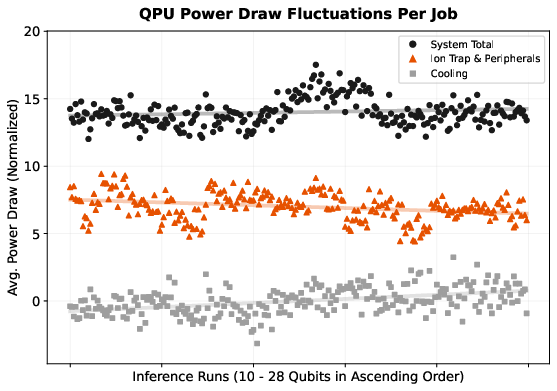
Figure 2: Per-job average power draw readings for inference tests show no significant increase with qubit number, supporting linear energy scaling for the QPU across 10–28 qubits.
Power Consumption Analysis
Analysis of hardware-level logs demonstrates that the system's major components, including the ion trap and combined cooling modules, do not correlate strongly or monotonically with circuit size. The average QPU power draw largely reflects the QPU's operational state rather than the logical circuit complexity, indicating that the primary factor determining total energy use is execution time, not device-level energy spikes from more complex circuits.
Quantum Fine-Tuning: Accuracy Evaluation
QPU accuracy studies are conducted for 10, 12, 14, 16, and 18 qubits, contrasting the debiased, hardware-executed PQCs against noiseless and noisy simulators as well as classical ML baselines:
- Best quantum fine-tuned model reduces classification error over classical baseline (SVC) by approximately 24% (Ideal simulation) and 15.7% (QPU with error mitigation).
- At 18 qubits, QPU+error mitigation achieves 91.2% accuracy, just 0.86 percentage points below the noiseless theoretical optimum and significantly exceeding SVC/logistic regression baselines (~89%).
- The quantum-classical performance gap narrows with increasing qubit counts and shot budgets, suggesting that scaling up further will likely increase QPU model performance advantages.
- The non-linear aggregation filter is most beneficial in intermediate shot regimes; as shot counts rise, simple averaging suffices to robustly denoise results.
The study also demonstrates that increasing circuit depth and qubit count yields monotonic accuracy gains up to 18 qubits, even though cumulative gate errors also increase. This signals that circuit expressivity growth outpaces noise contributions in this depth/window, especially with applied error mitigation.
Comparison to Tensor Network Simulation
Tensor networks—specifically matrix product states (MPS)—offer a powerful classical simulation technique for circuits with restricted entanglement and logarithmic depth. MPS simulation cost scales as O(Q4) for log-depth circuits, while QPU energy scales as O(QlogQ) under the same assumptions. The analysis suggests that for shallow circuits, although MPS is efficient, QPU execution is more energetically favorable at scale, projecting an ETS crossover at experimentally accessible NISQ system sizes. Classical MPS simulation, while effective for limited entanglement growth, becomes energetically prohibitive for arbitrary or deeper circuits, reinforcing the need for quantum hardware as model and dataset size increase.
Practical and Theoretical Implications
The results establish ETS as a robust, empirically accessible metric for benchmarking practical quantum advantage in the NISQ era, moving beyond traditional focus on asymptotic computational speedups. The evidence that QPU ETS scales linearly for shallow parameterized circuits—together with demonstrated accuracy improvements—strengthens the argument for quantum computing's role in sustainable, energy-efficient AI model adaptation. The integration of direct hardware energy monitoring and fine-grained error mitigation into end-to-end QML pipelines is crucial for accurately estimating quantum versus classical resource trade-offs in real applications.
Theoretically, these findings support the notion that quantum fine-tuning heads may deliver both accuracy and ETS advantage in specific ML settings well before the onset of fully error-corrected, fault-tolerant quantum computation. QPU-native operations, if leveraged with architectural and noise-aware modifications, can outperform both standard and advanced classical fine-tuning approaches on practical datasets like SST2, even using current NISQ devices.
Future Directions
Several open questions remain:
- Direct measurement of training energy (as opposed to inference only) on QPUs relative to classical baselines.
- Extension to deeper circuits, larger data splits, and more complex natural language tasks (multi-class, generative, or semantic parsing).
- Benchmarking against advanced tensor network and randomized contraction methods optimized for higher-depth circuits and alternative natural datasets.
- Exploration of fine-tuning architectures for multimodal or retrieval-augmented foundation models where high-dimensional quantum encodings may yield new learning regimes.
- Assessing the implications for real-world deployment in energy-constrained AI pipelines, including environmental and economic considerations.
Conclusion
This work provides an empirical foundation for evaluating both the energy consumption and functional validity of quantum fine-tuning in foundational AI models. For shallow quantum circuits executed on modern trapped-ion hardware, energy-to-solution scales linearly with qubit count, with effective error mitigation enabling accuracy improvement beyond classical baselines. The crossover point for quantum versus classical energetic efficiency is demonstrated to be within practical reach for near-term QPUs. These results motivate expanded study of QML energy metrics and promote direct ETS comparisons as essential for identifying actionable quantum advantage in AI model deployment.

