UniVidX: A Unified Multimodal Framework for Versatile Video Generation via Diffusion Priors
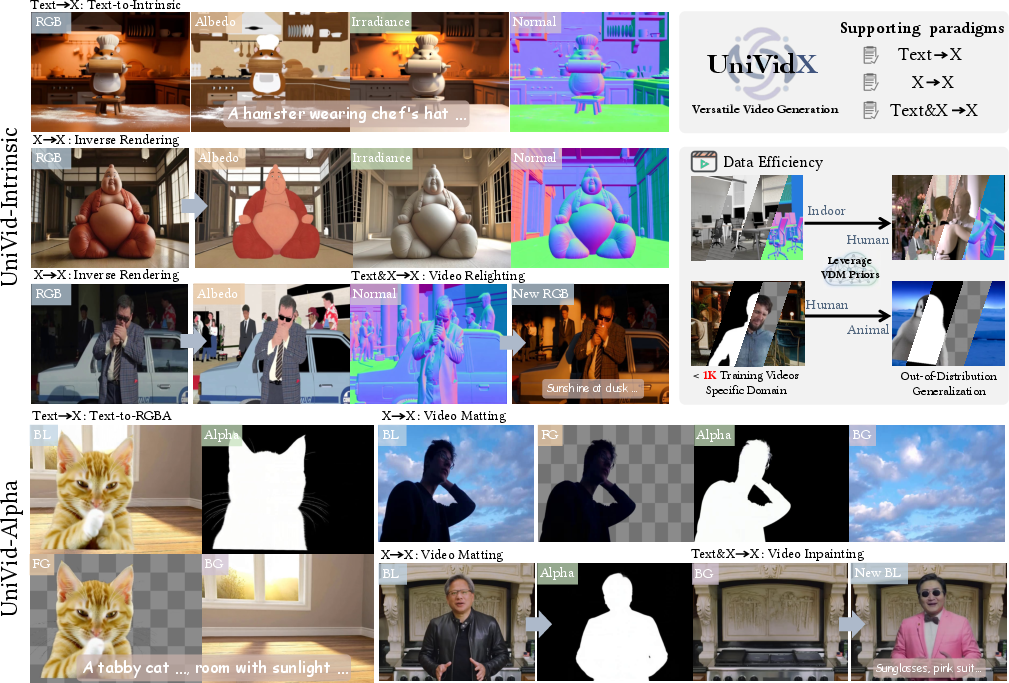
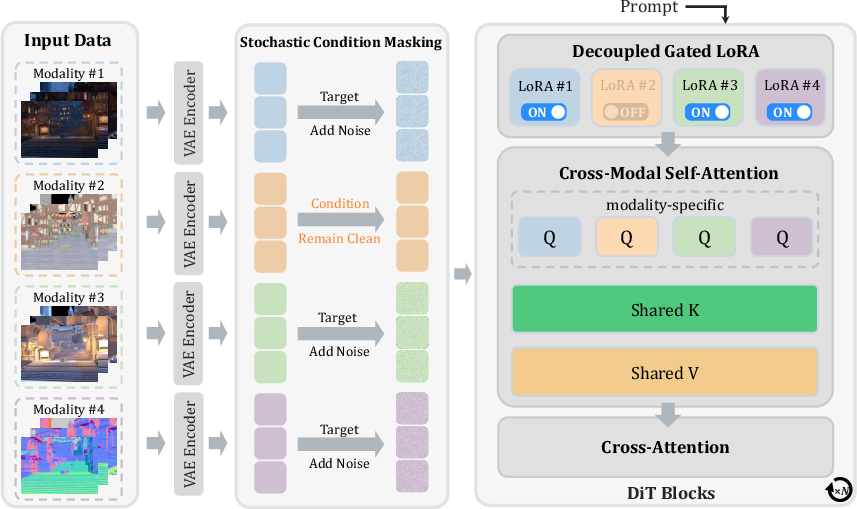
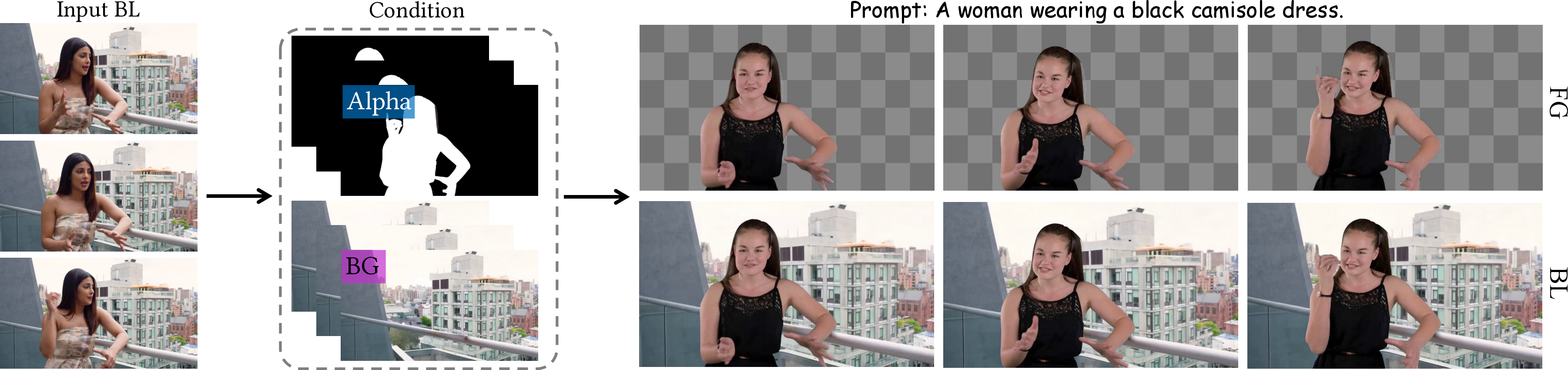
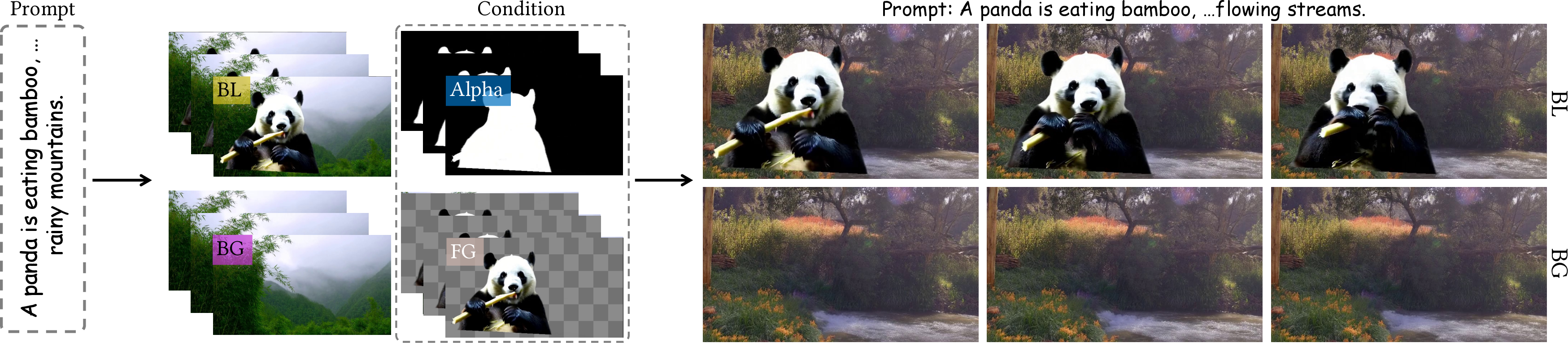
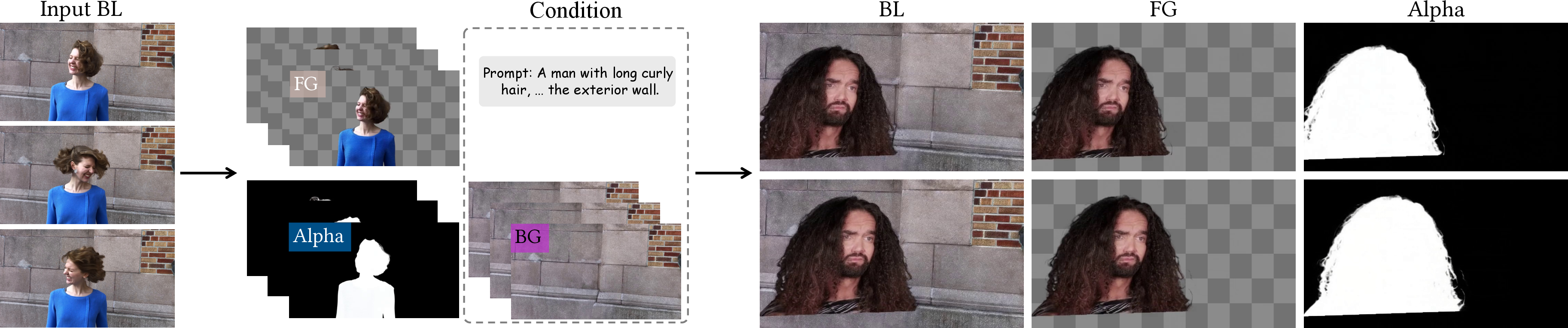
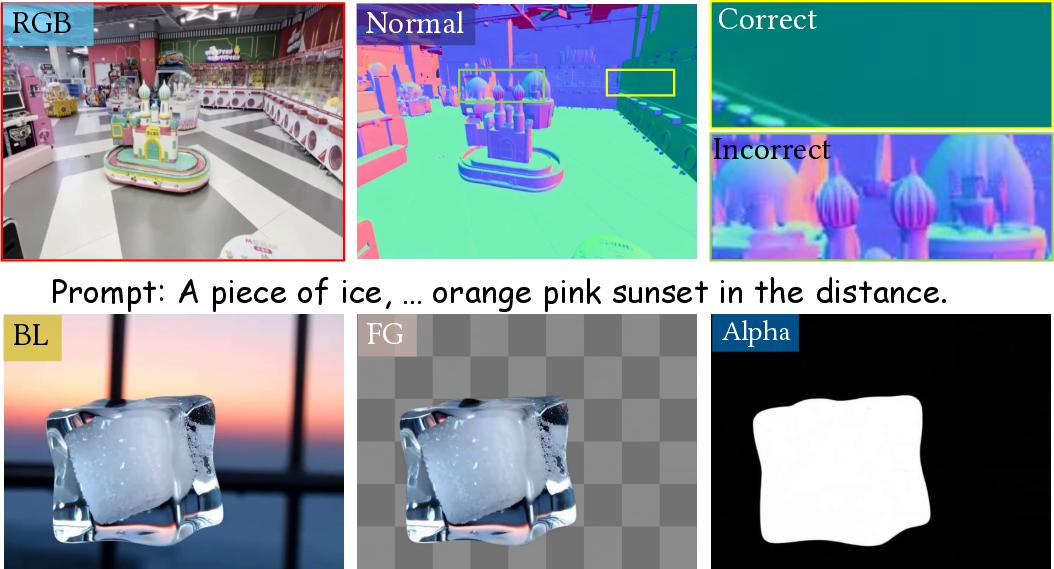
Abstract: Recent progress has shown that video diffusion models (VDMs) can be repurposed for diverse multimodal graphics tasks. However, existing methods often train separate models for each problem setting, which fixes the input-output mapping and limits the modeling of correlations across modalities. We present UniVidX, a unified multimodal framework that leverages VDM priors for versatile video generation. UniVidX formulates pixel-aligned tasks as conditional generation in a shared multimodal space, adapts to modality-specific distributions while preserving the backbone's native priors, and promotes cross-modal consistency during synthesis. It is built on three key designs. Stochastic Condition Masking (SCM) randomly partitions modalities into clean conditions and noisy targets during training, enabling omni-directional conditional generation instead of fixed mappings. Decoupled Gated LoRA (DGL) introduces per-modality LoRAs that are activated when a modality serves as the generation target, preserving the strong priors of the VDM. Cross-Modal Self-Attention (CMSA) shares keys and values across modalities while keeping modality-specific queries, facilitating information exchange and inter-modal alignment. We instantiate UniVidX in two domains: UniVid-Intrinsic, for RGB videos and intrinsic maps including albedo, irradiance, and normal; and UniVid-Alpha, for blended RGB videos and their constituent RGBA layers. Experiments show that both models achieve performance competitive with state-of-the-art methods across distinct tasks and generalize robustly to in-the-wild scenarios, even when trained on fewer than 1,000 videos. Project page: https://houyuanchen111.github.io/UniVidX.github.io/




Paper Prompts
Sign up for free to create and run prompts on this paper using GPT-5.
Top Community Prompts
Explain it Like I'm 14
What this paper is about
This paper introduces UniVidX, a new way to make and edit videos using AI. Instead of training a separate AI for each task (like one for cutting a person out of a video and a different one for relighting a scene), UniVidX is a single system that can handle many video tasks. It does this by building on top of powerful “video diffusion models,” which are AIs that learned how real videos look and move by watching tons of examples.
What questions the authors wanted to answer
In simple terms, the authors asked:
- Can one video AI learn to do many different jobs instead of having a separate AI for each job?
- Can it switch flexibly between different kinds of inputs and outputs (like text, RGB video, surface properties, or transparency layers)?
- Can it keep everything consistent across different layers of a video (so color, lighting, and shape agree with each other)?
- Can it do all this well even if we only give it a small amount of training data?
How the method works (in everyday language)
Think of UniVidX like a talented video chef that already knows a lot about cooking (videos) because it’s learned from a huge cookbook (pretrained diffusion model). The authors add three simple “kitchen rules” so the chef can cook many kinds of dishes from different ingredients:
- Stochastic Condition Masking (SCM):
- Text to video layers (Text → X),
- One visual layer to another (X → X),
- Or text plus some layers to other layers (Text + X → X).
- This breaks the habit of learning only a single fixed input-output route and teaches the model to be flexible.
- Decoupled Gated LoRA (DGL): A LoRA is like a small add-on that can tweak a big model without changing its core. The authors attach a separate tiny tweak for each type of layer (e.g., one for normals, one for albedo, one for alpha). These tweaks only turn on when the model is asked to generate that specific layer. When a layer is used just as a clue, its tweak is turned off. This prevents the tweaks from “fighting” each other and keeps the big model’s built-in knowledge intact.
- Cross-Modal Self-Attention (CMSA): Attention is how the model decides what parts of the video to focus on. Cross-modal attention is like having different team members (layers) share a common set of notes (keys/values) while each asks its own questions (queries). This lets the layers “talk” to each other so they stay in sync—for example, lighting and surface directions agree, or foreground and background fit together.
The team built two versions to show this works:
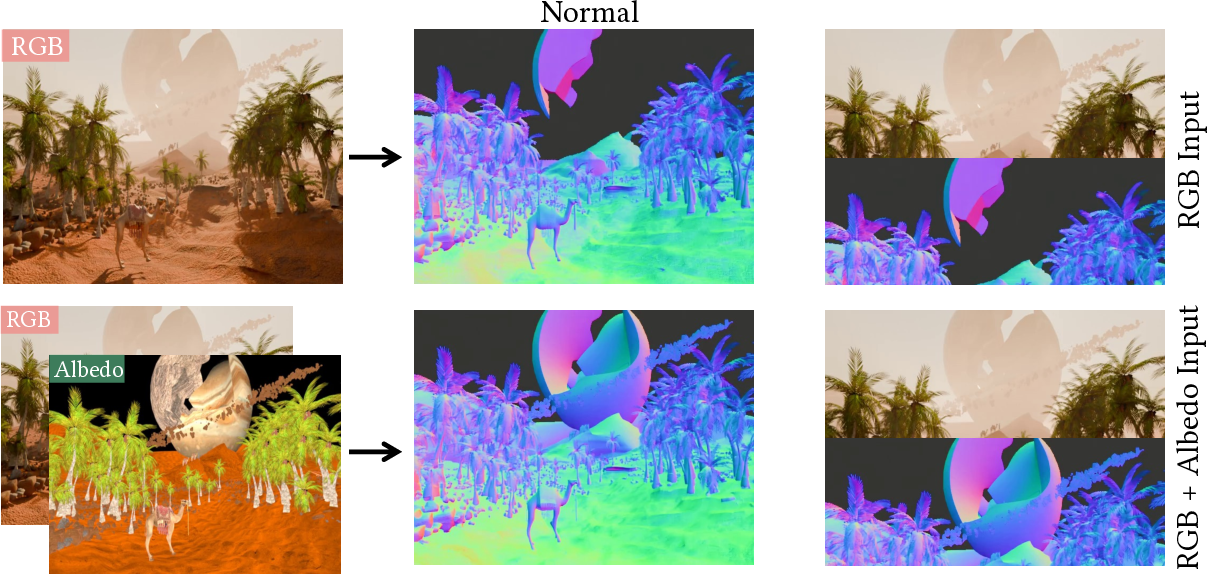
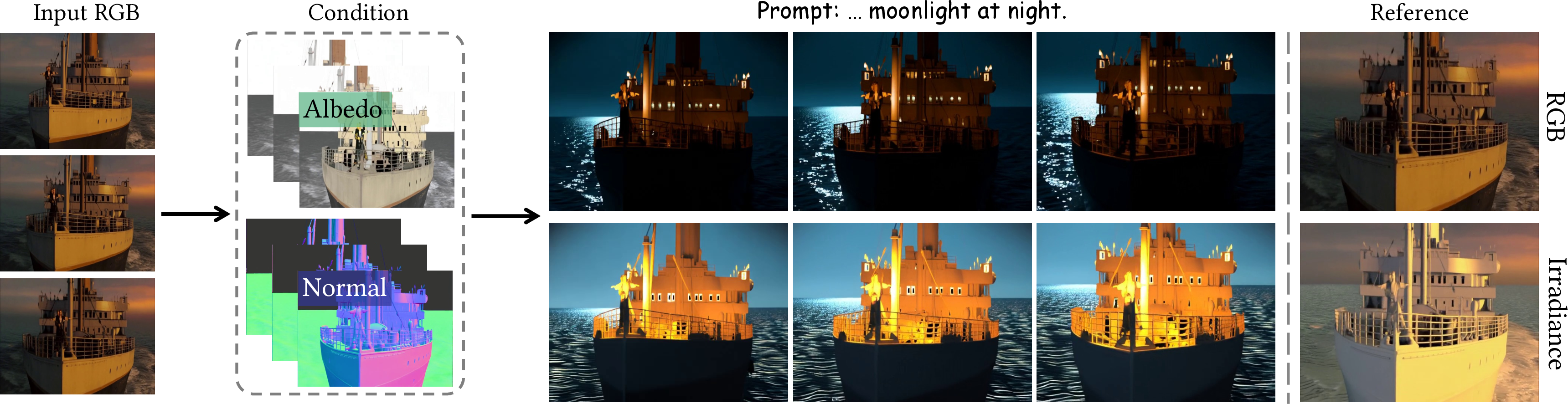
- UniVid-Intrinsic: works with normal RGB video plus “intrinsic” layers that describe the scene’s physical properties:
- Albedo: the true color of surfaces without lighting,
- Irradiance: the incoming light/shadows,
- Normal: the direction each tiny surface is facing (geometry details).
- UniVid-Alpha: works with layers used in video compositing:
- BL (blended RGB video),
- FG (foreground),
- BG (background),
- Alpha (transparency/soft edges).
Both versions can be controlled by text prompts, visual layers, or both.
What the authors found and why it matters
The authors tested UniVidX on many tasks and compared it to existing methods. In short:
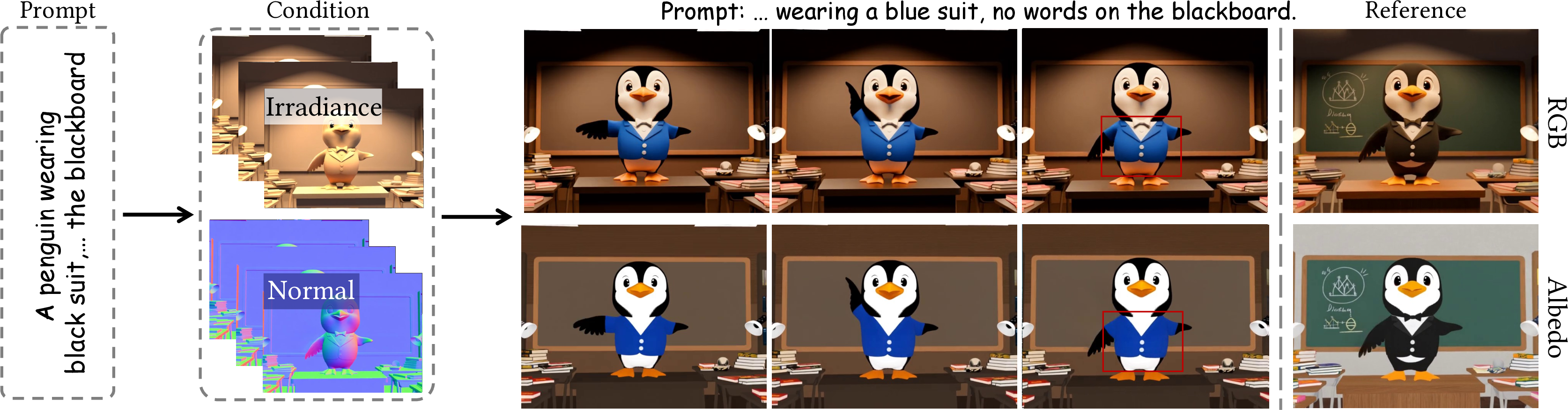
- One model, many jobs: It can do text-to-video layers, convert between layers, and combine text with layers to make new layers—all in one framework.
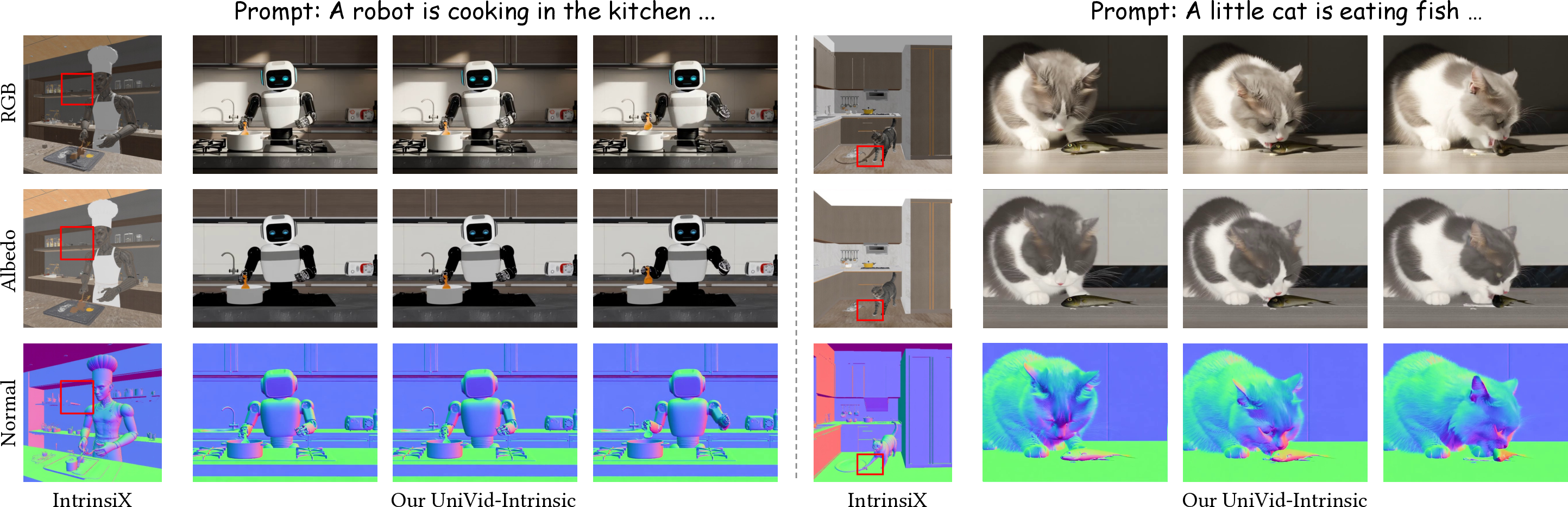
- Strong quality and consistency: It made videos that were temporally stable (less flicker over time) and kept layers aligned with each other. For example, when it generated RGB video together with albedo and normal maps, those layers matched well.
- Works with little data: Even when trained on fewer than 1,000 videos, it still performed competitively with top methods trained on much larger datasets.
- Outperformed or matched specialized tools:
- For generating intrinsic layers from text, it beat image-based baselines in user studies and was much more stable over time.
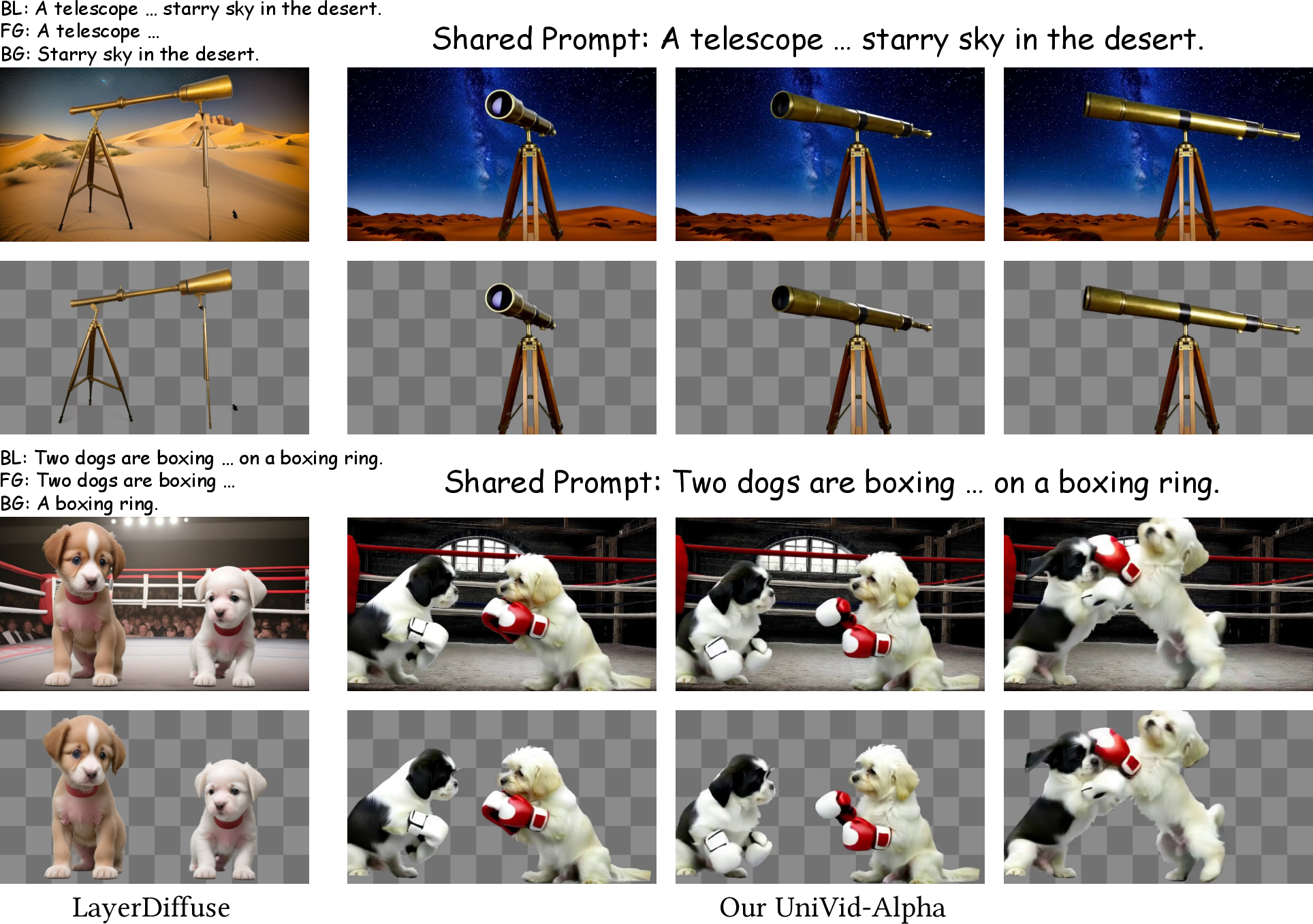
- For text-to-RGBA videos (foreground, background, transparency), it produced high-quality, moving results, while some baselines only handled single images.
- For inverse/forward rendering (splitting a video into physical layers and then reconstructing it), it showed strong numbers on standard metrics.
- For normal and albedo estimation (understanding geometry and true surface color), it achieved top or near-top performance, including on real-world benchmarks, despite being trained on synthetic or smaller data.
- For video matting (cutting subjects out of video), it was competitive with dedicated matting methods, even though UniVid-Alpha is a general generator and not just a matting tool.
Why this is important:
- Creators and developers can use a single, flexible tool to do many video tasks at once, saving time and simplifying pipelines.
- The model’s consistency across layers means fewer visual glitches when combining effects like relighting, retexturing, or background replacement.
- Data efficiency means it’s more practical to train and adapt in real settings where huge datasets aren’t available.
What this could lead to
This research suggests a future where:
- Video editing is more unified: the same AI can relight a scene, change materials, extract subjects, inpaint missing areas, and more—guided by text and/or example layers.
- Better cross-layer consistency: generated layers agree with each other, reducing artifacts in complex edits.
- Faster progress with less data: by reusing the “prior knowledge” of large video diffusion models and adding small, targeted tweaks, new tasks can be learned quickly.
In short, UniVidX is a flexible, teachable “video factory” that can take instructions in different forms (text or visual layers) and produce high-quality, matching outputs across many video tasks—even with relatively little training data.
Knowledge Gaps
Below is a concise, actionable list of the paper’s unresolved knowledge gaps, limitations, and open questions. Each item highlights what is missing or uncertain and suggests concrete directions future work could pursue.
- Limited modality coverage: the framework is only instantiated for {RGB, albedo, irradiance, normals} and {BL/FG/BG/Alpha}, while other common video modalities (e.g., depth, roughness/metallic, specular parameters, optical flow, segmentation, audio) are excluded; evaluate how to extend UniVidX to these modalities and validate performance.
- No explicit physical-consistency constraints: intrinsic generation is not constrained by a differentiable rendering equation (e.g., enforce R ≈ A ∘ I) and RGBA outputs are not guaranteed to satisfy R = αF + (1−α)B; add consistency losses and report recomposition/shading residuals.
- Alpha encoding mismatch: Alpha is forced into a 3-channel RGB VAE by channel replication; assess whether an alpha-specific encoder/decoder or multi-channel VAE improves matte precision and edge fidelity.
- Background layer ambiguity: BG is learned via inpainting without explicit compositing constraints; quantify whether FG/BG/α recomposition matches BL, and add compositing error as a training/evaluation metric.
- Scalability of cross-modal attention: CMSA shares keys/values across modalities, which may grow quadratically in memory/compute as modalities or resolution increase; benchmark scaling behavior and explore sparse/shared or low-rank cross-modal attention variants.
- Task sampling in SCM: the stochastic partitioning policy for targets vs. conditions is unspecified (probabilities, curriculum); study how masking distributions impact task balance, convergence, and rare-task performance, and design adaptive schedulers.
- Binary gating in DGL: per-modality LoRA is toggled on/off based on target/condition role; explore learnable, continuous gating and per-task strength control to better handle partial conditioning and nuanced domain shifts.
- Multi-target co-generation: it is unclear how DGL and CMSA behave when generating multiple modalities simultaneously; evaluate joint-target generation quality, cross-modal interference, and mechanisms to mitigate it.
- Preservation of base VDM priors: the claim that DGL preserves native priors is not quantitatively validated; measure pre/post fine-tuning text-to-video quality (e.g., VBench, FVD) to quantify catastrophic forgetting vs. full fine-tuning or other adapters.
- Long-range temporal consistency: training uses 21-frame clips; test and report performance on minute-long videos, scene transitions, and re-identification across shots, using long-horizon temporal metrics and user studies.
- Resolution and aspect ratio limits: experiments are at modest resolutions (e.g., 480×640, 432×768); evaluate high-resolution (HD/4K) generation, memory-time trade-offs, and strategies (tiling, latent upsamplers) for scaling.
- Inference efficiency: no sampling step counts, latency, or throughput are reported; provide benchmarks and explore accelerations (distillation, consistency models, progressive sampling).
- Domain generalization: UniVid-Intrinsic trains on synthetic indoor scenes; quantify domain gaps on real indoor/outdoor videos for all intrinsic modalities (beyond MAW albedo), and investigate weakly/self-supervised real-world adaptation.
- Dataset breadth and bias: InteriorVid scenes and VideoMatte data are narrow (indoor, human-centric); curate or leverage broader datasets (outdoors, varied materials, animals, vehicles) and assess bias/fairness impacts.
- Intrinsic modality choices: roughness/metallic are excluded due to label scarcity; test weakly supervised or pseudo-label strategies (e.g., inverse rendering with differentiable rendering, NeRF/relighting priors) to add specular/material maps.
- Cross-modal consistency measurement: beyond user study and flicker, introduce quantitative alignment metrics (e.g., recomposition error, photometric-consistency, normal–shading coherence) to validate CMSA’s effectiveness.
- Control disentanglement: the framework lacks tunable weights to resolve conflicts between text and visual conditions; introduce condition-strength controls and study instruction-following vs. visual adherence trade-offs.
- Prompt-layer control for RGBA: the text-to-RGBA pipeline uses a shared prompt; design and evaluate interfaces/mechanisms for layer-specific prompts and constraints without inducing modality leakage.
- Incremental modality addition: DGL suggests per-modality adapters, but it is not shown whether new modalities can be added without retraining others; study plug-and-play LoRA training and catastrophic interference in continual learning.
- Robustness and stress testing: no analysis under compression, noise, motion blur, extreme lighting, or occlusions; develop robustness benchmarks and augmentation strategies for all supported tasks.
- Ablations on CMSA/DGL: while ablations are mentioned, detailed quantitative analyses isolating CMSA vs. DGL contributions (and their interactions) are not provided; report controlled studies per task/modality.
- Evaluation breadth for matting: UniVid-Alpha is evaluated primarily on VideoMatte; include standard benchmarks (e.g., Adobe Composition-1k, Distinctions, real in-the-wild videos) and category-specific analyses (non-human, thin structures).
- Compositional applications: downstream tasks (relighting, retexturing, replacement) are shown qualitatively; design task-specific quantitative metrics (e.g., relighting fidelity, edit locality) and user studies for systematic assessment.
- Uncertainty and diversity: sampling variability and uncertainty are not characterized; report diversity metrics (e.g., variance across seeds) and provide mechanisms for uncertainty-aware editing/generation.
- Ethical and licensing considerations: the use of commercial assets (SuperHiveMarket) and proprietary backbones (Wan2.1) raises reproducibility/licensing questions; clarify data/model licenses and propose fully open-source replications.
Practical Applications
Immediate Applications
Below are concrete, deployable uses that can be built now on top of UniVidX (and its instantiations UniVid-Intrinsic and UniVid-Alpha), assuming access to a capable GPU and the Wan2.1-T2V backbone or an equivalent VDM.
- Video matting and background replacement at scale
- Sectors: media/entertainment, advertising, social platforms, video conferencing
- What: Use UniVid-Alpha (X→X) to extract high‑quality, temporally stable alpha mattes and FG/BG layers for compositing, green‑screen removal, and virtual backgrounds.
- Tools/workflows: Plugins for Adobe After Effects/Premiere/DaVinci; live-stream filters; batch processing services for agencies.
- Assumptions/dependencies: GPU inference; licensing for Wan2.1; throughput requires model distillation or batching for long videos; trained primarily on human/indoor content.
- Text-to-RGBA motion graphics and asset generation
- Sectors: creative software, marketing, SMB design tools
- What: Generate layered RGBA video assets from a single prompt (Text→X), enabling rapid title sequences, logo reveals, and stylized transitions with consistent FG/BG/alpha.
- Tools/workflows: “Text-to-RGBA Generator” feature in Canva/CapCut/Runway; library pre-population for stock marketplaces.
- Assumptions/dependencies: Prompt safety filters; compute costs for multi-second clips; quality may vary for underrepresented domains.
- Object/blemish removal and content cleanup with alpha-guided inpainting
- Sectors: post-production, journalism, e-commerce
- What: Use UniVid-Alpha to isolate elements (alpha) and inpaint occluded BG consistently over time for artifact-free object removal.
- Tools/workflows: “Alpha-guided Video Inpainter” node in Nuke/Resolve; newsroom anonymization tools.
- Assumptions/dependencies: High-resolution support may require tiling; ambiguous BG behind large occluders may need text guidance.
- Cinematic relighting and retexturing of indoor footage
- Sectors: film/games/VFX, architecture, real estate, e-commerce
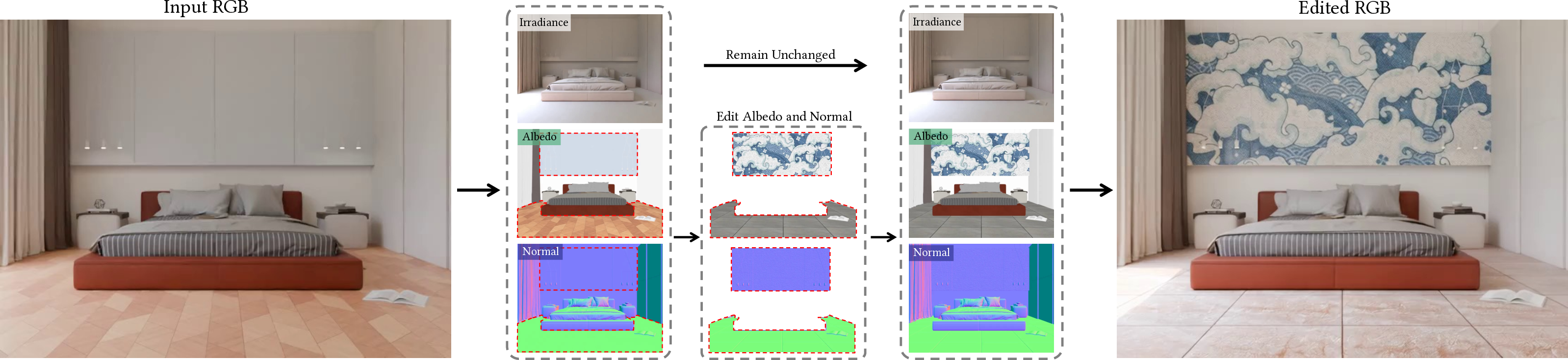
- What: Use UniVid-Intrinsic to decompose RGB into albedo/irradiance/normal (X→X), edit lighting/materials, then forward render back to RGB for relighting and material edits.
- Tools/workflows: NLE/Blender plugins for “inverse→edit→forward” pipelines; catalog video recoloring without re-shoots.
- Assumptions/dependencies: Best for indoor scenes; photometric fidelity bounded by training distribution; GPU-time heavy for long timelines.
- Product video varianting without re-shoots
- Sectors: e-commerce, advertising
- What: Edit albedo to change colors/materials while preserving lighting and geometry; swap BG via RGBA compositing.
- Tools/workflows: Self-serve “Variant Generator” integrated into PIM/DAM systems.
- Assumptions/dependencies: Consistency for fast motion or complex reflections can require prompt/parameter tuning; legal approvals for altered product imagery.
- Data bootstrapping for vision research and teaching
- Sectors: academia, robotics (indoor), CV startups
- What: Generate pseudo-labels (normals, albedo, irradiance) for small video corpora; create synchronized multimodal stacks for training and benchmarking.
- Tools/workflows: Dataset augmentation pipelines; courseware demos of intrinsic decomposition and shading.
- Assumptions/dependencies: Synthetic→real gap; verification/QA needed for high-stakes use; depth not provided out-of-the-box.
- Stable virtual backgrounds for conferencing and streaming
- Sectors: software/communications, consumer apps
- What: Deploy distilled UniVid-Alpha for robust, low-flicker mattes in low-latency settings.
- Tools/workflows: OBS/Zoom plugins; mobile SDKs.
- Assumptions/dependencies: Real-time constraints necessitate compression/acceleration; privacy and on-device execution preferred.
- Previsualization and storyboard lighting exploration
- Sectors: film/game pre-production, education
- What: Text→intrinsic or Text+X→X to rapidly explore lighting setups and material looks before full CG or set work.
- Tools/workflows: “Prompted Previs” nodes in Unreal/Blender; classroom labs for graphics/vision courses.
- Assumptions/dependencies: Coarse photometric accuracy may be sufficient for early ideation; domain prompts may need careful crafting.
Long-Term Applications
Below are forward-looking uses that would benefit from additional research, scaling, domain adaptation, or engineering (e.g., real-time performance, higher resolutions, broader domain coverage).
- Real-time, on-device multimodal video editing for AR glasses and mobile
- Sectors: AR/VR, consumer software
- What: Unified, interactive alpha matting, relighting, and material edits driven by text/gestures.
- Tools/workflows: AR SDKs with UniVidX-based layered editing; dynamic scene filters.
- Assumptions/dependencies: Significant model compression/distillation; energy-efficient inference; low-latency temporal consistency.
- Universal virtual production engine with coherent layered video synthesis
- Sectors: film/TV, virtual production stages
- What: Generate controllable layered sequences (FG/BG/alpha/intrinsics) for LED-wall backdrops and rapid iteration on lighting/materials.
- Tools/workflows: Integration with Unreal/LED stages; “layer-aware” asset libraries.
- Assumptions/dependencies: Higher resolutions, multi-camera consistency, safety guardrails and rights management for generated content.
- Robotics simulation data engine with physically consistent supervision
- Sectors: robotics, autonomy (indoor service robots)
- What: Generate training video sequences with synchronized normals/albedo/irradiance (and future depth) for robust perception and policy learning.
- Tools/workflows: Synthetic-to-real curriculum pipelines; domain randomization with text prompts.
- Assumptions/dependencies: Extend to depth/segmentation; generalize to outdoor/industrial domains; validate physical plausibility for control tasks.
- Layer-aware content authenticity and watermarking workflows
- Sectors: policy/governance, platforms
- What: Use consistent multi-layer stacks to embed and verify watermarks or provenance cues across layers.
- Tools/workflows: Platform-side ingestion that checks coherence of RGBA/intrinsic layers; C2PA extensions for layered video.
- Assumptions/dependencies: Industry standards for layered formats; cooperation among tool vendors and platforms.
- Instructional media and science communication with interactive decomposition
- Sectors: education, museums, edtech
- What: Interactive demos where learners toggle albedo/lighting/geometry to understand rendering and perception.
- Tools/workflows: Web-based viewers backed by UniVid-Intrinsic outputs; lesson modules in graphics/vision curricula.
- Assumptions/dependencies: Browser-friendly inference via server-side streaming; robust UI for non-experts.
- Lighting-aware building and interior design studies from plain video
- Sectors: architecture, energy efficiency
- What: Estimate intrinsics from walkthrough videos and simulate alternative lighting to assess comfort/energy tradeoffs.
- Tools/workflows: BIM/CAD plugins using inverse→edit→forward pipeline; rapid what-if analyses.
- Assumptions/dependencies: Photometric validation; integration with daylight/energy models; domain adaptation to professional measurements.
- Healthcare training and documentation with layered, de-identified videos
- Sectors: healthcare, medical education
- What: Separate patient-identifying BG/FG, overlay guidance layers, and create controlled lighting for clarity.
- Tools/workflows: “Layered Procedure Builder” for simulation labs.
- Assumptions/dependencies: Domain-specific fine-tuning; governance and safety review; strict privacy compliance.
- Automated creative versioning and testing at enterprise scale
- Sectors: finance/retail marketing, ad tech
- What: Generate and test many variants of product videos by altering materials, backgrounds, and light via prompts while preserving motion.
- Tools/workflows: MLOps pipelines that tie prompt libraries to brand guidelines and approval workflows.
- Assumptions/dependencies: Brand safety checks; human-in-the-loop review; dataset bias monitoring.
Cross-cutting Notes on Feasibility
- Compute and latency: The current backbone (Wan2.1-T2V-14B) is heavy; interactive and real-time uses require distillation, quantization, and optimized runtimes.
- Domain coverage: Reported training focused on indoor scenes and human videos; broad deployment (e.g., outdoor, industrial, medical) needs domain-specific fine-tuning and evaluation.
- Modalities: Depth is not included in the provided instantiations; some robotics/3D reconstruction use cases will need added modalities or hybrid pipelines.
- Tool integration: Practical adoption benefits from plugins for NLEs (Premiere/Resolve), DCCs (Blender/Unreal), and conferencing SDKs; standardized layered video formats would ease interchange.
- Legal/ethical: Content rights, watermarking/provenance, privacy (especially in background removal), and misuse prevention must be addressed before large-scale rollout.
Glossary
- AdamW: An optimizer that decouples weight decay from the gradient-based update to improve training stability. "using AdamW~\cite{adamw} (, weight decay=)"
- Albedo: The diffuse reflectance of surfaces, representing color independent of lighting. "albedo "
- Alpha matte: A per-pixel opacity map defining how foreground and background blend in compositing. "alpha matte (Alpha) "
- BFloat16 (BF16): A 16-bit floating-point format that preserves exponent range of FP32 for efficient training. "utilizing BFloat16 (BF16) mixed precision to maximize throughput."
- Bidirectional Reflectance Distribution Function (BRDF): A function describing how light is reflected at an opaque surface. "While the standard Disney BRDF model~\cite{disneybrdf} characterizes specular reflectance using roughness and metallic maps, we deliberately exclude them from our target modalities."
- Blender Compositor node tree: Blender’s node-based system for image compositing and layer manipulation in rendering pipelines. "We implement a fine-grained decoupling of physical components via the Blender Compositor node tree."
- Catastrophic forgetting: The tendency of a neural network to forget previously learned information after fine-tuning on new data. "mitigating the risk of catastrophic forgetting often associated with full fine-tuning, which typically leads to severe performance degradation~\cite{lotus}."
- Compositing layers: Separate image/video layers (e.g., foreground, alpha, background) combined to form the final output. "we decompose the input video space beyond the blended RGB (BL) video into three distinct compositing layers:"
- Cosine Annealing scheduler: A learning rate schedule that follows a cosine decay over time. "coupled with a Cosine Annealing scheduler~\cite{sgdr} that decays the learning rate from an initial to ."
- Cross-Modal Self-Attention (CMSA): An attention mechanism that shares keys/values across modalities while keeping queries modality-specific to promote alignment. "Cross-Modal Self-Attention (CMSA): we explicitly share keys/values across modalities while maintaining modality-specific queries, facilitating information exchange and inter-modal alignment."
- Decoupled Gated LoRA (DGL): A parameter-efficient adaptation strategy that assigns and gates separate LoRA modules per modality to avoid interference. "Decoupled Gated LoRA (DGL): we attach per-modality LoRAs and activate them when a modality serves as a generation target, thereby preserving the VDM's strong priors."
- DiT blocks: Diffusion Transformer blocks used in diffusion models’ architectures for processing latent representations. "The DiT blocks are equipped with Decoupled Gated LoRA (DGL): distinct LoRAs are assigned to each modality and are activated only for target inputs while deactivated for conditions (indicated by the faded modules)."
- Flow matching: A training objective that learns a vector field guiding data from noise to data distributions. "the flow matching~\cite{flow_matching} objective $\mathcal{L}_{\text{uni}$ is formulated to predict the velocity field specifically for the target subset:"
- Forward rendering: Synthesizing RGB images/videos from intrinsic scene representations (e.g., albedo, lighting, normals). "forward rendering (XX), which performs realistic RGB video synthesis derived from input intrinsic channels."
- Gaussian noise: Noise drawn from a normal distribution, commonly used as input to diffusion models. "the Gaussian noise "
- Inpainting: Filling in missing or occluded regions in images/videos using learned content. "alpha-guided inpainting, where transparency acts as a spatial constraint for content completion~\cite{propainter,powerpaint,videorepainter}."
- Intrinsic image decomposition: The process of separating an image into reflectance (albedo) and shading/geometry-related components. "Intrinsic image decomposition (inverse rendering), which aims to disentangle RGB images into appearance and geometry-related channels, has long been a fundamental problem in graphics~\cite{bell2014intrinsic}."
- Inverse rendering: Estimating scene properties (e.g., albedo, illumination, normals) from observed images/videos. "inverse rendering (XX), which estimates intrinsic maps given an input RGB video"
- Irradiance: The incoming light intensity at each point in the scene, capturing illumination effects. "irradiance "
- Latent space: The continuous vector space where inputs are encoded for generative modeling. "its latent space is adaptable, allowing us to seamlessly incorporate visual inputs alongside text."
- Latents: Encoded representations of inputs in the latent space used by the model. "Let denote the collection of latents from all visual modalities."
- LoRA (Low-Rank Adaptation): A technique that inserts low-rank adapters into large models to enable efficient fine-tuning. "assigns independent LoRAs~\cite{lora} to each specific modality."
- LPIPS: A perceptual similarity metric that compares deep feature distances between images. "we measure PSNR, SSIM, and LPIPS on both the estimated intrinsic maps (inverse rendering) and the reconstructed RGB videos (forward rendering)."
- Mean Angular Error (MAE): A metric measuring the average angular difference between predicted and ground-truth surface normals. "we report geometric accuracy using the Mean Angular Error (MAE)"
- Normal map: An image encoding per-pixel surface orientations to convey geometric detail. "normal "
- Omni-directional generation: A training goal where the model learns to generate any target modality conditioned on any subset of other modalities/text. "compelling the model to learn omni-directional generation."
- OpenEXR: A high dynamic range image file format widely used in VFX and rendering. "all output components are exported in OpenEXR 16-bit Float format"
- Path-tracing engine: A physically based renderer that simulates light transport via Monte Carlo path tracing. "with the Cycles path-tracing engine ($128$ samples)."
- Peak Signal-to-Noise Ratio (PSNR): A fidelity metric that quantifies reconstruction quality relative to ground truth. "we measure PSNR, SSIM, and LPIPS on both the estimated intrinsic maps (inverse rendering) and the reconstructed RGB videos (forward rendering)."
- Self-attention: A mechanism that computes representations by attending to different positions within the input. "the vanilla self-attention of standard VDMs operates on each modality in isolation"
- SSIM (Structural Similarity): A perceptual metric evaluating structural similarity between images. "we measure PSNR, SSIM, and LPIPS on both the estimated intrinsic maps (inverse rendering) and the reconstructed RGB videos (forward rendering)."
- Stochastic Condition Masking (SCM): A training strategy that randomly assigns modalities as conditions or targets to enable flexible conditional generation. "Stochastic Condition Masking (SCM): by randomly partitioning modalities into clean conditions and noisy targets during training, we enable the model to learn omni-directional conditional generation rather than fixed mappings."
- Temporal Flickering metric: A video quality metric assessing temporal stability across frames. "we employ the Temporal Flickering metric (range 0-1, higher is better) from VBench~\cite{vbench} to evaluate temporal stability."
- Text-to-Video (T2V) backbone: A pre-trained generative video model conditioned on text prompts. "SCM is built upon a T2V backbone, selected for two strategic reasons:"
- Variational Autoencoder (VAE): A generative model that encodes inputs into a latent distribution for reconstruction/generation. "The pre-trained VAE encoder in our backbone necessitates 3-channel RGB inputs."
- Velocity field: The vector field predicted by flow-based/diffusion models that guides noisy samples toward data. "is formulated to predict the velocity field specifically for the target subset:"
- Video Diffusion Models (VDMs): Diffusion-based generative models specialized for video synthesis. "Pre-trained Video Diffusion Models (VDMs) have evolved into powerful foundation engines, capturing rich priors of real-world dynamics~\cite{stablevideodiffusion,sora,opensora,opensora2,cogvideo,cogvideox,hunyuanvideo,wan}."
- Video matting: The task of extracting a subject and its transparency from video to obtain clean foreground/background layers. "video matting (XX), which decomposes an input blended video into its constituent RGBA layers."
Collections
Sign up for free to add this paper to one or more collections.