Scalar emission from binary neutron stars in scalar-tensor theories with kinetic screening
Published 1 May 2026 in gr-qc | (2605.00580v1)
Abstract: We investigate the scalar emission from binary neutron stars in shift-symmetric scalar-tensor theories with kinetic screening ($K$-essence), using 3+1 numerical simulations in the decoupling limit. To construct static binary initial data in the regime where the screening radius $r_$ greatly exceeds the orbital separation, we introduce a hyperbolization of the static field equations that bypasses the Keldysh-type breakdown affecting direct time evolutions. For equal-mass binaries, where the scalar emission is dominated by the $\ell=m=2$ mode, kinetic screening acts non-monotonically on the scalar radiation, suppressing or enhancing the quadrupolar amplitude depending on the relative size of $r_$ and $λ{22}$ (with $λ{22}$ the wavelength): for $λ{22}\ll r$ it is suppressed relative to the Fierz-Jordan-Brans-Dicke (FJBD) case, while for $λ{22}\gtrsim r$ it is amplified above FJBD. For unequal-mass binaries a scalar dipole re-emerges, growing linearly with the mass asymmetry, while the quadrupolar screening remains close to the equal-mass case down to mass ratios $\sim 0.6$. The non-monotonic behavior of kinetic screening that we uncover has potential implications for gravitational-wave-based tests of gravity. The relativistic double pulsar, in particular, requires $r_\gg 109$~km to efficiently suppress the scalar quadrupole; for cosmologically-motivated $Λ$, $r_\sim 10{11}$~km (for a solar-mass source), giving only moderate suppression.
The paper presents a combined numerical and analytical treatment to reveal non-monotonic scalar radiation effects in binary neutron stars.
It introduces a hyperbolization strategy and worldline techniques to overcome instabilities and resolve the multipolar structure of scalar emission.
The study demonstrates that kinetic screening can either suppress or enhance radiation depending on the ratio between the screening radius and the radiation wavelength.
Scalar Emission in Binary Neutron Stars with Kinetic Screening: Numerical and Analytical Perspectives
Introduction
The paper "Scalar emission from binary neutron stars in scalar-tensor theories with kinetic screening" (2605.00580) presents a comprehensive numerical and analytic investigation into scalar radiation from binary neutron stars (BNS) in shift-symmetric scalar-tensor theories employing kinetic screening (K-essence). Within this framework, scalar fields coupled to matter via non-canonical kinetic terms exhibit screening—dynamically suppressing deviations from GR near dense sources, but permitting modifications at larger distances. The study employs 3+1 numerical simulations in the decoupling limit and novel hyperbolization strategies for static binary initial data, enabling exploration of parameter regimes previously inaccessible due to instability-induced constraints. The primary focus is on resolving the multipolar structure of scalar emission, its scaling behavior, and implications for gravitational-wave (GW) based tests of gravity.
Theoretical Framework
The investigated theories are shift-symmetric K-essence models with the action:
S=∫d4x−g[2P2R+K(X)]+Sm[A(φ)gμν,Ψm]
where K(X) is expanded as −X/2+(β/4Λ4)X2−(γ/8Λ8)X3, with β=0 and γ=1 chosen to avoid Tricomi-type hyperbolicity breakdown. Matter couples universally via a conformal factor A(φ). Scalar sources are modeled using the worldline method, translating the matter sector to point particles with scalar charges αi determined by sensitivities si and rescaled masses.
The scalar field equation,
K0
with K1 encoded by effective stellar masses and sensitivities, is solved in the decoupling limit: the metric is fixed (Minkowski spacetime), reducing computational complexity and focusing on scalar-sector dynamics.
Numerical Scheme and Initial Data Construction
A major technical advance is the introduction of a hyperbolization strategy for static binary configurations. This procedure overcomes Keldysh-type breakdowns encountered when directly evolving time-dependent scalar configurations toward equilibrium in regimes where the screening radius K2 greatly exceeds the orbital separation. The hyperbolized static field equation,
K3
employs an artificial relaxation time K4 and damping K5, ensuring well-behaved characteristics and smooth convergence to binary configurations.
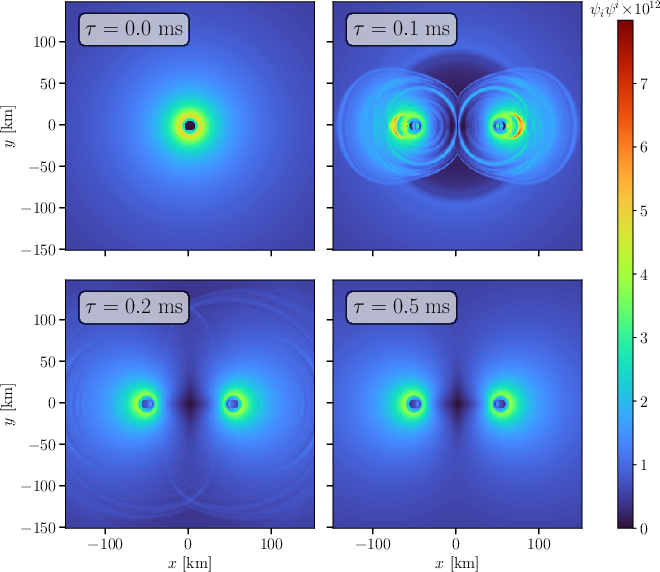
Figure 1: Relaxation of K6 demonstrating convergence from a single-star initial profile to the static binary solution under hyperbolization.
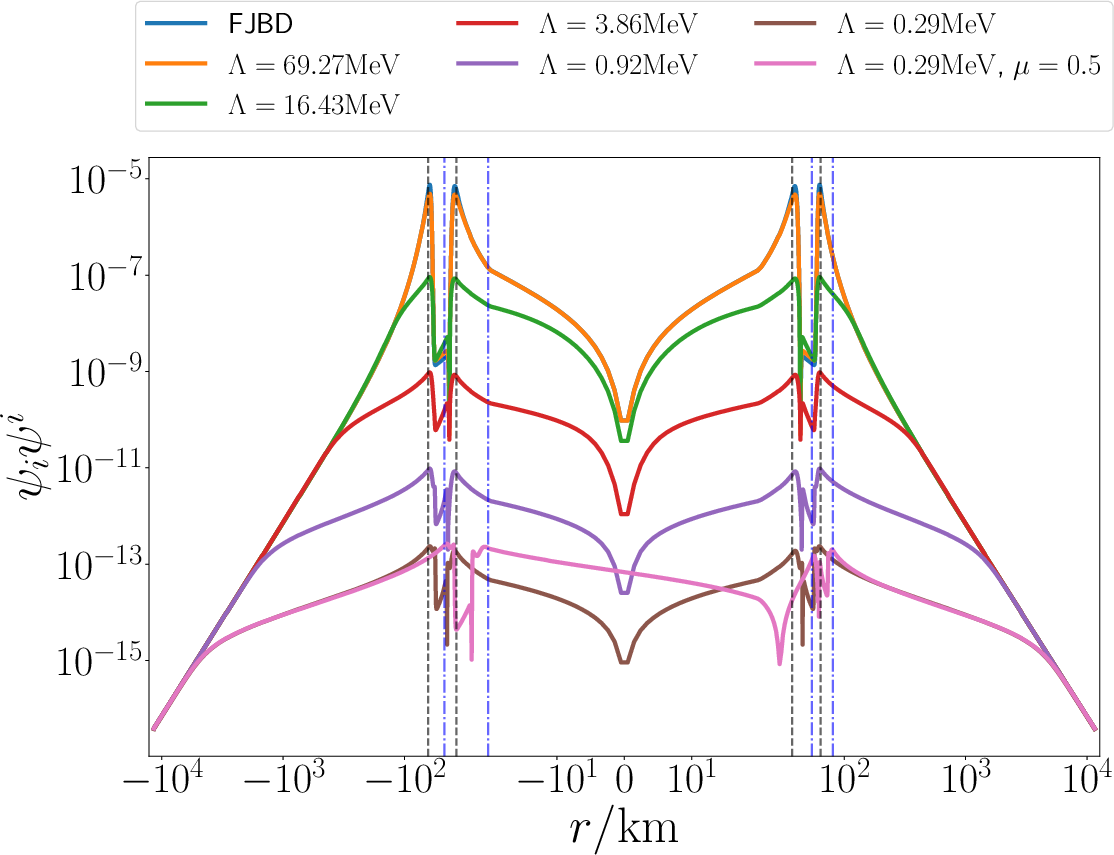
Scalar field derivatives K7 across the symmetry axis reveal the screening mechanism: decreasing K8 strengthens suppression within the source, shifting the transition radius where K9-essence solutions match FJBD predictions.
Figure 2: The scalar field's derivative squared S=∫d4x−g[2P2R+K(X)]+Sm[A(φ)gμν,Ψm]0 for various S=∫d4x−g[2P2R+K(X)]+Sm[A(φ)gμν,Ψm]1 values, illustrating increased screening at smaller strong coupling scales.
For computational stability, nonlinear scalar interactions are suppressed inside the compact objects by engineering spatial dependence in S=∫d4x−g[2P2R+K(X)]+Sm[A(φ)gμν,Ψm]2, guided by profile parameters that limit steep gradients and improve numerical behavior.
Scalar Radiation Extraction and Multipolar Structure
Scalar radiation is extracted by evaluating asymptotic amplitudes of the Newman-Penrose invariant S=∫d4x−g[2P2R+K(X)]+Sm[A(φ)gμν,Ψm]3, directly related to second time derivatives of S=∫d4x−g[2P2R+K(X)]+Sm[A(φ)gμν,Ψm]4. The screening radius S=∫d4x−g[2P2R+K(X)]+Sm[A(φ)gμν,Ψm]5 is defined as:
S=∫d4x−g[2P2R+K(X)]+Sm[A(φ)gμν,Ψm]6
Equal-Mass Binaries: Quadrupolar Screening and Non-Monotonic Scaling
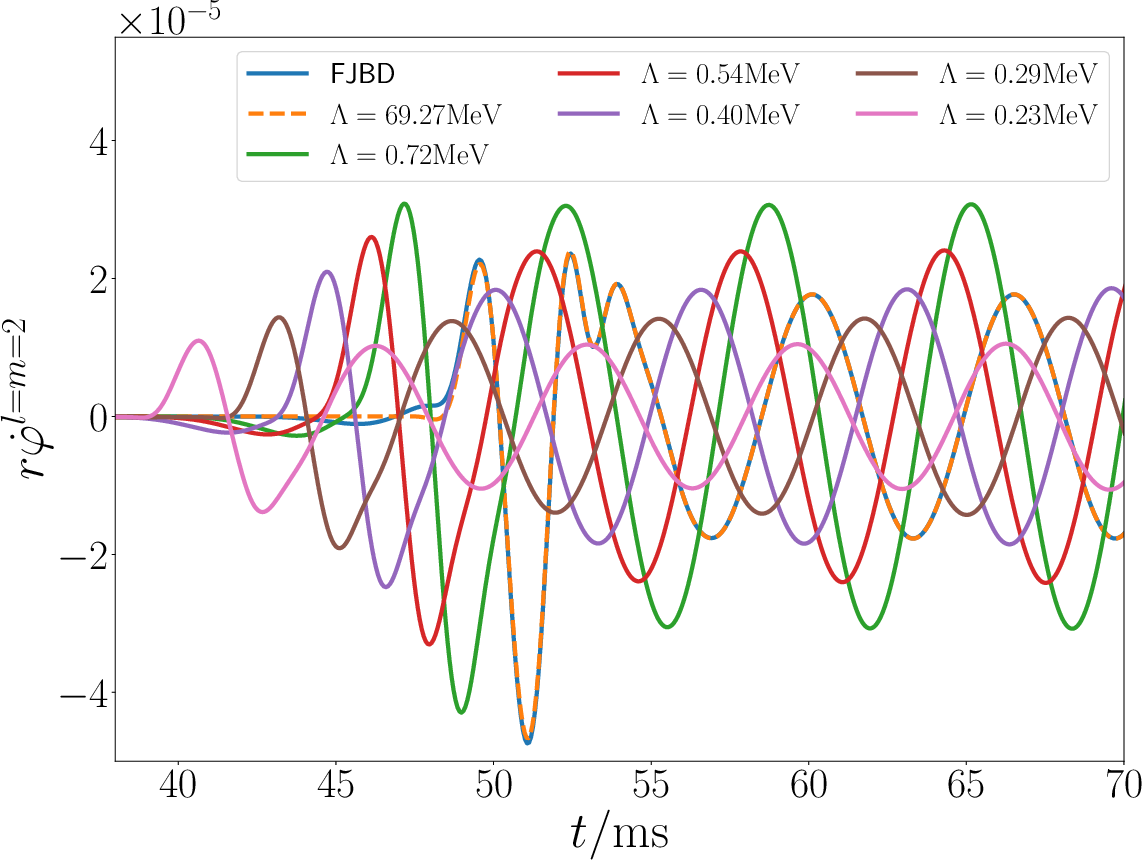
In equal-mass binaries (S=∫d4x−g[2P2R+K(X)]+Sm[A(φ)gμν,Ψm]7), symmetry forces suppression of the dipole, isolating quadrupolar emission. Numerical evolution, ramping the orbital frequency to Keplerian values, exhibits stationary waveforms after transients. Notably, waveform amplitude displays non-monotonic dependence on S=∫d4x−g[2P2R+K(X)]+Sm[A(φ)gμν,Ψm]8: initial increase with decreasing S=∫d4x−g[2P2R+K(X)]+Sm[A(φ)gμν,Ψm]9, followed by suppression below the FJBD benchmark in the deep-screening regime (K(X)0).
Figure 3: Waveforms for the quadrupole K(X)1 mode for several K(X)2, extracted at a large radius.
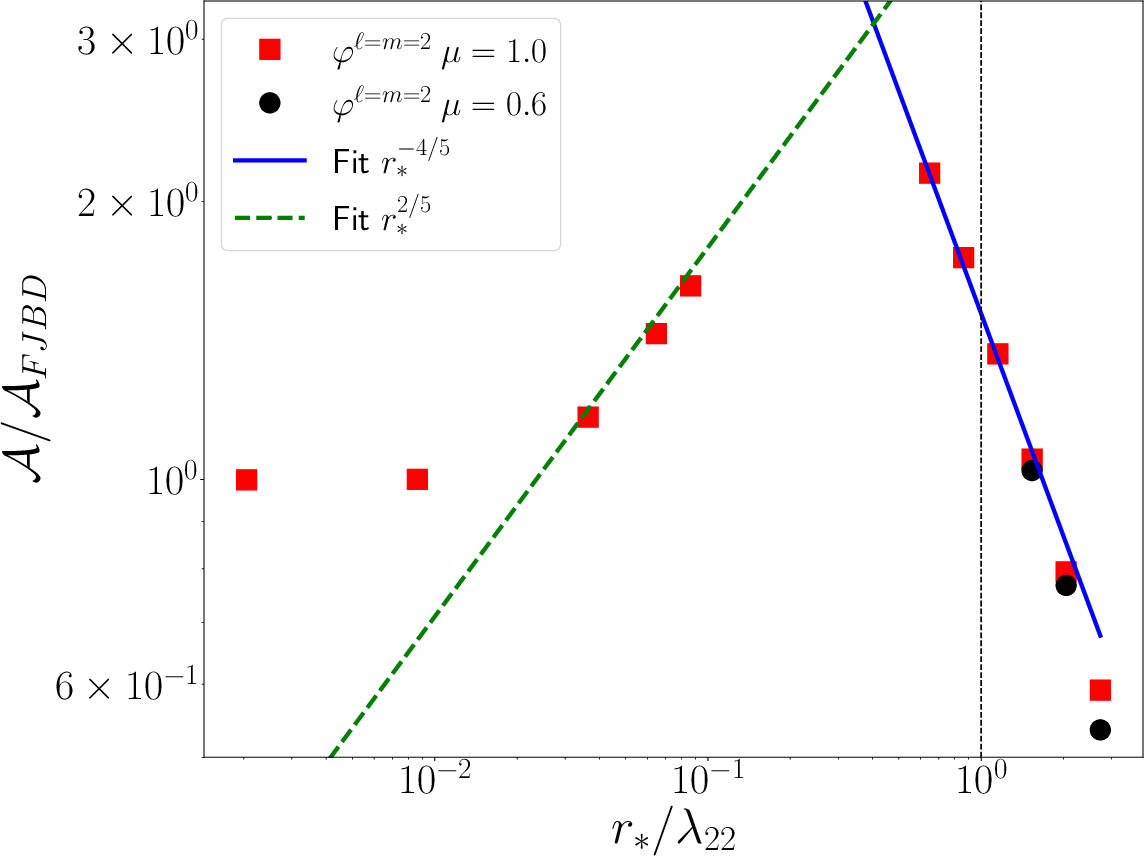
The amplitude ratio relative to FJBD, K(X)3, shows a clear transition: power-law suppression K(X)4 for K(X)5, and enhancement above FJBD with K(X)6 for K(X)7. These results reconcile prior full numerical relativity and perturbative studies, confirming non-monotonic screening behavior.
Figure 4: Quadrupole amplitude ratio versus K(X)8, marking two distinct scaling regimes separated at K(X)9.
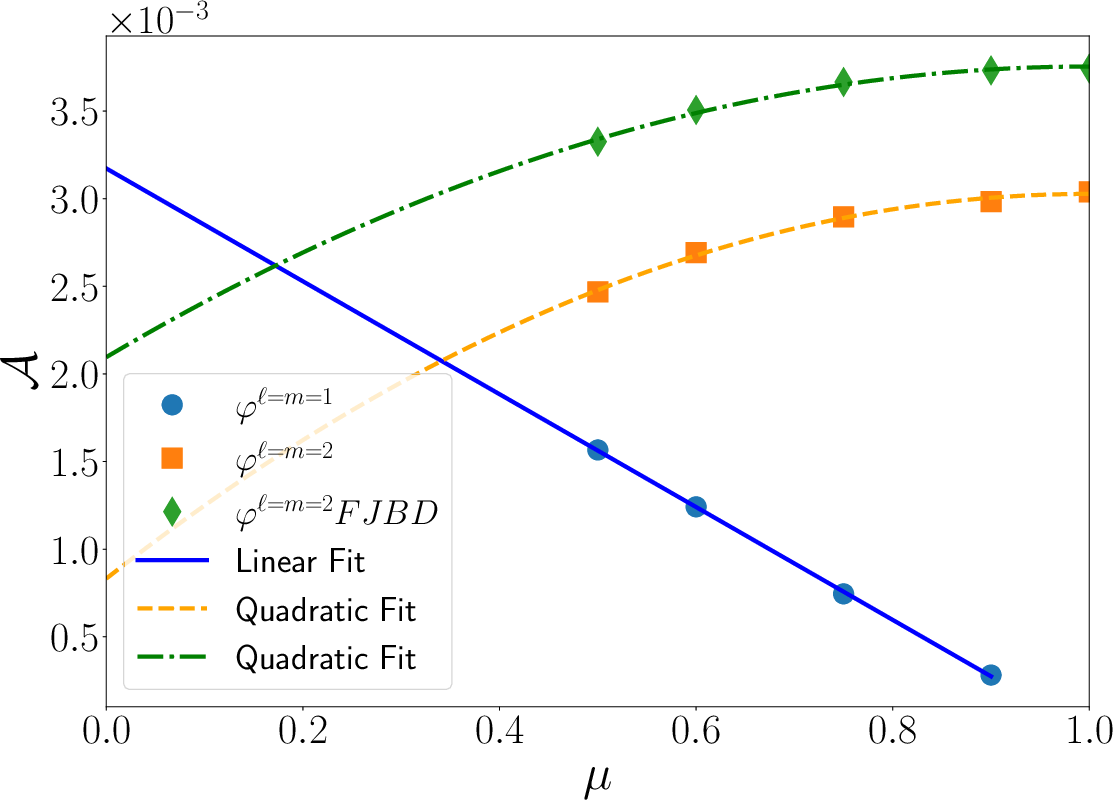
Unequal-Mass Binaries: Dipole Emergence and Quadrupole Robustness
For −X/2+(β/4Λ4)X2−(γ/8Λ8)X30, a dipolar channel reopens, with dipole amplitude growing linearly as mass ratio decreases, and quadrupole amplitude decreasing quadratically. For −X/2+(β/4Λ4)X2−(γ/8Λ8)X31, quadrupole screening remains close to equal-mass behavior, but for −X/2+(β/4Λ4)X2−(γ/8Λ8)X32, dipole dominance is anticipated.
Figure 5: Amplitudes of dipole and quadrupole as a function of mass ratio −X/2+(β/4Λ4)X2−(γ/8Λ8)X33, showing linear dipole growth and quadratic quadrupole suppression.
Analytical Scaling Argument
An analytic scaling argument predicts −X/2+(β/4Λ4)X2−(γ/8Λ8)X34 for quadrupole emission in the regime −X/2+(β/4Λ4)X2−(γ/8Λ8)X35, confirming numerical observations. The argument relies on perturbative expansion of the scalar field far from the source, matching to known solutions at large radii, and incorporates additional suppression factors intrinsic to quadrupole moments. The scaling is robust within the cubic −X/2+(β/4Λ4)X2−(γ/8Λ8)X36-essence truncation adopted, though quantitative exponents may shift with higher-order operators.
Implications and Future Directions
The findings establish that kinetic screening acts non-monotonically on scalar radiation in BNS systems: the amplitude may be suppressed or even enhanced depending on the relation between screening radius and radiation wavelength. This refutes simplistic uniform-cutoff models and demands nuanced interpretation of gravitational-wave constraints on −X/2+(β/4Λ4)X2−(γ/8Λ8)X37-essence parameters, notably the strong-coupling scale −X/2+(β/4Λ4)X2−(γ/8Λ8)X38. For observationally relevant systems (e.g., PSR J0737-3039 with −X/2+(β/4Λ4)X2−(γ/8Λ8)X39 km and cosmologically-motivated β=00 km), only moderate quadrupole suppression is realized—a factor of a few tens relative to FJBD.
The practical implications extend to waveform modeling and parameter inference for current and future GW detectors. Theoretical implications include deeper understanding of well-posedness criteria and screening efficacy in complex dynamical configurations. The approach enables exploration of scalar-tensor gravity beyond traditional constraints and sets the stage for extending to full metric backreaction and post-Newtonian modeling.
Potential future work includes:
Detailed characterizations of the transition region β=01.
Inclusion of scalar-metric backreaction and orbital dynamics to enable full post-Newtonian waveform calibration.
Exploration of strong-field effects with higher-order β=02-essence operators.
Extension to spinning binaries and non-circular orbits.
Conclusion
This paper provides a rigorous analysis of scalar emission from BNS in shift-symmetric scalar-tensor theories with kinetic screening, combining advanced numerical techniques and analytic scaling arguments. The study reveals non-monotonic screening effects, structural transitions between suppressed and enhanced quadrupole emission, and substantial dependence on orbital parameters and stellar mass ratios. These results refine theoretical expectations and observational strategies for testing alternative gravity models with compact binaries, emphasizing the need for versatile modeling and constraint frameworks as GW astronomy advances.