Screening of dipolar emission in two-scale Gauss-Bonnet gravity
Published 3 Dec 2025 in gr-qc, astro-ph.HE, and hep-th | (2512.04083v1)
Abstract: We study black holes in shift-symmetric scalar Gauss-Bonnet gravity extended by a cubic Galileon interaction with a distinct energy scale. Introducing this hierarchy profoundly modifies the theory's phenomenology. The cubic interaction allows for smaller black holes, and can generate a screening mechanism near the horizon, making large Gauss-Bonnet couplings consistent with gravitational-wave bounds. Observable quantities such as the scalar charge, the innermost stable circular orbit, and its frequency are most affected for small black holes. The resulting multi-scale effective field theory remains technically natural and offers new avenues to probe gravity in the strong-field regime.
The paper introduces a two-scale extension of shift-symmetric scalar Gauss-Bonnet gravity using a cubic Galileon term to modify black hole scalar charges.
The analysis demonstrates that the cubic interaction screens dipolar scalar emission via a Vainshtein-like mechanism, enabling smaller mass black holes than in standard sGB gravity.
Numerical and perturbative results validate the model's compatibility with gravitational wave data while revealing potential observable signatures in the ISCO and quasinormal mode spectra.
Screening Mechanism and Dipolar Emission Suppression in Two-Scale Gauss-Bonnet Gravity
Introduction: Context and Theoretical Motivation
The paper "Screening of dipolar emission in two-scale Gauss-Bonnet gravity" (2512.04083) explores the impact of multi-scale effective interactions in shift-symmetric scalar Gauss-Bonnet (sGB) gravity, emphasizing the inclusion of a cubic Galileon term characterized by a distinct energy scale. This generalization alters the typical black hole (BH) phenomenology observed in classical sGB scenarios. Scalar-tensor extensions of gravity, particularly those incorporating the Gauss-Bonnet invariant G, are notable for evading strict no-hair theorems and producing secondary scalar charges sourced by spacetime curvature. Current gravitational wave (GW) experiments are beginning to probe the horizon-scale regime, sharpening constraints on such light or massless fields.
An outstanding feature of sGB gravity is the presence of a minimal BH mass dependent on the coupling constant αGB; above this mass, solutions exist with fixed scalar charge. However, within an effective field theory (EFT) formalism, the introduction of additional shift-symmetric interactions, especially those suppressed by hierarchically distinct energy scales, has the potential to modify these stringent properties, with implications for both astrophysical observables and the viability of gravity modifications compatible with current GW data.
Multi-Scale Model Formulation
The analysis centers on an EFT extension of sGB gravity incorporating a cubic Galileon term σX□ϕ, where X=−21∇μϕ∇μϕ and □ϕ is the d'Alembertian of the scalar. Crucially, the scale Λ^ associated with the cubic interaction is allowed to differ from the Gauss-Bonnet scale ΛGB, yielding a two-parameter suppression structure. The explicit action considered is:
S=MPl2∫d4x−g[2R+X+ΛGB2αϕG+Λ^2σX□ϕ]
The hierarchy Λ^≪ΛGB≪(Λ^MPl2)1/3 is imposed, motivated by quantum correction suppression and the requirement for observable scalar-tensor imprints in GW sources with characteristic scales set by BH Schwarzschild radii ($1-100$ km). The presence of multiple scales fundamentally alters both technical naturalness and model phenomenology.
Black Hole Solutions: Scalar Charge and Minimum Mass
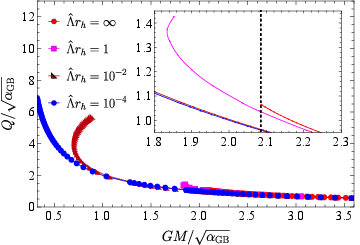
In conventional sGB gravity, the secondary scalar charge αGB0 is rigidly set by BH mass and Gauss-Bonnet coupling, as confirmed in the decoupling regime and full sGB solutions. The inclusion of a cubic Galileon interaction, however, leaves the scalar charge for larger BHs substantially unmodified, but dramatically alters the minimum mass threshold. The existence condition generalizes to:
αGB1
where αGB2 is the horizon radius. For αGB3, αGB4, and αGB5, the upper bound on αGB6 increases sharply with decreasing αGB7, now accommodating significantly smaller BHs or larger couplings without violating observational or theoretical consistency.
Figure 1: αGB8 vs.\ normalized ADM mass, showing negligible impact of the cubic interaction for αGB9, but allowing BHs substantially below the pure sGB minimum mass.
This distinction is crucial for interpreting astrophysical compact object populations and reconciling sGB theory with GW events.
Impact on Astrophysical Observables: ISCO and Gravitational Wave Signatures
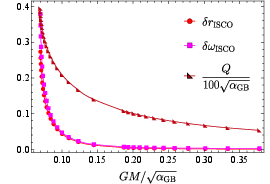
The model's ramifications for observables such as the innermost stable circular orbit (ISCO) and its frequency are evaluated through both perturbative and numerical integration. Notably, deviations from general relativity (GR) in the ISCO radius and orbital frequency remain negligible except within the regime of small BH masses—precisely those enabled by the cubic Galileon term.
Figure 2: Relative deviation of ISCO location and frequency versus GR, accentuating substantial differences only for small BHs with large charge and strong cubic coupling.
Thus, the extended sGB model remains largely compatible with GW observations for typical BH masses, but distinct signatures could arise as GW detectors reach higher precision and probe the lower mass regime.
Screening Mechanism: Suppression of Dipolar Emission
A principal claim of the work is the demonstration that the cubic Galileon interaction induces a Vainshtein-type screening effect in the BH near-horizon region, substantially suppressing dipolar scalar emission. Expanding the scalar field σX□ϕ0 about the background, the kinetic term for perturbations is renormalized:
σX□ϕ1
In the strong screening regime σX□ϕ2, the canonically normalized field σX□ϕ3 couples to the GB invariant with a suppressed effective scale σX□ϕ4. This translates into much weaker observational bounds on σX□ϕ5 from GW data, since the scalar sector's response is dynamically diminished.
The parameter space consistent with this screening is characterized by the relation:
σX□ϕ6
demonstrating the model's ability to evade otherwise stringent GW constraints and enabling larger scalar charges at fixed BH mass.
Kinetic Mixing and Quasinormal Modes
The study offers an order-of-magnitude estimate of kinetic mixing between metric and scalar perturbations, finding an upper bound of σX□ϕ7 on the corrections to kinetic terms and the quasinormal mode (QNM) spectrum. While below current GW sensitivity, future advancements could render these effects observable, motivating more refined modeling of scalar-tensor theories in the strong-field regime.
Implications and Future Directions
The two-scale Gauss-Bonnet gravity framework with a cubic Galileon interaction introduces a technically natural path toward reconciling strong scalar-tensor modifications with both existing observational bounds and the theoretical demands of EFT. The mechanism's capacity to screen dipolar emission—and propose the existence of BHs with masses inaccessible in pure sGB gravity—has significant implications for the interpretation of GW data, compact object surveys, and constraints on alternative gravity theories.
Extension to rotating BHs, incorporation of alternative interaction terms, and systematic analysis of QNM deviations represent promising next steps. The proposed model offers a robust ground for probing strong-field gravity in conjunction with ongoing and future GW observations.
Conclusion
The paper provides a rigorous analysis of BH solutions, scalar charge phenomenology, and dipolar emission suppression in a two-scale shift-symmetric scalar Gauss-Bonnet model with a cubic Galileon extension. The screening mechanism introduced by the cubic term allows for substantially enlarged parameter space, accommodates smaller mass BHs, and weakens GW observational constraints on the Gauss-Bonnet coupling. Numerical and perturbative results confirm the negligible effect on most astrophysical observables except in newly enabled regimes. The theoretical structure remains technically natural, signaling a promising avenue for future strong-field gravity explorations and model discrimination via precision GW astrophysics.
“Emergent Mind helps me see which AI papers have caught fire online.”
Philip
Creator, AI Explained on YouTube
Sign up for free to explore the frontiers of research
Discover trending papers, chat with arXiv, and track the latest research shaping the future of science and technology.Discover trending papers, chat with arXiv, and more.