Post-Newtonian Constraints on Scalar-Tensor Gravity
Published 17 Apr 2026 in gr-qc and astro-ph.CO | (2604.16226v1)
Abstract: Solar-System constraints on a general scalar-tensor theory with generic non-minimal coupling function, non-canonical kinetic function, and scalar potential, are investigated in both the metric and Palatini formalisms. A unified post-Newtonian treatment is developed, yielding analytical expressions for the effective scalar mass, the effective gravitational coupling, and the parametrised post-Newtonian parameters $γ$ and $β$. The results show explicitly how the choice of variational principle affects the weak-field phenomenology. Comparison with Solar-System observations, primarily the Cassini bound on $γ$, indicates that the observational impact of the formalism is strongly model dependent. Generic non-minimally coupled scalar fields may satisfy significantly weaker local bounds in the Palatini case because of stronger Yukawa suppression, whereas in Brans-Dicke gravity the differences are typically small and become appreciable only in restricted regions of parameter space. For the point-particle source considered here, Palatini $f(\hat{R})$ gravity reproduces the general-relativistic exterior post-Newtonian limit, unlike metric $f(R)$ gravity.
The paper provides a unified post-Newtonian expansion for scalar-tensor gravity, deriving analytic expressions for the scalar mass, Yukawa screening, and PPN parameters in both metric and Palatini approaches.
It demonstrates that differences in variational principles lead to order-of-magnitude variations in allowed parameter spaces, particularly under non-minimal coupling and screening effects.
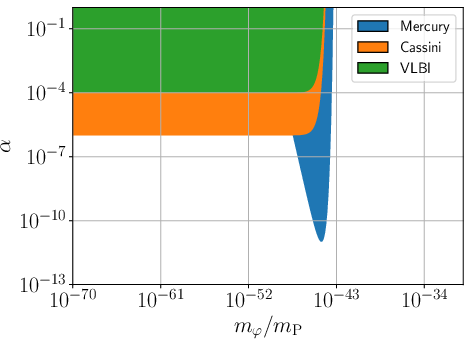
Solar System tests, notably from Cassini, VLBI, and Mercury perihelion, are used to map exclusion regions in parameter space, highlighting the interplay between scalar potentials and gravitational theory.
Post-Newtonian Constraints on Scalar-Tensor Gravity: Formalism, Predictions, and Solar System Bounds
Introduction
The paper "Post-Newtonian Constraints on Scalar-Tensor Gravity" (2604.16226) performs a comprehensive parametric analysis of Solar System constraints on general scalar-tensor gravity theories, encompassing generic non-minimal coupling, non-canonical kinetic terms, and scalar potentials. The analysis explicitly compares the predictions derived within the metric and Palatini variational formalisms, providing unified post-Newtonian (PN) expansions and analytics for the scalar mass, effective gravitational coupling, and Parameterized Post-Newtonian (PPN) parameters γ and β. The authors systematically confront the model space—including non-minimally coupled quintessence, Brans-Dicke, and f(R) gravity—with experimental results, principally the Cassini bound on γ, delineating the consequences for the underlying parameter space and discriminative power between the two formalisms.
Scalar-Tensor Framework and Variational Principles
where A(Φ) encodes non-minimal coupling, B(Φ) the (possibly non-canonical) kinetic term, and V(Φ) the potential. Two distinct formalisms are investigated:
Metric: the connection is set to the Levi-Civita connection at the level of the action;
Palatini: the metric and connection are varied independently, resulting in supplementary non-metricity and additional algebraic constraints.
This distinction is crucial: for minimally coupled Einstein-Hilbert gravity, the variational formalisms coincide, but in generic scalar-tensor or f(R) extensions, their physics diverge significantly.
Unified Post-Newtonian Expansion and PPN Parameters
The authors derive the post-Newtonian expansion at O(4), providing complete expressions for the effective scalar mass, the screening (Yukawa) length, and the PPN parameters β0 (spatial curvature per unit mass) and β1 (nonlinear gravitational self-interaction). The analytic expressions are exact in terms of the background values and derivatives of β2, β3, β4, and their formalism-dependent coefficients.
Scalar Mass, Yukawa Suppression, and Effective β5
A key aspect is the screening of the scalar field through a Yukawa-type mass β6, with its value set differently in the two formalisms. In the Palatini case, the screening is always stronger (i.e., the mass is always larger for identical couplings), directly impacting the detectability of fifth-force corrections.
β7 and β8 for General Scalar-Tensor Models
Analytic formulas for β9 and f(R)0 include all dependence on model parameters and formalism. Crucially, in non-minimally coupled models,
f(R)1
with f(R)2 encoding the strength of Yukawa corrections and f(R)3 their range. For Palatini models, the parameter f(R)4 (kinetic fraction) is unity; for metric, it is suppressed by f(R)5.
Vacuum Solution and Model Dependence
For a point-particle static source, the full weak-field metric is constructed in isotropic coordinates; the PPN parameters are extracted by matching the metric to the standard PN form. Explicit dependence on the formalism and coupling functions is retained, allowing consistent mapping between Solar System observables and fundamental theory parameters.
Solar System Constraints and Parameter Exclusion
Experimental tests, particularly the Cassini measurement of the Shapiro time delay, VLBI constraints on light deflection, and Mercury perihelion precession, are employed to constrain the parameter space. These are mapped into exclusion regions in the f(R)6 plane, revealing the formalism-dependent reach of Solar System tests.
Figure 1: Excluded regions in the f(R)7 plane from Cassini (orange), VLBI (green), and Mercury perihelion (blue) constraints, with the effective scalar mass f(R)8 in reduced Planck mass units.
The Cassini f(R)9 constraint is particularly stringent, forcing γ0 for γ1 (in Planck units). For larger masses, the bounds rapidly weaken under Yukawa screening. The perihelion shift restricts an intermediate band around γ2.
Non-Minimal Coupling and Formalism Sensitivity
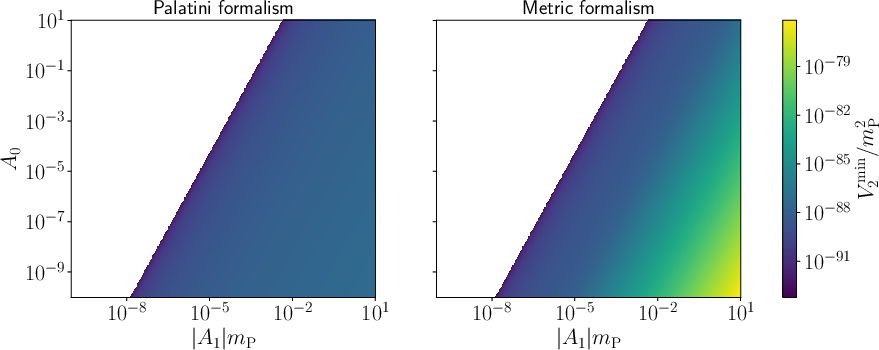
A critical insight is that, for generic non-minimal coupling and canonical kinetic term, the Palatini and metric formalisms can yield large differences in allowed parameter space due to screening effects. This is visualized in the heatmap of the minimum allowed γ3 (potential curvature) as a function of γ4 and γ5.
Figure 2: Minimum γ6 below which the Cassini bound is violated, as a function of γ7 in Palatini (left) and metric (right) formalisms for non-minimally coupled scalar fields; white unshaded region is unconstrained.
In the Palatini formalism, a much broader region of γ8 is viable due to stronger Yukawa suppression (i.e., shorter screening lengths). Therefore, for large γ9 and small S=21∫d4x−g[8A(Φ)R^−B(Φ)gμν∇^μΦ∇^νΦ−2V(Φ)]+Sm[gμν,Ψ],0, the metric case is excluded while the Palatini case remains fully allowed. This underscores that local gravitational tests do not merely bound the presence of light scalars, but can discriminate between gravitational variational principles.
Brans-Dicke Sector: Degeneracy and Exceptions
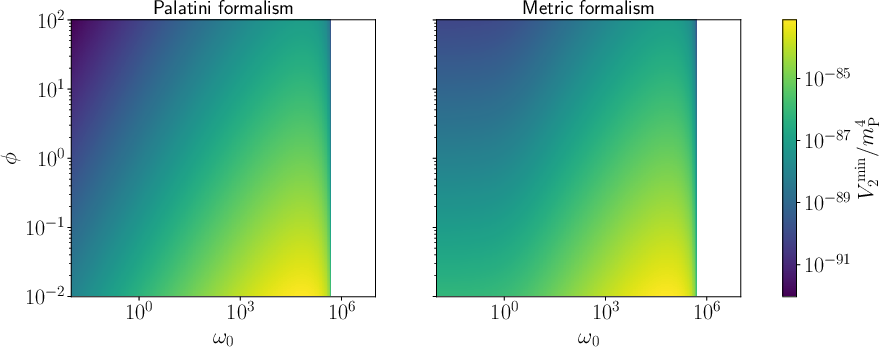
For Brans-Dicke gravity, both Palatini and metric formalisms are studied as a function of S=21∫d4x−g[8A(Φ)R^−B(Φ)gμν∇^μΦ∇^νΦ−2V(Φ)]+Sm[gμν,Ψ],1. For large S=21∫d4x−g[8A(Φ)R^−B(Φ)gμν∇^μΦ∇^νΦ−2V(Φ)]+Sm[gμν,Ψ],2, the difference shrinks and the usual limits on S=21∫d4x−g[8A(Φ)R^−B(Φ)gμν∇^μΦ∇^νΦ−2V(Φ)]+Sm[gμν,Ψ],3 apply. For small S=21∫d4x−g[8A(Φ)R^−B(Φ)gμν∇^μΦ∇^νΦ−2V(Φ)]+Sm[gμν,Ψ],4, the Palatini case again admits slightly broader parameter space, highlighting subtle but model-dependent sensitivities to variational structure.
Figure 3: Minimum S=21∫d4x−g[8A(Φ)R^−B(Φ)gμν∇^μΦ∇^νΦ−2V(Φ)]+Sm[gμν,Ψ],5 below which the Cassini bound is violated, as a function of S=21∫d4x−g[8A(Φ)R^−B(Φ)gμν∇^μΦ∇^νΦ−2V(Φ)]+Sm[gμν,Ψ],6 for Brans-Dicke gravity in Palatini (left) and metric (right) formalisms; unconstrained regions are white.
Notably, when the scalar mass is nonzero, the canonical massless Brans-Dicke bound (S=21∫d4x−g[8A(Φ)R^−B(Φ)gμν∇^μΦ∇^νΦ−2V(Φ)]+Sm[gμν,Ψ],7) can be strongly relaxed if the scalar potential is sufficiently steep, exploiting Yukawa suppression even for small S=21∫d4x−g[8A(Φ)R^−B(Φ)gμν∇^μΦ∇^νΦ−2V(Φ)]+Sm[gμν,Ψ],8.
S=21∫d4x−g[8A(Φ)R^−B(Φ)gμν∇^μΦ∇^νΦ−2V(Φ)]+Sm[gμν,Ψ],9 Gravity: Decoupling of Scalar in Palatini Formulation
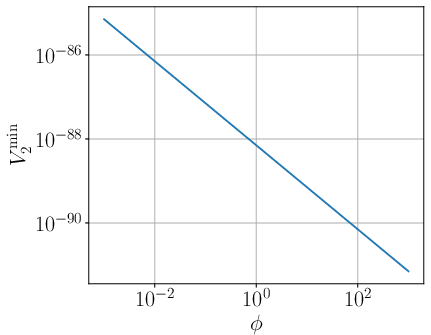
Metric and Palatini A(Φ)0 gravity correspond to metric Brans-Dicke with A(Φ)1 and A(Φ)2, respectively. In the metric case, the scalar persists and is constrained by the Cassini bound, while in Palatini A(Φ)3 the scalar is auxiliary and not dynamical for point-particle/exterior solutions, yielding A(Φ)4 identically.
Figure 4: Minimum A(Φ)5 below which the Cassini bound is violated in metric A(Φ)6 gravity as a function of A(Φ)7.
This result confirms that Solar System constraints can tightly restrict the allowed curvature of the A(Φ)8 function in the metric formalism, while Palatini A(Φ)9 gravity is essentially unconstrained in the idealized point-particle limit.
Implications, Theoretical Prospects, and Outlook
The unified formalism derived in this work provides a rigorous analytic framework for mapping Solar System constraints onto the model space of late-time scalar-tensor modifications of gravity, including non-minimally coupled quintessence and generalized dark energy models. The primary findings are:
The observable consequences of the variational principle (metric vs Palatini) are strongly model-dependent, with sometimes order-of-magnitude differences in allowed parameter space for non-minimally coupled models.
The presence of a scalar potential (i.e., nonzero mass) can enable evasion of tight PPN bounds via Yukawa suppression, especially in Palatini scenarios.
In Brans-Dicke and B(Φ)0 subclasses, the discriminative power is reduced, and Palatini B(Φ)1 gravity is essentially hidden from Solar System tests in the point-mass limit.
The result emphasizes the need for a joint analysis of local and cosmological datasets, as local tests alone have formalism-dependent blind spots.
The analysis invites further study into the interplay of cosmological and local gravity constraints in non-minimal and multi-field extensions, the consequences of screening mechanisms for dynamical scalar sectors, and the systematic incorporation of full ephemeris analyses. The derived framework can be directly ported to constrain broader classes of scalar-tensor modifications under forthcoming precision ephemeris and time-delay measurements.
Conclusion
This paper delivers a technically complete, general, and formally unified post-Newtonian analysis of scalar-tensor gravity models in both metric and Palatini formulations, confronting them robustly with the most stringent Solar System data. The results clarify how viable parameter space is determined not only by the presence and mass of a scalar, but by the variational definition of gravity. This work will serve as a foundation for further confrontations of modified gravity with upcoming high-precision tests and for the proper theoretical interpretation of screening mechanisms in gravity and dark energy phenomenology.