- The paper introduces an improved one-body conformal-factor correction that significantly reduces constraint violations in boson star-black hole binary initial data.
- The study demonstrates that the enhanced method stabilizes scalar field dynamics, preventing premature boson star collapse and other unphysical artifacts.
- The extracted gravitational wave signals reveal distinctive multipole patterns, particularly the (3,0) mode, providing a robust diagnostic between mixed and pure binary mergers.
Head-On Collisions of Boson Star-Black Hole Binaries: Initial Data and Gravitational Wave Phenomenology
Introduction and Motivation
The paper "Boson star-black hole binaries: initial data and head-on collisions" (2604.15240) provides a systematic numerical-relativity investigation into the dynamics and gravitational wave (GW) emission of head-on collisions between comparable-mass boson star (BS) and black hole (BH) binaries. While previous studies have addressed the GW signatures of pure BH-BH or BS-BS mergers, and to some degree of extreme-mass-ratio BS-BH interactions, the phenomenology of mixed, comparable-mass BS-BH collisions remained comparatively underexplored. The presence of such binaries is of significant interest within the context of compact dark matter candidates—particularly ultralight scalars forming macroscopic soliton-like BSs—and the potential for GW observations to distinguish exotic compact objects (ECOs) from canonical BHs.
A central challenge addressed in the paper is the construction of initial data that robustly represents a BS-BH binary without inducing strong spurious constraint violations or artificial dynamical artifacts (e.g., unphysical collapse of the BS core) that can contaminate the extracted GW signals. The authors propose and validate a BS-centered one-body conformal-factor correction, generalizing methods previously devised for BS-BS binaries, as a physically motivated improvement over the widely used plain superposition technique.
Initial Data Construction: Constraint Handling and Artifacts
Constraint Violations in Plain vs. Improved Superposition
Plain pointwise superposition of isolated BS and BH solutions is shown to generate large Hamiltonian-constraint violations, especially in the vicinity of the BS core, due to the nonlocal influence of the BH's gravitational tail. This can inject spurious mass-energy, distort the scalar field equilibrium, and—for compact BSs—trigger premature collapse prior to the physical merger.
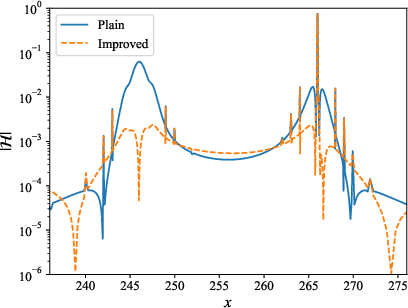
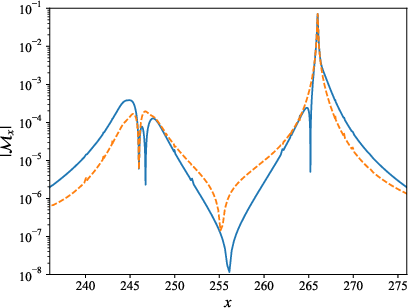
Figure 1: The improved superposition substantially reduces Hamiltonian and momentum constraint violations near both the BS and BH compared to plain superposition.
To address this, the authors generalize the conformal-factor correction developed for BS-BS binaries, producing a prescription that restores the BS core volume element in the combined metric while preserving asymptotic flatness and leaving the BH puncture region uncorrected. This one-body correction is both computationally efficient and, as demonstrated, highly effective at suppressing unphysical constraint violations.
Scalar Field Dynamics and Spurious Collapse
The initial data improvement shows a decisive impact on early-time scalar field dynamics. The plain superposition frequently leads to artificially amplified central scalar amplitudes and subsequent spurious collapse of the BS into a BH at small initial separations, or persistent radial oscillations even at modest separations.
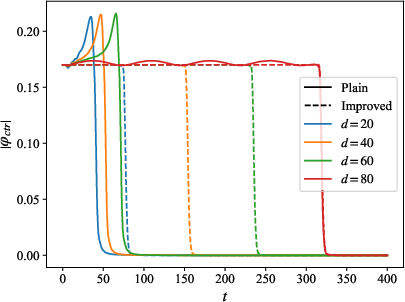
Figure 2: Central scalar amplitude evolution for plain versus improved superposition. Only the improved method maintains physical equilibrium prior to merger.
The improved conformal-factor correction eliminates these artifacts, resulting in scalar field evolution that remains physically stable and consistent with expectations from isolated equilibrium solutions until genuine binary interaction occurs.
Impact on Gravitational Wave Emission
The prescription's effectiveness further manifests in the extracted GW signals. The plain superposition not only distorts the temporal profile of the leading (2,0) mode but systematically overestimates the total radiated GW energy, especially at small initial separations.
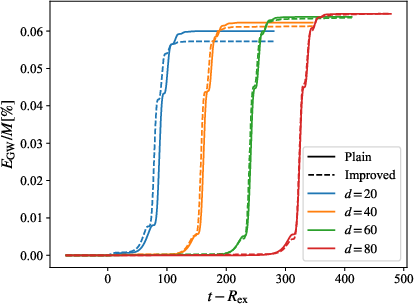
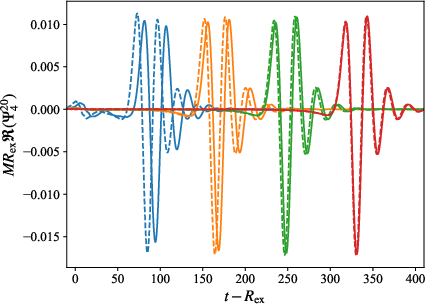
Figure 3: Radiated GW energy and (2,0) mode for different initial separations, showing that plain superposition injects unphysical features into both energy output and waveform morphology.
With sufficiently large initial separations, the influence of the unphysical artifacts wanes, but for astrophysically plausible scenarios, the difference is non-negligible, underscoring the necessity of the improved technique.
Gravitational Wave Signatures: Equal and Unequal Mass Collisions
Equal-Mass BS-BH, BS-BS, and BH-BH Collisions
The GW emission is studied across a grid of BS compactness and mass ratios, with direct comparison to matched BS-BS and BH-BH runs. For BS-BH binaries with high BS compactness, the radiative efficiency approaches that of pure BH-BH collisions, while for less compact stars, the emission is suppressed relative to both the corresponding BS-BS and BH-BH baselines (see upper panel of Figure 4).
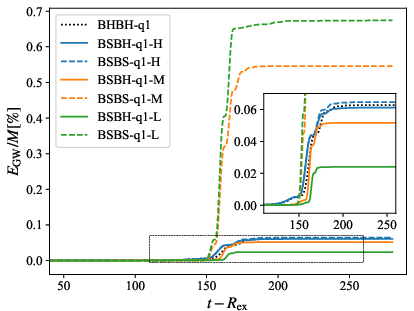
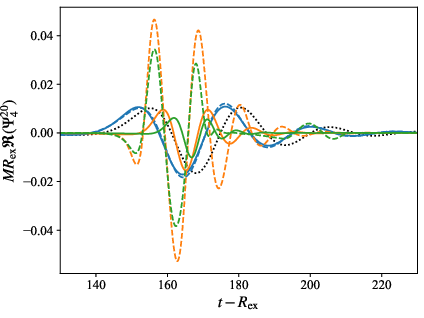
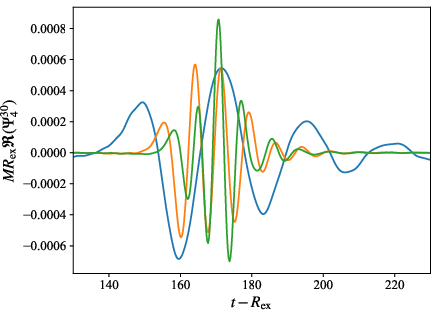
Figure 4: Radiated GW energy, (2,0), and (3,0) modes for equal-mass BS-BH, BS-BS, and BH-BH collisions. The octupole (3,0) mode is uniquely excited in BS-BH binaries.
The excitation of the (3,0) mode is a distinctive feature of BS-BH systems, even at q=1, as the intrinsic asymmetry between the horizon and the scalar condensate breaks the x→−x reflection symmetry present in pure binaries. The amplitude of this mode anticorrelates with compactness: it is strongest for low-compactness BSs.
The time evolution of the Noether charge further illustrates that the merger typically results in near-total accretion of scalar field by the BH, except for low-compactness cases where a fraction of scalar charge can persist post-merger.
Unequal-Mass Collisions and Mode Structure
For unequal-mass systems (q=1), GW output and mode structure depend on both the mass ratio and the ordering of masses. The dominant (2,0) quadrupole retains BH-BH-like morphology across most configurations, while the (2,0)0 octupole becomes particularly informative. If the BH is more massive (2,0)1, tidal disruption of the BS generates clear enhancement and phase advances in the octupolar component, associated with marked matter asymmetries and the formation of scalar wakes during accretion.
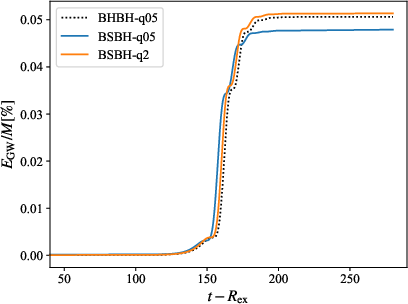
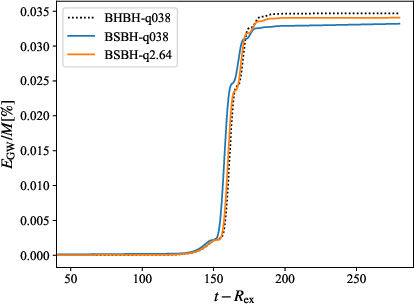
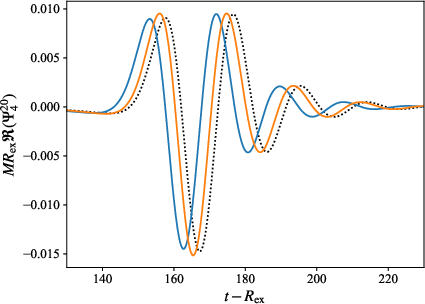
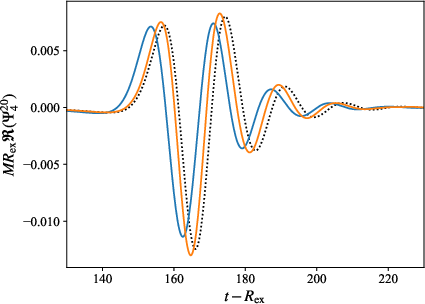
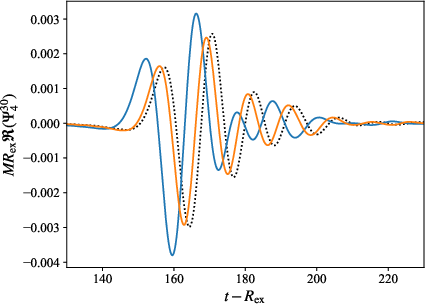
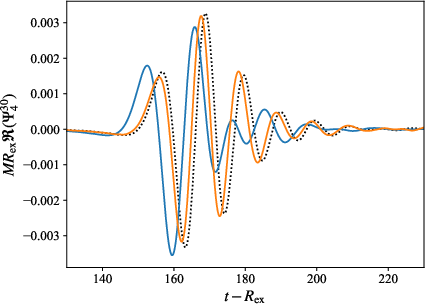
Figure 5: For unequal-mass BS-BH binaries, the (2,0)2 octupole—especially for (2,0)3—shows clear, diagnostic differences with respect to BH-BH collisions, highlighting matter asymmetric accretion dynamics.
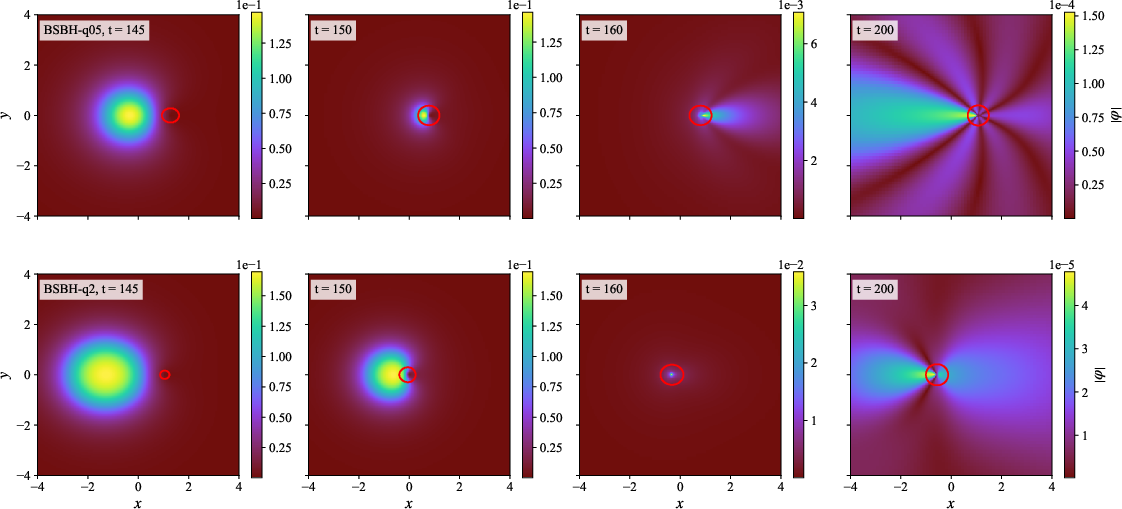
Figure 6: Snapshots of scalar-field modulus in the orbital plane reveal the presence of persistent matter asymmetries and tidal wakes in unequal-mass mergers, particularly for (2,0)4.
When the BS is the more massive companion, the collision is more akin to a point-mass infall: octupolar emission aligns closely with that of a pure BH-BH system, and the destruction of the scalar condensate proceeds rapidly.
Numerical Reliability
The code achieves between second and third order convergence in GW energy and constraint violation norms, as demonstrated by direct scaling in grid refinement tests.
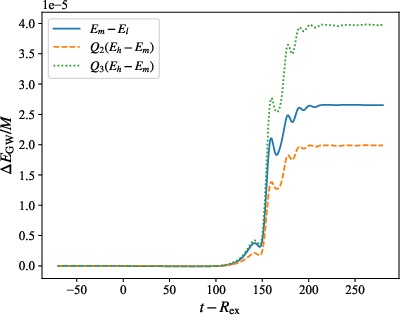
Figure 7: Convergent behavior in total radiated GW energy differences confirms the robustness of the numerical infrastructure.
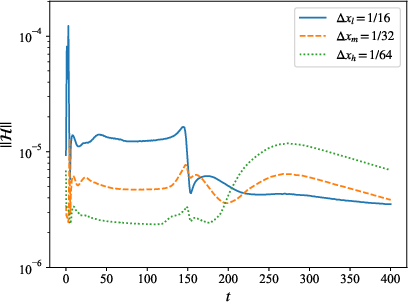
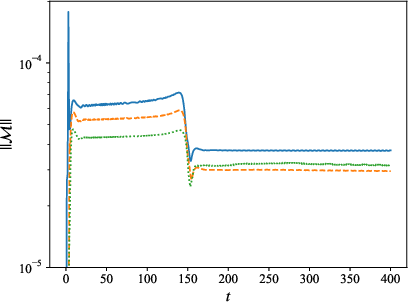
Figure 8: Hamiltonian and momentum constraint violations decrease with increasing resolution, supporting the validity of the improved superposition methodology.
Implications and Outlook
This study demonstrates that accurate initial data are not merely a technical nicety: they are essential for modeling the dynamical and GW emission characteristics of mixed BS-BH binaries. Several practical and theoretical implications arise:
- GW Mode Structure and Detection: The presence and amplitude of higher multipoles, especially the (2,0)5 mode, furnish a discriminant between mixed and pure binaries. This feature is not degenerate with compactness and persists even for (2,0)6, providing a robust observational handle for future GW detectors targeting tests of strong gravity and searches for non-BH compact object candidates.
- Astrophysical Consistency and Tidal Effects: The suppression of GW energy in the presence of a BH companion relative to BS-BS analogues, especially at low compactness, highlights the dominant role of accretion dynamics over tidal deformability, in contrast to naive expectations.
- Numerical Methods for ECOs: The conformal-factor correction strategy offers a generalizable approach for preparing physically faithful initial data in numerical-relativity studies of ECO mergers involving matter-supported objects without horizons.
Future work should address inspiralling, quasi-circular orbits (more astrophysically realistic), explore a broader swath of scalar potentials (including mini-BSs and other self-interaction regimes), and benchmark against fully elliptic constraint-solved data. Further, comparison of method variants (e.g., the TwoPunctures correction used in other recent works) will help refine best practice for initial data prescription in multi-field and multi-fluid compact object collisions.
Conclusion
This paper establishes that in head-on, comparable-mass BS-BH mergers, the initial data prescription materially affects the physical reliability of the dynamical and GW outcomes. The improved one-body conformal-factor correction ensures suppression of unphysical initial artifacts and yields robust, physically interpretable GW data—all of which is indispensable for extracting matter signatures in the strong-field regime. While the quadrupolar GW emissions for high-compactness BS-BH binaries mimic BH-BH signals, the excitation pattern and amplitude of higher modes remain a powerful probe, with significant implications for both fundamental scalar field phenomenology and gravitational wave astrophysics.

