- The paper introduces local tensor-train (TT) surrogates that efficiently approximate trained quantum models with explicit error and sample complexity guarantees.
- It employs a Taylor polynomial expansion with tensor embedding to achieve aggressive parameter compression and inferential speedups up to 400×.
- Empirical validations on QCNNs demonstrate that the surrogate method maintains accuracy while providing theoretical PAC-style error bounds and practical scalability.
Local Tensor-Train Surrogates for Quantum Learning Models: A Technical Analysis
The paper "Local tensor-train surrogates for quantum learning models" (2604.25631) develops a theoretical and practical framework for efficiently constructing local classical approximations of trained quantum machine learning (QML) models using tensor-train (TT) representations. The central focus lies in the inference bottleneck: evaluating a trained quantum model entails nontrivial quantum hardware cost per query, impeding scalable deployment. This work leverages TT tensor networks as efficient surrogates, yielding provably accurate, fully classical local models with explicit error and sample complexity guarantees. Below, the key theoretical contributions, algorithmic design, empirical validation, and implications are detailed.
Problem Setting and Motivation
Quantum machine learning models, especially variational quantum circuits (VQCs), are increasingly prominent for leveraging non-classical resources in learning tasks. However, inference with a trained QML model is fundamentally resource-constrained due to repeated quantum circuit executions required for the evaluation of predictions or gradients. Unlike classical models, there is no generic procedure to convert a trained quantum model into a cheap classical evaluator except in special cases (e.g., reuploading networks with Fourier surrogates [Schreiber et al. 2023]). This motivates the search for general, model-agnostic surrogate frameworks that retain accuracy on relevant data regions and are equipped with rigorous complexity and generalization guarantees.
Framework Overview
The proposed framework constructs local tensor-train surrogates (LTTS) for arbitrary, trained quantum models. Given a black-box QML function g:RN→R, the method operates as follows:
- Local Patch Selection: Around a point of interest x0, a local hypercube B(x0,r) is defined for some radius r.
- Taylor Polynomial Approximation: The function g is expanded as a total-degree-p Taylor polynomial within B(x0,r), with explicit remainder analysis.
- Tensor Embedding and Compression: The tensor of Taylor coefficients is embedded (with simplex-to-box zero-padding) into a TT network with prescribed bond dimension χ; this provides strong tensor compression, scaling parameter count as O(N(p+1)χ2).
- Empirical Risk Minimization (ERM): The TT surrogate is fit to noisy or exact samples (Xi,Yi) from the patch by ERM, optionally using the Taylor-TT certificate as a warm start.
- Statistical Guarantees: The method provides explicit, high-probability excess-risk bounds for the ERM surrogate, with PAC-style sample complexity scaling.
A schematic is illustrated below.
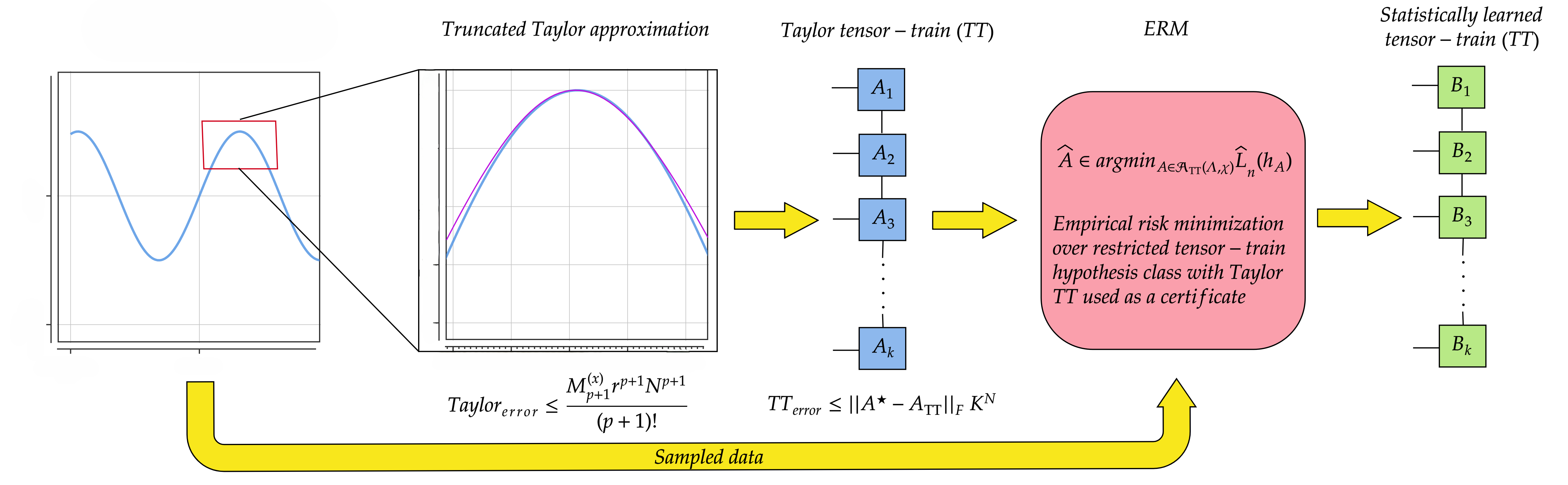
Figure 1: Pipeline for local TT surrogate construction, from Taylor truncation to TT embedding, with ERM over samples providing statistical guarantees.
Theoretical Results: Error Decomposition and Guarantees
The central analytic results partition the surrogate’s test error into three independently controllable sources:
- Taylor truncation error: Decreases rapidly with patch radius x00 and polynomial degree x01 as x02.
- TT approximation error: Controlled by the TT bond dimension x03 and measured via the Frobenius norm between the full and compressed TT tensors.
- Statistical estimation error: Determined by the number of samples x04 and the pseudo-dimension of the TT hypothesis class.
Specifically, for an ERM-fitted TT surrogate x05, with probability at least x06 over x07 sampled points,
x08
where x09 reflects exponential scaling from the tensor product structure, and B(x0,r)0 is the TT approximation error. The sample complexity (number of queries) required to reach target risk scales as B(x0,r)1 in TT parameters but includes B(x0,r)2 in the worst case, isolating the curse of dimensionality to the feature embedding rather than the TT representation.
Notably: The parameter count scales polynomially in B(x0,r)3, contrasting with exponential scaling for dense (unconstrained) tensor approaches, subject to the exponential pre-factor from the Bessel feature norm.
Numerical Experiments
Rank Scaling for TT Zero-Padding
The sensitivity of TT ranks to the embedding of Taylor tensors (simplex-supported to box-shaped via zero-padding) is characterized. Across a diverse set of smooth test functions (separable, polynomial, trigonometric, Gaussian), the median rank inflation from zero-padding is neutral to deflationary for non-separable families, confirming that the TT structure remains efficient and robust under the embedding.
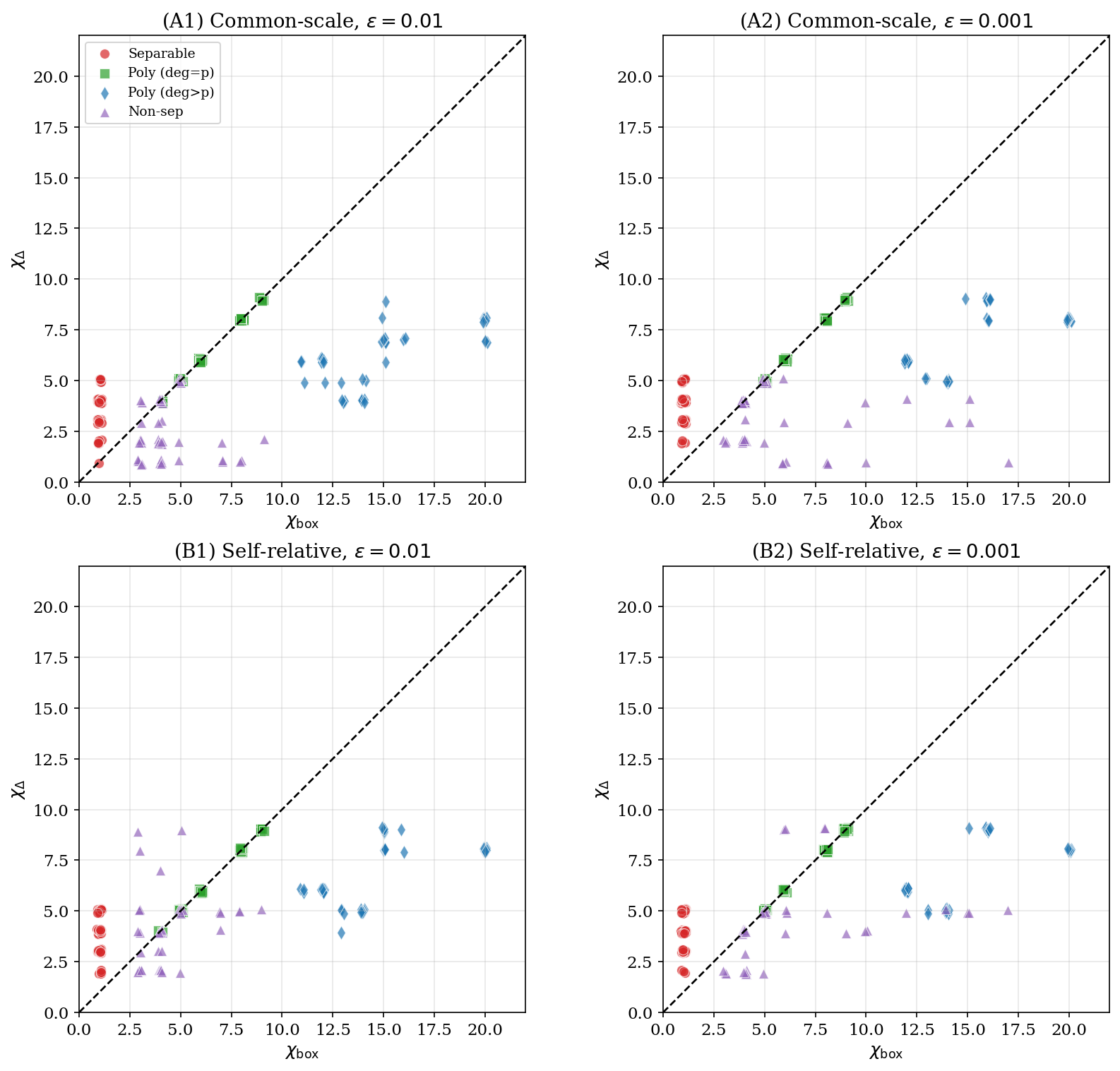
Figure 2: Scatter plot of TT rank caps for simplex (box) and zero-padded (Δ) tensors across function classes, showing clustering near or below the diagonal for non-separable families, indicating no systematic rank inflation.
Empirical Validation on Quantum Models
Empirical tests on trained quantum convolutional neural networks (QCNNs) for classification tasks (synthetic Gaussian and UCI Banknote datasets) confirm the theoretical findings. For moderate patch radii, the TT surrogate can match or improve upon the Taylor certificate when fit via ERM, with compression errors negligible relative to truncation error at modest TT ranks. A wall-clock speedup of 250–400B(x0,r)4 for inference is observed, supporting the practical value of local surrogation.
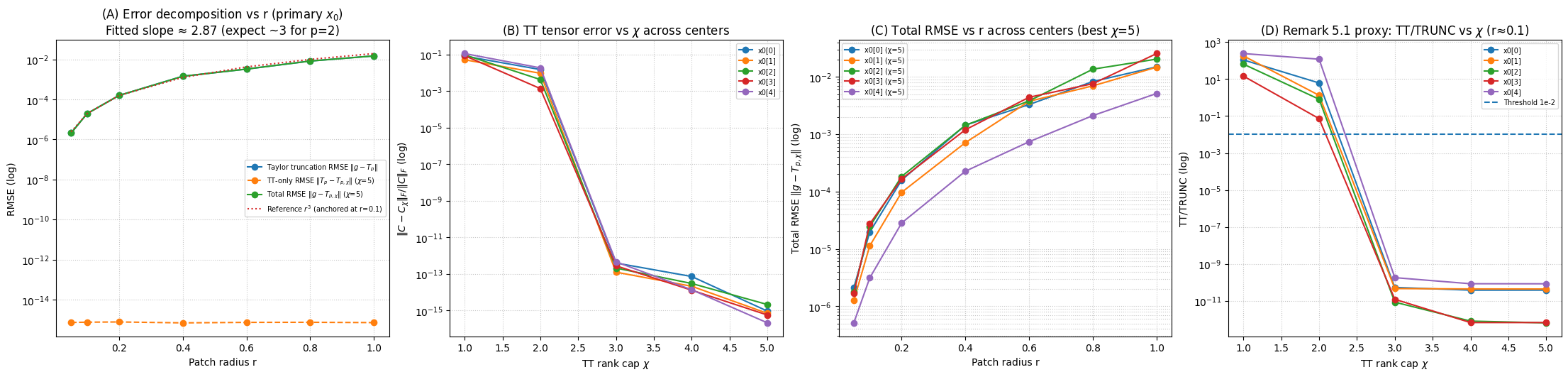
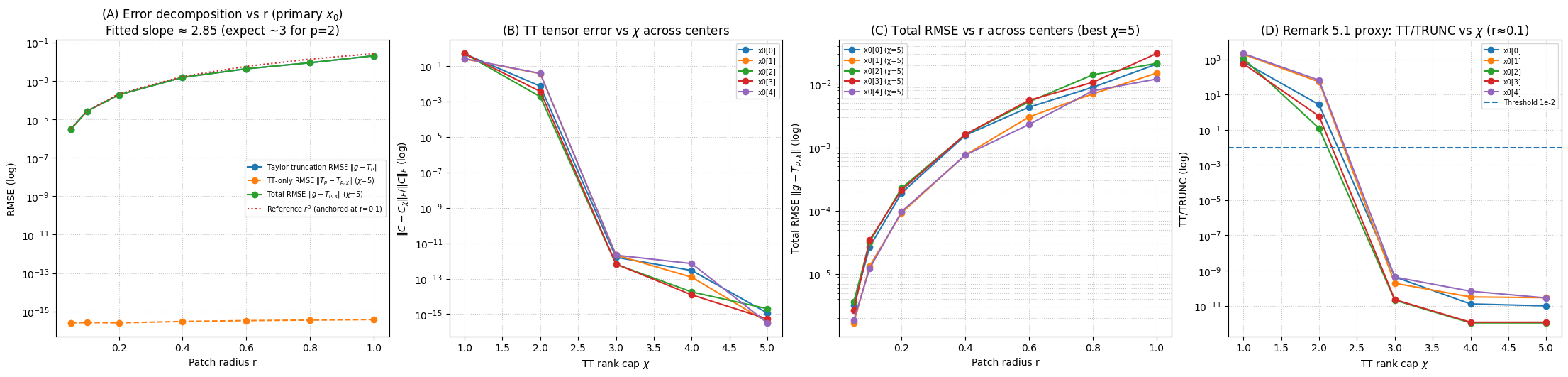
Figure 3: Local TT surrogate diagnostics—error decomposition across patch radii, TT truncation error vs. rank, total surrogate RMSE vs. B(x0,r)5, and the ratio of TT compression to Taylor truncation error—demonstrating effective error separation and rapid error decay at modest TT ranks.
Claims and Contrasts with Prior Work
The paper asserts explicit PAC-style sample complexity bounds for local classical surrogates of arbitrary quantum models and demonstrates that local surrogation admits aggressive parameter compression and reduced statistical estimation cost compared to global surrogate approaches. This stands in contrast to prior surrogate frameworks that:
- Are restricted to special classes (e.g., Fourier surrogates for reuploading PQCs [Schreiber et al. 2023], tensor networks for specific MPO-compatible circuits [Watanabe et al. 2026])
- Do not provide generalization or sample complexity guarantees outside these restricted settings
- Lack error certificates sensitive to the data locality and adaptive complexity
The independence of the three error terms enables precise engineering of computational and statistical budgets, a strong advance for surrogate-based deployment in QML.
Practical and Theoretical Implications
The method enables the deployment of quantum machine learning models using classical surrogates with retained accuracy within user-specified local patches—mitigating hardware bottlenecks and supporting explainability and local interpretability (in line with XAI paradigms). The Taylor-TT certificate not only quantifies best-achievable local error in the hypothesis class but also provides a constructive warm start for ERM, improving convergence in practice. The decoupling of parameter scaling and feature-norm scaling clarifies trade-offs relevant for high-dimensional applications.
Caveats: The worst-case exponential scaling remains for the embedded Taylor features, reflecting an inherent barrier (curse of dimensionality) for generic function surrogation; further research on basis adaptation (e.g., Chebyshev or Fourier alternatives) or active subspace strategies may mitigate this.
Empirically: For smooth or structured quantum models, the TT ranks required for high accuracy can be quite low, making the approach effective in practice.
Prospects for Future Research
Several avenues are opened by this work:
- Extension to adaptively chosen polynomial degrees, bond dimensions, or patch radii based on model smoothness and empirical error decay.
- Sharpening worst-case exponential dependence in B(x0,r)6 through alternative tensor feature embeddings.
- Integration with active learning or experimental design methods to further reduce quantum sampling during the surrogate construction phase.
- Application to interpretable and explainable quantum AI pipelines, where local surrogates support model introspection and robustness analysis.
Conclusion
This work formalizes and implements a tractable, provably accurate method for constructing local tensor-train surrogates for arbitrary trained quantum learning models. The explicit decomposition of approximation and estimation errors, tight PAC bounds, and empirical validation on real quantum models position LTTS as a valuable tool for both practical and theoretical advancements in quantum machine learning deployment and interpretability.