- The paper introduces an adaptive patching framework that recursively partitions tensor domains to allow local compression with smaller bond dimensions.
- By employing techniques like SVD and Tensor Cross Interpolation, the method reduces memory requirements from O(N_G^2) to O(N_G) for localized features.
- The approach significantly improves the efficiency of MPO contractions, enabling scalable evaluations in complex quantum many-body and high-precision computations.
Adaptive Patching for Tensor Train Computations
Introduction and Motivation
The curse of dimensionality persists as a fundamental obstacle for computational methods in quantum many-body physics, applied mathematics, and high-dimensional function approximations. Matrix Product States (MPS) and, equivalently, Tensor Trains (TT) have achieved significant mitigation of this problem in compressible settings by leveraging low-rank factorizations. Recent advances in Quantics Tensor Train (QTT) representations, where grid points are encoded in binary format, have extended these techniques to multiscale function representations and high-precision computations.
However, key computational steps—especially elementwise multiplication, convolution, and generalized matrix product operator (MPO) contractions—remain bottlenecked by steep O(χ4L) cost scaling in bond dimension χ and tensor length L, restricting the practical scope for large-scale or sharply localized problems. This work introduces an adaptive patching framework for QTTs and MPOs. The central conceptual innovation is the recursive partitioning (patching) of tensor domains based on local complexity, whereby each patch is compressed with a much smaller local bond dimension, yielding a block-sparse representation tailored to the function’s structure.
A QTT encodes a function on a 2R-point grid by associating the R bits of each variable’s binary representation with tensor indices, leading to a TT of length L and binary (or, upon grouping, higher) local dimensions. For multivariate functions, interleaved or fused index orderings are possible; the best ordering depends on the analytic structure. In many relevant applications, nontrivial function structure (discontinuities, localized peaks, rapid oscillations) is confined to small subregions; as a result, the full-bond TT decomposition is highly block-sparse, with most core slices being trivially zero or negligible.
Adaptive patching exploits this observation: instead of approximating the function on the entire domain with a single, large-bond TT, the domain is recursively partitioned so that subpatches can each be represented with a much smaller bond dimension. For functions comprising NG delta-peaks or narrow Gaussians, the total memory requirement is reduced from O(NG2) to O(NG).
Adaptive Patching Algorithm
The adaptive patching algorithm recursively partitions the configuration space by projecting tensor indices, guided by estimated truncation error and the bond-cap parameter. The partitioning order can be adapted heuristically, e.g., to minimize cumulative local TT-rank, which efficiently aligns patch corners with sharp features or boundaries in the represented function.
The tree-like set of patches produced is strictly non-overlapping, collectively covering the full tensor. Compression is performed patchwise, either by SVD or, more efficiently, by Tensor Cross Interpolation (TCI); a patched QTCI (pQTCI) variant is described for QTTs. Importantly, the resulting sum of local TTs preserves an efficient global representation.
Performance on highly localized and oscillatory test functions demonstrates that for well-chosen bond-cap, the number of patches scales inversely with the square of the cap, with global memory cost remaining constant or even reduced compared to the full TT representation.
Patch-wise Operations and MPO Contractions
The utility of adaptive patching is accentuated in operations that increase bond dimension, such as direct MPO--MPO contractions. In standard algorithms, the bond dimension grows multiplicatively, quickly rendering contractions infeasible. The patching strategy allows for local contraction within compatible patch pairs, reducing the scaling to O(Lχ4/Npatches) in ideal cases.
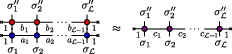
Figure 1: Contraction of two MPOs, with on-the-fly compression and adaptation of the resulting operator.
An adaptive scheme ensures that output patches exceeding the allowed bond dimension are further subdivided, while neighboring low-rank patches are merged post-contraction when feasible. This controls memory growth dynamically and optimizes for the actual distribution of complexity in the product.
Patch ordering and partitioning pattern exert a significant influence on performance; optimal splitting minimizes the number of nontrivially interacting patch pairs in contractions.
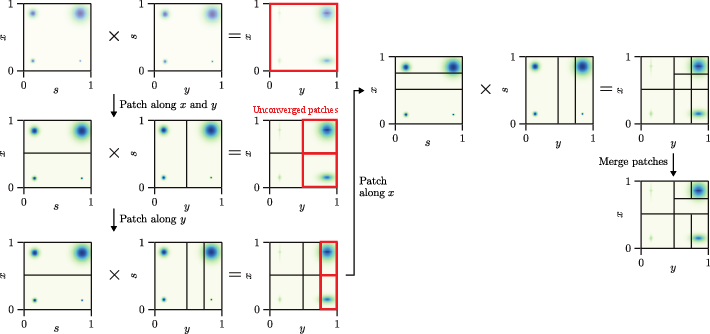
Figure 2: Adaptive patched MPO--MPO contraction dynamically refines patches for efficient contraction and minimal bond dimension.
Patched QTCI is shown to yield strong efficiency improvements in scenarios where the represented function is highly localized, e.g., two-dimensional Green's functions in quantum lattice models at small broadening, high-resolution convolutions, and integral kernels with singularities.
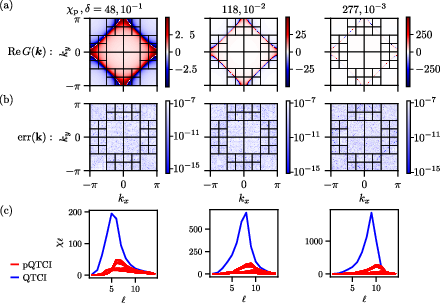
Figure 3: Patched QTCI yields an accurate local reconstruction of ReG(k) with patch-constant bond dimension capping, preserving accuracy over sharp features.
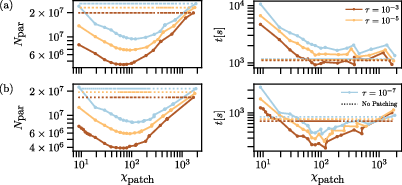
Figure 4: Total parameter count and runtime versus bond-cap χp for patched QTCI, exhibiting clear optima and substantial overhead avoidance relative to non-patched approaches.
One must nevertheless tune the bond-cap to problem and function structure. Excessively fine patching—termed overpatching—creates a pathological proliferation of patches whose TT cores have unchanged bond ranks, inflating total storage. Diagnostics for overpatching and strategies for automating robust cap selection are proposed and discussed.
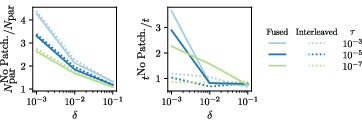
Figure 5: Optimal parameter and runtime ratios between patched and single-QTT for varying feature localization, highlighting crossover regimes.
Applications: Many-body Physics and Feynman Diagram Evaluation
The adaptive patching framework is applied to prototypical problems in quantum many-body physics. For instance, the computation of the bare susceptibility (bubble diagram) involves convolutions of QTT-compressed Green's functions; patch-wise contraction sharply reduces both wall-time and memory for high-precision evaluation at large grid sizes and low temperatures.
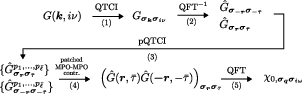
Figure 6: Pipeline for patchwise computation of the bare susceptibility χ0 in reciprocal and imaginary-frequency domains.
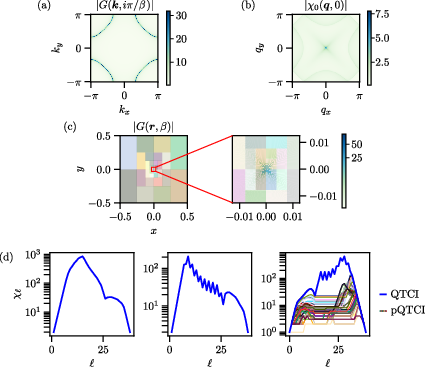
Figure 7: Localized Green's functions, bubble susceptibility, fine-grained patch grids, and TT-rank distributions highlight adaptive refinement aligned with physical structure.
For calculations on the real-frequency axis, where temperature broadening is negligible and features are even sharper, patching enables scalable evaluation of fully resolved two-dimensional bubble integrals.
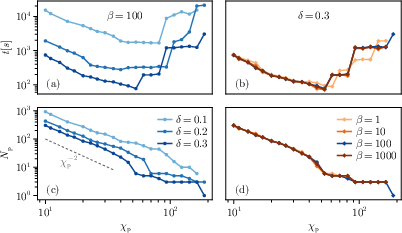
Figure 8: Scaling of wall-time and patch count for real-frequency bubble computations demonstrates controlled complexity at high frequency and momentum resolution.
A substantial improvement is also demonstrated for the Bethe-Salpeter equation and general two-particle vertex contractions, where single-patch approaches are hampered by prohibitive bond growth.
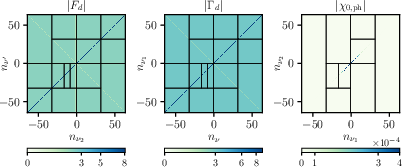
Figure 9: Adaptive pQTCI compression efficiently targets regions with strong two-particle vertex structure, minimizing patch count while maintaining accuracy.
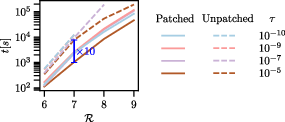
Figure 10: CPU time scaling for the BSE contraction reveals up to an order of magnitude acceleration via patched MPO--MPO contraction at high resolution and precision.
Theoretical Implications and Outlook
The theoretical framework laid out links adaptive patching for QTTs and MPOs to divide-and-conquer strategies known in AMR (H-matrices, mosaic skeletons), generalizing them to the multi-scale, binary-indexed setting and permitting arbitrary partitioning order. Its practical relevance is amplified by its compatibility with state-of-the-art tensor algorithms, potential for symmetry exploitation (enabling further parameter sharing), and proposal for heuristics on patch ordering.
Adaptive patching represents a substantial refinement for large-scale tensor computations and diagrammatic many-body approaches, promising further advances for function operations—especially in highly inhomogeneous, sparsely localized, or symmetry-rich application domains. Its application to large-scale simulations in quantum chemistry, stochastic processes, and even field-theoretic PDEs is a clear potential development.
Conclusion
The adaptive patching scheme for QTTs and MPOs defines a robust methodology for efficiently encoding, manipulating, and contracting high-dimensional tensor objects with spatially heterogeneous complexity. By capping bond dimensions locally and targeting refinement where intrinsic structure demands, substantial gains in runtime and memory usage are demonstrated across diverse test cases, notably in quantum many-body diagrammatics. The paradigm enables computations previously deemed intractable for sharply localized or high-precision tasks. Extensions to optimal patch order selection, hybrid partitioning, and symmetry-driven compression represent compelling directions for future research in scalable tensor computations.
Reference: "Adaptive Patching for Tensor Train Computations" (2602.22372)