- The paper introduces DiRe-RAPIDS, a method that preserves true topology by optimizing both 2-D k-NN accuracy and topology error.
- It leverages NSGA-II for multi-objective optimization, achieving zero topology error on several datasets and consistently outperforming UMAP.
- The approach demonstrates practical impact on large-scale data, such as 723K arXiv embeddings, by maintaining continuous global manifold structures.
Topology-Faithful Dimensionality Reduction at Scale: An Analysis of DiRe-RAPIDS
Introduction
Dimensionality reduction (DR) is fundamental for visualizing high-dimensional data in a form amenable to human interpretation, with t-SNE and UMAP representing standard approaches. However, their neighborhood-preserving objectives induce limitations, as these methods can conflate manifold structure with sampling noise and often distort global topological characteristics such as connectivity and the presence of cycles. "DiRe-RAPIDS: Topology-faithful dimensionality reduction at scale" (2604.25209) systematically investigates these failings, highlighting the role of local-metric-driven methods in producing topologically spurious artifacts. The work introduces a rigorous, topologically-motivated evaluation criterion and demonstrates that, when tuned via multi-objective optimization, the DiRe method achieves superior topology-faithful embeddings and Pareto-dominance over GPU-accelerated UMAP across a range of large-scale datasets.
Critique of Neighborhood-Preservation Metrics
Standard k-NN preservation metrics serve as the prevailing benchmark for DR methods. However, these metrics reward embeddings that reproduce not only manifold-geometric relationships but also high-frequency sampling noise, which is non-informative and topologically deleterious. Empirical analysis on noisy figure-8 manifolds demonstrates that as sampling noise σ increases, the number of detected first homology (β1) cycles inflates dramatically in both the point cloud and UMAP's 2-D embedding far beyond the ground-truth value, whereas DiRe's output maintains fidelity to the theoretical topology.
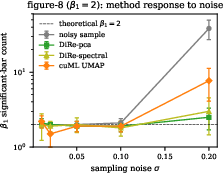
Figure 1: As sampling noise increases, local metrics incentivize the memorization of spurious cycles, seen as escalating β1 in UMAP and noisy point clouds, while DiRe closely adheres to the ground-truth topological complexity.
This finding illustrates a systematic bias in neighborhood-based metrics: methods optimizing such metrics may score highly despite gross violations of the manifold's true topological properties, underlining the need for supplementary evaluation criteria.
Topology Error: A Scale-Invariant Faithfulness Metric
To address these shortcomings, the authors propose a topology error (TE) metric defined as the aggregate absolute deviation in first Betti number (∣β1embed−β1true∣) computed across stress-test manifolds with known homology. Utilizing persistent homology (via ripser), embeddings are quantitatively assessed for their success in preserving nontrivial topological features against sampling noise and increasing complexity. This scalar, robust approach directly captures topological faithfulness and is not conflated by local overfitting.
Multi-Objective Optimization with NSGA-II
DiRe is subjected to multi-objective optimization using NSGA-II, with objectives of maximizing 2-D k-NN classification accuracy and minimizing topology error. The hyperparameter search spans initializations, neighbor counts, spread, and layout iterations, delivering optimized configurations. Across 11 OpenML datasets, DiRe is found to strictly Pareto-dominate cuML UMAP (the dominant GPU baseline) on both objectives in 7 of 11 cases, and on all datasets, a DiRe configuration achieves topology error 0 (exact homology recovery), while UMAP consistently exhibits nonzero topology error.
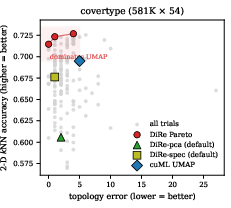
Figure 2: Pareto front for covertype demonstrates that DiRe achieves both higher kNN classification and lower topology error than UMAP; DiRe's optimal configuration delivers exact topology at a +2pp kNN advantage.
Large-Scale Real Data: arXiv Corpus
The paper validates DiRe further on a corpus of 723,457 arXiv-paper embeddings (dimension 384), assessing the ability to preserve topological summaries (Betti curves) of the real data after reduction to 2-D. Notably, DiRe retains 3–4× more of the β1 structure than UMAP at comparable runtime.
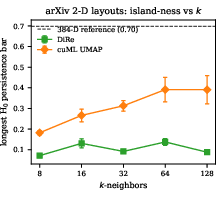
Figure 3: UMAP exhibits extended persistence bars indicative of fragmented, island-like layouts, while DiRe's output is more continuous, matching the reference distribution and faithfully preserving global manifold structure.
Qualitative inspection of the 2-D layouts reinforces these results. When visualized by arXiv primary category, both methods discern clusters, but UMAP separates categories into disjoint 'islands', introducing artificial discontinuities and misrepresenting long-range similarities. DiRe preserves a more accurate, continuous spectrum of inter-category relationships, reflecting the high-dimensional structure.
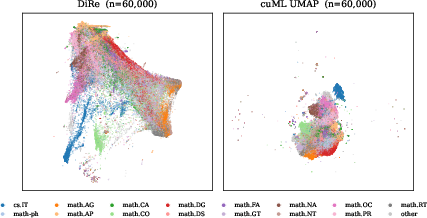
Figure 4: In arXiv-paper embeddings, DiRe (left) preserves global continuum and inter-category topology, while UMAP (right) fragments the manifold into artificial islands.
Practical Implications and Theoretical Insights
The findings directly challenge the sufficiency of local-neighborhood-driven metrics as a sole optimization target for DR. The paper demonstrates that topology-aware methods are practical at modern data scales (over 700K points) and that topology-preserving configurations can be discovered efficiently using NSGA-II, with tuned DiRe also delivering improved or comparable computational performance. The proposed topology error metric establishes a simple, robust criterion for future DR work.
The results have immediate impact:
- For practitioners, topology-faithful embedding is critical in datasets where continuity, connectedness, and global relationships are meaningful (e.g., biological, linguistic, or scientific domains).
- For algorithm design, multi-objective approaches considering topological metrics should supersede reliance on local neighborhood accuracy alone.
Limitations and Future Directions
The study acknowledges that persistent homology computations are currently prohibitive for higher-order Betti numbers (k≥2) and large sample sizes due to O(N3) complexity. This confines quantitative evaluation in the paper to β0 and β1 on large-scale data. Progress on GPU-native, scalable persistent homology tools will enable evaluation and optimization for even richer global invariants in the future. Additionally, while the current work focuses on 2-D/3-D DR, the extension to more general manifold-learning settings and alternative data types remains an open direction.
Conclusion
This paper provides a comprehensive critique of local-neighborhood metrics as the guiding objective in dimensionality reduction, demonstrating that such metrics systematically reward embeddings that memorize noise and distort genuine topology. By introducing a topology error benchmark and employing multi-objective optimization, DiRe is shown to produce embeddings that are both classifier-accurate and topologically faithful at scale, with significant improvements over cuML UMAP. The approach reframes empirical evaluation in DR, advocating topology-aware optimization as essential for robust, interpretable scientific workflows.