- The paper introduces WxFlow, a conditional flow matching model that transforms coarse climate data into high-resolution snowfall predictions with orders-of-magnitude faster ensemble generation.
- The paper leverages a 23M-parameter conditional U-Net with self-attention and optimizes a mean-squared error velocity loss to accurately model fine-scale precipitation fields.
- The paper demonstrates improved probabilistic calibration and spectral fidelity over traditional methods, enabling efficient hydrologic prediction and hazard analysis in mountainous regions.
Conditional Flow Matching for Probabilistic Downscaling of Maximum 3-day Snowfall in Alaska
Introduction
"Conditional Flow Matching for Probabilistic Downscaling of Maximum 3-day Snowfall in Alaska" (2604.25172) presents WxFlow, a conditional generative model leveraging flow matching (CFM) to emulate fine-scale orographic snowfall in Alaska. The paper addresses the substantial computational bottleneck inherent in dynamical downscaling with high-resolution RCMs such as WRF, aiming to achieve physically plausible, uncertainty-aware probabilistic ensemble downscaling at a fraction of the computational cost. This work has immediate significance for hydrologic prediction, hazard analysis, and climate adaptation in mountainous regions where ensemble-based uncertainty quantification is essential.
Problem Statement and Scope
General Circulation Models (GCMs) exhibit coarse (∼100 km) horizontal resolution, precluding the representation of critical orographic precipitation mechanisms. Dynamical downscaling using WRF improves effective resolution to a few kilometers but results in prohibitive computational costs (months per scenario). The inability to generate large ensembles restricts rigorous uncertainty quantification and precludes their operational use in decision support.
WxFlow seeks to learn a conditional, generative mapping from low-resolution climate predictors and high-resolution orography to fine-scale precipitation fields, producing physically consistent and calibrated probabilistic ensembles in seconds.
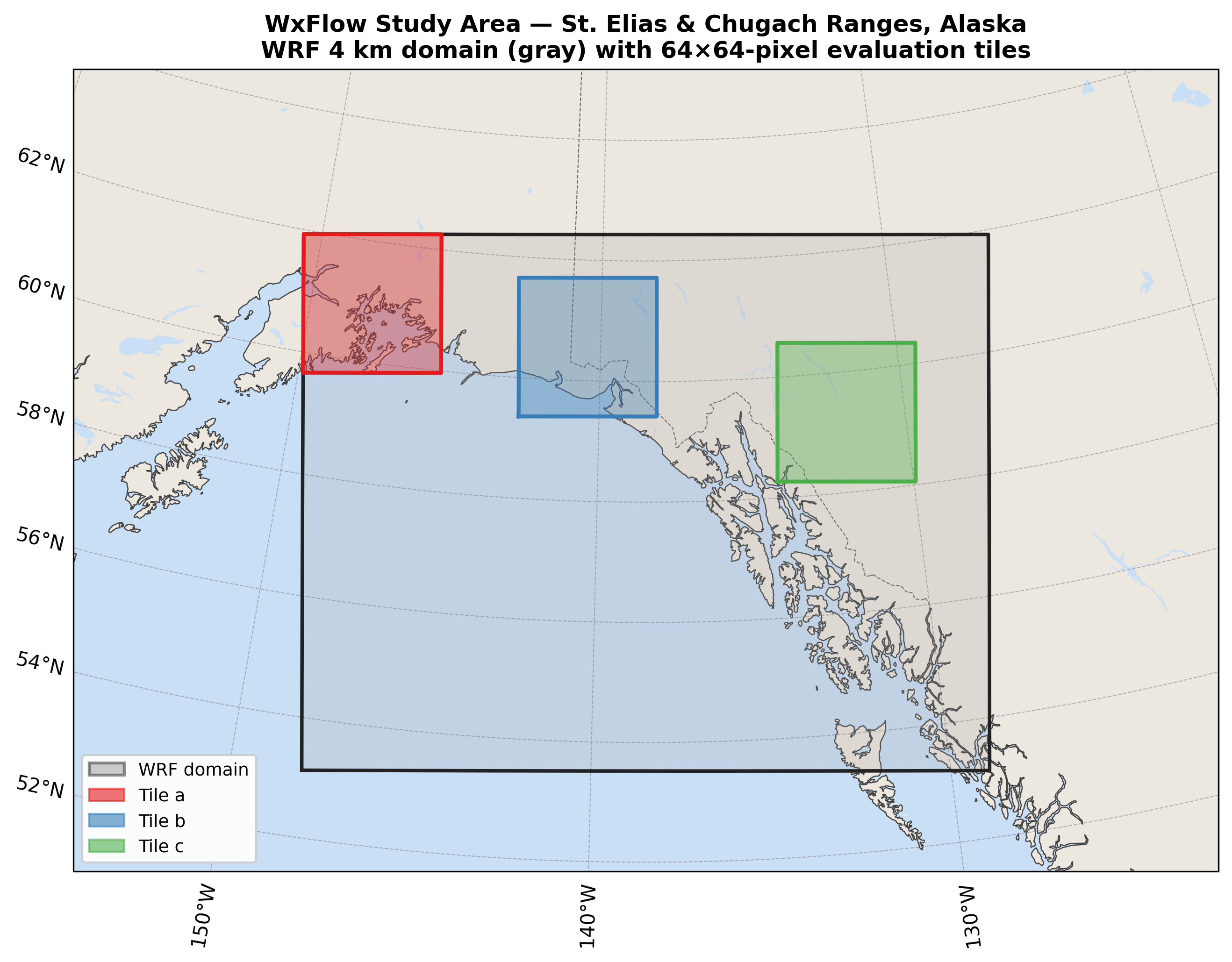
Figure 1: Reference regions in Alaska employed for evaluation and demonstration of WxFlow's capabilities.
Methodology
WxFlow is fundamentally constructed as a conditional flow matching model, learning a neural velocity field in distribution space that morphs standard Gaussian noise into realistic high-resolution snowfall accumulations, conditioned on topography and coarse climate input. The neural architecture is a 23M-parameter conditional U-Net with self-attention, operating on 64×64 tiles (4 km resolution) and incorporating sinusoidal time embeddings for denoising progress.
Given training pairs of noisy and ground-truth precipitation fields, the flow matching framework optimizes a mean-squared error velocity loss, targeting the direct trajectory between zero-mean noise and data. The velocity field is learned in the presence of input conditioning (coarse precipitation, orography, missing data mask) and enables sample generation by integrating an ODE from prior to data density.
Key architectural features include multi-scale U-Net encoding, intermediate self-attention at reduced spatial resolution (16×16), group normalization, and dropout. The integration for sample generation employs DOPRI5 (adaptive Runge-Kutta), typically requiring ∼10 function evaluations per sample.
Training and Evaluation Setup
Training utilizes reanalysis and GCM-forced 4 km WRF simulations over Southeast Alaska, degraded to 64 km to simulate coarse model input. Dataset partitioning is temporal, enabling rigorous test set evaluation across 30+ independent time steps. ~2.5 training epochs are executed via stochastic tiling and time-biasing in the denoising trajectory. The Continuous Ranked Probability Score (CRPS) is used for quantitative probabilistic calibration assessment.
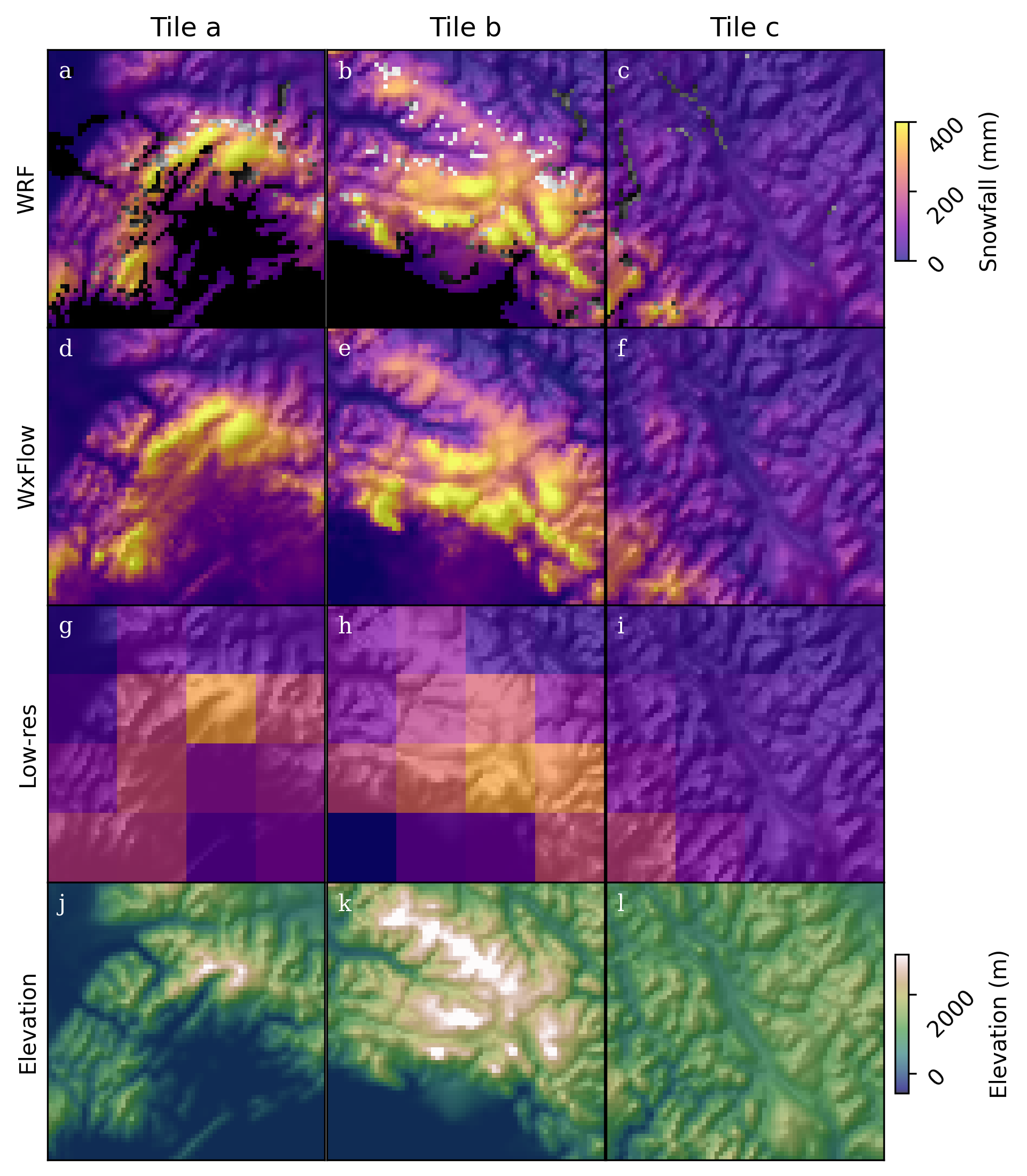
Figure 2: Comparison of high-resolution WRF, WxFlow outputs, and coarse forcings, highlighting qualitative similarity and the physical coherence of WxFlow's samples.
Ensemble Properties and Uncertainty Quantification
By varying the initialization noise vector, WxFlow rapidly generates large ensembles of fine-grained precipitation fields. The spread among ensemble members is spatially organized, reflecting the underlying orographic complexity: high-relief regions exhibit greater variance, and modeled uncertainties manifest as coherent spatial structures, including shadowing and enhancement on opposite flanks of orographic barriers.

Figure 3: WxFlow sample anomalies (with ensemble mean removed) for the Malaspina Glacier region, demonstrating spatially coherent, physically plausible ensemble variability linked to topography.
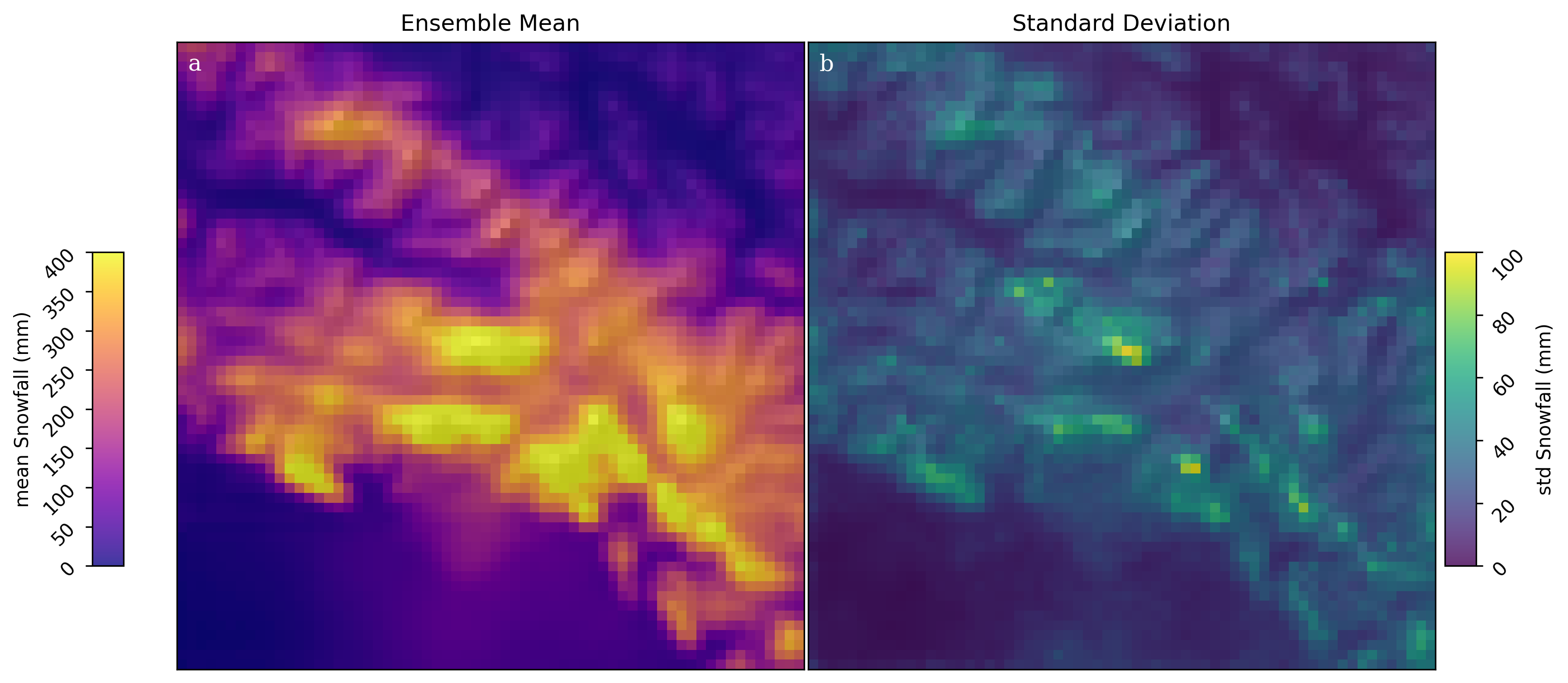
Figure 4: Standard deviation in WxFlow ensembles centered on the St. Elias mountain range, evidencing increased forecast uncertainty in complex, high-precipitation terrain.
Quantitative Forecast Skill and Spectral Evaluation
WxFlow's probabilistic downscaling is assessed against a lapse-rate-corrected bicubic interpolation baseline using CRPS. Across all test domains, WxFlow achieves lower CRPS, particularly in high-relief areas, demonstrating substantial gains in both reliability and resolution of forecasted precipitation compared to regression-based upscaling. The model faithfully localizes heavy precipitation maxima and produces calibrated ensemble spread that reflects forecast ambiguity.
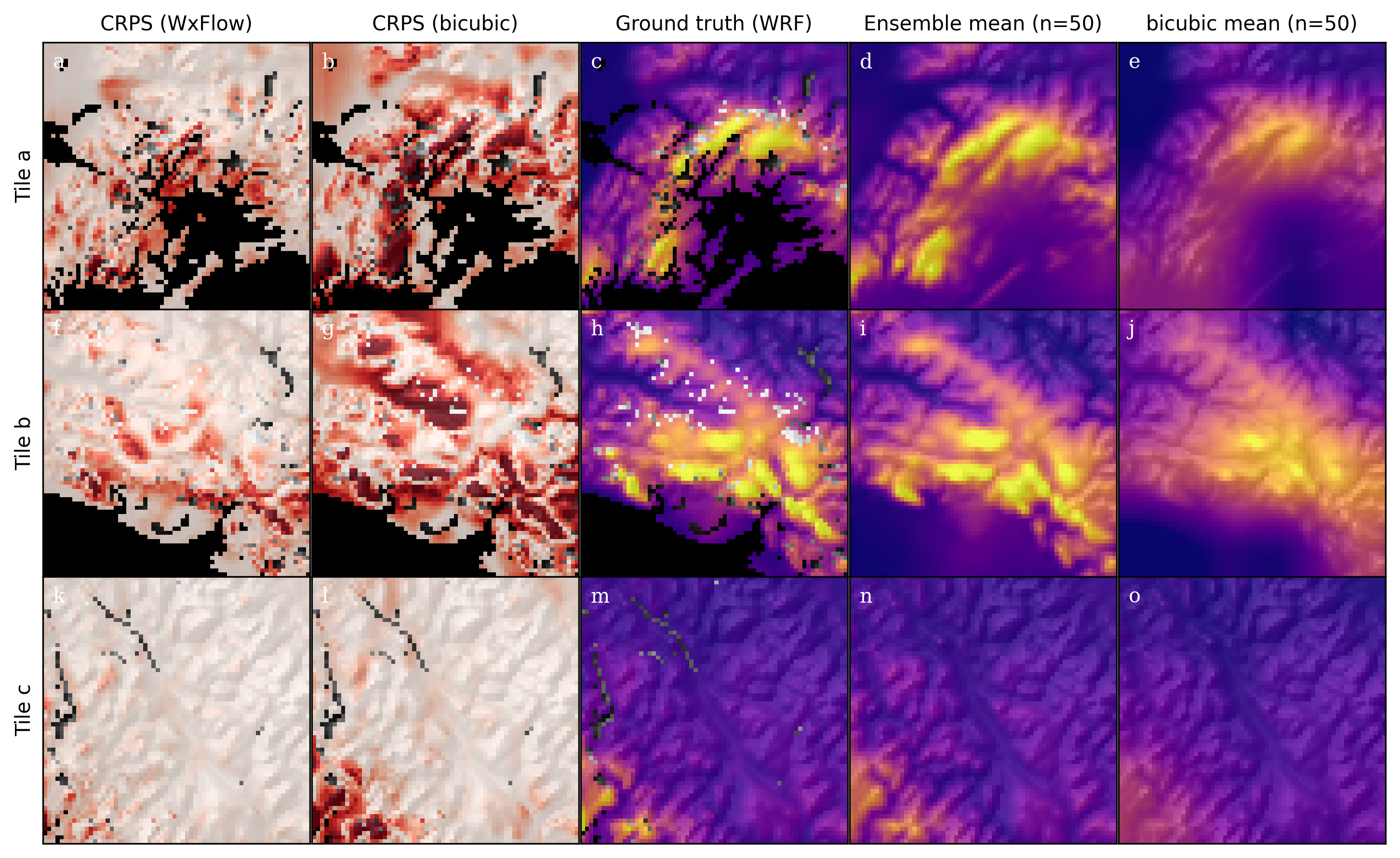
Figure 5: Spatial CRPS maps comparing WxFlow to the baseline, with WxFlow exhibiting improved probabilistic calibration especially in mountainous regions.
To assess spatial structure fidelity, the power spectral density (PSD) of generated fields is computed and compared to WRF ground truth. WxFlow preserves the observed variance cascade across most resolved scales, yielding 87.8% improvement in mean absolute log-spectral error relative to the baseline. A minor high-frequency deficit (<0.3 dB for ≲10 km scales) is observed, consistent with generative model tendencies towards smoothness over noise.
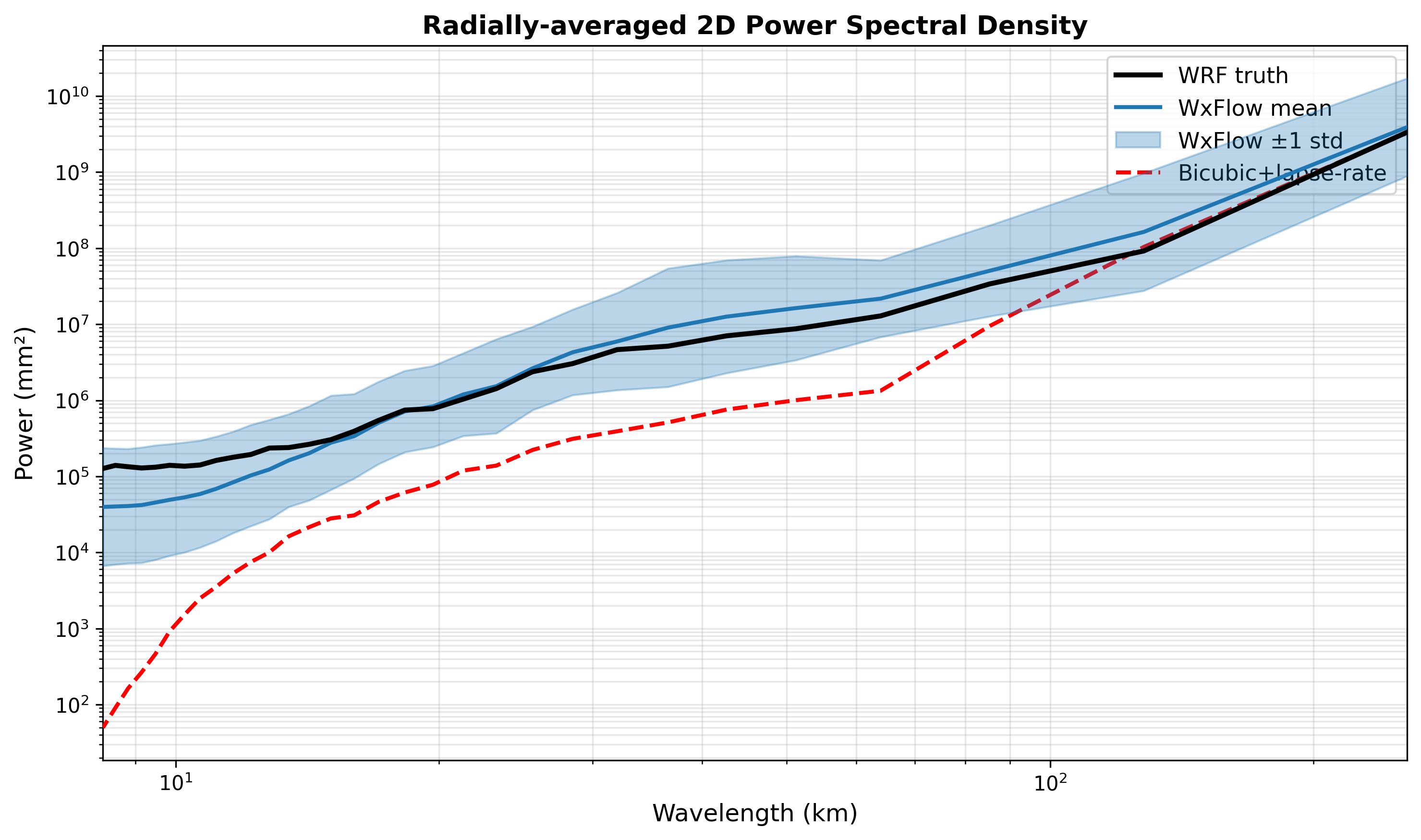
Figure 6: Log-log PSD comparison for WxFlow, baseline, and WRF, showing marked fidelity of WxFlow except at the highest frequencies.
Theoretical and Practical Implications
The use of conditional flow matching as a generative, uncertainty-aware surrogate for WRF and similar high-resolution RCMs provides a computationally practical alternative for climate adaptation and hydrologic assessment frameworks. This substantially reduces (from months to seconds) the wall-time required for ensemble scenario generation, removing a core practical barrier to robust, uncertainty-aware climate impact modeling.
Theoretically, this work demonstrates that velocity-based generative modeling (as opposed to diffusion-based score matching) can better retain small-scale spatial structure, achieve efficient training targets, and offer faster sample generation via ODE integration. The physical coherence of ensemble uncertainty maps opens opportunities for downstream evaluation and hazard modeling where structured probabilistic predictions are critical.
Additionally, the modular nature of the approach (velocity network with flexible conditional channels) suggests feasibility for transfer to other climate variables, domains, or physical processes, contingent on available high-resolution training data.
Limitations and Future Directions
While WxFlow marks significant improvement over bicubic and regression-based downscaling, the residual small-scale spectral bias underscores a persistent challenge in generative emulation of ultra-fine spatial variability, likely requiring architectural or objective function advances. Further work is warranted in:
- Explicitly correcting high-frequency spectral loss: Incorporating spectral loss terms or adversarial refinements.
- Generalization beyond Alaska: Extension to wider geographic and variable domains, including multi-variable generative conditioning.
- Integration with operational climate workflows: Validating operational impact on hydrological prediction, hazard quantification, and adaptation planning.
Conclusion
WxFlow demonstrates that conditional flow matching enables probabilistic, high-resolution emulation of orographic precipitation, matching spectral and probabilistic properties of expensive WRF forecasts, yet offers orders-of-magnitude faster ensemble generation. This work substantiates CFM as a viable framework for physical, uncertainty-aware atmospheric downscaling and motivates further methodological refinement for robust climate-aligned generative modeling.