- The paper introduces a modular flow matching-based super-resolution framework that reconstructs high-resolution residuals to enhance coarse weather forecasts.
- It employs a 3D Swin U-Net transformer to stochastically recover subgrid-scale features, preserving large-scale dynamics while improving forecast skill.
- Experimental results show significant CRPS improvements and spectral consistency, demonstrating the method’s efficiency and physical reliability.
Super-Resolving Coarse-Resolution Weather Forecasts with Flow Matching: A Modular, Generative Approach
Introduction and Motivation
This work presents a modular methodology for obtaining high-resolution weather forecasts by applying learned generative super-resolution (SR) as a post-processing layer to the outputs of coarse-resolution, ML-based weather forecasting models. The motivation stems from growing evidence that modern ML weather models, though competitive with operational NWP systems, become computationally prohibitive when operated and trained at high spatial resolutions. On the other hand, coarse models capture synoptic-scale dynamics well but fail to resolve critical mesoscale and subgrid features essential for regional and local weather phenomena.
The approach decouples the forecasting and spatial resolution tasks, positioning SR as an independent, generative statistical operator. The aim is to bridge the gap between tractable, large-scale forecasting and the need for fine-scale physical accuracy, leveraging advances in flow-matching generative modeling and transformer-based architectures.
Given a sequence of coarse-resolution forecasts xtLR, the objective is to construct physically consistent high-resolution analogs x^tHR without retraining the forecasting model at high resolution. The SR mapping is formalized as learning an approximate stochastic inverse Cϕ−1 to the known coarse-graining operator C, which is fundamentally lossy and non-invertible. The residual-based approach introduces an explicit Reynolds-style decomposition:
xtHR=↑xtLR+rt,
where ↑xtLR is a spatial interpolation of the coarse field, and rt is a high-resolution residual reconstructed using a conditional generative process.
The generative SR component consists of a conditional flow-matching model, parameterized as a 3D Swin U-Net transformer, which is trained exclusively on reanalysis pairs (xtLR,xtHR) from ERA5 data. The model learns to stochastically reconstruct the residual distribution p(rt∣↑xtLR), thus capturing the inherent non-uniqueness of the inverse problem.
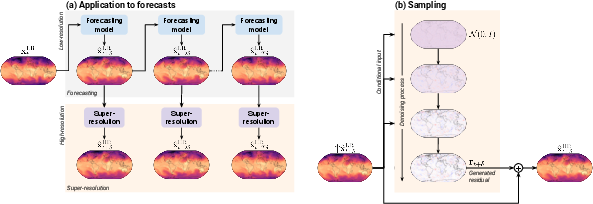
Figure 1: The super-resolution pipeline: forecasts at coarse resolution are independently upscaled by sampling a high-resolution residual conditioned on each interpolated forecast step.
Experimental Protocol and Evaluation
Data and Training
The SR model is trained using first-order conservative regridded ERA5 data, targeting a 6× upscaling from x^tHR0 to x^tHR1. Training is restricted to 1979–2018 data, validation to 2019, and testing to 2020. Critically, the SR model is applied in zero-shot mode to ArchesWeatherGen ensemble forecasts, whose distribution is closely matched to that of reanalysis.
Validation Strategy
Two primary axes of validation are implemented:
- Design Consistency: Re-coarsening super-resolved outputs and comparing them to the original trajectory, using pattern correlation, activity ratio, and normalized RMSE, to ensure that large-scale dynamics are preserved.
- Forecast Skill: Assessment of the high-resolution forecasts through standard ensemble skill metrics (CRPS, energy scores, Brier scores, spread-skill ratio), evaluated per WeatherBench2 protocol and baseline comparisons (notably against IFS ENS and GenCast).
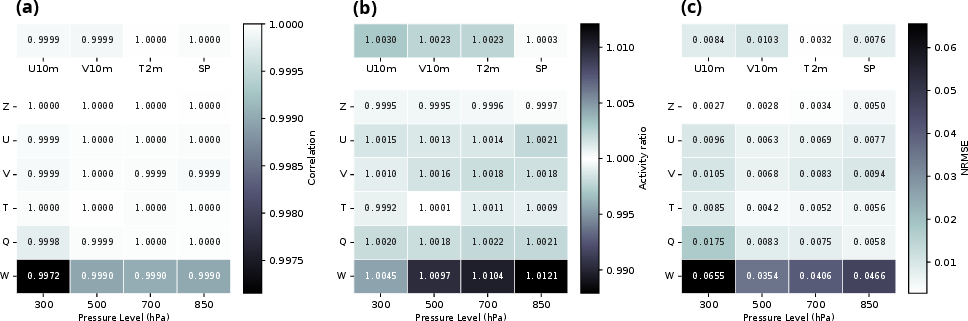
Figure 2: Re-coarsened SR outputs exhibit near-perfect agreement in metrics, confirming preservation of large-scale structure and physically plausible subgrid modifications.
Results
Consistency with Coarse Forecasts
Re-coarsening SR outputs yields high spatial correlations (near unity), activity ratios close to 1, and uniformly low normalized RMSEs across all evaluated variables and pressure levels. This establishes that the large-scale flow, as dictated by the underlying forecast, remains unaffected by the super-resolution transformation.
High-Resolution Ensemble Skill
Global Skill: GenCast delivers the strongest short-to-medium range skill, but ArchesWeatherGen (AWG) super-resolved forecasts are competitive, especially at extended leads (x^tHR2 days) and for wind and moisture variables. Ensemble spread-skill ratios suggest AWG is marginally less underdispersive than GenCast.
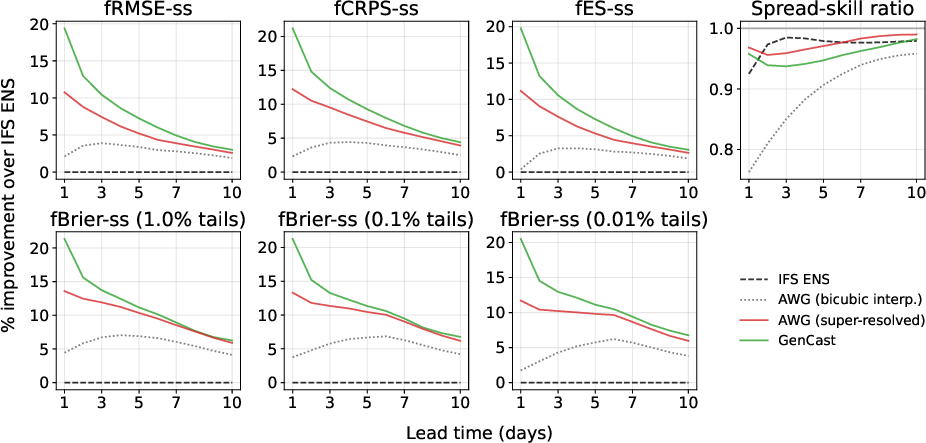
Figure 3: AWG exhibits competitive or superior skill relative to IFS ENS across canonical ensemble verification metrics at x^tHR3 resolution.
Per-Variable CRPS: Learned SR substantially outperforms bicubic interpolation in CRPS skill across variables with significant small-scale structure (e.g., humidity, winds), but not for geopotential which is naturally smooth. AWG bridges the performance gap with GenCast for most variables at longer lead times, with an average improvement of 7.4% in CRPS skill versus IFS ENS.
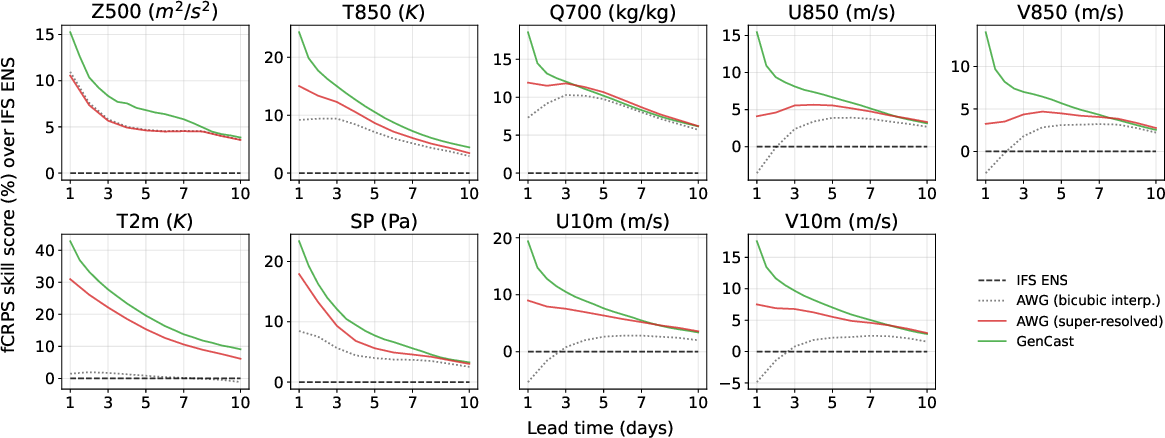
Figure 4: CRPS skill versus IFS ENS, stratified by variable and lead; AWG-SR matches high-res benchmarks at medium ranges and excels in moisture and wind variables.
Spectral and Physical Consistency
The super-resolved forecasts, as evidenced by power spectral analysis, systematically recover missing small-scale energy absent from bicubic interpolations.
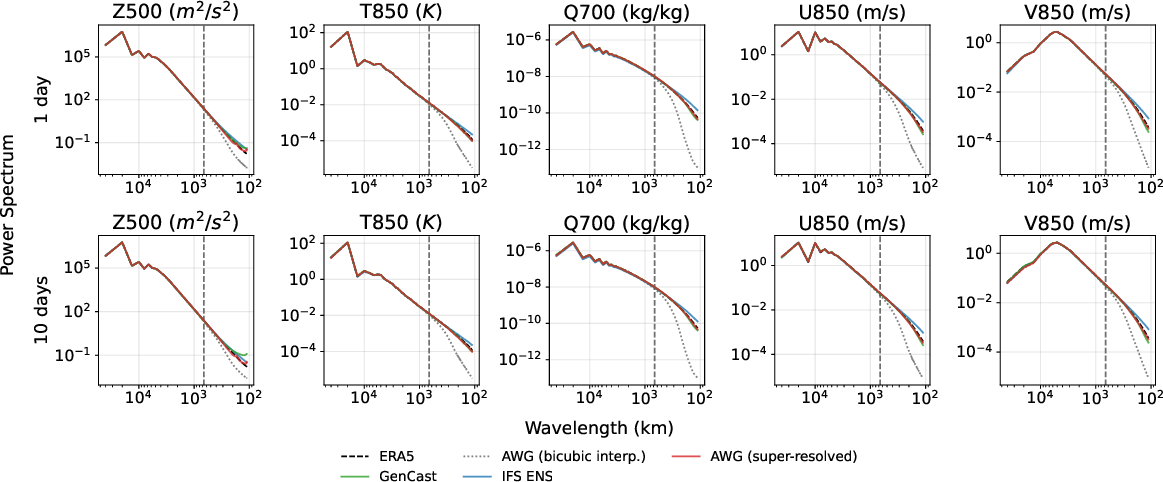
Figure 5: Both generative SR models reconstruct substantial fine-scale variance, particularly at sub-1.5x^tHR4 scales; AWG is particularly strong at maintaining realistic spectral slopes at high wavenumbers.
AWG-SR exhibits superior small-scale energy retention (especially for T2M and Q700), evidenced by closer matches to the ERA5 truth in power spectrum ratios and zoomed analysis at unresolved scales.
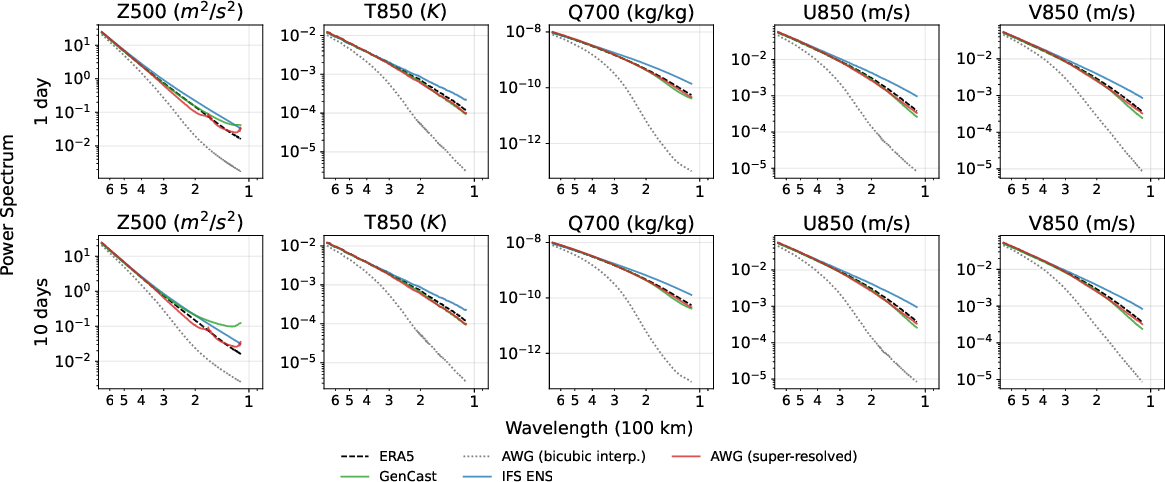
Figure 6: AWG-SR matches ERA5 spectral energy at small scales more faithfully than direct high-resolution generative models, highlighting consistency of SR-generated stochastic structure.
Case Studies: Tropical and Orographic Events
Analysis of Hurricane Teddy (Category 4, September 2020) demonstrates that SR reconstructs fine-scale convective and moisture structures while reflecting ensemble spread primarily through large-scale organization.
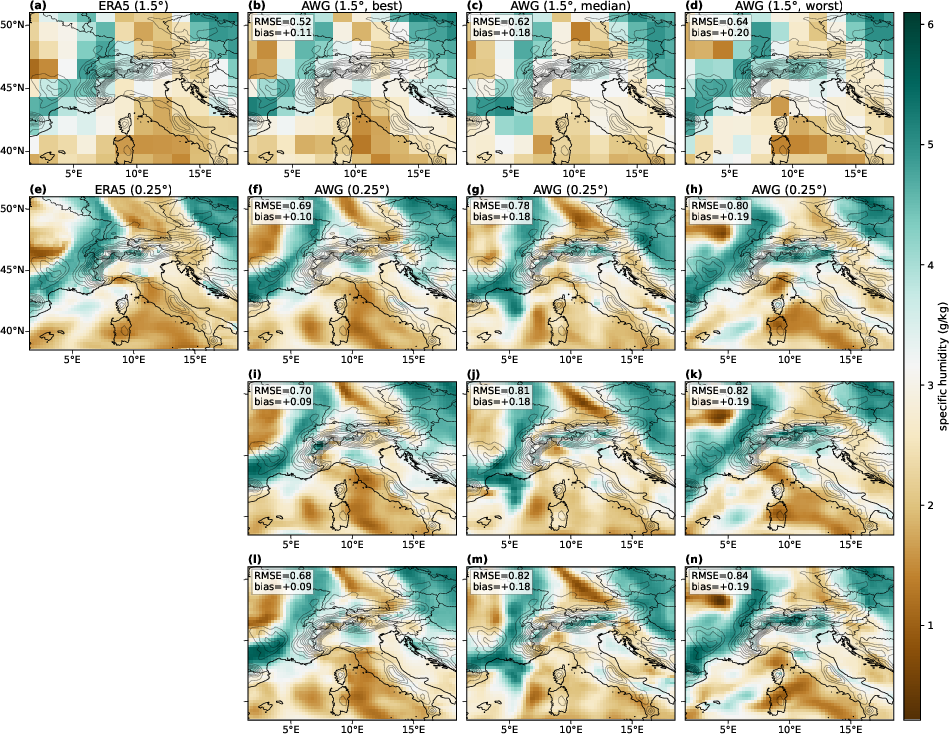
Figure 7: SR enables stochastic, physically realistic reconstructions of fine-scale features such as spirals and dry intrusions, consistent across varying large-scale forecast members.
Extended analysis under complex orography (Storm Alex over the Alps) further illustrates high-resolution detail recovery in wind, humidity, and temperature fields.
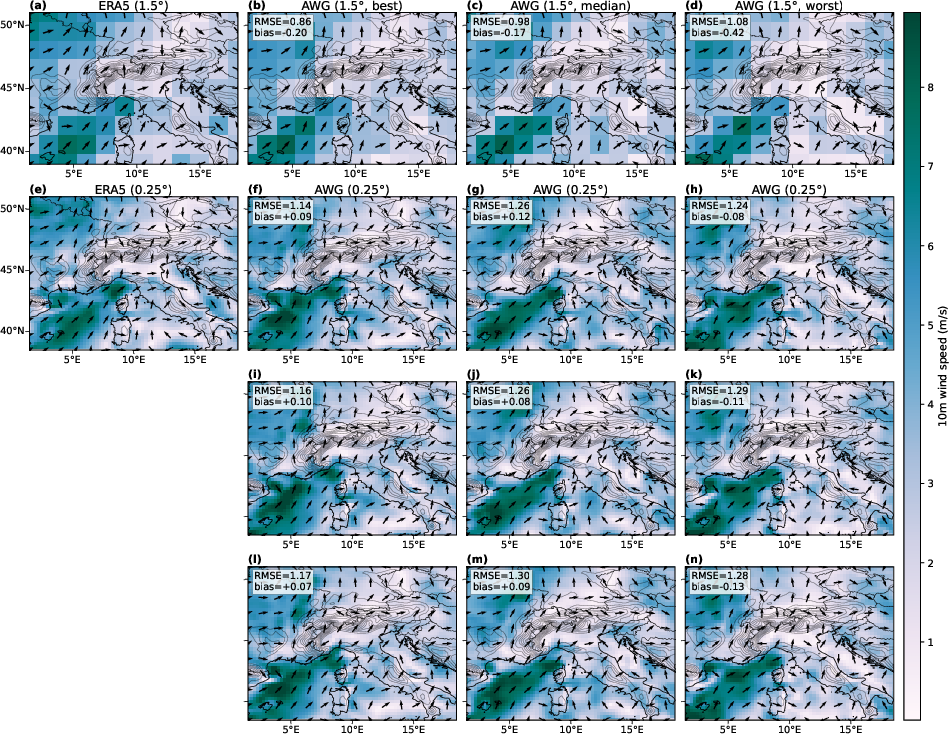
Figure 8: Super-resolved wind speed recaptures orographic channeling absent in the LR forecast, with ensemble diversity reflecting uncertainties at the subgrid scale.
Implications, Limitations, and Future Research
The decoupling of forecasting and super-resolution constitutes a flexible, modular paradigm: any coarse-resolution model yielding plausible synoptic states can be downstream-super-resolved. This supports broad applicability beyond the ArchesWeatherGen system, including climate-scale and subseasonal tasks. The SR operator trained on reanalysis is also, to some extent, portable to post-process NWP forecasts, albeit with expected deviations in small-scale statistical distributions.
From a computational perspective, SR training incurs roughly a quarter of the cost of high-res generative model training. Inference overhead (about 8 minutes per 10-day forecast on a V100) remains a limiting factor for operational deployments, suggesting opportunities for speedup via model distillation or consistency-trained generators.
A key theoretical implication is the disentanglement of large-scale and fine-scale uncertainties, enabling stochastic representations of subgrid processes decoupled from deterministic low-res evolution. However, SR cannot correct large-scale forecast errors nor does it improve forecast skill in variables governed entirely by resolved dynamics. Furthermore, proper SR performance at shorter temporal sampling (e.g., hourly) requires temporal super-resolution extensions.
Conclusion
This work establishes learned stochastically-conditioned super-resolution, trained with flow matching and transformer backbones, as a viable and efficient route to operationally competitive high-resolution weather prediction. The approach preserves dynamical consistency, injects physically plausible variance at unresolved scales, and achieves verifiable improvements in probabilistic and spectral forecast skill at a fraction of the cost of native high-resolution models. Its modularity, interpretability, and extensibility recommend it as a practical pathway for scalable ML-based weather and climate simulation.