- The paper introduces PC-AFM, a generative downscaling model that enforces physical conservation via soft constraints to enhance climate predictions.
- It employs noise-adaptive penalization and Conflict-Free Gradient (ConFIG) surgery to balance generative objectives with physical consistency.
- Experimental results show significant reductions in bias, conservation error, and miscalibration across European regions, establishing a new benchmark in climate downscaling.
Physics-Constrained Adaptive Flow Matching for Climate Downscaling
Introduction and Motivation
High-resolution regional climate information is crucial for quantifying climate impacts, but direct simulation with global kilometer-scale models is computationally intractable. Generative machine learning methods offer orders-of-magnitude efficiency gains, but have two key deficiencies: they often violate physical conservation laws (e.g., mass, energy), and their statistical fidelity degrades severely under geographic distributional shift. The paper "Physics-Constrained Adaptive Flow Matching for Climate Downscaling" (2604.03459) introduces Physics-Constrained Adaptive Flow Matching (PC-AFM), a generative downscaling architecture designed to address both issues by enforcing physical consistency via explicit conservation constraints, and by employing gradient surgery to resolve conflicts between physics and generative objectives during training.
Methodological Contributions
PC-AFM extends the Adaptive Flow Matching (AFM, based on CorrDiff++) framework, which interpolates between a high-resolution encoder initialization and the true target using a neural denoiser along smooth probability flows. PC-AFM's principal novelties are:
- Soft conservation constraints: Deviations between the area-weighted mean of the high-resolution prediction and the coarse-resolution input are penalized for precipitation and specific humidity, ensuring physical consistency at each spatial scale. This is implemented on denormalized (physical) variables to preserve transferability.
- ConFIG gradient surgery: Direct addition of physics-based and generative loss terms leads to conflicting gradient updates; PC-AFM applies Conflict-Free Gradient (ConFIG) optimization to ensure simultaneous non-negative progress on both objectives, moving solutions toward the Pareto front between fidelity and constraint satisfaction.
- Noise-level adaptive penalization: Constraint penalties are down-weighted for samples with high stochastic noise, limiting their impact to predictions near physical reality. A warmup phase disables constraints early in training for stability.
This architectural approach is illustrated in the model schematic below.
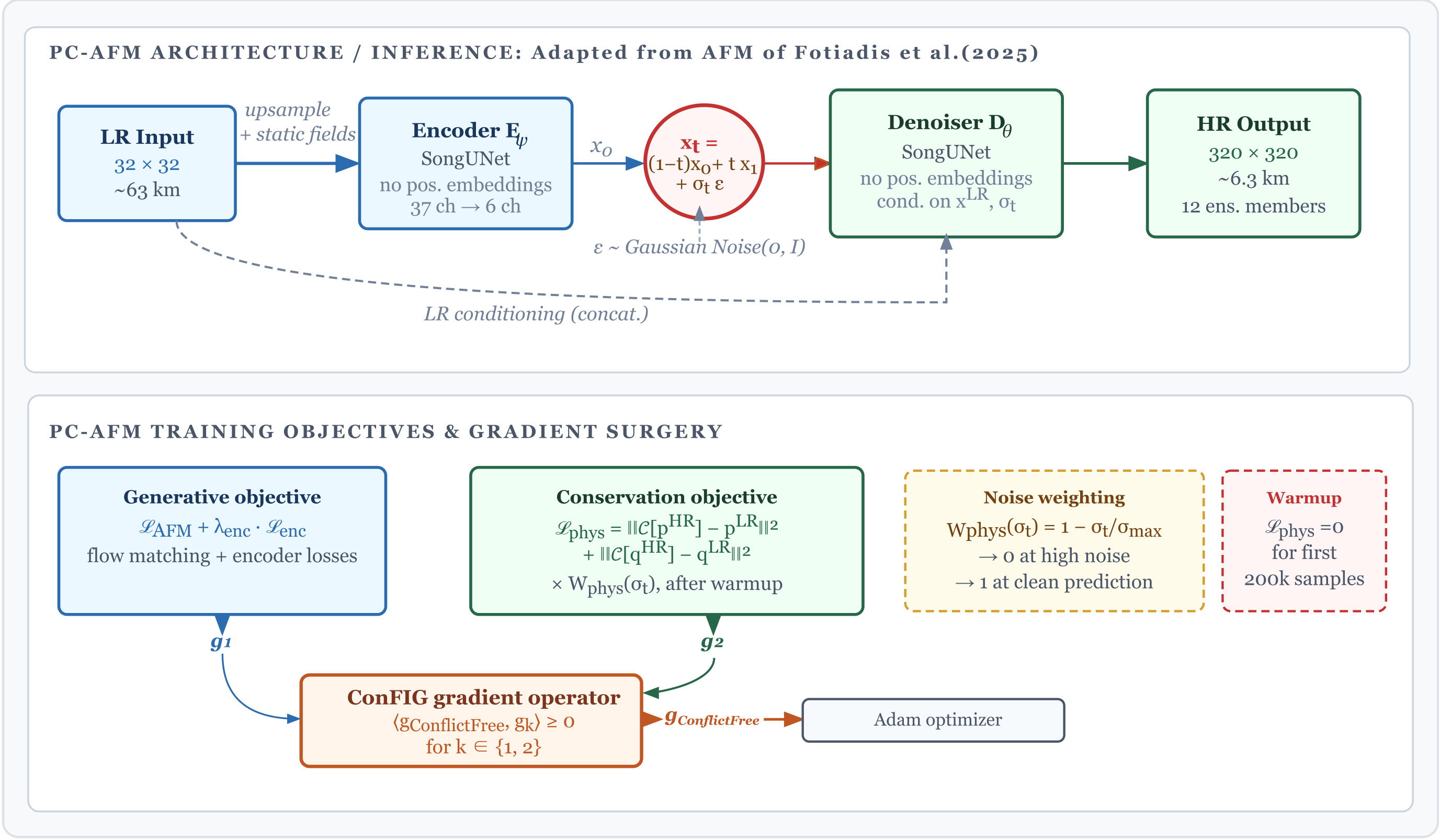
Figure 2: Overview of the PC-AFM architecture and training regime, with soft conservation losses and gradient surgery applied during the denoising flow-matching process.
Experimental Design and Data
Training and evaluation use high-resolution (6.3 km) convection-permitting nextGEMS ICON simulations over three European regions (Central Europe for training; Iberian Peninsula and Northern Europe as ‘out-of-distribution’ test cases).
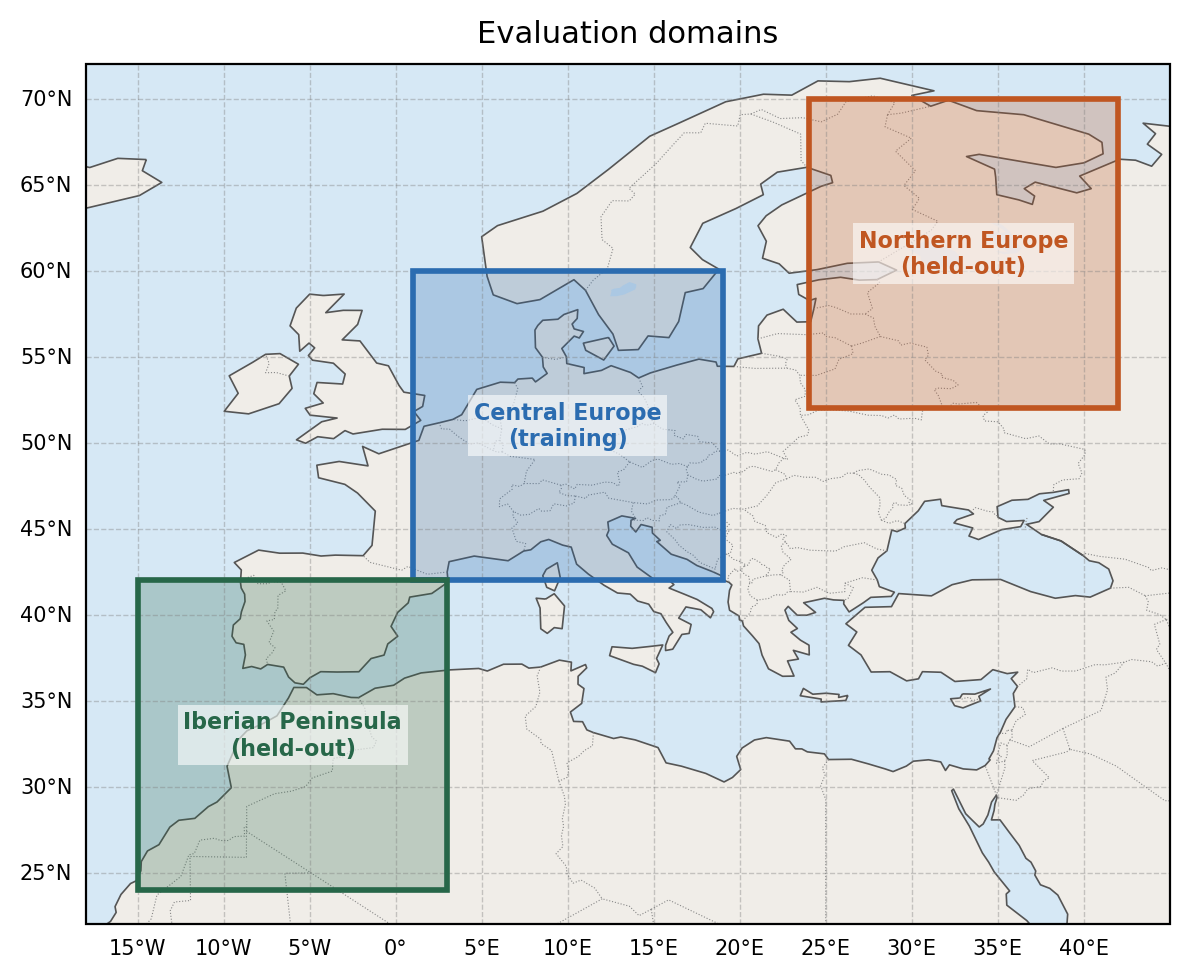
Figure 1: Training (blue) and evaluation (green, orange) domains for assessing in-distribution and geographic out-of-distribution generalization.
The downscaling targets a 10× resolution enhancement (63 km → 6.3 km) across six key variables (temperature, precipitation, specific humidity, pressure, 10 m winds). A comprehensive diagnostic suite evaluates bias, ensemble skill, power spectra, conservation error, quantile-based distributional fidelity, and calibration.
On Central Europe, PC-AFM achieves:
- Aggregate improvement: PC-AFM yields an average 0.89 performance ratio to unconstrained AFM (i.e., 11% average improvement).
- Conservation gains: For constrained variables, conservation error is reduced by ~41%.
- Ensemble calibration: Precipitation miscalibration (MCB) drops significantly (0.767→0.523).
- Distributional accuracy: Quantile MAE for impact-relevant diagnostics is reduced by 29% (ratio 0.71).
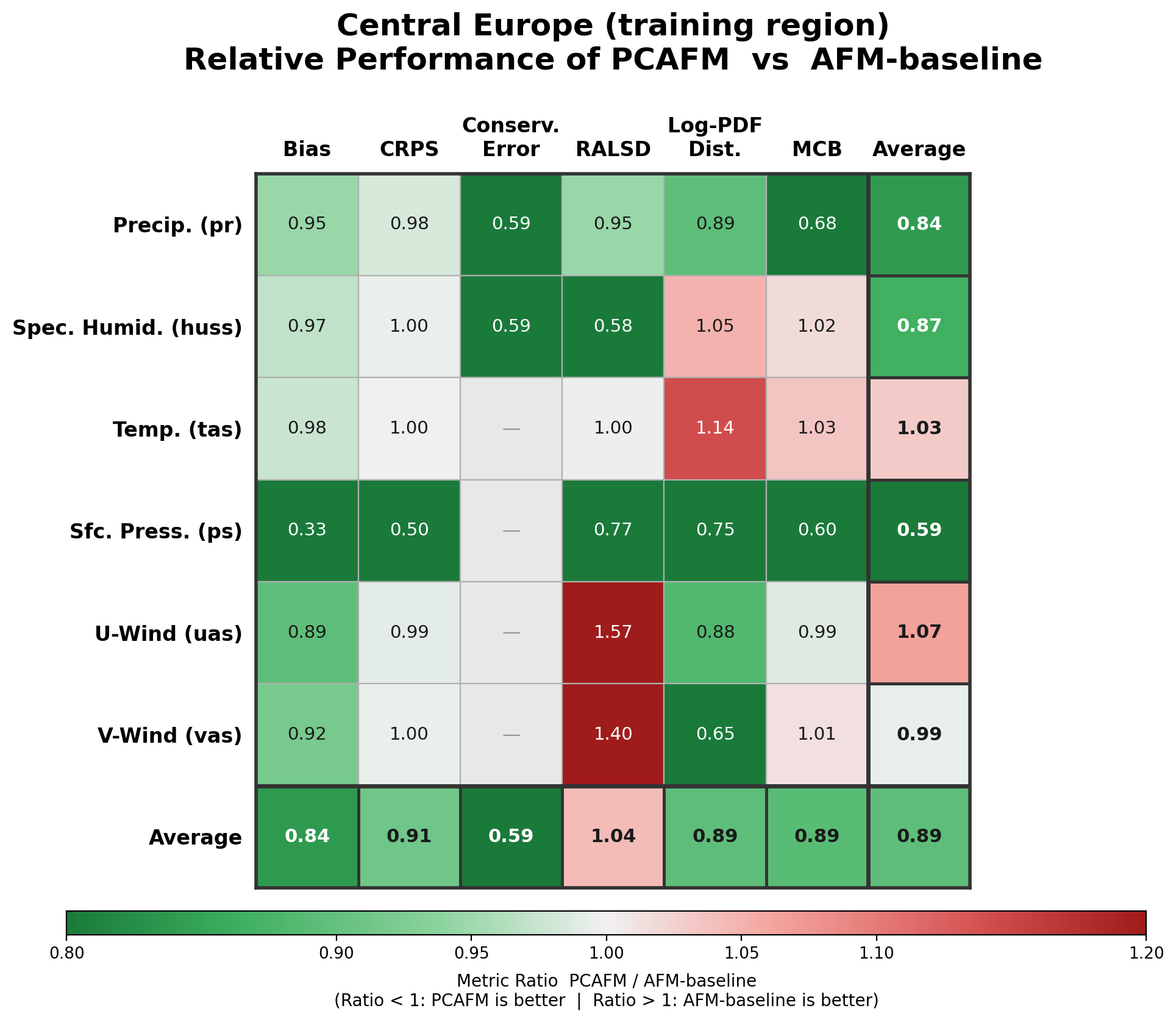
Figure 3: Relative performance of PC-AFM vs AFM for Central Europe; values <1 (green) indicate improved scores for PC-AFM.
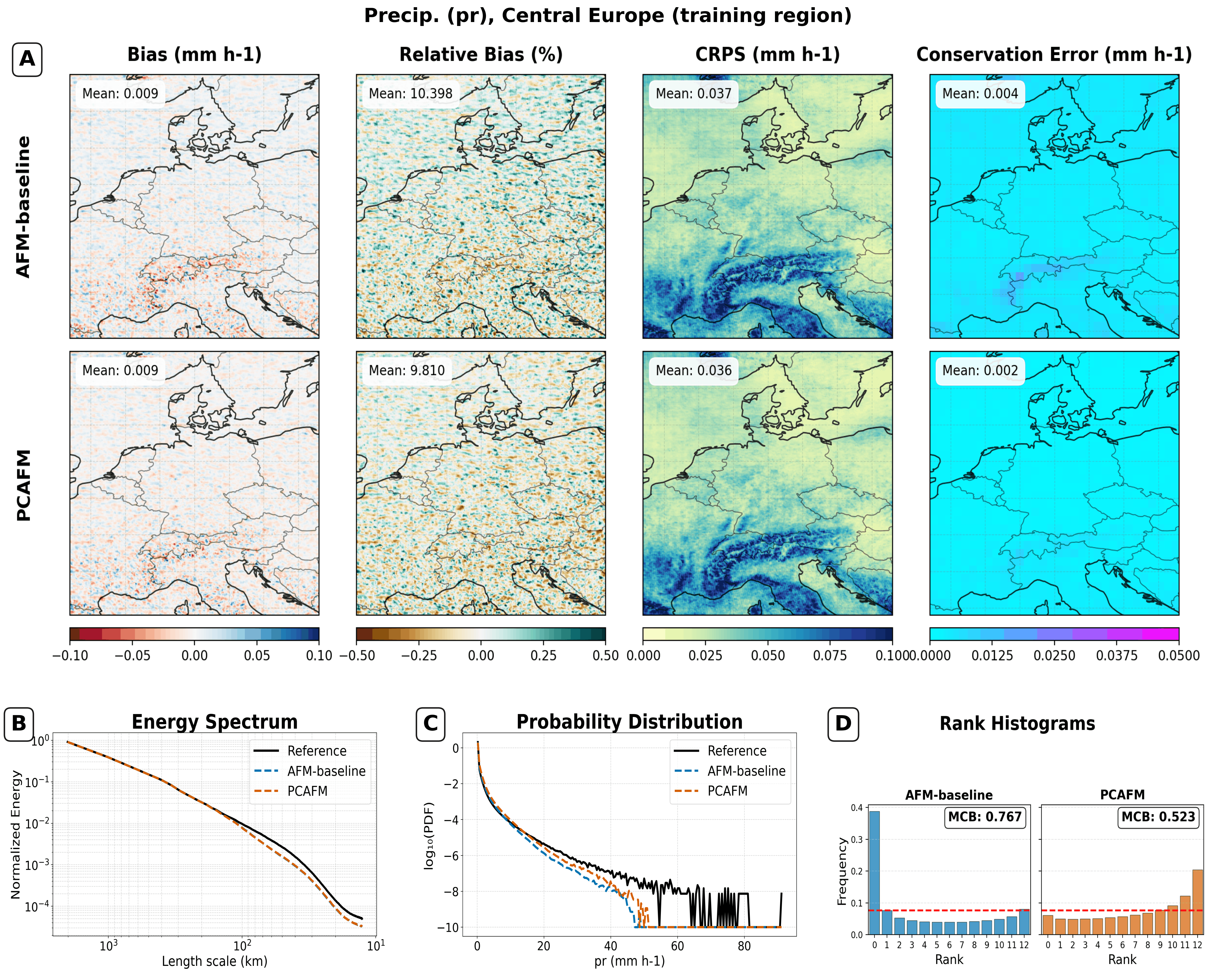
Figure 4: Spatial bias, CRPS, conservation error, spectra, PDFs, and ensemble calibration for precipitation; PC-AFM halves conservation violation and improves calibration with negligible skill trade-off.
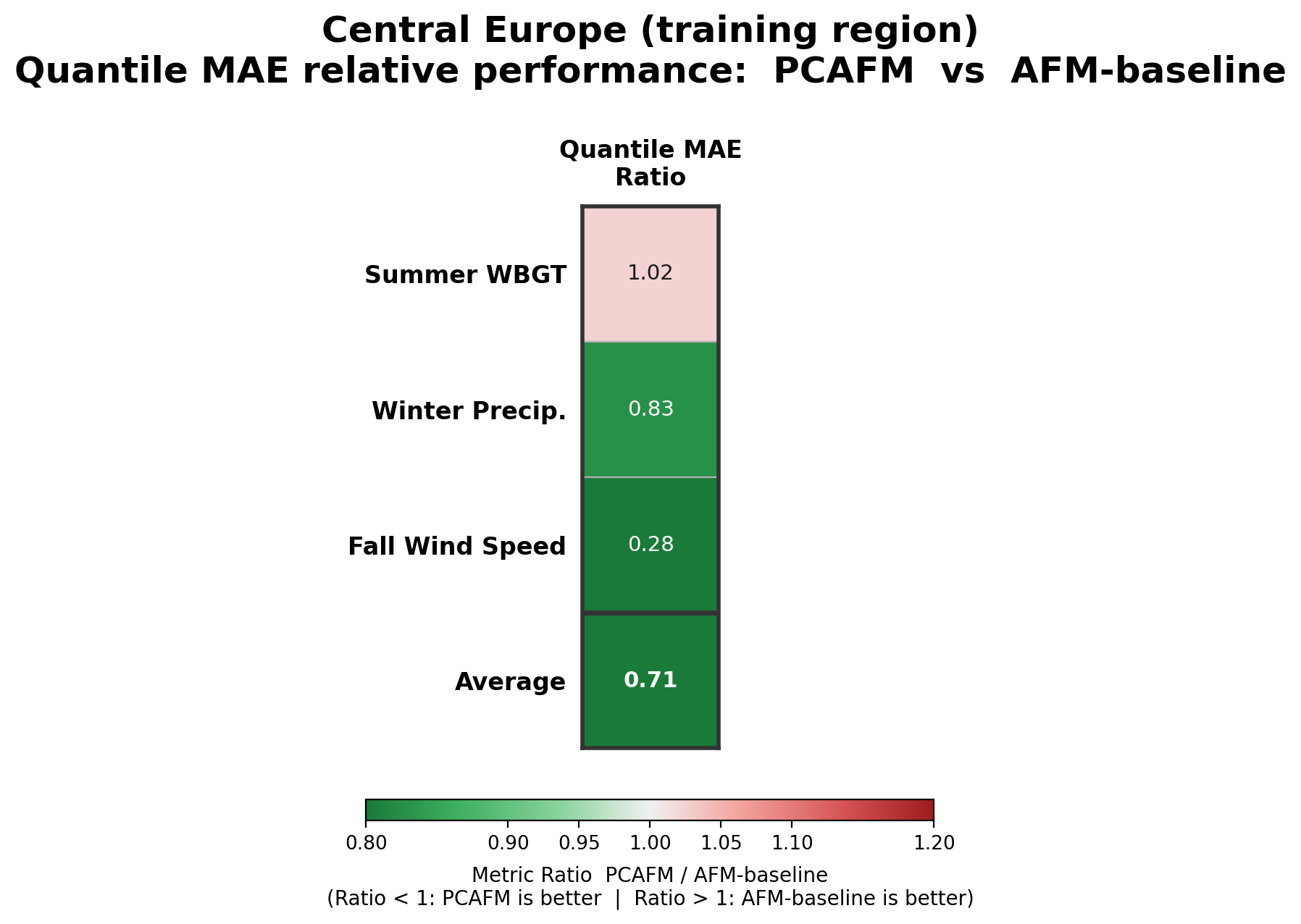
Figure 5: Quantile MAE for compound hazards (WBGT, wind, precipitation extremes) showing marked improvement for non-directly-constrained outputs (e.g., wind speed).
Out-of-Distribution Generalization
Northern Europe
- Precipitation wet bias: AFM baseline exhibits a 49.9% relative wet bias; PC-AFM reduces this to 24.6%.
- Conservation and CRPS: Conservation error for precipitation cut by 52%; CRPS reduced by 23%.
- Quantile MAE: Winters’ extremes see 32% relative improvement.
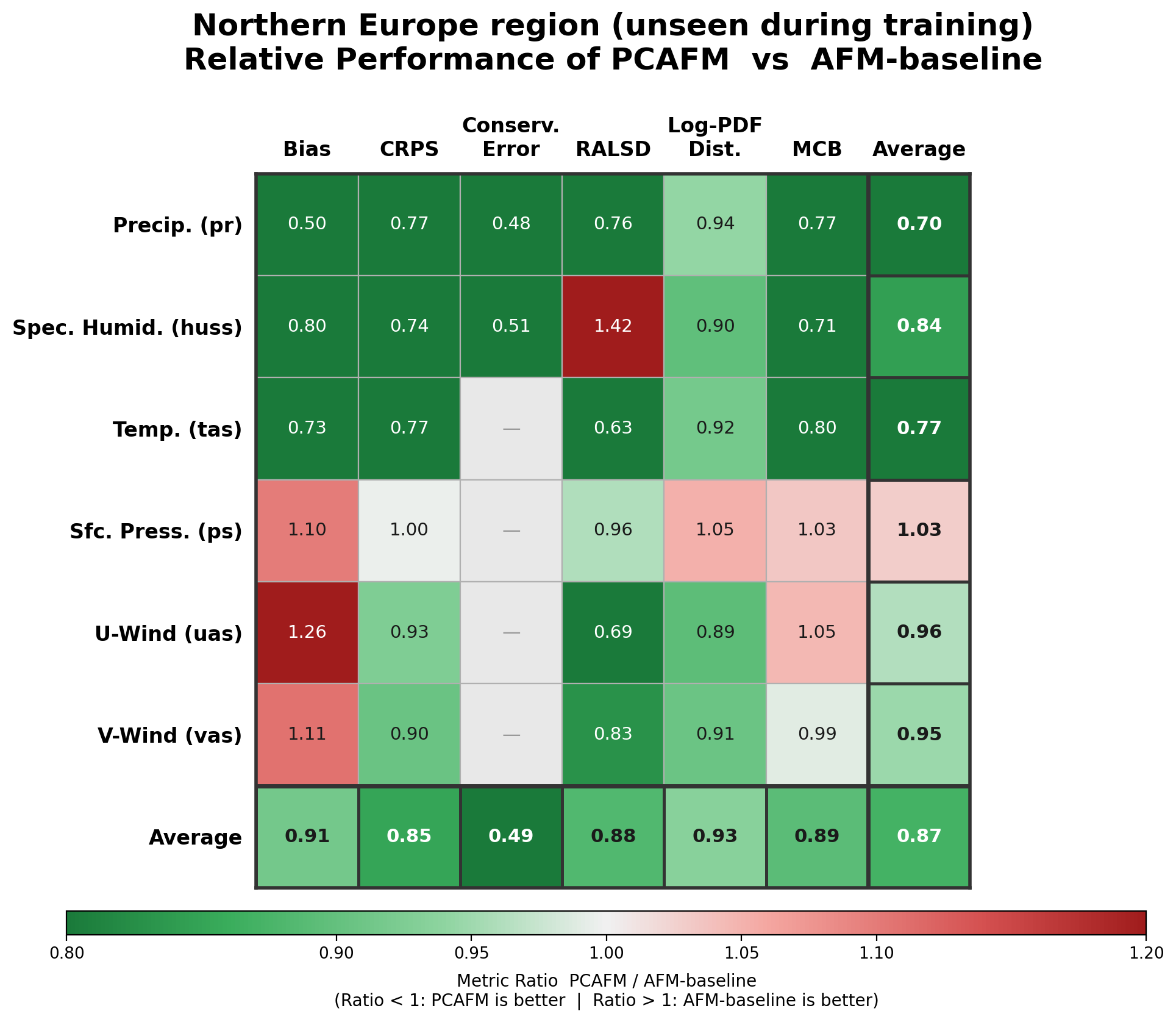
Figure 6: PC-AFM delivers consistent out-of-sample improvements in Northern Europe, especially for precipitation and temperature, with moderate wind degradation.
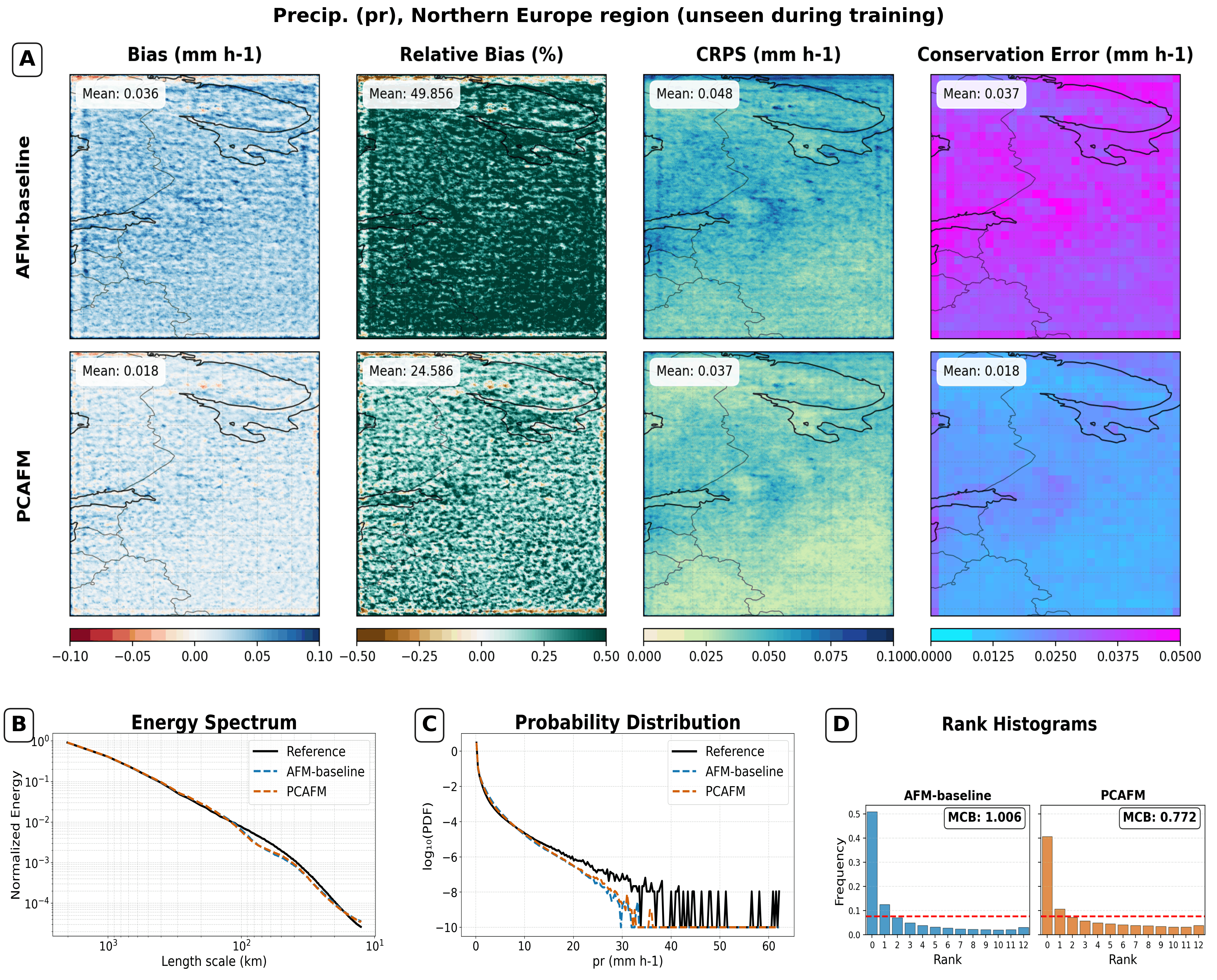
Figure 7: Northern Europe precipitation: PC-AFM halves wet bias, reduces CRPS, and substantially improves ensemble calibration.
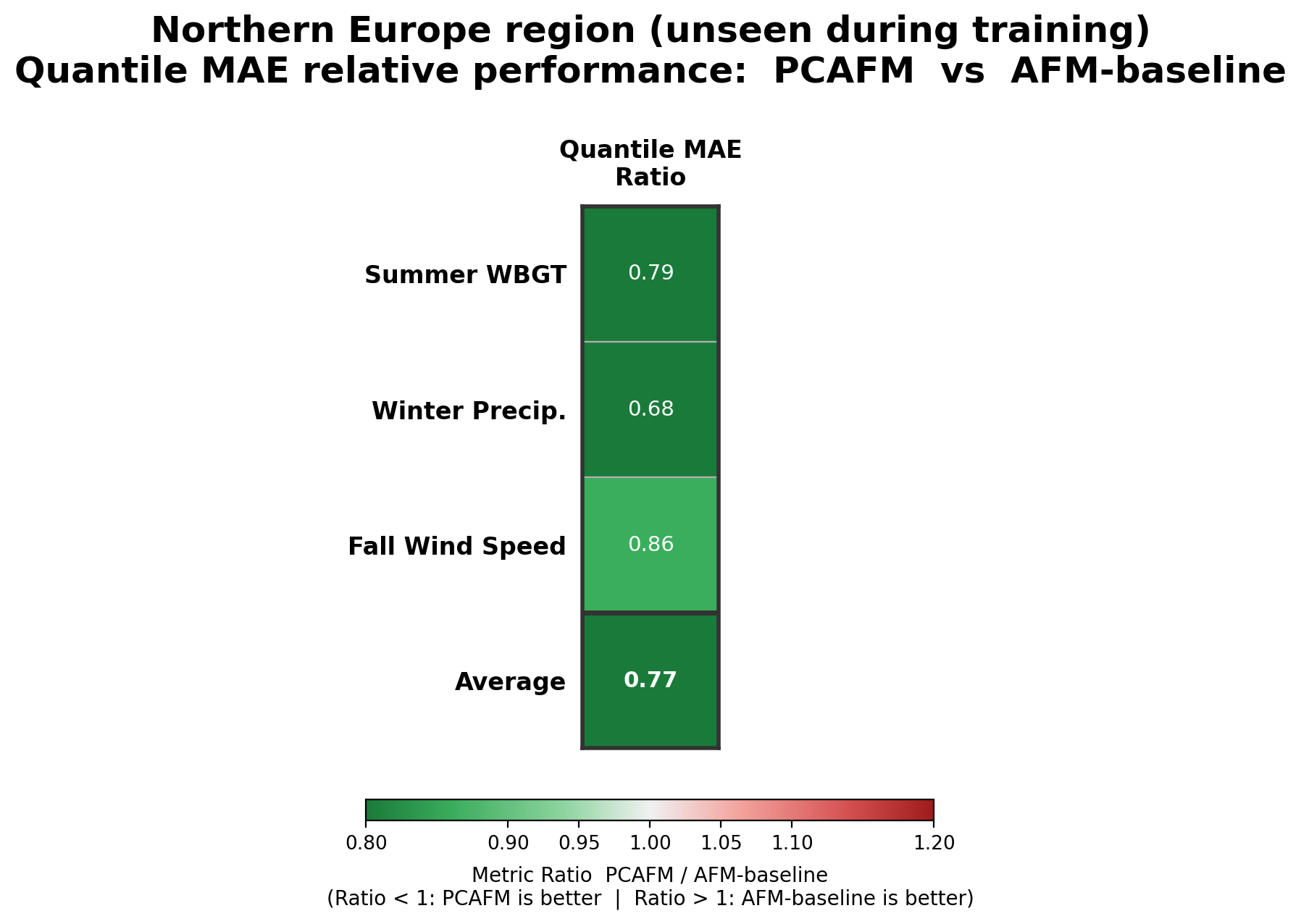
Figure 8: Quantile MAE improvements, emphasizing PC-AFM’s retention of accuracy for event extremes outside the training regime.
Iberian Peninsula
- Aggregate performance: Overall ratio 0.89, matching in-distribution rates.
- Largest gains: Temperature (0.74) and pressure (0.86); conservation error improvements for precipitation/specific humidity are 30% and 23%.
- Ensemble calibration: MCB drops from 1.104 to 0.879.
- Trade-off: Slight spectral fidelity degradation is observed on out-of-sample moisture fields.
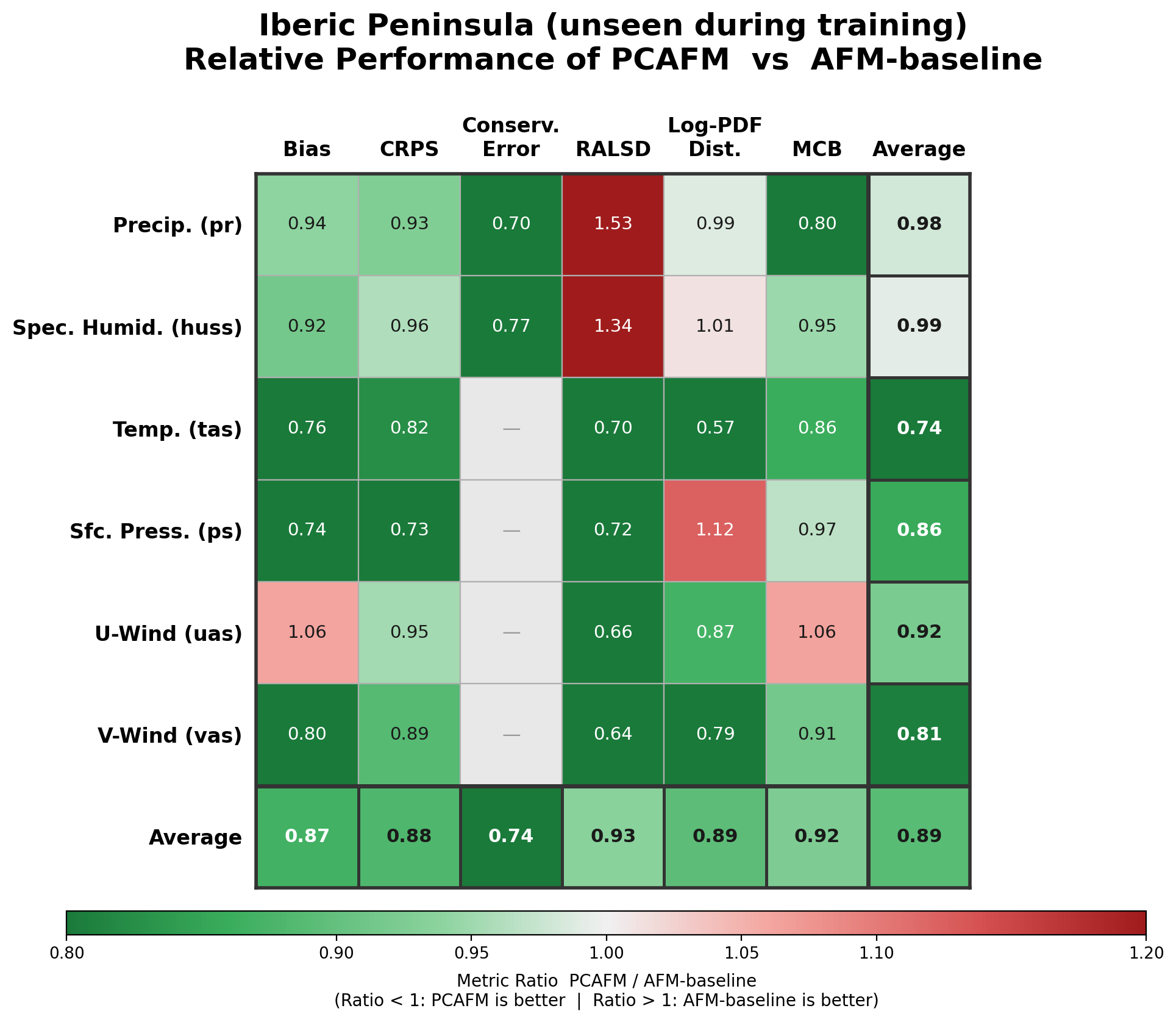
Figure 9: Performance ratios in Iberia reinforce PC-AFM’s stability and generality.
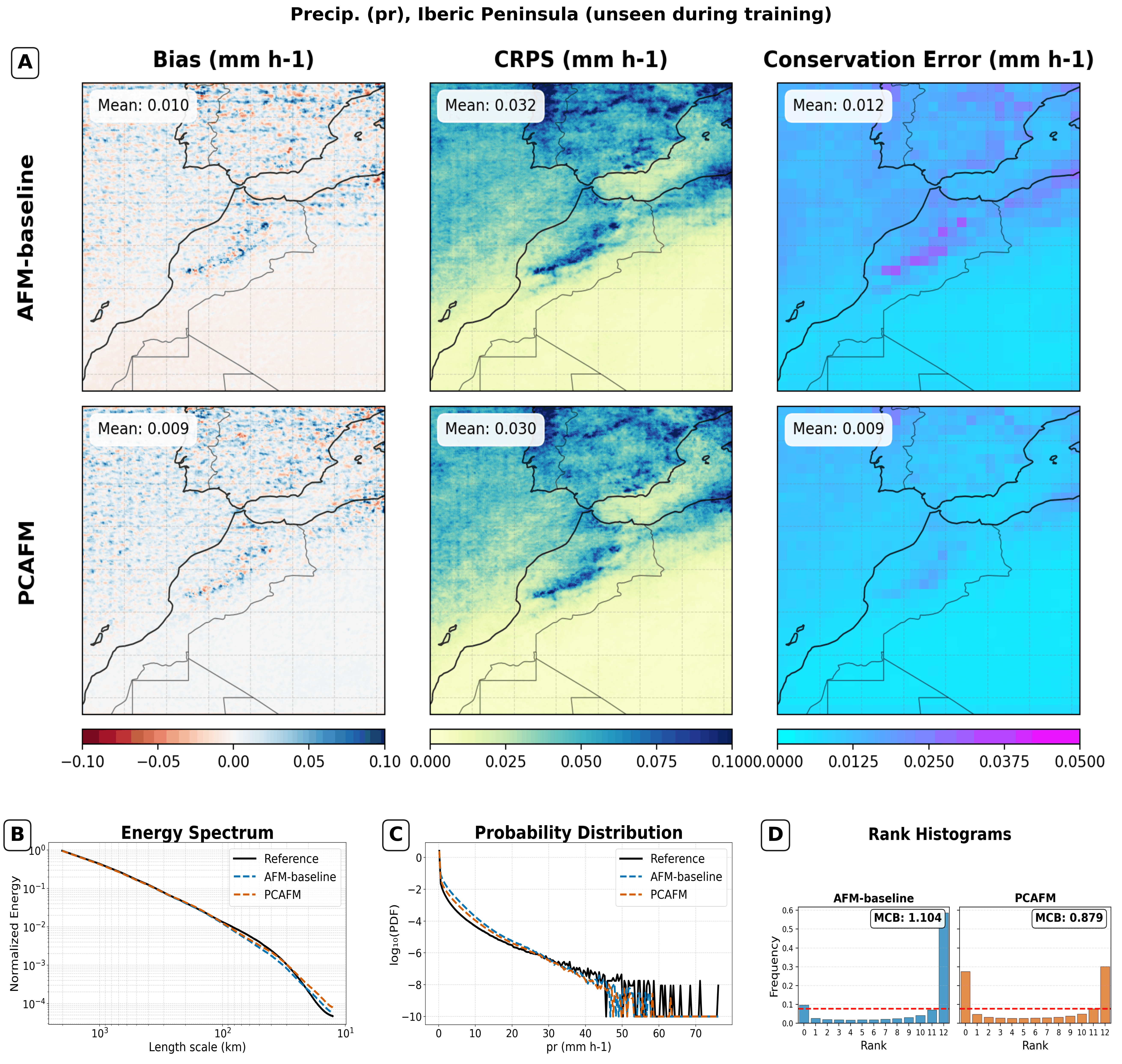
Figure 10: Iberian precipitation: substantial improvement in conservation error and calibration.
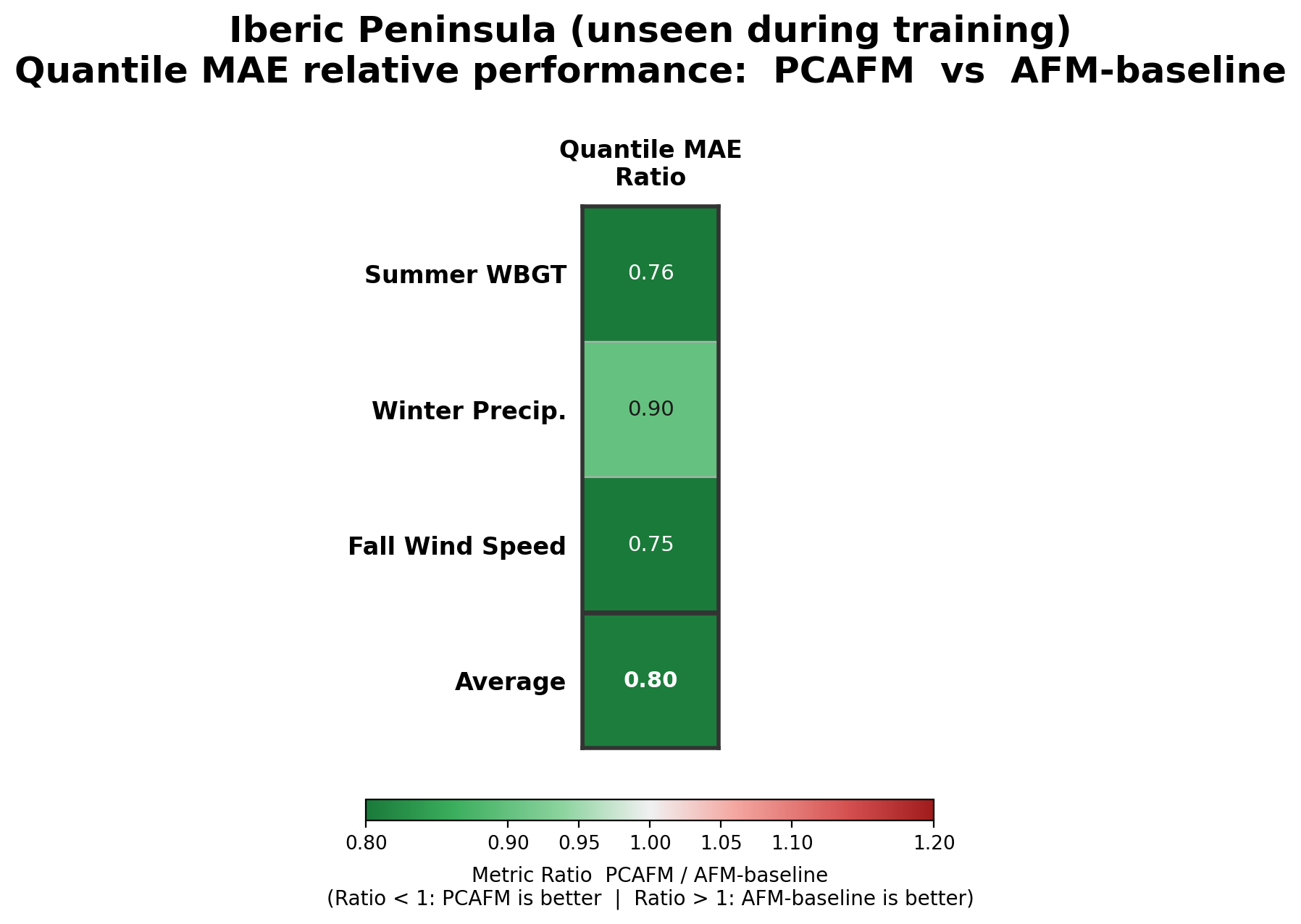
Figure 11: Quantile MAE improvements for impact-relevant variables underscore physical constraints’ transfer benefits.
Ablation and Mechanistic Insights
Gradient surgery is essential; naive constraint addition without ConFIG leads to major regressions (notably, severe worsening of unconstrained variables like pressure). The noise-aware penalty and warmup further stabilize optimization. Improvements in unconstrained variables (pressure, temperature, wind) indicate cross-variable regularization due to joint modeling—highlighting the architectural advantage of multivariate denoiser coupling in flow matching.
Theoretical and Practical Implications
- Pareto trade-off: Consistent with recent theoretical work [baldan_physics_2026], PC-AFM empirically finds a Pareto front where physical constraint satisfaction can come with minor degradation in unconstrained diagnostics (e.g., power spectra under domain shift) but with marked gains in physical realism and bias mitigation.
- Out-of-sample robustness: Unlike prior ML-based downscalers, PC-AFM’s physical constraints systematically correct spurious distributional extrapolation outside the training domain—critically halving bias and error in challenging climatic regimes—establishing a new standard for plausible, reliable climate information under extrapolation.
- Cross-variable impact: Benefits for unconstrained outputs (pressure, temperature, wind) raise intriguing questions about multivariate coupling and regularization within joint generative models, suggesting directions for physically consistent correlation modeling.
Limitations and Future Directions
The conservation constraint’s current formulation depends on exact coarse-fine mean equivalence, which holds in perfect-model settings but may require relaxation for operational GCM-driven downscaling. There is a trade-off between conservation enforcement and spatial spectral fidelity, especially in highly non-stationary or unseen regimes. Temporal/trajectory coherence is not modeled—extensions to sequential or autoregressive architectures are warranted for applications needing physically plausible weather sequences. Incorporation of further physical constraints (e.g., energy conservation, multi-level coupling) and exploration of spectral-aware or wavelet-domain regularization remain open research vectors.
Conclusion
PC-AFM demonstrates that explicit physical constraints, rigorously enforced with gradient surgery, yield generative downscaling models that are both physically consistent and robust to regime shifts. Its capacity to structural correct bias, enhance calibration, and regularize out-of-distribution model output sets a benchmark for next-generation climate downscaling. Future development should target integration into operational workflows, sophisticated treatment of imperfect GCMs, and generalized spatiotemporal consistency. PC-AFM is a substantial advancement in the pragmatic application of physics-informed ML to high-resolution climate information production.

