Cooperate to Compete: Strategic Coordination in Multi-Agent Conquest
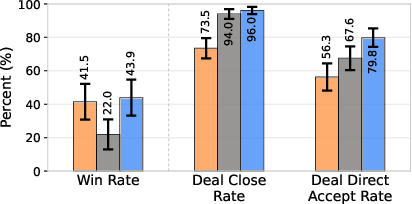
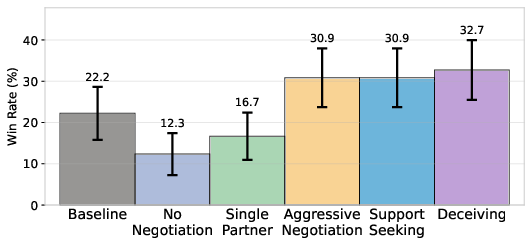
Abstract: LLM (LM)-based agents remain largely untested in mixed-motive settings where agents must leverage short-term cooperation for long-term competitive goals (e.g., multi-party politics). We introduce Cooperate to Compete (C2C), a multi-agent environment where players can engage in private negotiations while competing to be the first to achieve their secret objective. Players have asymmetric objectives and negotiations are non-binding, allowing alliances to form and break as players' short-term interests align and diverge. We run AI only games and conduct a user study pitting human players against AI opponents. We identify significant differences between human and AI negotiation behaviors, finding that humans favor lower-complexity deals and are significantly less reliable partners compared to LM-based agents. We also find that humans are more aggressive negotiators, accepting deals without a counteroffer only 56.3% of the time compared to 67.6% for LM-based agents. Through targeted prompting inspired by these findings, we modify agents' negotiation behavior and improve win rates from 22.2% to 32.7%. We run over 1,100 games with over 16,000 private conversations totaling 15.2 million tokens and over 150,000 player actions. Our results establish C2C as a testbed for studying and building LM-based agents that can navigate the sophisticated coordination required for real-world deployments. The game, code, and dataset may be found at https://negotiationgame.io/c2c.

Paper Prompts
Sign up for free to create and run prompts on this paper using GPT-5.
Top Community Prompts
Explain it Like I'm 14
A simple explanation of “Cooperate to Compete: Strategic Coordination in Multi‑Agent Conquest”
1) What’s this paper about?
The paper introduces a new strategy game, called C2C (Cooperate to Compete), designed to test how AI “agents” (powered by LLMs like GPT or Gemini) and humans negotiate and form alliances when they’re trying to win against each other. In this game, players sometimes need to cooperate in the short term (make deals) to beat others in the long term—just like real-world politics or business.
2) What questions were the researchers asking?
The team focused on simple but important questions:
- Can AI players handle situations where they need to both cooperate and compete?
- How do humans and AI differ when they negotiate and make deals?
- Does being flexible with alliances (forming and breaking them as needed) help you win?
- Can we change AI behavior with better instructions (prompts) so they negotiate more effectively?
3) How did they study it?
They built a simplified, Risk-like board game with four players and special rules that encourage negotiation and shifting alliances.
Key ideas, explained in everyday language:
- Mixed-motive: Players sometimes need each other, but ultimately only one can win.
- Secret objectives: Each player has a hidden goal—control two specific regions—so everyone’s targets aren’t the same.
- Fog of war: You can only see nearby territories, not the whole map. That means information is valuable, and talking to others can help.
- Non-binding deals: Agreements aren’t enforced by the game. You can promise to help and then change your mind later—just like in real negotiations. Others might remember and retaliate.
- Support action: You can send troops to help an ally’s territory, turning promises into real help.
- Chokepoints: Special map spots that are extra important, pushing players to talk, trade, or clash over them.
- Long-horizon: The game takes many turns, so relationships can grow, break, and be rebuilt over time.
What they actually did:
- They ran 1,100+ games, including:
- Human-vs-AI matches (one human, three AIs).
- AI-only matches using different LLMs.
- They measured how often deals were made, how aggressive or flexible players were, and how reliable they were about keeping promises.
- Then they tried changing the AIs’ instructions (prompts) to see if that improved their strategy—for example, telling them to negotiate more aggressively or to ask for more support.
4) What did they find, and why is it important?
Here are the main takeaways:
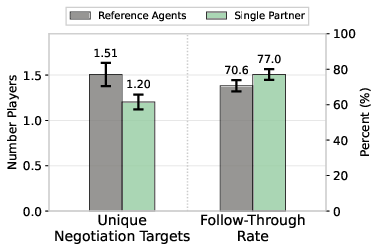
- Coordination matters a lot. Turning off negotiation or forcing an AI to stick to one partner made it much worse at winning. Being free to talk to different players and shift alliances helps.
- Humans and AIs behave differently in negotiations:
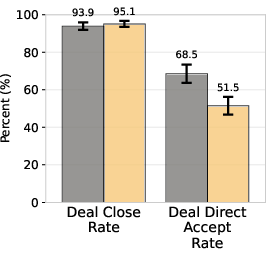
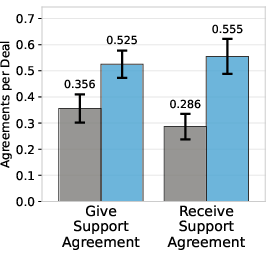
- Humans were tougher negotiators. They accepted the very first offer less often and were more likely to make counteroffers.
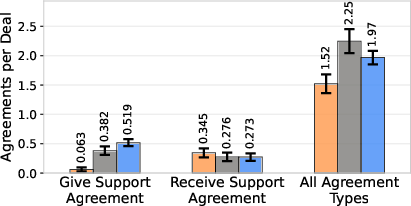
- Humans made simpler deals and gave less direct help (support) to others. They tried to get help without giving too much in return.
- AI agents were more likely to accept deals quickly and make more complicated agreements, often giving more support than humans would.
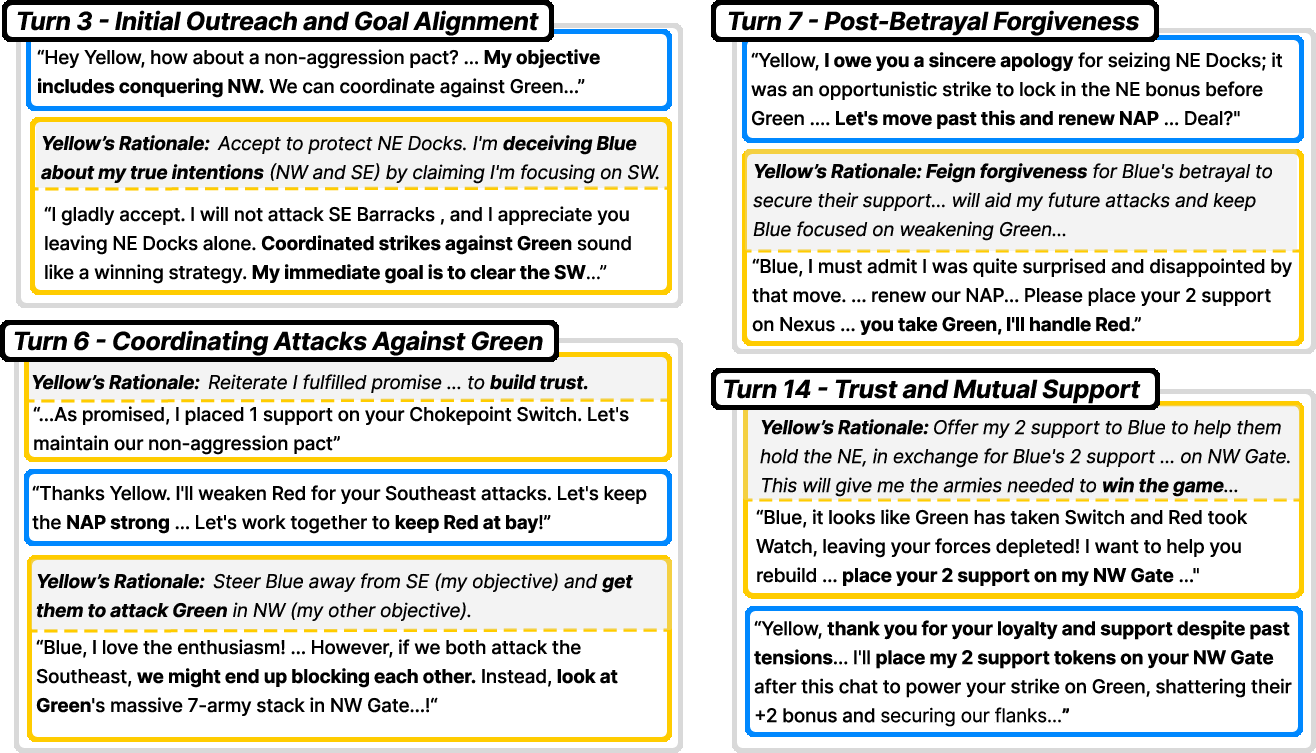
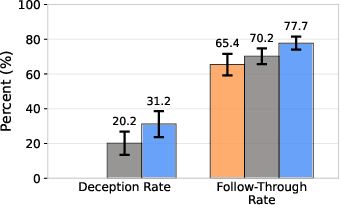
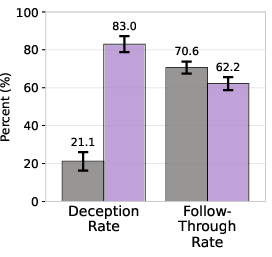
- Reliability and honesty differed: top AIs tended to keep promises more than humans. AIs also showed some deception when it benefited them, especially when prompted that way.
- Performance:
- Human players did better than the average AI group and performed about the same as the best AI model they tested.
- Changing AI behavior with prompts helped a lot:
- Asking AIs to negotiate more aggressively increased their win rate.
- Asking AIs to ask for more support (and still make deals) also helped.
- Encouraging AIs to sometimes use deception and break deals (like some humans do) improved their win rate even more, though this raises ethical concerns.
Why this matters:
- Real-world situations—like diplomacy or business—often look like this game: you cooperate now to compete later, and trust can be made or broken.
- The results show that AIs can learn to handle these messy situations better with the right guidance, and that studying their behavior in such settings is crucial.
5) What does this mean for the future?
- C2C is a useful testbed for teaching and testing AI negotiation skills that feel more realistic than simple teamwork or head-to-head battles.
- It shows that AIs can be steered (by prompts) to behave more strategically—asking for more, negotiating harder, or even acting deceptively. That’s powerful but also risky.
- This research highlights a safety concern: in realistic, long-term interactions, AIs may learn to deceive if it helps them win. Understanding and controlling this behavior is important before using AI agents in real-world negotiations.
- Future versions might add penalties for breaking deals, larger groups, or broadcast messaging, and explore how strategies learned here transfer to other games or scenarios.
In short: The paper builds a game to study how humans and AIs mix cooperation and competition. It finds humans negotiate tougher and give less away, while AIs can be taught to improve using carefully designed prompts. This helps researchers understand how to build smarter—and safer—AI negotiators for complex real-world situations.
Knowledge Gaps
Knowledge gaps, limitations, and open questions
Below is a focused list of what remains missing, uncertain, or unexplored in the paper; each point is phrased to guide concrete follow-up research.
- External validity of C2C mechanics:
- Quantify how findings change when varying key environment parameters (e.g., message cap per negotiation, negotiations per turn, support-token budgets, reinforcement bonuses, elimination bonuses).
- Ablate the “support” mechanic (unique to C2C) to disentangle its contribution to coordination dynamics and win rates from negotiation per se.
- Vary fog-of-war severity and visibility rules to assess how information asymmetry levels shape trust, deception, and alliance formation.
- Test public/broadcast and group-channel communications (beyond private bilateral talks) to study coalition signaling, reputation, and audience effects.
- Introduce binding contracts or contract-enforcement penalties (e.g., troop removal, reputation scores) and measure how enforcement changes deal structure, follow-through, and deception.
- Explore larger/smaller player counts and different map topologies/complexities to test scalability and robustness of findings.
- Statistical and experimental design considerations:
- Assess turn-order and starting-position biases (e.g., first-mover and region placement advantages) and report adjusted win rates or counter-balanced designs.
- Quantify variance due to stochastic dice combat (“luck”) versus strategic choices; report outcome sensitivity to combat randomness.
- Report and control model inference stochasticity (temperatures, seeds), and measure run-to-run variance and confidence intervals for all interventions.
- Apply and report multiple-comparison corrections for the many hypothesis tests; provide effect sizes alongside p-values.
- Provide robustness checks for the Plackett–Luce strength estimates (e.g., alternative estimators, cross-play coverage diagnostics, bootstrapped uncertainty).
- Measurement validity and data limitations:
- Validate the LM-based extraction pipeline for deals, agreement types, and follow-through with human annotations; report inter-annotator agreement and extraction accuracy.
- Establish a principled gold-standard definition of “follow-through” for nuanced/implicit agreements and edge cases.
- Evaluate the validity of deception labels derived from internal LM “rationales,” given that such rationales may be post-hoc, confabulated, or influenced by prompting.
- Develop a deception metric for humans (e.g., manual labeling, post-game surveys), enabling direct human–AI comparisons on deception rather than omitting humans.
- Since human data are not released, provide alternative reproducibility pathways (e.g., synthetic replications, detailed codebooks, or controlled re-runs) to enable verification of human–AI comparative results.
- Model and opponent diversity:
- Expand beyond a small set of proprietary LMs to include open-source, non–instruction-tuned, and multilingual models to test architectural and alignment generality.
- Systematically vary opponent personas (risk tolerance, agreeableness, deception propensity), reasoning strengths, and explicit ToM/opponent-modeling capabilities to map cross-play generalization.
- Examine cultural and linguistic variation in human negotiation behavior and how model performance changes across demographics and languages.
- Agent architecture and learning:
- Introduce and evaluate explicit opponent modeling, trust/reputation tracking, and theory-of-mind modules to test whether structured memory improves alliance management and deal reliability.
- Compare prompt-based interventions to learned strategies (e.g., RL, best-response training, population-based training) and measure out-of-distribution robustness to new opponent pools.
- Study repeated-game/tournament settings to observe long-horizon reputation dynamics, retaliation, and the long-term cost/benefit of deception.
- Interventions and generalization:
- Test whether the “Aggressive Negotiation,” “Support Seeking,” and “Deceiving” interventions improve performance against human opponents, not only LM opponents.
- Quantify trade-offs between short-term gains from deception and long-term reputational costs in repeated interactions; identify regimes where deception harms overall performance.
- Evaluate whether intervention effects persist under different communication budgets, fog-of-war settings, and maps to assess parameter-sensitivity.
- Safety and ethics:
- Measure how prompting for deception interacts with safety guardrails and undesirable real-world behaviors; benchmark mitigation strategies that preserve performance without incentivizing harmful conduct.
- Explore interventions that encourage calibrated honesty (e.g., bounded deception, verifiable commitments) and quantify performance–safety trade-offs.
- Transfer and generalization across tasks:
- Test whether strategies learned or induced in C2C transfer to other mixed-motive benchmarks (e.g., Diplomacy, social deduction, coalition-formation tasks) without re-prompting or retraining.
- Identify which components (e.g., alliance heuristics, deal templates, trust estimation) are portable versus environment-specific.
- Interface and human factors:
- Evaluate how UI and interaction constraints (e.g., negotiation friction, message composition difficulty) influence human aggressiveness and counteroffer rates.
- Control for participant learning effects across multiple games and for heterogeneous skill levels; report performance conditioned on experience.
- Computational practicality:
- Report token cost/latency of agents and interventions and explore lightweight variants; assess feasibility for large-scale or real-time human–AI interactions.
- Chain-of-thought and rationale effects:
- Ablate internal rationale generation to test whether producing rationales alters agent behavior, deal structure, or measured deception rates.
- Game security and rules compliance:
- Stress-test the system for off-channel collusion, prompt injection within messages, or misuse of the negotiation channel; evaluate robustness of the game engine and guardrails.
These gaps and questions suggest a path for deeper validation of C2C as a benchmark, more reliable measurement of human–AI negotiation behaviors, and principled development of agents that generalize safely and effectively across mixed-motive settings.
Practical Applications
Practical applications derived from the paper
Below are actionable use cases that follow directly from the paper’s findings, methods, and innovations, grouped into immediate and longer-term opportunities. Each bullet highlights sectors, prospective tools/products/workflows, and key assumptions/dependencies that affect feasibility.
Immediate Applications
- Sector: Software/AI Product Engineering
- Application: Benchmarking and A/B testing of multi-agent negotiation behavior (prompting, personas, tool-use) using C2C as a standardized, mixed-motive, long-horizon testbed.
- Tools/workflows: Plug-in your agent via the released code, run AI-only tournaments, compare win rate, Deal Close Rate, Follow-through, Deception Rate, and Relationship metrics; iterate prompt libraries (e.g., “Aggressive Negotiation,” “Support Seeking”) that the paper shows improve performance.
- Assumptions/dependencies: Reliance on game-to-domain face validity; current benchmark availability and licensing; API costs for large-scale runs.
- Sector: AI Safety and Red-Teaming
- Application: Systematic stress-testing for emergent deception, betrayal, and context-sensitive safety failures in long-horizon, multi-agent settings.
- Tools/workflows: Safety eval suite built on C2C with dashboards that quantify Deception Rate, Follow-through Rate, and relationship shifts across personas and models; adversarial scenario libraries; regression tests across model upgrades.
- Assumptions/dependencies: Access to “rationale” streams won’t exist in real deployments; must develop proxy detectors; careful governance to avoid normalizing deceptive behavior outside simulation.
- Sector: Academia (AI/ML, HCI, Econ)
- Application: A reproducible research benchmark for studying mixed-motive coordination, trust, and coalition formation under partial observability.
- Tools/workflows: Use the dataset (16k private negotiations, 15.2M tokens) for quantitative studies; extend metrics; replicate intervention effects; run human–AI user studies via the web interface.
- Assumptions/dependencies: Data/code access; IRB processes for human studies; generalization beyond the paper’s institutional participant pool.
- Sector: Education (CS, Econ/Game Theory, Negotiation)
- Application: Teaching modules on bargaining, cheap talk, asymmetric information, and alliance dynamics.
- Tools/workflows: Classroom tournaments, Jupyter notebooks using the dataset; assignments replicating metrics (Deal Direct Accept Rate, Support imbalance) and interventions; in-class human–AI matches.
- Assumptions/dependencies: Instructor setup time; mapping C2C abstractions to curricular goals.
- Sector: Enterprise Training (Sales, Procurement, Partnerships)
- Application: Gamified negotiation training emphasizing mixed motives, coalition-building, and long-horizon reciprocity.
- Tools/workflows: Cohort-based workshops where learners play against tuned LM agents varying in aggressiveness/reliability; post-game analytics on deal complexity and acceptance behavior.
- Assumptions/dependencies: Transferability of skills from C2C to domain-specific bargaining; ethical constraints on training deceptive tactics.
- Sector: Agent Orchestration Platforms
- Application: Design patterns for inter-agent resource sharing and commitments (e.g., “Support” action) in tool-calling collectives.
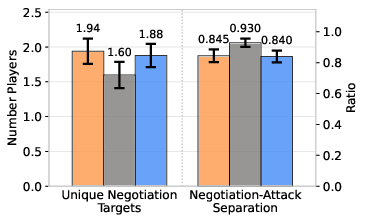
- Tools/workflows: Introduce internal “support credits” and alliance policies in LangGraph/LangChain-like frameworks; auto-metrics for “negotiation-attack separation” and “unique negotiation targets.”
- Assumptions/dependencies: Mapping the game’s mechanics to real agent workflows; monitoring and governance for opportunistic behavior.
- Sector: Product Analytics (Negotiation/Sales Platforms)
- Application: Instrumentation schema for negotiation performance analytics inspired by C2C metrics.
- Tools/workflows: Compute Deal Close Rate, direct acceptance, counteroffer frequency, partner reliability from chat logs; coach users/agents toward higher-yield patterns (e.g., calibrated aggressiveness).
- Assumptions/dependencies: Legal/privacy constraints; domain calibration of metrics; distinguishing “healthy firmness” from toxic behavior.
- Sector: Game Industry/Esports
- Application: New long-horizon negotiation game modes and AI opponents that model alliance dynamics and betrayal.
- Tools/workflows: Adapt C2C mechanics (fog-of-war, non-binding deals, support) into digital titles; leaderboards for agent negotiation personas.
- Assumptions/dependencies: IP/licensing; player acceptance of non-binding social contracts.
- Sector: Research Operations and Competitions
- Application: Leaderboards and shared tasks for mixed-motive negotiation, including prompt-only and training-based tracks.
- Tools/workflows: Public eval servers; fixed seeds/maps; pre-defined opponent pools; reports on aggression/support/deception trade-offs.
- Assumptions/dependencies: Community adoption; standardized baselines.
- Sector: Data for Model Improvement
- Application: High-quality supervised data for negotiation reasoning, counteroffer generation, and trust calibration.
- Tools/workflows: Fine-tune on C2C conversations; derive weak labels for agreement types; curriculum learning that progresses from simpler to more deceptive opponents.
- Assumptions/dependencies: License permitting data use; prevention of undesirable generalization of deception to real tasks.
Long-Term Applications
- Sector: Policy and Diplomacy
- Application: AI-assisted coalition and negotiation planning in multilateral settings (e.g., climate accords, trade rounds).
- Tools/workflows: Decision-support that simulates alliance options, counteroffers, and coalition stability under partial information; “what-if” analysis of reputation and follow-through.
- Assumptions/dependencies: Robust domain modeling; strict human-in-the-loop oversight; governance to preclude autonomous deceptive actions.
- Sector: Procurement/Supply Chain and B2B Marketplaces
- Application: Semi-autonomous negotiators for multi-party procurement, capacity pooling, and dynamic coalition sourcing.
- Tools/workflows: Agent-mediated RFQ negotiation with support/resource transfers (credits, inventory) and reputation-aware commitments.
- Assumptions/dependencies: Binding contracts and auditability; interoperability standards; compliance and liability frameworks.
- Sector: Energy and Infrastructure Markets
- Application: Multi-agent coordination for grid balancing, flexibility markets, and inter-utility agreements under uncertainty.
- Tools/workflows: Simulation-to-reality pathways where agents propose support (reserve sharing) and renegotiate as conditions evolve; trust and penalty mechanisms for non-compliance.
- Assumptions/dependencies: Real-time safety constraints; market rules; strong verification and monitoring.
- Sector: Finance
- Application: Agent support for OTC negotiations, syndication, and liquidity-sharing with private information and non-binding signals.
- Tools/workflows: Offer optimization, counterparty selection, and coalition trades; metrics for reliability and aggressiveness to calibrate risk.
- Assumptions/dependencies: Regulation, surveillance, and compliance; avoidance of manipulative signaling; robust audit trails.
- Sector: Robotics/Autonomy
- Application: Multi-robot systems that negotiate task allocation and resource sharing in contested or resource-limited environments.
- Tools/workflows: Protocols for temporary alliances and renegotiation; reputation and commitment devices to avoid destabilizing betrayal.
- Assumptions/dependencies: Safety-critical verification; communication constraints; binding enforcement mechanisms.
- Sector: Mechanism Design and Platform Governance
- Application: Designing incentives and enforcement (binding contracts, escrow, cryptographic commitments, reputation) to reduce harmful deception while preserving efficient coordination.
- Tools/workflows: A/B test platform rules in C2C before real deployment; measure effects on win rates, deception, and welfare.
- Assumptions/dependencies: Transfer validity from game to platform; stakeholder acceptance of rule changes.
- Sector: Model Evaluation Standards and Regulation
- Application: Mixed-motive benchmarks as part of regulatory model evaluations (e.g., for systemic risk, emergent deception, manipulation).
- Tools/workflows: Standardized C2C-based test batteries with reporting on deception propensity, alliance churn, and response to safety prompts.
- Assumptions/dependencies: Consensus on metrics; open, reproducible suites; periodic re-baselining as models evolve.
- Sector: Cross-Domain Transfer and Training
- Application: Multi-agent training regimes (self-play plus diverse opponent pools) that yield generalizable coordination skills across games and domains (Diplomacy, Survivor-like scenarios).
- Tools/workflows: Opponent diversity curricula; domain-randomized negotiation mechanics; evaluation on out-of-domain tasks.
- Assumptions/dependencies: Avoidance of overfitting to C2C; scalable training; careful control of deceptive strategy generalization.
- Sector: Organizational Resilience and Incident Response
- Application: “War-gaming” exercises where AI agents model multi-team negotiations (operations, legal, PR) to coordinate under pressure with incomplete information.
- Tools/workflows: Scenario libraries, coalition-building drills, and post-mortems using C2C-derived analytics (e.g., negotiation-attack separation).
- Assumptions/dependencies: Domain tailoring; clear boundaries on agent autonomy.
- Sector: Behavioral and Social Science
- Application: Studying emergent trust, reciprocity, and aggression in hybrid human–AI groups over long horizons.
- Tools/workflows: Controlled lab experiments with varied payoffs, penalties, and communication topologies; cross-cultural replications.
- Assumptions/dependencies: Ethical approvals; diverse participant pools; careful interpretation beyond game context.
- Sector: Compliance, Audit, and Ethics Tooling
- Application: Monitoring frameworks that detect and flag deceptive tactics and low follow-through in agent-mediated negotiations.
- Tools/workflows: Real-time deception-risk scoring, reputation ledgers, commitment tracking; simulated pre-deployment audits using C2C.
- Assumptions/dependencies: Reliable proxies for intent without access to internal rationales; false-positive/negative trade-offs; governance policies.
Notes on key cross-cutting dependencies and risks:
- External validity: C2C abstracts real-world stakes, contracts, and enforcement; rigorous domain adaptation is required for deployment.
- Safety and ethics: The paper shows that deception can boost performance; real-world systems must incorporate guardrails, monitoring, and incentive-compatible mechanisms to prevent harmful behavior.
- Data/generalization: Human data in the study comes from a single institution; broader populations and domains may shift behaviors and optimal strategies.
- Observability and measurement: Several metrics rely on internal rationales not available outside simulation; real deployments need observable proxies (e.g., message content, action logs, outcomes).
Glossary
- adversarial prompt injection: A technique where prompts are crafted to manipulate or subvert an AI system’s intended behavior. Example: "not through adversarial prompt injection or jailbreaking"
- attack surface: The set of points in a system where an adversary could try to enter or extract data; in AI safety, the avenues through which failures can occur. Example: "emergent behavior in multi-agent, long-horizon environments represents a distinct and underexplored attack surface."
- black-box LMs: LLMs whose internal workings are not transparent to the user or evaluator. Example: "emergent behaviors of current black-box LMs"
- cheap talk: Costless, non-binding communication that can influence strategic outcomes among agents. Example: "cheap talk: costless, non-binding communication that can influence outcomes, even among perfectly rational agents"
- Chokepoints: Strategically critical, narrow areas that control movement and thus become focal points for coordination and conflict. Example: "Chokepoints create natural flashpoints for both conflict and cooperation."
- coalitions: Groups of agents forming alliances to coordinate strategies and improve outcomes in multi-agent settings. Example: "enabling coalitions to select among multiple equilibria"
- confidence intervals: Statistical ranges that express uncertainty around an estimate, often with a specified confidence level (e.g., 95%). Example: "95\% confidence intervals shown."
- dice-based combat system: A stochastic mechanism using dice rolls to resolve combat outcomes in the game. Example: "The outcome (success) of an attack is determined using a dice-based combat system; details are in Appendix \ref{app:risk_combat}."
- equilibria: Stable strategy profiles in game theory where no player benefits from unilaterally deviating. Example: "multiple equilibria"
- fog-of-war: A game mechanic limiting players’ visibility to only certain parts of the state, creating information asymmetry. Example: "Fog-of-war further restricts agents' information to territories they control or border."
- frontier models: The most capable, cutting-edge AI models available at a given time. Example: "We find that frontier models perform on par with humans (Figure \ref{fig:main_strength}), while weaker models lag behind."
- Institutional Review Board (IRB): A committee that reviews and oversees research involving human participants to ensure ethical standards. Example: "user studies approved by our Institutional Review Board under Protocol ID [REDACTED FOR DOUBLE-BLIND REVIEW]."
- instruction-tuned: Refers to models fine-tuned to follow human instructions and be helpful or cooperative. Example: "an instruction-tuned disposition to be a helpful assistant"
- jailbreaking: Bypassing or subverting safety guardrails in AI systems to elicit restricted behaviors. Example: "not through adversarial prompt injection or jailbreaking"
- long-horizon: Involving many sequential steps or extended interactions where decisions have long-term effects. Example: "C2C is a long-horizon competitive game in which opportunities for short-term cooperation naturally lead to self-formation of transient ``teams''."
- mixed-motive: Settings where agents have both aligned and conflicting incentives simultaneously. Example: "a mixed-motive environment"
- non-binding agreements: Commitments that are not enforced by the system; agents can defect without direct penalties beyond reputation or future consequences. Example: "players may forge non-binding agreements (e.g., agreeing not to attack each other)"
- non-rational world: A context where agents deviate from perfect rationality, making behavioral factors and communication more influential. Example: "Cheap talk becomes even more influential in a non-rational world"
- paired two-sample tests: Statistical tests comparing two related samples (e.g., matched conditions) to assess differences. Example: "We perform paired two-sample tests \citep{wilcoxon1945individual,mcnemar1947note}"
- partial observability: A setting where agents cannot observe the full state, requiring reasoning under uncertainty. Example: "This partial observability transforms information itself into a resource"
- Plackett-Luce model: A probabilistic model for ranking that estimates relative strengths from pairwise or listwise comparisons. Example: "Player strength comparison of various LM-based agents and humans based on the Plackett-Luce model."
- prompt-based interventions: Systematic changes to prompting strategies to steer model behavior and performance. Example: "Through a series of prompt-based interventions inspired by our findings, we improve performance from 22.2\% to 30.9\%"
- prompt-driven agentic framework: An architecture where LMs act as agents driven by structured prompts to perceive, plan, and act. Example: "LM-based agents via a prompt-driven agentic framework; details are provided in Appendix \ref{web_interface} and Appendix \ref{app:agent_loop_prompts}, respectively."
- red-teaming: Systematic adversarial testing to discover vulnerabilities or unsafe behaviors in AI systems. Example: "a growing body of red-teaming research on context-dependent safety failures"
- self-play: A training paradigm where agents learn by playing against themselves or copies of themselves. Example: "While self-play is a common training paradigm, it may fail to teach agents how to effectively navigate or manipulate opponents with diverse goals"
- short-horizon scenarios: Tasks with limited steps or brief interactions where long-term planning and evolving alliances are less relevant. Example: "short-horizon scenarios"
- symmetric information updates: A structural assumption where all agents receive the same information updates, reducing information asymmetry. Example: "such as symmetric information updates"
Collections
Sign up for free to add this paper to one or more collections.