- The paper provides closed-form eikonal quasinormal mode expressions that link modified gravity parameters with observable ringdown frequencies.
- The paper applies a first-order WKB analysis and small-coupling approximations to detail corrections to Schwarzschild geometry with relative errors below 3%.
- The paper establishes an analytic correspondence between shadow size and lensing deflections, enabling joint multi-messenger tests of quasi-topological gravity.
Analytic Eikonal Modes and Observational Correspondence in Quasi-Topological Regular Black Holes
Overview and Motivation
The study develops an analytic framework for perturbations of four-dimensional regular black holes in quasi-topological gravity by applying eikonal expansions, first-order Schutz–Will WKB analysis, and small-coupling approximations. Explicit closed formulas for quasinormal modes (QNMs) are constructed, showing explicit dependence on the parameters (M,μ,ν,α). The same geodesic invariants that control QNM frequencies are mapped directly to shadow radius and strong-deflection lensing observables, yielding a unified analytic correspondence for ringdown, shadow imaging, and gravitational lensing. This analytic bridge enables consistency checks across theory and astrophysical measurements and provides an efficient parameter space probe for quasi-topological modifications to GR.
Geometry and Perturbative Setup
The metric is specified as
ds2=−f(r)dt2+f(r)dr2+r2(dθ2+sin2θdφ2).
The function f(r) incorporates a deformation scale ε tied to the quasi-topological coupling α and further parameters μ and ν. For small α, expansions are organized to first order in ε, with the leading corrections to the Schwarzschild geometry written explicitly. The eikonal regime is characterized by large L=ℓ+21, supporting analytic treatment of photon sphere and perturbative quantities.
Photon Sphere Quantities and Small-Coupling Approximations
Central geodesic invariants—the photon sphere radius ds2=−f(r)dt2+f(r)dr2+r2(dθ2+sin2θdφ2).0, angular frequency ds2=−f(r)dt2+f(r)dr2+r2(dθ2+sin2θdφ2).1, and Lyapunov exponent ds2=−f(r)dt2+f(r)dr2+r2(dθ2+sin2θdφ2).2—are systematically expanded in the deformation parameter, with corrections derived to first order and compared to their exact numerical values for representative models. The approach achieves quantitative reliability, with relative errors below ds2=−f(r)dt2+f(r)dr2+r2(dθ2+sin2θdφ2).3 in the controlled regime. The dependence of ds2=−f(r)dt2+f(r)dr2+r2(dθ2+sin2θdφ2).4 and ds2=−f(r)dt2+f(r)dr2+r2(dθ2+sin2θdφ2).5 on ds2=−f(r)dt2+f(r)dr2+r2(dθ2+sin2θdφ2).6 is explicit, facilitating downstream comparison between analytic and observational sectors.
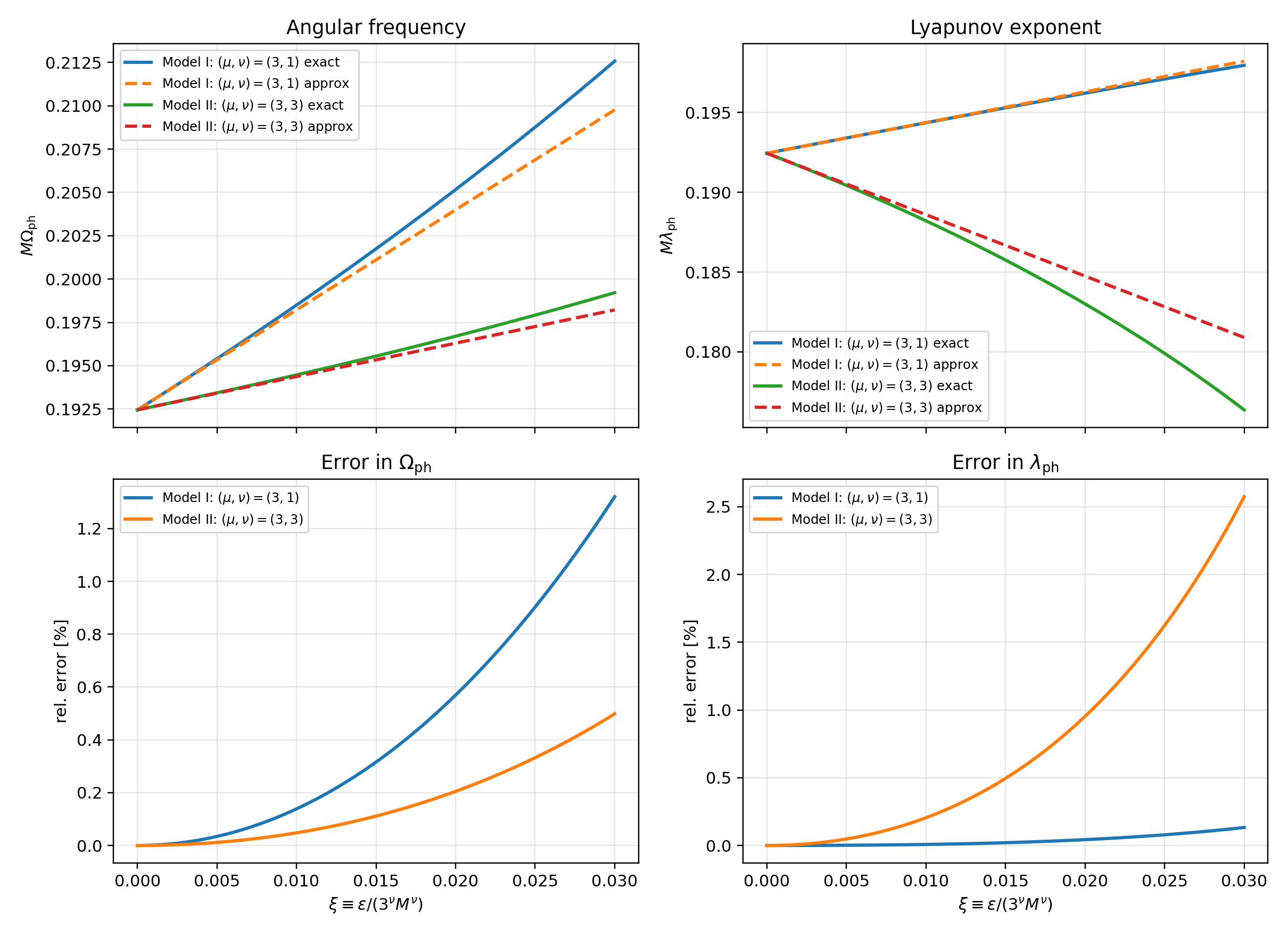
Figure 1: Exact vs first-order ds2=−f(r)dt2+f(r)dr2+r2(dθ2+sin2θdφ2).7 and ds2=−f(r)dt2+f(r)dr2+r2(dθ2+sin2θdφ2).8 approximations for two quasi-topological models (ds2=−f(r)dt2+f(r)dr2+r2(dθ2+sin2θdφ2).9 and f(r)0) as a function of scaled coupling f(r)1.
Eikonal Quasinormal Mode Spectrum via WKB Analysis
First-order WKB conditions are employed, yielding leading-order QNM frequencies
f(r)2
Real and imaginary parts encode oscillation frequency and damping rates. For each representative model, the analytic expressions show explicit parameter dependence:
- For f(r)3 (Model I), both real frequency and damping increase.
- For f(r)4 (Model II), real frequency increases while damping decreases.
Numerical mappings in the complex plane illustrate migration away from the Schwarzschild limit, with model-dependent behavior: Model II exhibits reduced damping, approaching the real axis, while Model I shows enhanced decay rates.
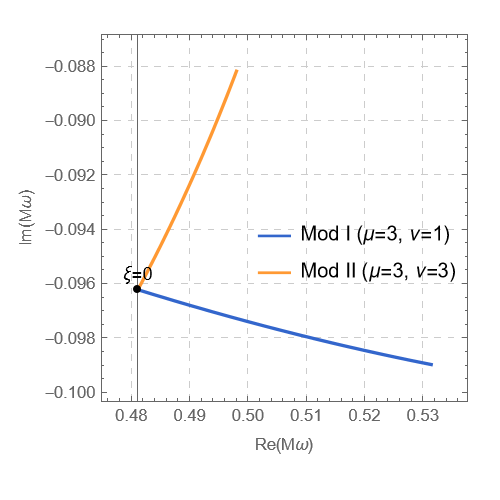
Figure 2: QNM spectrum trajectories (f(r)5) as f(r)6 increases for Models I and II; Schwarzschild point indicated.
Shadow Size and Geodesic-Ringdown Correspondence
The photon sphere determines the black hole shadow radius f(r)7 for static observers at infinity:
f(r)8
This establishes an exact duality in the eikonal approximation, with ringdown frequency scales setting the inverse shadow size. The analytic mapping directly relates QNMs (real part) to the measured shadow radius; imaginary part remains tied to f(r)9.
Strong Gravitational Lensing: Stefanov-Type Correspondence
Gravitational lensing observables in the strong-deflection regime include ε0 (position), ε1 (separation), and ε2 (magnitude ratio). The critical coefficients are
ε3
Strong-deflection coefficient ε4 is explicitly identified as ε5, demonstrating complete analytic correspondence between eikonal QNMs and lensing observables. The Stefanov-type map allows extraction of ringdown parameters directly from lensing data (or vice versa), supporting joint constraints on quasi-topological deformation from complementary channels.
Implications and Future Directions
Analytic closed-form eikonal QNM spectra, shadows, and lensing coefficients for quasi-topological regular black holes advance theoretical control over parameter inference in modified gravity scenarios. The explicit mapping establishes a robust bridge for combining gravitational and electromagnetic signals, crucial for phenomenological tests as observational sensitivity improves. The domain is restricted by the validity of eikonal approximations, WKB reliability, and single-barrier potentials; in more intricate cases (e.g., double-well potentials, near-extremal configurations), corrections or breakdowns may occur, as seen in other higher-curvature or quantum-corrected backgrounds [KonoplyaStuchlik2017, Bolokhov2023]. Extensions to rotating regular black holes indicate further potential for generalization [PedrottiVagnozzi2024].
The analytic scheme provides rapid evaluation and facilitates parameter constraints on ε6 based on ringdown, shadow, and lensing measurements. Applications range from astrophysical imaging (e.g., EHT results) to gravitational wave ringdown analyses.
Conclusion
The paper supplies a comprehensive analytic eikonal sector for quasi-topological regular black holes, unifying QNM, shadow radius, and strong lensing observables via closed-form geodesic invariants. This correspondence offers a precise and highly efficient toolkit for phenomenological probes of high-curvature gravity, with direct application to multi-messenger astrophysics. The approach is anticipated to play a key role in constraining quasi-topological gravity theories, supporting rapid analysis, and guiding extensions to more complex backgrounds and perturbative regimes (2604.13613).

