- The paper presents a novel construction of AdS ABG massive black holes that incorporates nonlinear electrodynamics and massive gravity to yield regular, phase-critical solutions.
- It employs numerical analyses to reveal thermodynamic phase transitions, stability regimes, and distinctive deformation of photon spheres affecting black hole shadows.
- Quasinormal mode computations using higher-order WKB and eikonal approximations confirm dynamical stability and link scalar perturbations to observable shadow features.
Thermodynamics, Shadows, and Quasinormal Modes of AdS ABG Massive Black Holes
Introduction and Context
The paper "Thermodynamics, Shadow, and Quasinormal Modes of AdS Ayón–Beato–García Massive Black Hole" (2604.01065) systematically investigates the thermodynamics, photon sphere, shadows, and dynamical stability (via quasinormal modes, QNMs) of the Ayón–Beato–García (ABG) black hole solution within the context of anti-de Sitter (AdS) space, including the effects of a magnetic charge and a graviton mass as motivated by ghost-free massive gravity theories and nonlinear electrodynamics (NLED). The ABG black hole is a well-known regular (singularity-free) solution sourced by NLED, and this work substantially generalizes its domain to encompass both AdS asymptotics and modifications from massive gravity.
Exact Solution Construction and Properties
The gravitational action incorporates the Einstein-Hilbert term, a negative cosmological constant, mass terms for the graviton following the de Rham–Gabadadze–Tolley framework, and a nonlinear electromagnetic sector. The black hole metric is derived using a static, spherically symmetric ansatz, leading to an exact solution parametrized by mass M, magnetic charge g, graviton mass m, and AdS radius l.
A notable feature is the smooth interpolation between known black hole solutions under appropriate parameter limits:
- g=0: recovers AdS massive black hole
- m=0: reduces to the AdS ABG black hole
- m=0,g=0: Schwarzschild-AdS black hole
- Asymptotic regime: matches AdS Reissner–Nordström–(massive) black hole
The metric function's roots define the black hole horizons, which are determined numerically. Increasing either g or m generally reduces the event horizon radius.
Black Hole Thermodynamics
Thermodynamic analysis proceeds by evaluating the black hole mass, Hawking temperature, entropy, and specific heat (heat capacity). The first law of black hole thermodynamics is found to require a correction factor to restore a consistent area law for entropy in the NLED context, reconciling the deviation due to nonlinear electrodynamics. After applying the Wald approach and a first-law modification, the entropy retains the expected area dependence S=πr+2.
The temperature exhibits nontrivial dependence on both g0 and g1, with strong evidence for critical points indicating local extrema in temperature as a function of horizon radius. Heat capacity analysis reveals both stability and instability regimes separated by second-order phase transitions (divergence points of g2). The black hole demonstrates stability for small and large horizons but a thermodynamically unstable branch for intermediate radii—behavior characteristically linked to criticality and phase transition phenomena in extended black hole thermodynamics.
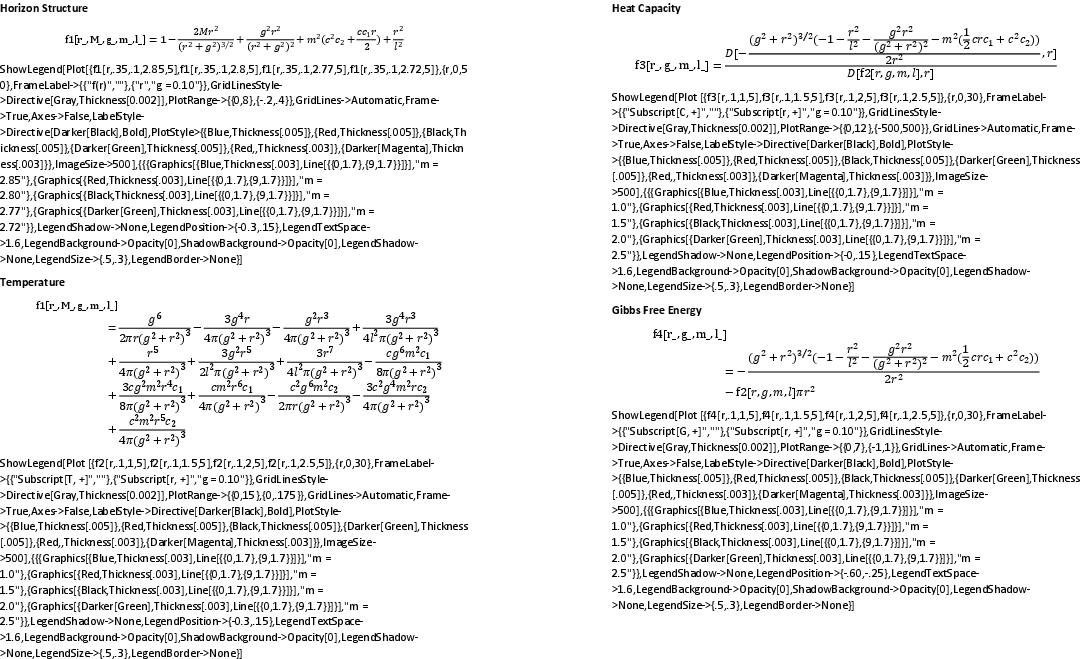
Figure 2: Critical behavior in temperature and heat capacity of the ABG massive black hole for varying g3 and g4.
The Gibbs free energy, constructed with the extended phase space perspective (g5 as pressure), provides a robust probe of global thermodynamic stability. The sign change and extrema in g6 demarcate favored and disfavored phases, respectively, and mark merger points of thermodynamic branches.
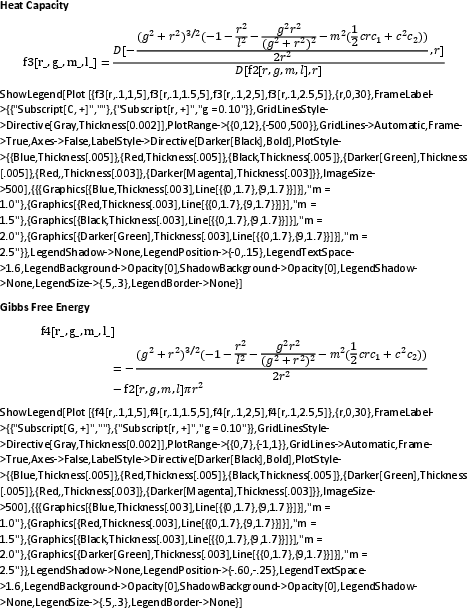
Figure 4: Behavior of the Gibbs free energy against horizon radius for varying g7 and g8, highlighting stable and unstable configurations.
Photon Sphere and Black Hole Shadows
Photon sphere analysis and black hole shadow computation are carried out by considering null geodesics in the equatorial plane, solving for the effective potential's extrema. The impact parameter g9 and shadow radius m0 are computed numerically for a range of m1 and m2 values. The results demonstrate a distinctive and opposing influence:
- Increasing m3 expands both the photon sphere and the shadow radius.
- Increasing m4 contracts these radii.
This parameter sensitivity offers explicit phenomenological signatures distinguishing the model from RN or Schwarzschild AdS cases, with implications for future tests using black hole imaging and shadow observations.
Quasinormal Modes and Dynamical Stability
QNMs are computed for scalar perturbations using both higher-order WKB expansions and eikonal (large m5) approximations. Across all parameter ranges, the imaginary part of the lowest-lying QN frequencies remains negative, confirming dynamical stability under scalar perturbations. The real part of the QNM frequencies decreases with m6, while the (absolute) imaginary component initially increases, eventually saturating for large m7. Discrepancy between WKB and eikonal results narrows for higher multipolar numbers, as expected.
This analysis links the QNM spectrum directly to the photon sphere structure, corroborating the Lyapunov exponent connection in the eikonal limit.
Implications and Future Directions
The systematic treatment of the ABG black hole with AdS asymptotics and massive gravity substantially broadens the landscape of regular black holes in modified theories of gravity. Key implications include:
- Thermodynamic criticality with explicit phase structure, controlled by NLED and graviton mass
- Observable shadow deformations sensitive to both matter field and graviton modifications, suggesting future constraints via Event Horizon Telescope or similar instruments
- Dynamical stability confirming the physical viability of the solution across parameter space, including regimes outside classic Einstein-Maxwell theory
From a theoretical standpoint, these results provide a template for the interplay between horizon regularity, nonlinear gauge fields, and mass-generating gravity extensions, with direct application to AdS/CFT scenarios, the thermodynamics–information link, and potential signatures of modified gravity in astrophysical black holes.
Conclusion
This work provides a comprehensive analysis of AdS ABG black holes endowed with a graviton mass and NLED charge, encompassing thermodynamic, optical (shadow), and dynamical stability properties. The explicit parameter dependencies uncovered enrich both the theoretical understanding and observational prospects for discerning extensions of general relativity via black hole phenomenology. The interplay between m8 and m9 is manifest in all physical observables, emphasizing the necessity of considering broad, multi-parameter black hole solutions as potential signatures or constraints in both gravitational wave astrophysics and black hole shadow measurements.
The results motivate further exploration of analogous solutions in higher curvature (e.g., Gauss–Bonnet), higher dimensions, and rotating analogs, as well as the hydrodynamic and holographic aspects in AdS/CFT contexts.