- The paper constructs a novel class of asymptotically flat, regular black holes with topological hedgehog scalar hair by employing a constrained SO(3) scalar triplet and a three-form sector.
- Utilizing a closed-form first-order ODE, it derives an analytic mass function that replaces singular centers with de Sitter cores and ensures Schwarzschild-like asymptotics.
- The study examines strong-field observables and thermodynamic behavior, offering insights into horizon structures and setting the stage for future tests of black hole dynamics.
Geometrically Regular Black Holes with Hedgehog Scalar Hair
Introduction and Theoretical Context
The paper "Geometrically Regular Black Holes with Hedgehog Scalar Hair" (2604.15758) constructs a novel class of exact, asymptotically flat, and geometrically regular black hole solutions within General Relativity (GR). This is achieved by coupling GR to a constrained SO(3) scalar triplet in a hedgehog configuration and an auxiliary, non-propagating three-form sector, thereby introducing topological "scalar hair" and avoiding central curvature singularities.
A fundamental challenge addressed is the incompatibility of single real scalar fields with explicit angular dependence and spherical symmetry in the metric. The general spherically symmetric line element cannot be supported by a single scalar with angular derivatives without inducing off-diagonal stress-energy tensor components or breaking symmetry. The obstruction is avoided by promoting the scalar degree of freedom to an SO(3) triplet and employing the hedgehog ansatz ΦI=ηnI(θ,φ), where nI is the unit normal vector on S2.
The three-form sector is crucial—the integration constant it generates allows for a continuous family of ADM masses within a single theory, rather than discretely among different theories. The scalar sector is frozen in radial modulus via a Lagrange multiplier, focusing dynamics on the angular Goldstone directions. This architectural choice enables the exact closure of field equations in a single first-order ODE for the mass function, rendering all subsequent analysis tractable in closed form.
Construction of Geometrically Regular Solutions
Within the model, the effective matter Lagrangian is taken as
Kn(Y)=ρ0(Y+μ⋆2Y)n,n>23,
with Y=η2/r2, ρ0 the integration constant from the three-form, and L≡η/μ⋆ the core scale. The stress-energy tensor is generically anisotropic, with pr=−ρ and SO(3)0.
Imposing SO(3)1 leads to regular solutions. For SO(3)2, the preferred branch, the mass function and corresponding metric read:
\begin{align*}
m(r) &= \frac{\pi \rho_0 L3}{2} \left[ \arctan\left(\frac{r}{L}\right) + \frac{r/L (r2/L2-1)}{(1 + r2/L2)2} \right], \
A(r) &= 1 - \frac{4GM}{\pi r} \left[ \arctan\left(\frac{r}{L}\right) + \frac{r}{L} \frac{r2/L2 - 1}{(1 + r2/L2)2} \right],
\end{align*}
with ADM mass SO(3)3. Near SO(3)4, the geometry is de Sitter with SO(3)5, and all curvature invariants remain finite, signifying geometric regularity.
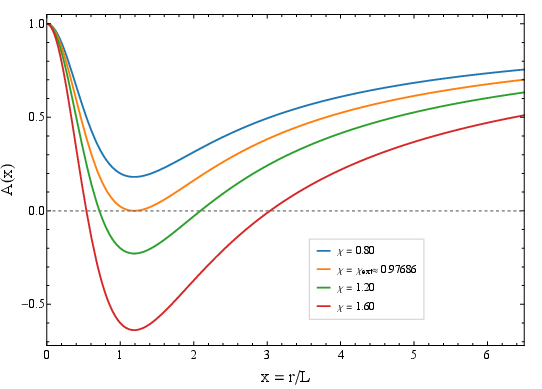
Figure 1: Metric profiles SO(3)6 of the SO(3)7 solution (SO(3)8) for several SO(3)9. The curves illustrate the existence (or absence) of horizons and the extremal configuration.
The horizon structure is parametrically controlled by ΦI=ηnI(θ,φ)0. For ΦI=ηnI(θ,φ)1 the spacetime is horizonless, at ΦI=ηnI(θ,φ)2 extremality is achieved, and for ΦI=ηnI(θ,φ)3 there are inner and outer horizons with regular interiors.
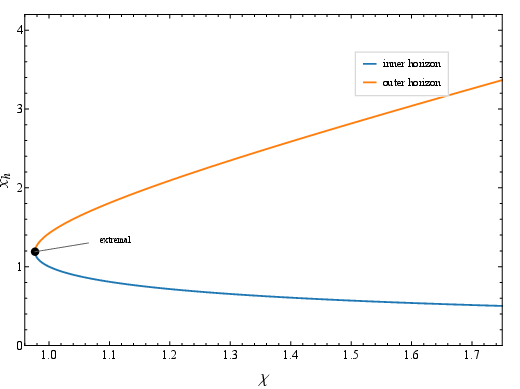
Figure 2: Inner and outer horizon radii as functions of ΦI=ηnI(θ,φ)4, merging at the extremal point.
The ΦI=ηnI(θ,φ)5 solution possesses the cleanest asymptotic behavior in the constructed family: the first correction to Schwarzschild is at order ΦI=ηnI(θ,φ)6, precluding any solid-angle deficit or ΦI=ηnI(θ,φ)7 Reissner–Nordström-like term seen in ΦI=ηnI(θ,φ)8.
Physical Properties, Energy Conditions, and Topological Hair
The matter sector of these solutions manifests anisotropic pressures, with vacuum-like behavior (ΦI=ηnI(θ,φ)9) at the de Sitter core and a transition to nI0 in the asymptotic limit. The radial null and weak energy conditions are respected, while the dominant energy condition is violated globally, and the strong energy condition is violated near the center—standard in regular black holes with a repulsive de Sitter core.
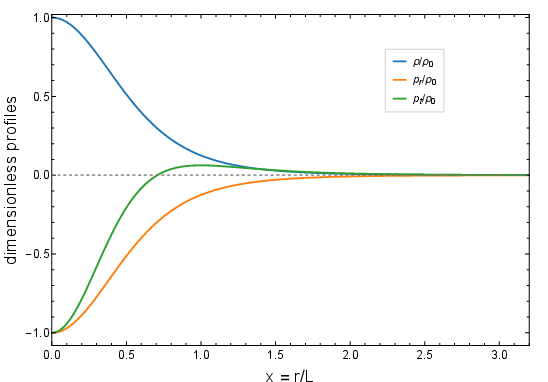
Figure 3: Density and pressure profiles for the nI1 solution, demonstrating isotropy at the core and rapid (nI2) decay of energy density at large nI3.
Topological scalar hair is a central feature. The hedgehog map nI4 carries a winding number of one, distinguishing these solutions from those with "Gauss-law" charges. The continuous parameter nI5 (and thus nI6) is sourced by the three-form, not by a scalar charge.
Strong-Field Observables and Phenomenological Implications
Deviations from Schwarzschild arise only in the strong-field regime, with all post-Newtonian corrections highly suppressed:
- The photon sphere and shadow radius are slightly reduced relative to Schwarzschild at fixed nI7; explicit formulas show these corrections scale as nI8 and are negligible for nI9.
- The ISCO moves inward and the corresponding orbital frequency increases, implying a minor blue shift for accretion disk edges.
- The eikonal (geometric-optics limit) quasinormal modes are shifted: higher oscillation frequency and reduced damping relative to Schwarzschild, but again only at subleading order.
Because the far field is essentially Schwarzschild-like, phenomenological differences are confined to the event-horizon and photon-sphere region.
Thermodynamics and Stability
For the S20 branch, the outer horizon and Hawking temperature recover Schwarzschild values in the large-mass limit, with S21 always vanishing at extremality. The heat capacity is positive near extremality and negative for larger masses, signaling the presence of a locally thermodynamically stable small black hole regime, as well as Schwarzschild-like instability for larger holes.
While the solution is geometrically regular, the matter sector is only piecewise smooth—S22 diverges at S23, making S24 ill-defined there. Full field smoothness would require restoring a dynamical radial modulus, moving beyond the fixed-modulus truncation.
Outlook and Future Directions
This work demonstrates that GR with a constrained S25 scalar triplet and a non-propagating three-form sector admits a continuous family of asymptotically flat, regular black holes with topological scalar hair and secondary (but not primary) hair. The construction is analytic, physically transparent, and highlights the role of topological, rather than Gauss-law, hair.
Further investigation is warranted in several directions:
- A complete analysis of linear perturbations and dynamical stability, particularly of the Cauchy horizon, which is known to be problematic in other regular black hole scenarios.
- Extending the model to include a dynamical radial modulus, potentially achieving both geometric and matter smoothness.
- Probing the phenomenological implications for black hole shadows, ringdown, and other strong-field observables in regimes where S26 is not parametrically small.
- Examining the interplay with quantum corrections to the three-form sector, which may discretize the parameter space or introduce new global charges.
Conclusion
This study provides an explicit analytic realization of regular black holes with topological scalar hair in standard four-dimensional GR. The approach leverages internal symmetry structure to overcome the traditional no-hair obstructions and replaces central singularities with de Sitter cores while maintaining precise control of asymptotics. The solutions tightly constrain phenomenological deviations to the near-horizon zone, offering a tractable and physically motivated setting for future studies of strong gravity, hair, and regularity in black hole physics.

