OmniShotCut: Holistic Relational Shot Boundary Detection with Shot-Query Transformer
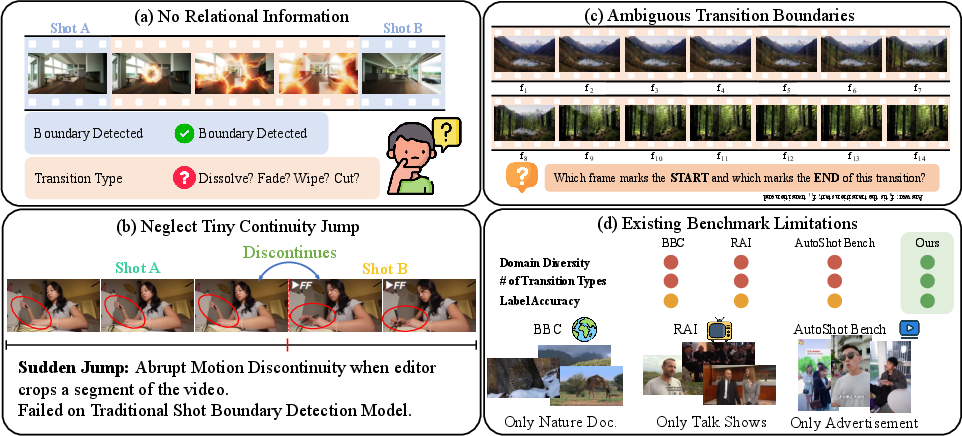
Abstract: Shot Boundary Detection (SBD) aims to automatically identify shot changes and divide a video into coherent shots. While SBD was widely studied in the literature, existing state-of-the-art methods often produce non-interpretable boundaries on transitions, miss subtle yet harmful discontinuities, and rely on noisy, low-diversity annotations and outdated benchmarks. To alleviate these limitations, we propose OmniShotCut to formulate SBD as structured relational prediction, jointly estimating shot ranges with intra-shot relations and inter-shot relations, by a shot query-based dense video Transformer. To avoid imprecise manual labeling, we adopt a fully synthetic transition synthesis pipeline that automatically reproduces major transition families with precise boundaries and parameterized variants. We also introduce OmniShotCutBench, a modern wide-domain benchmark enabling holistic and diagnostic evaluation.

Paper Prompts
Sign up for free to create and run prompts on this paper using GPT-5.
Top Community Prompts
Explain it Like I'm 14
What is this paper about?
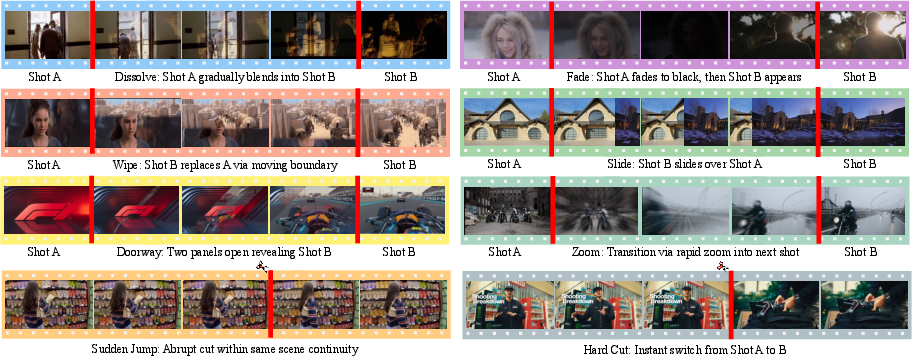
This paper is about teaching a computer to spot where one “shot” ends and the next begins in a video. Think of a video like a book made of many short “chapters” (shots). Sometimes you turn the page suddenly (a hard cut), and sometimes the page slowly fades into the next (a dissolve). The authors introduce a new system called OmniShotCut that not only finds these shot boundaries very precisely, but also explains what kind of transition happened (fade, wipe, cut, etc.) and whether the change between shots is smooth or a jarring “sudden jump.”
What questions did the researchers ask?
They focused on four simple questions:
- Can we detect exactly where each shot ends, even when transitions are subtle?
- Can we explain the kind of transition (like fade, dissolve, wipe), not just say “there’s a cut”?
- Can we catch “sudden jumps” — instant, unpleasant glitches where frames don’t flow smoothly — that can mess up other video tools?
- Can we train and test on better data that matches modern internet videos, instead of old, limited datasets with messy labels?
How did they do it?
1) Building better training data (synthetic transitions)
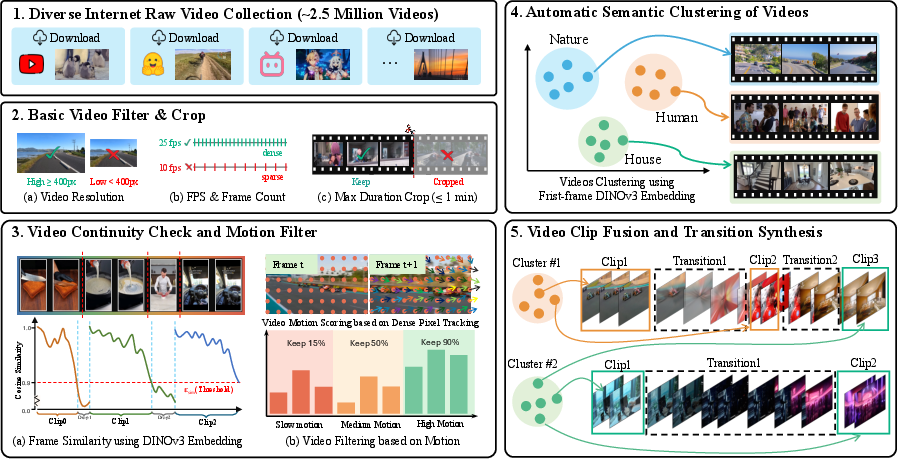
- Instead of asking people to label every transition by hand (which is slow and imprecise), they programmatically create transitions using clean video clips. This is like using video-editing software to insert fades, wipes, slides, and more — but done automatically.
- Because the computer creates the transitions, it knows the exact start and end frame of each effect. No guesswork.
- They collect a huge pool of internet video clips and:
- Filter for quality (right size, length, frame rate).
- Group similar videos together using an image-understanding model (so transitions feel realistic, like going from one city scene to a slightly different city scene).
- Estimate how much things are moving in the video to pick good examples for training “sudden jump” cases.
In short: they create millions of realistic, precisely labeled transition examples to train on.
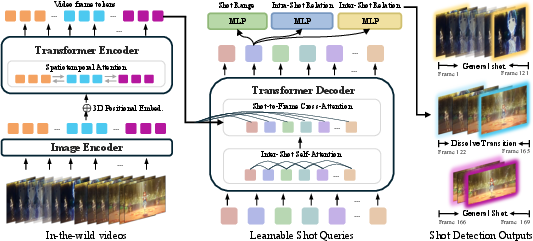
2) A new model that “asks” for shots (shot-query Transformer)
- The core model is a Transformer (a type of AI that’s great at paying attention to important parts of data over time, like reading a story and remembering what happened earlier).
- Imagine placing a set of “sticky notes” (queries) across the video. Each sticky note tries to figure out:
- Where a shot ends (the exact frame number),
- What type of transition it is (fade, cut, wipe, etc.), and
- Whether the change from the previous shot is smooth or a sudden jump.
- Instead of estimating a fuzzy number for the boundary, the model chooses a specific frame index — like picking a number from a list — to be extra precise.
3) A new test set for modern videos (OmniShotCutBench)
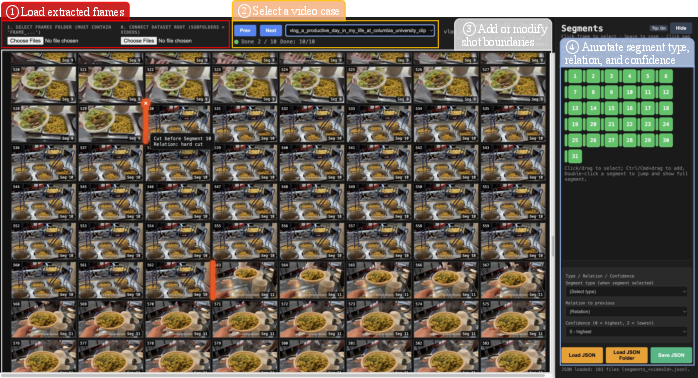
- They also create a modern benchmark of edited internet videos (vlogs, anime, games, concerts, sports, etc.) with careful, consistent labels.
- This test set checks not only traditional shot detection, but also how well a system identifies transition types and sudden jumps.
What did they find, and why is it important?
- Their method finds transitions more accurately than previous systems:
- It’s much better at locating the exact range of gradual transitions (like fades and dissolves).
- It catches sudden jumps far more reliably.
- It still performs very well on standard “find the cut” scores.
- It also outputs useful labels:
- Intra-shot labels: what kind of transition the shot contains (e.g., dissolve, wipe, slide, zoom, fade, doorway, or just a normal shot).
- Inter-shot labels: how the new shot relates to the previous one (e.g., transition, hard cut, sudden jump).
Why this matters:
- Many video tools need clean, smooth clips to work well (video generation, tracking objects, video compression, and segmentation).
- If a tool misses a sudden jump or misplaces a boundary, those downstream systems can fail or look glitchy.
- By being both precise and explainable, OmniShotCut makes it easier to build reliable video pipelines at internet scale.
What’s the impact?
- For creators and developers: better automatic chopping of long videos into clean shots, fewer glitches, and clearer information about transitions.
- For modern AI video systems: improved data quality helps video generators, trackers, and compressors perform better.
- For research: the paper shows that training with high-quality synthetic transitions can outperform old, noisy human-labeled data, and that adding “relation” labels (transition types and continuity) makes results more useful.
- The authors note a limitation: extremely artistic or complex movie-style transitions may still need more advanced templates or data to model perfectly. That’s a direction for future work.
Overall, OmniShotCut helps computers understand “how a video is stitched together,” not just “where the cuts are,” making video editing and AI video tasks more accurate, reliable, and explainable.
Knowledge Gaps
Knowledge gaps, limitations, and open questions
The paper advances SBD with relational outputs, a shot-query Transformer, synthetic supervision, and a new benchmark. The following concrete gaps and open questions remain:
- External validity: No evaluation on established real-world SBD benchmarks (e.g., ClipShots, BBC, RAI, TRECVID IACC), so generalization from synthetic training to legacy datasets and production media remains unquantified.
- Benchmark scope and bias: OmniShotCutBench is relatively small (~110 minutes, 114 videos) and focused on “modern internet” content at 480p/30fps; representativeness of professional film/TV, documentaries, news, UHD/4K, 24/60/variable fps, and diverse regional editing styles is unclear.
- Annotation reliability: The benchmark includes confidence scores but reports no inter-annotator agreement statistics, error analyses per transition type, or protocols for adjudicating ambiguous boundaries—hindering reproducibility and comparability.
- Synthetic-to-real gap: The model is trained purely on synthetic transitions; the degree and nature of domain shift to real edits (e.g., nonlinear opacity curves, color grading, lens effects, compression pipelines) are not measured or mitigated (no domain adaptation or fine-tuning study).
- Transition taxonomy coverage: The intra-shot labels (8 types) omit common and emerging effects (e.g., morphs, whip pans, match cuts/graphic matches, speed ramps, glitch/RGB split, split-screen, overlays/lower-thirds, stylized AI transitions, occlusion-based wipes). A roadmap and tooling for adding these classes is not provided.
- Continuity granularity: Inter-relation labels (Transition/Hard Cut/Sudden Jump) do not capture graded continuity (e.g., soft jump, cut on action, continuity-preserving edits) or a scalar continuity score; downstream tasks may need finer measures of temporal coherence.
- Sudden jump definition and evaluation: Sudden jumps are synthesized by cropping [24, 40] frames in “medium motion” clips and evaluated with zero tolerance; this may not reflect real-world phenomena (dropped frames, encoder glitches, shutter artifacts, whip pans). Robustness to such real causes is untested.
- Resolution and frame rate robustness: Training at 128×96 and benchmarking at 480p/30fps leaves open performance at higher resolutions (1080p–4K), high/low/variable fps, and strong motion blur or rolling shutter.
- Streaming and long-video scalability: The approach flattens F×H×W tokens; inference memory/latency on long-form or multi-hour videos, streaming/online detection, and windowing/overlap strategies are not specified or evaluated.
- Fixed-capacity decoding: Using a fixed number of shot queries (24) plus a termination token raises questions about handling windows with more shots, query allocation under rapid cutting, and failure modes when the true number exceeds capacity.
- Boundary prediction formulation: Predicting only “end frame” per shot via frame-index classification presumes non-overlapping, perfectly sequential shots; overlapping edits (e.g., multilayer composites, picture-in-picture, B-roll overlays) and nested or multi-clip transitions remain unsupported.
- FPS normalization and cross-fps transfer: All benchmark videos are normalized to 30fps; it is unclear how the frame-index classifier transfers across native fps without re-timing and whether temporal calibration is needed.
- Robustness to overlays and artefacts: Only light offline augmentation (5% subtitles, 7.5% lighting changes) is used; robustness to heavy captions/HUDs, logos, watermarks, flicker, flashes, deflicker plugins, compression cascades, and color grading is not analyzed.
- SSL clustering assumptions: The curation pipeline relies on DINOv3 embeddings, ε thresholds (ε_sim, ε_dup), and 27k clusters; sensitivity to these hyperparameters, cluster quality metrics, and their impact on realism of synthesized transitions are underexplored.
- Legal/ethical data sourcing: The paper aggregates ~2.5M internet videos but does not specify license filtering, provenance auditing, or compliance for redistribution and model training.
- Downstream utility: Claims about benefits to video generation, temporal VAEs, tracking, and segmentation are not validated with end-task metrics; no study quantifies how improved SBD translates to measurable gains downstream.
- Uncertainty and calibration: Although outputs are probabilistic, there is no uncertainty calibration, abstention policy, or risk-controllable operating points—important for high-precision curation pipelines.
- Failure mode analyses: Qualitative/quantitative breakdowns of common errors (missed subtle fades, false sudden jumps during whip pans, confusion with exposure flicker or dynamic lighting) and per-domain/per-transition stratified results are missing.
- Comparative breadth: Baselines include PySceneDetect, TransNetV2, and AutoShot; comparison to recent transformer-based or hybrid SBD models and to modern learning-free detectors beyond histogram methods is absent.
- Architectural ablations: Limited ablations are provided; the effects of the number of queries, termination token design, encoder/decoder depth, video image-encoder choice, 3D positional embedding variants, and training window length are not systematically studied.
- High-resolution deployment path: There is no strategy for multi-scale processing or high-res edge-aware detection (important for thin wipe edges/slits) without sacrificing speed.
- Overlapping audio-visual cues: The model is purely visual; leveraging audio cues (music transitions, crossfades, hard audio cuts, J/L-cuts) to disambiguate boundaries is unexplored.
- Data distribution shaping: While 25% “short dense hard-cuts” are synthesized, broader matching of real transition distributions (per domain/genre/platform) and automated distribution alignment remain open.
- Reproducibility of synthesis: Precise parameterizations, opacity curves, easing functions, mask libraries, and randomness controls for transition synthesis are not fully specified in the main text, limiting exact replication and extension.
- Licensing and release of assets: Availability and licensing terms for the synthetic pipeline, trained models, and OmniShotCutBench (including any restricted content) are not detailed, affecting community adoption and benchmarking.
Practical Applications
Immediate Applications
Below are actionable use cases that can be deployed now, leveraging the paper’s Shot-Query Transformer for relational shot boundary detection, the synthetic transition pipeline, and the OmniShotCutBench benchmark.
- Sector: Software/Streaming/Media Encoding
- Application: Drop-in “scene/shot-change” detector for transcoders and streaming encoders
- What it enables:
- More accurate I‑frame placement and adaptive GOP sizing at true shot boundaries and transitions (hard cuts, dissolves, wipes), reducing cross-shot prediction errors and improving rate control.
- Automatic isolation of sudden jumps to split GOPs and avoid temporal prediction across discontinuities, improving compression efficiency and QoE.
- Tools/workflows: Integrate OmniShotCut as a scene-change module in FFmpeg/x264/x265/AV1 pipelines; implement pre-encoding pass in VOD workflows; batch job in cloud media pipelines (e.g., AWS MediaConvert, Bitmovin).
- Assumptions/dependencies: Access to frame-accurate video (consistent FPS); compute budget for pre-pass; minimal latency constraints for VOD; domain-generalization from synthetic training is acceptable for internet-style content.
- Sector: Data Curation for Video Generation and Video Foundation Models
- Application: Clean segmentation and filtering of long-form internet videos for training sets
- What it enables:
- Extraction of “vanilla” shots (intra-shot “General” label) while excluding transitions and sudden jumps that harm temporal VAEs, token sharing, or diffusion pipelines.
- Quality filters that remove or isolate discontinuous segments to improve temporal consistency and compression in latent spaces.
- Tools/workflows: Automated pre-processing in dataset builders for CogVideoX/Wan-class models; clip reindexing by inter/intra labels; shard-level QC dashboards.
- Assumptions/dependencies: Adoption into existing curation pipelines; alignment between synthetic-trained SBD and target domains; batch compute availability.
- Sector: Post-production/Video Editing (Consumer and Pro)
- Application: Smart timeline annotation and auto-cut assistance with interpretable transition tags
- What it enables:
- Automatic labeling of shot boundaries plus transition type (dissolve, fade, wipe, slide, push, zoom, doorway) for fast review and selective removal of non-vanilla segments.
- Sudden-jump flagging for QC and repair (e.g., insert B‑roll, retime, or stabilize).
- Tools/products: Plug-ins for Adobe Premiere/DaVinci Resolve/Final Cut; mobile editors suggest cuts and transition fixes; shot-aware storyboard views.
- Assumptions/dependencies: Efficient inference at editor preview resolutions; UX integration; permission to process user media.
- Sector: Search/Media Asset Management (MAM/DAM)
- Application: Shot-level indexing and transition-aware retrieval
- What it enables:
- Faster browsing (jump to next cut/transition), skip transition-heavy spans, and query by editing patterns (e.g., “find dissolved entries,” “find fast-cut sequences”).
- Tools/workflows: MAM backends store shot ranges with intra/inter labels; UI scrubbing aids; export shot lists for downstream editors or analytics.
- Assumptions/dependencies: Storage and schema changes for shot metadata; batch processing on ingestion.
- Sector: Scene/Story Segmentation and Video Analytics (Academia and Industry)
- Application: Improved scene segmentation pipelines and film-style analysis
- What it enables:
- Better scene boundary detection by consuming clean shot segments; quantification of editing pace and stylistic patterns via transition distributions.
- Tools/workflows: Replace legacy SBD modules in MovieNet/LGSS/BaSSL/ShotCOL/Scene-VLM-like stacks with OmniShotCut; build editing-style dashboards for content teams.
- Assumptions/dependencies: Minimal code changes; reliance on OmniShotCutBench for evaluation.
- Sector: Advertising/Brand Safety/Programmatic Insertion
- Application: Safer ad insertion and pacing analytics
- What it enables:
- Precise insertion points at clean hard cuts; avoid placing ads inside transitions; identify segments with high-frequency cut patterns that may affect ad performance.
- Tools/workflows: Pre-insertion boundary APIs; analytics reports for cut-rate and transition types; integration with SSAI/DAI systems.
- Assumptions/dependencies: API latency budget; alignment with ad policy and UX targets.
- Sector: Accessibility/Compliance
- Application: Automated warnings for transition-heavy or flashing content
- What it enables:
- Detect sequences with rapid hard cuts or certain transitions and surface warnings or playback adaptations for photosensitive viewers.
- Tools/workflows: Player-level overlays; accessibility metadata tags at the asset level.
- Assumptions/dependencies: Clear policy thresholds; false-positive mitigation; user preference controls.
- Sector: Video Forensics/Integrity (Security, Legal)
- Application: Discontinuity/tamper triage using sudden-jump detection
- What it enables:
- Flagging unexpected discontinuities in editorial or surveillance archives (e.g., splices, frame drops) for human review.
- Tools/workflows: Forensic scan reports with timestamps and jump confidence; chain-of-custody annotation storage.
- Assumptions/dependencies: Edited vs. tampered content must be distinguished with context; domain shift for surveillance (usually unedited) may require fine-tuning.
- Sector: Education/Knowledge Platforms
- Application: Lecture/tutorial segmentation into units at clean cuts with transition-aware trimming
- What it enables:
- Chapterization and slide-switch detection using hard cuts; removal of transitional frames to improve OCR and ASR alignment.
- Tools/workflows: LMS ingestion pipelines generate chapter markers; synchronized caption/slide alignment.
- Assumptions/dependencies: Mixed content (screen capture + camera) may require minor domain tuning.
- Sector: Benchmarking and Model QA (Academia/ML Ops)
- Application: Use OmniShotCutBench for standardized SBD evaluation
- What it enables:
- Holistic and diagnostic testing (including transitions and sudden jumps) for SBD and downstream segmentation models.
- Tools/workflows: CI/CD evaluation harness; leaderboard baselines; ablations comparing 3D CNN SBDs vs. shot-query Transformers.
- Assumptions/dependencies: Benchmark licensing and availability; dataset mirrors for reproducibility.
- Sector: Synthetic Data Services
- Application: Synthetic transition data generation to replace manual labeling
- What it enables:
- Scalable, precisely labeled corpora across 9+ transition families and 30+ subtypes for SBD or transition-effect classifiers.
- Tools/workflows: Internal “transition synthesizer” microservice; parameter sweeps for rare effects (doorway, mosaic, puzzle, cube).
- Assumptions/dependencies: Faithfulness of synthetic variants to production transitions; ability to cover proprietary studio templates.
Long-Term Applications
These use cases require further research, scaling, or domain adaptation before wide deployment.
- Sector: Real-time Live Production and Low-Latency Streaming
- Application: On-the-fly relational SBD for live broadcasts
- What it could enable:
- Real-time I-frame control, ad insertion, and accessibility flags during live events.
- Dependencies/assumptions:
- Efficient, low-latency implementations or model distillation; high-resolution support beyond 128×96; robust performance under live encoding constraints.
- Sector: Generative Video and Auto-Editing Assistants
- Application: Editing-style-aware generation and automatic trailer/recap assembly
- What it could enable:
- Models that condition on or synthesize coherent transitions; auto-assemble story arcs using shot and inter/intra relationship cues; personalized editing-style assistants.
- Dependencies/assumptions:
- Joint training of SBD signals with generative models; larger style corpora; UX evaluation of stylistic quality.
- Sector: Advanced Cinematic Transition Modeling
- Application: Library-driven or learned cinematic transition templates
- What it could enable:
- Recognition and synthesis of complex, studio-grade transitions (custom plug-ins, nested composites, semantic wipes).
- Dependencies/assumptions:
- Access to industry-level template collections; richer parameterization beyond current synthetic pipeline; multimodal cues (audio, text overlays).
- Sector: Robust Surveillance/Medical/Industrial Video QA
- Application: Domain-adapted sudden-jump detection for sensor dropouts and data loss
- What it could enable:
- Reliable detection of discontinuities in surgical videos, endoscopy, or industrial inspection streams; automated QC and alerting.
- Dependencies/assumptions:
- Domain fine-tuning and regulatory validation (especially in healthcare); handling unedited, long, low-motion recordings; privacy-preserving deployment.
- Sector: Content Understanding for Media Intelligence and Finance
- Application: Large-scale editing analytics at enterprise scale
- What it could enable:
- Tracking editing trends (cut rates, transition types) across news, social, and branded content; correlating with engagement or market signals.
- Dependencies/assumptions:
- Scalable, cross-platform ingestion; alignment between editing metrics and business KPIs; robust cross-domain generalization.
- Sector: Multimodal Reasoning and Video-LLMs
- Application: Structure-aware video captioning and QA
- What it could enable:
- LLMs that condition on shot boundaries and transition semantics for better temporal grounding and long-video reasoning.
- Dependencies/assumptions:
- Dataset pipelines that fuse shot metadata with text; training curricula for structure-aware video-language pretraining.
- Sector: Mobile and Edge Deployment
- Application: On-device shot detection for creators and AR apps
- What it could enable:
- Battery-efficient auto-cut/suggestion tools; AR experiences that adapt at shot changes.
- Dependencies/assumptions:
- Model compression/distillation; hardware acceleration; offline mode and privacy constraints.
- Sector: Standards and Policy (MPEG/ATSC/Accessibility)
- Application: Incorporating relational SBD into standards for scene-change signaling
- What it could enable:
- Standard metadata fields for transitions and discontinuities to guide encoders/players and inform accessibility services.
- Dependencies/assumptions:
- Industry consensus; evaluation across diverse content libraries; backward compatibility with existing toolchains.
- Sector: Forensic-grade Edit/Tamper Detection
- Application: Certifying editorial integrity in legal and archival contexts
- What it could enable:
- Coupling sudden-jump detection with provenance (e.g., C2PA) to differentiate editorial cuts from suspicious splices.
- Dependencies/assumptions:
- Provenance metadata integration; rigorous validation and expert workflows; low false positives in unstaged environments.
Notes on feasibility across applications:
- Synthetic-to-real generalization: While results are strong on a modern benchmark, highly stylized, proprietary, or domain-specific transitions may require fine-tuning or expanded synthetic libraries.
- Throughput and latency: The model processes dense frame inputs; production deployment may need batching, sliding-window inference, or lighter backbones.
- Data and licensing: Some workflows need access to raw frames, which can be restricted by policy or storage constraints.
- Evaluation: Adoption of OmniShotCutBench promotes comparability, but organizations should also build domain-specific validation sets (e.g., sports, lectures, medical).
Glossary
- 1D GIoU: A generalized Intersection-over-Union metric adapted to 1D intervals for measuring overlap between predicted and ground-truth time ranges. "an + 1D GIoU regression loss"
- 3D CNN: A convolutional neural network that applies 3D kernels over space and time to model video sequences. "They employ 3D CNNs to detect transition intervals."
- 3D positional embedding: Positional encodings extended to include temporal information so Transformers can model space-time order. "we need to extend the 2D position embedding to 3D position embedding"
- auxiliary supervision: Additional intermediate losses used during training to stabilize and improve optimization. "We retain auxiliary supervision at intermediate decoder layers to facilitate stable optimization."
- CoTracker3: A dense point-tracking model used to estimate motion strength across frames. "We estimate motion strength using the CoTracker3 model"
- cross-attention: A Transformer mechanism where query tokens attend to source tokens (e.g., frames) to aggregate relevant information. "interact with frame features through cross-attention"
- DETR: A Transformer-based object detection framework that uses learnable queries and bipartite matching. "image-based DETR object detection Transformer model"
- DINO embeddings: Self-supervised visual embeddings (from DINO/ViT) used to measure semantic similarity between frames. "encode frames sampled at a constant interval into DINO embeddings"
- DINOv3: A self-supervised Vision Transformer variant providing robust image/video representations. "DINOv3~\cite{simeoni2025dinov3} ViT large variant."
- dissolve (transition): A gradual transition where one shot fades out while another fades in with temporal overlap. "including dissolve, fade, wipe, slide, doorway, zoom, sudden jump, and hard cut."
- Doorway (transition): A stylistic transition where the next shot is revealed through an opening-like mask (e.g., door-shaped). "including dissolve, fade, wipe, slide, doorway, zoom, sudden jump, and hard cut."
- hard cut: An instantaneous transition where one shot ends and the next begins at the next frame without overlap. "including dissolve, fade, wipe, slide, doorway, zoom, sudden jump, and hard cut."
- hierarchical K-means: A multi-level clustering approach that recursively applies K-means to form semantic groups at different granularities. "apply hierarchical K-means clustering"
- Hungarian matching: An algorithm for optimal bipartite matching, often used to pair predictions with ground truths. "Consequently, Hungarian matching is no longer required."
- Intersection over Union (IoU): A metric measuring overlap between predicted and true intervals or regions, defined as intersection divided by union. "calculate the IoU"
- inter-shot relation: A label that describes the continuity relationship between consecutive shots (e.g., transition, hard cut, sudden jump). "we introduce inter-shot relation classification."
- intra-shot relation: A label that characterizes the internal nature of a shot, such as whether it contains a specific transition type. "we introduce intra-shot relation classification"
- latent video compression: Compression performed in a learned latent space (e.g., within VAEs) to reduce video dimensionality while preserving structure. "latent video compression"
- range head: A prediction head that outputs the temporal endpoint (frame index) of a shot. "a range head, an intra-relation head, and an inter-relation head."
- Self-Supervised Learning (SSL) clustering: Clustering using representations learned without labels to group semantically similar video clips. "Self-Supervised Learning-based (SSL) clustering"
- semantic deduplication: Removing near-duplicate samples based on semantic similarity to improve dataset diversity. "apply a semantic deduplication paradigm"
- self-attention: A mechanism in Transformers where tokens attend to each other within a sequence to model dependencies. "multi-head self-attention"
- Shot Boundary Detection (SBD): The task of automatically locating transitions to segment a video into coherent shots. "Shot Boundary Detection (SBD) aims to automatically identify shot changes"
- shot query: A learnable query token in the Transformer decoder that aggregates evidence for a specific shot’s prediction. "Learnable shot queries in the decoder interact with frame features through cross-attention"
- sinusoidal embeddings: Fixed positional encodings based on sinusoids that encode token positions along axes. "apply sinusoidal embeddings along the temporal and spatial axes"
- Sudden Jump: An abrupt frame-to-frame discontinuity (e.g., after trimming out a short segment) causing a harmful visual jump. "Sudden Jump typically arise during video editing"
- temporal VAE: A variational autoencoder architecture that models temporal dependencies to compress/represent video sequences. "videos are encoded by a temporal VAE"
- termination token: A special output indicating that no more shot predictions follow in the sequence. "predict a dedicated termination token"
- VisTR: A video instance segmentation Transformer whose positional encoding approach is adapted here for spatiotemporal modeling. "following the approach of VisTR"
Collections
Sign up for free to add this paper to one or more collections.

