- The paper introduces GBP to capture finite loop correlations by passing messages over overlapping regions, significantly improving contraction accuracy.
- It demonstrates robust convergence and precise thermodynamic predictions across frustrated classical models, ice models, and deformed AKLT quantum states.
- The method reveals insights into contraction hardness transitions and outlines future directions for optimizing tensor network contractions in complex, quantum settings.
Contracting Tensor Networks with Generalized Belief Propagation
Introduction and Motivation
Tensor networks are central to the efficient representation and computation of high-dimensional, correlated systems, with extensive applications in quantum many-body physics, statistics, and machine learning. However, the computational cost of contracting arbitrary tensor networks, especially those involving closed loops and complex correlations, remains a major bottleneck. Traditional variational contraction approaches for two- and three-dimensional networks (e.g., CTMRG [Nishino1996, Orus2009], boundary-MPS [Murg2007], cluster expansions) scale poorly or become uncontrolled in frustrated or highly entangled settings.
Belief propagation (BP), initially developed for probabilistic graphical models, has recently been adopted for tensor network contraction. BP's efficiency arises from its ability to exploit local graphical structure, but its uncontrolled nature and failures in the presence of short loops and frustration have limited its practical utility. This paper introduces a significant generalization: the application of Generalized Belief Propagation (GBP) to tensor network contraction, enabling systematic improvements by passing messages on overlapping regions and capturing complex loop correlations.
GBP extends BP by refining the region-based approximations to the global partition function, replacing factorized marginal beliefs on single nodes or edges with beliefs defined over a hierarchy of overlapping regions ("parent" and "child" regions; see (Figure 1) and (Figure 2)). The set of regions is constructed recursively via intersections, enabling systematic inclusion of non-local and multi-node correlations.
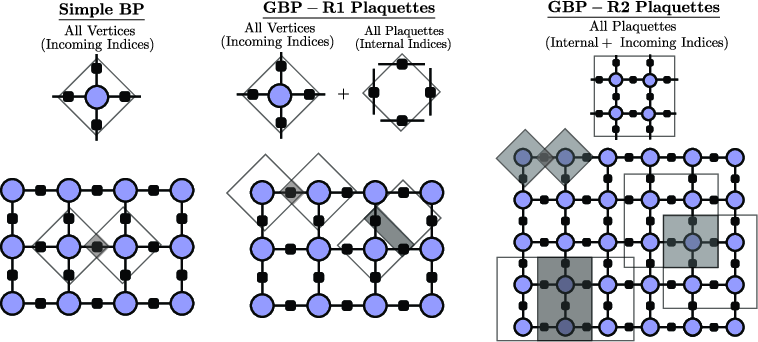
Figure 1: Schematic for different GBP region choices in a square-lattice tensor network, outlining parent and child region structures for simple BP and GBP (R1, R2 Plaquettes).
GBP operates by iteratively updating message tensors associated with region intersections in a manner that seeks to minimize the Kikuchi (generalized Bethe) free energy. The update equations guarantee consistency of beliefs under marginalization over overlaps but, unlike simple BP, can capture corrections from loops of finite length, provided the region structure encompasses the relevant cycles.

Figure 2: Region diagrams and message passing structure for GBP, indicating parent and child region sets and the associated belief update dependencies.
The formalism accommodates both scalar ("flat") and norm networks, enabling computation of partition functions, expectation values, and network derivatives for both classical and quantum settings.
Free Energy and Observables
GBP provides a variational upper bound to the negative log partition function (approximate free energy), constructed via Moebius-counted weighted entropy contributions of the region beliefs. GBP also enables efficient computation of observables—tensors derivatives—by relating local observables to marginalizations and, for arbitrary index subsets, by recombining beliefs from subregions via inclusion–exclusion.
Computational Complexity
The computational cost of GBP is strongly dependent on both tensor network geometry and region size. For two-dimensional square and hexagonal networks, GBP with R1 plaquette regions achieves computational scaling competitive with BP for flat networks, while for norm networks (i.e., double-layer contraction), complexity increases due to higher order message interactions. The implementation leverages message update orderings to mitigate scaling bottlenecks (see Table 1 in the main text).
Numerical and Analytical Validation
The paper demonstrates GBP efficacy over a suite of model systems, including (1) classical frustrated systems (Villain model), (2) discrete constraint satisfaction problems (ice models, i.e., residual entropy), (3) quantum ground states (deformed AKLT state), and (4) random networks interpolating between positive and sign-problematic entries.
Frustrated Classical Models
For the fully frustrated Ising (Villain) model, BP fails to converge or produces highly inaccurate free energy and entropy estimates in the low-temperature limit due to instability in the presence of frustration and short loops. In contrast, GBP with minimal additional region structure (plaquettes) converges robustly and yields accurate estimates for all thermodynamic quantities across temperature regimes, including the extensive zero-temperature entropy.
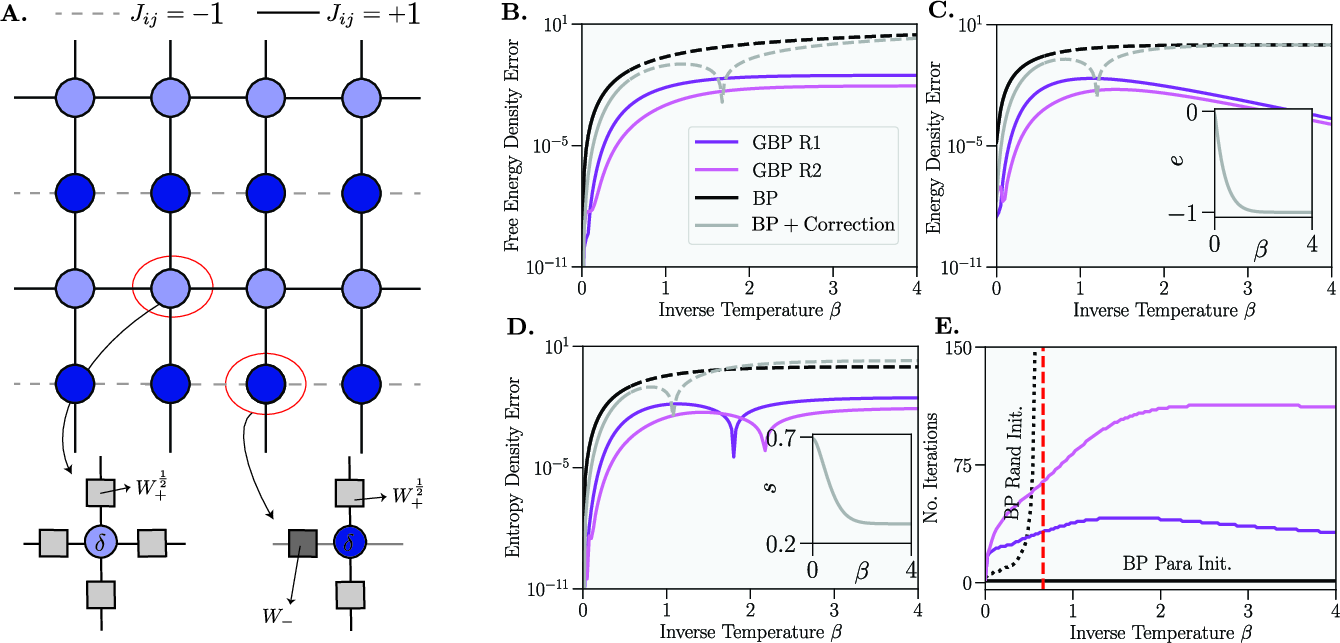
Figure 3: Partition function contraction and GBP convergence for the Villain model, showing error suppression and rapid convergence for GBP relative to BP.
Constraint Satisfaction: Ice Models
GBP applied to three-dimensional ice-type vertex models with "ice rules" constraints achieves accuracy in residual entropy estimates competitive with state-of-the-art Monte Carlo and CTMRG methods. Notably, by choosing voxel-level parent regions and exploiting message sparsity, GBP estimates reach within 0.05% of best-known literature values for both cubic (Ic) and hexagonal (Ih) forms of ice, outperforming high-order loop/cluster expansions.
In the context of the deformed AKLT model on the honeycomb lattice, GBP accurately estimates the norm, detects the critical points of symmetry breaking, and, unlike BP, preserves continuous symmetries in the XY phase. GBP produces significantly improved correlator and observable derivatives—especially near the second-order phase transition—compared with BP.
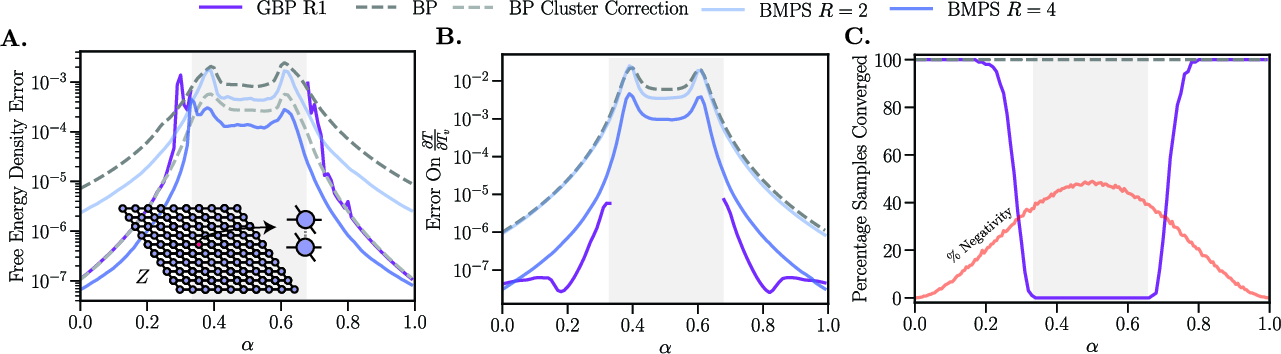
Figure 4: GBP contraction results on a deformed AKLT PEPS, showing error suppression in free energy, correct determination of critical points, and symmetry preservation in correlators.
Random Tensor Networks and Sign Transition
For random norm networks, GBP remains accurate and convergent so long as the tensors are predominantly positive. A sharp loss of convergence emerges as the fraction of negative elements surpasses ~20%, coincident with increased errors for BP and boundary-MPS. This supports a conjectured transition in contraction complexity ("sign transition") for quantum or frustrated models, with implications for general-purpose algorithms and the sign problem [Chen2025, Gray2024].
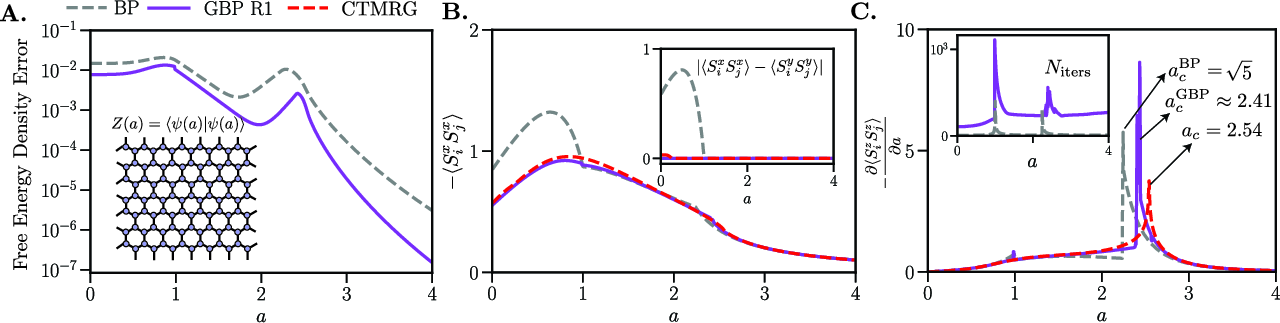
Figure 5: Accuracy and convergence of GBP across ensembles of random networks with varying sign structure, indicating the onset of non-convergence and error spikes at a critical fraction of negative tensor elements.
Implications and Theoretical Insights
The successful application of GBP to tensor network contraction provides a systematic, controlled generalization of BP that is capable of capturing finite loop correlations and exhibits heightened stability and accuracy in settings where standard BP is ill-behaved—chiefly in frustrated and critical systems. Importantly, the method exploits region-based graphical model dualities developed in statistical mechanics (Kikuchi's cluster expansion), now recast for tensor network settings.
Theoretical implications include:
- Improved contraction for frustrated and constraint-saturated models: GBP can access accurate thermodynamic and ground-state properties in settings where both variational boundary methods and simple BP are ineffective or require computationally prohibitive resources.
- Insights into contraction hardness transitions: The onset of non-convergence for GBP at a finite "negativity" threshold in random networks offers a new lens on the practical and fundamental limitations of tensor contraction algorithms, connecting with recent results on phase transitions in sign structure [Chen2025].
- Variational structure and convexity issues: GBP's use of the Kikuchi free energy as a nonconvex objective reflects the trade-off between controlled improvement and practical stability; positivity constraints that guarantee convexity in classical cases are generically lost in quantum norm networks, a key limitation.
Future Directions
Further development of GBP for tensor networks may involve:
- Handling sign and complex-valued networks: Progress requires novel optimization schemes, e.g., Riemannian optimization on the manifold of PSD matrices [Lin2019, Bergmann2022], or double-loop algorithms that ensure convergence for non-convex objectives [hes03a, yuille01].
- Integration with loop/cluster expansions and cluster-cumulant approximations: Systematic interpolation between GBP and cluster expansions [evenbly2025loopseriesexpansionstensor, midha2025beyond] may permit exponential control over contraction errors, particularly for higher-dimensional and critical networks.
- Efficient large-scale sparse implementations: Adaptation of GBP to exploit message/belief sparsity offers a route to competitive contraction of combinatorially complex constraint networks, with immediate relevance in combinatorics, statistical physics, and machine learning.
- Message-passing hybridization: Combining GBP with tensor network message-passing protocols [Wang2023] can further alleviate limitations in networks with both local density and global sparsity.
Conclusion
This work establishes Generalized Belief Propagation as a rigorous, highly effective approach to approximate contraction of tensor networks, with robust performance in frustrated, critical, and constraint-saturated systems where standard BP and boundary methods underperform. GBP enables systematic accuracy improvements via region hierarchy and provides a practical pathway to contracting complex tensor networks, albeit with limitations for nonpositive or highly quantum networks that warrant further theoretical investigation and algorithmic innovation.

