- The paper introduces a precise loop-decay criterion that governs the accuracy of belief propagation in tensor network contraction.
- It reformulates BP as a mathematically controlled cluster expansion, enabling exponential convergence in gapped quantum phases.
- Numerical simulations on 2D/3D models validate that BP and its cluster-corrected variants achieve rigorous error bounds away from criticality.
Rigorous Analysis of Belief Propagation and Cluster Expansions in Quantum Many-Body Tensor Networks
Introduction and Motivation
The paper "Belief Propagation and Tensor Network Expansions for Many-Body Quantum Systems: Rigorous Results and Fundamental Limits" (2604.03228) addresses longstanding open questions regarding the theoretical foundations and performance guarantees of belief propagation (BP) for tensor network contraction in quantum many-body systems, especially in higher dimensions where tensor networks possess nontrivial loops. While BP is exact for tree tensor networks, its application to loopy networks—ubiquitous in 2D and 3D quantum problems—has lacked rigorous justification and has relied primarily on empirical observations. This work reformulates BP within a mathematically controlled cluster expansion framework, deriving necessary and sufficient criteria for its accuracy, connecting the algorithmic behavior of BP directly to physical properties—most notably, the decay of correlation functions—and establishing the fundamental limits for the applicability of BP-based contraction and inference algorithms.
Belief Propagation and Tensor Networks: Exactness, Loop Corrections, and Cluster Expansions
Tensor networks such as PEPS are essential for representing ground and Gibbs states of quantum lattice Hamiltonians due to their efficient encoding of area-law entanglement. Direct contraction of tensor networks in dimensions d>1 is computationally intractable—owing to the proliferation of loops, contraction complexity becomes exponential.
BP offers an approximate contraction paradigm by constructing a rank-one, tree-like factorization via iterative message passing. While BP is exact for acyclic networks, its accuracy on loopy graphs depends critically on the magnitude and structure of "loop corrections." This work leverages and extends recent developments in cluster and cumulant expansions (Midha et al., 2 Oct 2025, Gray et al., 7 Oct 2025, Evenbly et al., 2024, Welling et al., 2012) to provide an exact expansion of the tensor network partition function: Z=ZBP[1+Γ⊂L∑l∈Γ∏Zl]
where the sum runs over subsets of mutually compatible generalized loops L, and each Zl is the loop excitation contribution determined using the BP fixed points.
The formalism is further refined by reorganizing the expansion—now for the free energy—in terms of connected clusters only (cluster expansion), and compactly into cluster cumulants, enabling efficient, controlled approximations for local observables and correlations.
Rigorous Loop-Decay Criterion and Its Consequences
A principal result of the paper is the derivation of a precise "loop-decay" condition as the physical and algorithmic criterion for BP success. For a given tensor network, if the contribution ∣Zl∣ of any loop l decays as
∣Zl∣≤O(e−c∣l∣)
for all l, and c>c0=O(logΔ) (with Δ the graph's maximal degree), then the cluster and cumulant expansions converge exponentially—BP and its systematic cluster-corrected variants thus exhibit rigorously controlled errors, with the truncation error for the free energy or a local observable decaying as Z=ZBP[1+Γ⊂L∑l∈Γ∏Zl]0. The loop-decay parameter is therefore an operational diagnostic for practitioners: measuring it determines not only the accuracy of BP but also the order of cluster corrections required for target precision.
The decay of loop corrections directly implies exponential clustering of connected correlation functions, and the breakdown of loop-decay (such as at quantum critical points or in gapless phases) mandates BP failure regardless of further algorithmic sophistication. This sharp theoretical result is significant because many numerical schemes in quantum many-body problems attempt to "patch" BP's breakdown near criticality; this work shows such attempts are fundamentally limited by the underlying physics.
Loop Corrections and Physical Correlations
The paper rigorously proves that the structure of loop corrections in the expansion corresponds exactly to the structure of connected correlation functions in the underlying quantum state. This is a high-dimensional generalization of the transfer matrix paradigm in 1D MPS, where the sub-leading eigenvalues of the transfer operator control correlation decay. On loopy graphs, exponentially many clusters contribute; thus, the existence of a transfer matrix gap is necessary but not sufficient to guarantee short-range correlations—loop entropy must also be suppressed, i.e., the energetic penalty for long loops must outpace their combinatorial proliferation.
BP thus ceases to be a mere heuristic, but becomes a controlled, physically interpretable series expansion whose range of validity is governed by precise decay properties of the tensor network.
Methodology for Local Observables: Algorithms with Error Guarantees
Local expectation values and correlations in PEPS and Gibbs states are core observables in quantum simulation. The cluster expansion is extended to local measurements, yielding two structurally distinct but mathematically equivalent expansion schemes: the ratio expansion (cluster-corrected BP estimator) and the derivative expansion (cluster-cumulant estimator). For a local observable Z=ZBP[1+Γ⊂L∑l∈Γ∏Zl]1, the exact expectation
Z=ZBP[1+Γ⊂L∑l∈Γ∏Zl]2
Only clusters intersecting Z=ZBP[1+Γ⊂L∑l∈Γ∏Zl]3 contribute; thus, the computational cost depends only logarithmically on system size and exponentially on truncation order Z=ZBP[1+Γ⊂L∑l∈Γ∏Zl]4, making it efficient for local quantities in gapped phases. Numerical error bounds for both additive and relative errors are rigorous, allowing certified estimation of quantum expectation values in parameter regimes where loop decay holds.
Fixed-Point Problem: Algorithmic Pathologies and Open Questions
A subtle but critical aspect is the dependence of the expansion on the BP fixed point—a good fixed point is necessary for the fast decay of all loop corrections. The paper illustrates how, in symmetry-broken or near-critical regimes, BP may converge to "spurious" (wrong-phase) fixed points ("confusion regime"), leading to systematically incorrect physical predictions and poor convergence of loop expansions. Remedies such as initializing message passing at symmetry-unbroken points, or employing generalized or partitioned belief propagation expansions, are discussed, and their systematic study is highlighted as a future direction.
Numerical Results: 2D and 3D Transverse Field Ising Model
The theoretical results are validated using extensive simulations of the 2D and 3D transverse field Ising model (TFIM), both at zero and finite temperature, with ground states represented as iPEPS optimized by CTMRG.
Magnetization and energy errors upon truncation of the cluster expansion show:
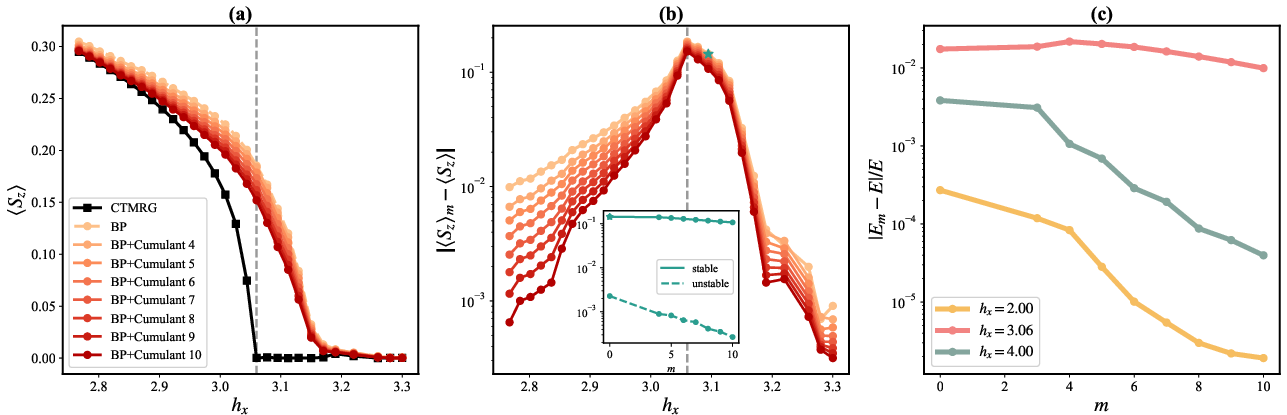
Figure 1: Tensor network belief propagation on the ground state of the 2D TFIM obtained via CTMRG-based optimization; [left] BP and cumulant expansion estimates for longitudinal magnetization across the critical point; [middle] error vs. cumulant order; [right] exponential convergence deep in gapped phases, systematic failure near criticality.
- In gapped regimes, exponential convergence of local observables and energies is observed with increasing expansion order.
- Near critical points, loop decay is lost, convergence breaks down, and BP-based estimates deviate sharply from benchmark results.
Loop decay is quantified explicitly in finite-temperature simulations of 2D and 3D TFIM, demonstrating its role as a universal marker of BP validity.
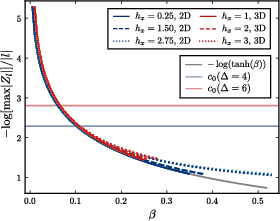
Figure 2: Z=ZBP[1+Γ⊂L∑l∈Γ∏Zl]5-decay of even-weight loops in 2D (blue) and 3D (red) TFIM at finite temperature, indicating rapid convergence away from the critical region.
Cumulant-based expansions for single-site observables confirm rapid error suppression with order, except near phase transitions. Odd-even effects in loop weights are also numerically characterized, especially in the high-temperature regime.
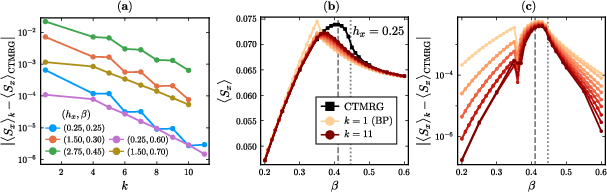
Figure 3: [left] Convergence of cumulant cluster expansion for Z=ZBP[1+Γ⊂L∑l∈Γ∏Zl]6 in 2D TFIM at various parameters; [right] improved precision for expectation values and maximum error near the critical temperature.
Implications and Future Developments
The formalism rigorously delineates the algorithmic and physical limits of BP and cluster-corrected tensor network contractions. Its applicability is sharply tied to bulk physics: gapped, noncritical phases with sufficiently fast loop decay permit systematic, certified contraction and observable estimation. Near criticality, or with pathological fixed-point selection, BP and all cluster-corrected relatives fundamentally fail. This insight provides actionable diagnostics and stopping conditions for practitioners while opening multiple frontier directions.
Potentially, the methods may reveal deeper links between tensor network contraction complexity, loop entropy, and quantum phase structure, with broader impact on quantum information theory, complexity theory, and even classical inference algorithms. Extension to generalized belief propagation, handling of unstable fixed points, and constructive identification of "hard" contraction instances (e.g., verifying that certain PEPS are not efficiently contractible even with cluster corrections) are proposed as important open problems.
Conclusion
This work places BP and its cluster-corrected variants on a firm mathematical foundation for quantum many-body tensor networks. The identification of the loop-decay criterion as both an operational algorithmic threshold and a marker of physical clustering of correlations unifies algorithmic and physical perspectives and yields a family of contraction algorithms with quantitative performance guarantees in noncritical states. The connections drawn here between tensor network structure, BP fixed points, correlation decay, and algorithmic tractability establish new paradigms for both theoretical and practical development in the computational quantum many-body sciences.
References
- S. Midha et al., "Belief Propagation and Tensor Network Expansions for Many-Body Quantum Systems: Rigorous Results and Fundamental Limits" (2604.03228)
- S. Midha, Y. F. Zhang, "Beyond Belief Propagation: Cluster-Corrected Tensor Network Contraction with Exponential Convergence" (Midha et al., 2 Oct 2025)
- J. Gray, G. Park, et al., "Tensor Network Loop Cluster Expansions for Quantum Many-Body Problems" (Gray et al., 7 Oct 2025)
- G. Evenbly et al., "Loop Series Expansions for Tensor Networks" (Evenbly et al., 2024)
- M. Welling et al., "A Cluster-Cumulant Expansion at the Fixed Points of Belief Propagation" (Welling et al., 2012)