- The paper establishes algorithmic locality by proving that local perturbations in quantum tensor networks only have an exponentially decaying impact.
- It leverages a Banach contraction framework to guarantee the existence, uniqueness, and rapid convergence of belief propagation fixed points in strongly injective PEPS.
- It employs rigorous loop and cluster expansion techniques to control systematic errors, enabling polynomial-time computation of observables and correlations.
Algorithmic Locality and Provable Convergence in Quantum Tensor Networks
Introduction
Tensor network methods, and specifically Projected Entangled Pair States (PEPS), have become essential computational tools for simulating quantum many-body systems on complex networks and lattices. Evaluating observables or contractive quantities in these networks is computationally demanding in higher dimensions due to the growth of entanglement and network loops, which complicate both analytical tractability and variational algorithms. The belief propagation (BP) paradigm—the foundation for scalable inference in tree-like and locally-tree-like graphical models—has found increasing application for these tensor networks, opening avenues for efficient approximations and systematic corrections using loop and cluster expansions. However, rigorous performance guarantees for these BP-based approaches in the context of quantum tensor networks were lacking, especially on arbitrary graphs with loops typical of physical models.
This work addresses these foundational gaps by introducing a comprehensive proof framework that establishes conditions under which tensor network BP is both efficient and accurate for strongly injective PEPS. The central result is the formal demonstration of algorithmic locality: local modifications to the network impact only a finite region with an exponentially decaying influence, enabling localized recomputation and efficient contraction. The results connect practical tensor network simulation protocols with rigorous performance guarantees and clarify the regimes for which BP and cluster-corrected BP are not merely heuristics but certified, polynomial-time algorithms for quantum simulation.
Theoretical Framework: PEPS, Injectivity, and Belief Propagation
The methodology is developed for PEPS defined on general graphs G=(V,E) with uniform bond dimension D and maximum degree Δ. Each site associates a tensor Tv, which can be visualized as a map from virtual to physical spaces, and injectivity is defined through singular-value decompositions of these maps. A PEPS is termed δ-injective if every site tensor has singular values λi≥δ, so that the injectivity parameter ε:=1−δ2 quantifies deviation from maximal injectivity.
Belief propagation on tensor networks is formulated as a message-passing process associating positive operators ("messages") to every directed edge in the network. The BP fixed point is reached when incoming messages are mapped to outgoing messages via superoperators induced by local tensors, subject to normalization constraints. The BP approximation is computationally meaningful only if such a fixed point exists and can be efficiently reached by simple iteration.
Two main results introduce provable existence and efficient computability of BP fixed points:
- A fixed point exists for any injective PEPS (ε<1).
- Uniqueness and exponential convergence are obtained when ε<ε∗, where ε∗=1/(2Δ−1).
These are established by proving that the message-passing map is a Banach contraction for strongly injective PEPS, enabling efficient fixed point computation.
Loop and Cluster Expansions: Rigorous Error Control
A systematic error analysis is built upon recent developments in loop and cluster expansions for BP. In this formalism, the BP fixed point provides the leading approximation to normalization and local observables, with corrections organized as a convergent series over closed loops ("loop activities") and their clusters.
Decay of loop corrections is proven for strongly injective PEPS. Specifically, for any loop ℓ with D0 edges, the correction satisfies D1, provided D2. The convergence of the cluster expansion, and thus the control of systematic error, is guaranteed in this regime.
This yields the following polynomial-time algorithms, valid for systems with D3 qubits:
- Computation of the norm to inverse-polynomial error.
- Computation of local observables to inverse-polynomial multiplicative error, provided their expectation values are non-zero.
- Computation of correlation functions to inverse-polynomial additive error.
Numerically, the regime in which BP and cluster-corrected BP are efficient can be visualized as a phase diagram parameterized by the injectivity parameter (Figure 1b).
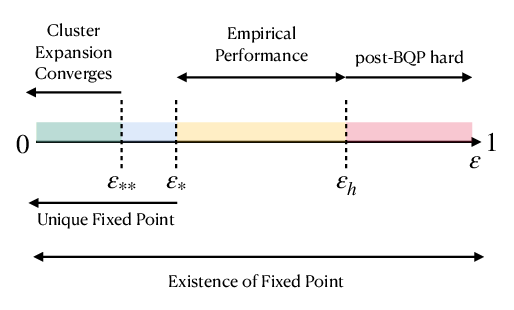
Figure 1: (a) Demonstrates algorithmic locality: the impact of a central perturbation on BP messages decays exponentially with distance. (b) Phase diagram summarizing regions of existence, uniqueness, and computational hardness of fixed points as a function of injectivity.
Algorithmic Locality: Exponential Decay of Influence
The central phenomenon validated is algorithmic locality: for D4, a local perturbation to the tensor network impacts distant BP messages and observables with an influence decaying exponentially in graph distance. This result mirrors the exponential clustering of correlations found in gapped quantum systems, but here is proven for algorithmic convergence and computational efficiency within the BP framework.
Formally, perturbing tensor(s) in region D5 leads to a change in BP fixed point messages at distance D6 satisfying: D7
with a correlation length set by D8 and the contraction constant of the BP update.
Similarly, changes in local expectation values of an observable D9 at distance Δ0 from the perturbation satisfy: Δ1
Figure 1: (a) The effect of a local tensor perturbation is exponentially suppressed in BP messages with distance—a graphical demonstration of algorithmic locality.
These decay rates derive from combining locality in iterative message-passing, the Banach contractive property of BP, and the exponential decay of cluster corrections in the expansion. Message-passing itself has a strict "light cone" structure, with influences propagating no faster than linearly in the number of update steps.
Practical and Theoretical Implications
Practically, algorithmic locality enables localized recomputation: when simulating physical processes or optimizing tensor networks, only nearby regions need to be updated following a local change, resulting in potentially exponential algorithmic speedup in large-scale simulations.
Theoretically, the work unifies previous numerical BP practices with rigorous cluster expansion techniques, providing error control and computational complexity thresholds tied directly to physical properties (strength of injectivity, network degree, bond dimension). Notably, results require only graph locality and do not depend on Euclidean embedding, making them relevant for non-local graphs—e.g., in quantum error correction with quantum LDPC codes or Δ2-local Hamiltonian simulation.
Contrasted with the known hardness for generic non-injective PEPS, these theorems delineate tractable parameter regimes, informed by both numerical evidence and complexity-theoretic bounds (Harley et al., 24 Sep 2025). The identification and proof of exponential decay scales in the BP fixed point and cluster expansion also enable new forms of resource-efficient quantum simulations beyond standard spatially local models.
Conclusion
This study rigorously establishes the efficacy and locality of belief propagation algorithms for a broad class of strongly injective quantum tensor network states. The results provide polynomial-time and error-controlled methods for contraction and simulation, with sharp thresholds on injectivity and precise locality scalings. The demonstration of algorithmic locality bridges theory and practice, not only characterizing the speed of information propagation in algorithms but also providing actionable insights for large-scale simulation of quantum systems, quantum codes, and related graph-based models.
Given the broader applicability and the explicit, constructive nature of these proofs, future work may extend algorithmic locality analysis to less restrictive classes of quantum states (e.g., weakly injective or critical PEPS), generalized tensor network ansätze, and more complex interaction graphs, illuminating fundamental limits and optimization strategies in both quantum many-body and quantum information science.

