- The paper introduces a universal diagrammatic mechanism that reveals hidden zeros and 2-split factorizations in tree-level amplitudes.
- It generalizes the shuffle factorization method to complex vertex structures in φ³, NLSM, and Yang-Mills theories with explicit cancellation of mixed vertices.
- The findings offer practical detection tools and deeper insights into kinematic constraints and the analytic structure of scattering amplitudes.
Universal Diagrammatic Interpretation of Hidden Zeros and 2-Splits in Tr(ϕ3), NLSM, and Yang-Mills Amplitudes
Introduction and Motivation
This work provides a highly structured and universal diagrammatic framework for understanding hidden zeros and $2$-split factorizations of tree-level scattering amplitudes in three prominent field theory models: the color-ordered Tr(ϕ3) massless scalar theory, the Nonlinear Sigma Model (NLSM), and Yang-Mills (YM) theory (2604.23680). These phenomena were recently linked to deep combinatorial-geometric structures emerging from the study of "surfaceology" and the kinematic mesh for amplitudes (Arkani-Hamed et al., 2023), but a full field-theoretic picture has remained elusive.
By generalizing the shuffle factorization along a specific line (SFASL), originally established in the Tr(ϕ3) context, to encompass the greater vertex complexity of NLSM and YM, the paper demonstrates that both hidden zeros and $2$-splits have a common, sufficient origin: kinematic conditions imposed on Feynman diagrams lead to a systematic diagrammatic factorization, which is robust to the higher-dimensional spaces and index structures inherent in those models.
This approach not only accounts for previously observed amplitude zeros and splittings but also yields new practical and conceptual tools for analysis—crucially, by relating amplitude properties to constraints on Feynman rules and Lagrangian structures.
SFASL: Structure and Diagrammatics
The SFASL mechanism is defined as follows. Choose a “marked line” (either between two specified external legs or from an external leg to an interaction vertex) in each tree diagram. The lines attached to this marked line are split into two classes: A-lines and B-lines. Summing over all shuffle permutations of the A and B lines, the authors show that, under certain kinematic constraints (orthogonality conditions on momenta and, in the case of YM, polarization vectors and BG currents), the sum of diagrams factorizes into products of sub-currents associated to the A- and $2$0-side blocks.
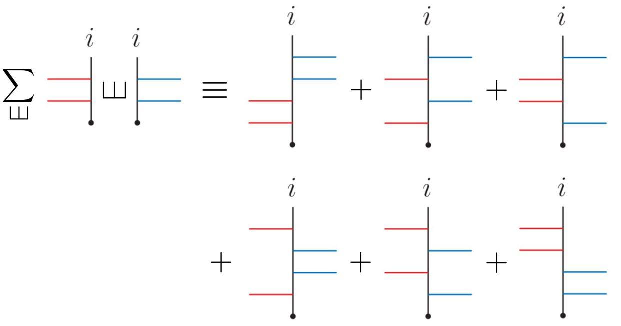
Figure 1: The meaning of summing over shuffle permutations. The red lines are $2$1-lines, the blue lines are $2$2-lines.
The shuffle permutation is critical: the set of allowed permutations preserves the order within each block while allowing the two sets to be interleaved.
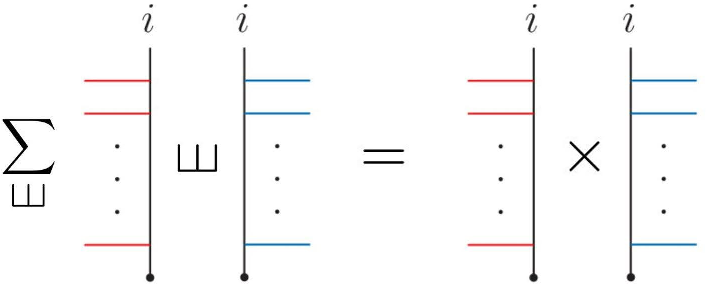
Figure 2: Shuffle factorization along a marked line $2$3. If momenta on $2$4/$2$5-lines are mutually orthogonal, the sum over shuffle permutations factorizes.

Figure 3: First example of SFASL, showing explicit propagator factorization for two attachments (the simplest nontrivial case).

Figure 4: A nontrivial extension with three lines where SFASL factorization is realized recursively in propagators.
A key technical insight is the role of "mixed" vertices—vertices attached to both $2$6 and $2$7 block lines. Such contributions are systematically canceled in the sum over shuffle permutations, with the cancellation enforced by commutation properties and the constraints on vertex mass dimension.
Hidden Zeros: On-Shell Origin and Diagrammatic Realization
The hidden zero structure occurs when the kinematics are tuned so that every $2$8-line is orthogonal in momentum (and polarization, where relevant) to every $2$9-line. In this limit, the sum over diagrams as organized by SFASL produces an overall factor proportional to (ϕ3)0, where (ϕ3)1 is the “opposite” external line to (ϕ3)2. Imposing the on-shell condition (ϕ3)3 yields the vanishing of the full amplitude—this is the hidden zero.
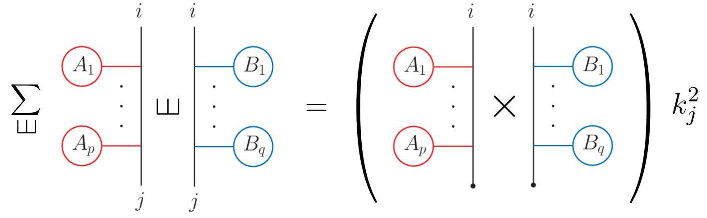
Figure 5: Diagrammatic representation for the hidden zero—summation over blocks yields an overall factor (ϕ3)4.
This reduction to a “trivial” on-shell condition is nontrivial due to the highly nonlocal nature of the constraints in diagram space (they are not simple Mandelstam pole residues, but zeros at codimension in kinematic space).
(ϕ3)5-Split Factorization: Double Zipper Decomposition
By relaxing the hidden zero kinematic constraint to remove a single “exceptional” (ϕ3)6-line, the sum over diagrams can be partitioned along two non-intersecting lines, leading to a “(ϕ3)7-split”—the amplitude factorizes into a product of two amputated sub-currents, each with off-shell legs. This is a new, pole-free factorization distinct from ordinary unitarity.
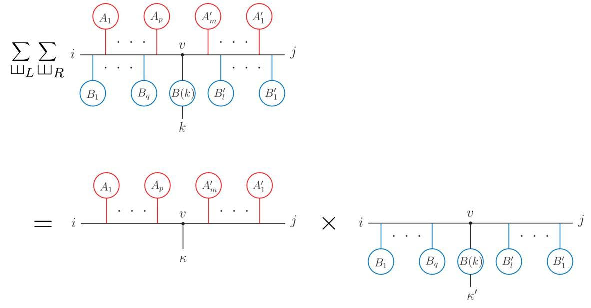
Figure 6: Diagrammatic interpretation of the (ϕ3)8-split: sum over shuffle permutations along two lines, with each side factorizing into an amputated current.
This factorization structure is recursive and combinatorially robust, with explicit verification in all three models. The contribution of mixed vertices again cancels, leaving only unmixed terms. The result is that the (ϕ3)9-split has a universal explanation in terms of SFASL-organized diagrammatics.
Extension to Higher-Degree Vertices and Index Structures
A crucial advancement in the paper is the extension of the shuffle factorization pattern beyond the simple cubic-vertex structure of Tr(ϕ3)0. In the NLSM and YM, with higher-degree vertices and nontrivial Lorentz structures, the generalized SFASL maintains the reducibility of the sum under appropriately identified kinematic constraints.
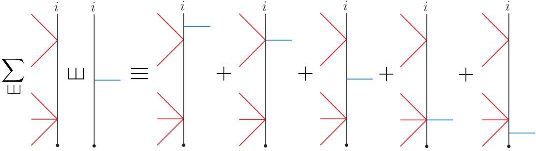
Figure 7: Example of a generalized shuffle permutation involving sets of lines attached at higher-point vertices.
For the NLSM, special attention is paid to the cancellation of terms between mixed and unmixed quartic vertices (see Figs. 9–15), ensuring that only factorization-friendly contributions survive. In YM, the situation is more intricate due to polarization and gauge redundancy. Here, the method of splitting spacetime into orthogonal subspaces (for (ϕ3)1- and (ϕ3)2-side currents and polarizations) is introduced, allowing for dimensional reduction arguments and clean factorization even in the presence of gauge structure.
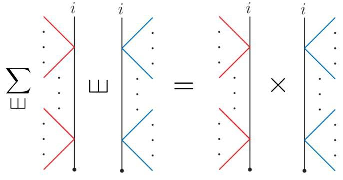
Figure 8: Generalized SFASL pattern based on generalized shuffle permutations for higher-degree vertices.
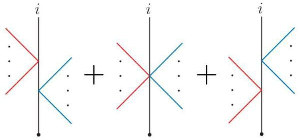
Figure 9: Cancellation mechanism for mixed vertices under generalized shuffle permutations; mixed-vertex diagrams cancel against noncommuting parts of unmixed diagrams.
Explicit Verification: NLSM and Yang-Mills
Detailed recursive proofs and diagrammatic arguments are provided for both NLSM (with its distinctive quartic and higher-degree vertices) and Yang-Mills (requiring careful index contraction and polarization vector tracking).
For NLSM, the proof relies on the Cayley parametrization and demonstrates the cancellation and factorization patterns through explicit calculation of simple and higher-point diagrams.
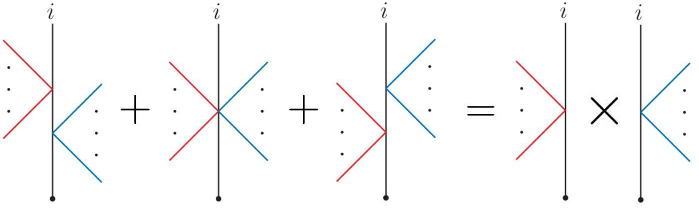
Figure 10: First case of the simplest shuffle permutation in NLSM—no contribution arises when both sets contain odd numbers of lines, due to cancellation.
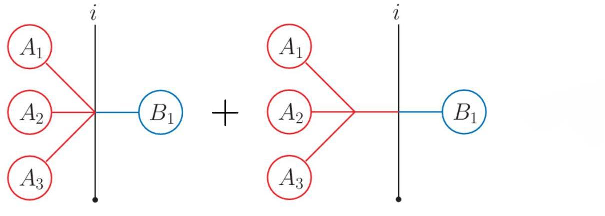
Figure 11: Generic demonstration of cancellations in the simplest shuffle permutation with odd-sized sets.
For YM, the recursive extension of SFASL addresses the challenges of Lorentz and color structures. The contraction pattern is made transparent diagrammatically (Figs. 18–25), and the case of polarization vector decomposition into orthogonal subspaces is implemented to partition contributions according to the factorization pattern.
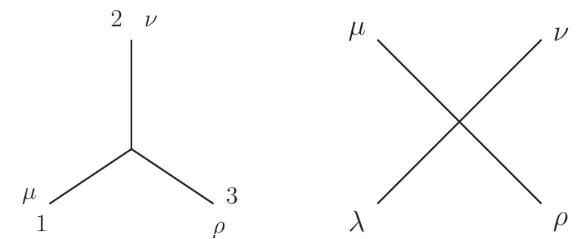
Figure 12: First case of the simplest shuffle permutation in YM—index contractions explicitly shown.
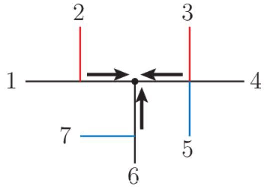
Figure 13: Example for understanding contractions in presence of cubic and quartic vertices in YM.
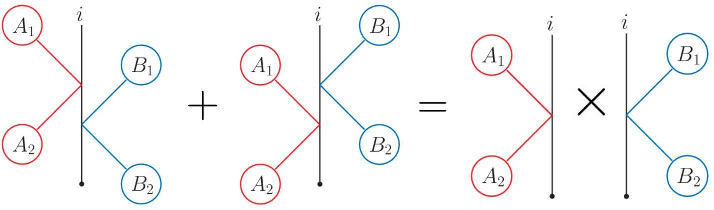
Figure 14: Third case of the simplest shuffle permutation, illustrating full cancellation of mixed contributions.
Implications, Theoretical Insights, and Future Directions
The main results demonstrate that SFASL provides a universal combinatorial origin for both hidden zeros and (ϕ3)3-splits in scalar, pion, and gluon amplitudes at tree level, reducing the analytic structure of the amplitude—previously seen only in intricate geometric or residue-theoretic frameworks—to a conceptual property of Feynman diagrammatics.
Key claims and consequences:
- Universality: The mechanism unifies scalar, Goldstone boson, and Yang-Mills amplitudes under a single combinatorial paradigm.
- Cancellation Mechanisms: All mixed-vertex contributions, despite higher-valence and Lorentz complications, systematically cancel and do not contribute to the final amplitudes.
- On-shell Origin: The only non-canceled factors enforcing zeros are the on-shell conditions of external momenta—providing a conceptually clarifying explanation for the analyticity of the hidden zeros.
- Factorization without Poles: The (ϕ3)4-split is a genuinely new type of factorization, not associated to any pole singularity but to the presence of a particular combinatorial partition—distinct from both unitarity and locality.
The authors argue that this diagrammatic paradigm can be extended to higher-derivative deformations, gravity (GR), special Galileons, and other models where vertices satisfy similar mass-dimension constraints. It can also, in principle, be iterated to loop-level integrands, which would allow for a recursive, all-orders understanding of hidden zeros and (ϕ3)5-splits in quantum corrections.
Future Prospects
Practical implications of this work include:
- Algorithmic detection: The diagrammatic method could allow almost immediate determination of whether a given model has hidden zeros/(ϕ3)6-splits based solely on its Feynman rules.
- Constraints on model building: Requiring such analytic structures in amplitudes imposes nontrivial constraints on the allowed structure of Lagrangians and interaction terms.
- Connections to surfaceology and positive geometry: The combinatorial pattern matches, and potentially sharpens, higher-level geometric and positive-grassmannian-based approaches to scattering theory.
- Extensions to loops and higher-derivative corrections: The SFASL paradigm hints at universality at loop level and in more general effective field theory settings.
Conclusion
This work achieves a universal and robust diagrammatic mechanism for the occurrence of hidden zeros and (ϕ3)7-splits in tree-level amplitudes of Tr(ϕ3)8, NLSM, and Yang-Mills models (2604.23680). The construction exposes a common combinatorial factorization structure rooted in shuffle permutations along marked lines and enforced by explicit cancellations of mixed-vertex contributions. The resulting analytical and practical tools have significant implications, offering pathways to extend these structural insights across broader classes of field theories and into higher-loop orders.

